Why Bank Transfers Take Time to Complete
Bank transfers can appear almost instantaneous from a customer’s perspective. A few taps on a banking app can send money from one account to another, yet the funds may not arrive immediately.
The delay can be confusing, especially when a transfer appears to have been submitted successfully but the recipient is still waiting for the money.
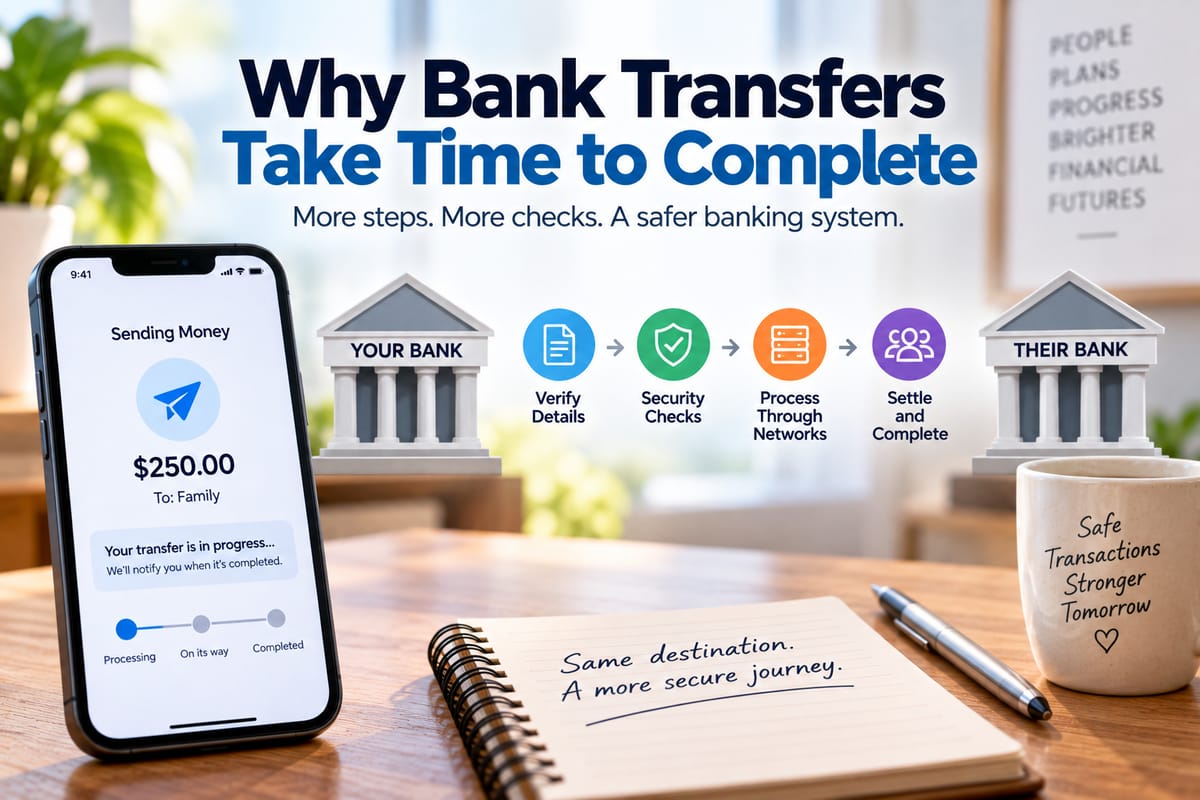
The reason is that moving money between accounts involves more than simply changing two balances. Banks and payment networks need to identify the accounts involved, verify transactions, check for potential problems, communicate with other financial institutions, and settle the transfer through the appropriate payment system.
Understanding these steps helps explain why some transfers are completed within seconds while others take hours or several business days.
What Happens When a Bank Transfer Is Made?
A bank transfer generally begins when the sender provides instructions to move money from one account to another.
The banking system then needs to process those instructions.
Depending on the type of transfer, the process can involve:
- The sender’s bank receiving the payment instruction.
- The transaction being authenticated and checked.
- The sender’s available balance being verified.
- The payment being routed through an appropriate network.
- The receiving institution processing the transaction.
- The payment being settled between institutions.
- The recipient’s account being credited.
The exact process depends on the countries, banks, currencies, payment networks, and types of accounts involved.
The guide to how payment systems work and how money moves between accounts provides a broader explanation of the infrastructure behind these transactions.
Not All Bank Transfers Use the Same System
One of the biggest reasons transfer times vary is that there is no single universal method for moving money.
Banks can use different payment systems depending on the transaction.
Examples include:
- Internal transfers between accounts at the same bank
- Domestic bank transfers
- Automated clearing systems
- Real-time payment systems
- Wire transfers
- International transfers
- Card-based payment networks
- Other electronic payment systems
Some systems process transactions continuously, while others process groups of transactions at scheduled intervals.
As a result, two transfers that look similar to customers can have very different processing times.
Transfers Between Accounts at the Same Bank
An internal transfer can sometimes be completed quickly because both accounts are maintained by the same financial institution.
The bank does not necessarily need to communicate with another institution to complete the movement of funds.
For example, transferring money between two eligible accounts held at the same bank may involve updating the bank’s internal records rather than sending the transaction through an external clearing network.
However, even internal transfers can be subject to security checks, account restrictions, transaction limits, or system processing schedules.
Transfers Between Different Banks
Moving money between different banks can require additional steps.
The sender’s bank may need to send payment instructions through an external payment network or clearing system. The receiving bank then needs to process the incoming transaction and credit the recipient’s account.
This introduces additional points where processing can occur.
The guide to digital bank transfers between accounts explains how electronic transfers can move through the banking system before reaching the recipient.
Clearing and Settlement Can Cause Delays
Two concepts are particularly important when understanding transfer timing: clearing and settlement.
Clearing involves processing and reconciling payment information between participating institutions.
Settlement involves the actual financial obligations between those institutions being completed.
These processes do not always happen simultaneously.
A bank may receive a customer’s transfer instruction and show the transaction as submitted before the underlying payment has completed all stages of clearing and settlement.
This is one reason a transfer can appear to be “on its way” without the recipient immediately having access to the money.
Business Days Can Affect Transfer Times
Some payment systems operate according to business-day schedules.
If a transfer is initiated on a weekend or public holiday, processing may not occur until the next applicable business day.
For example, a transfer submitted late on Friday may be handled differently from one submitted during normal processing hours on Monday.
The exact treatment depends on the payment system and participating institutions.
This is why estimated delivery times often refer to business days rather than simply counting calendar days.
Cut-Off Times Matter
Banks and payment networks may establish daily cut-off times for certain transactions.
A transfer submitted before a cut-off time may enter that day’s processing cycle, while one submitted afterward may move into the next cycle.
This can create an apparent delay even when the sender submitted the transaction correctly.
For instance, a payment initiated shortly after an institution’s processing window closes may not begin the relevant external processing stage until the following business day.
Cut-off times can vary by:
- Bank
- Transfer type
- Currency
- Payment network
- Country
- Transaction method
- Day of the week
Security Checks Can Add Processing Time
Banks have systems designed to identify suspicious or unusual transactions.
A payment may receive additional scrutiny when certain characteristics trigger a review.
Possible factors include:
- Unusually large transaction amounts
- New recipients
- Unusual account activity
- International payments
- Multiple transactions in a short period
- Incorrect or incomplete information
- Security concerns
Additional checks can delay a transaction even when there is nothing ultimately wrong with it.
These processes are part of the broader effort to protect accounts and payment systems from unauthorized activity and financial crime.
Incorrect Information Can Delay a Transfer
Bank transfers depend on accurate payment details.
Depending on the transfer method, the sender may need to provide information such as:
- Recipient name
- Account number
- Bank details
- Routing information
- Branch information
- International banking identifiers
- Transfer reference
If information is incorrect or does not match the requirements of the receiving institution, the payment may be delayed, rejected, or returned.
A transfer that appears simple from the sender’s perspective can therefore depend on several pieces of information being correct.
Currency Conversion Can Add Another Step
International transfers often involve currency conversion.
When the sender’s currency differs from the recipient’s currency, the transaction may need to be converted before the recipient receives the funds.
This can introduce additional processing considerations, including:
- Exchange-rate calculation
- Currency availability
- Correspondent banking arrangements
- International payment networks
- Additional compliance checks
- Different operating hours across countries
International transfers can therefore take longer than domestic transactions.
Correspondent Banks Can Be Involved
Some international payments do not move directly between the sender’s bank and recipient’s bank.
Instead, intermediary or correspondent banks may participate in the transaction.
Each additional institution can introduce another processing stage.
This is one reason international payments may be less predictable than transfers between accounts at the same financial institution.
The path a payment takes can depend on the currencies involved, relationships between banks, and the payment infrastructure available for that transaction.
Real-Time Payments Can Be Much Faster
Modern payment infrastructure increasingly includes systems designed to process transactions quickly.
Real-time or instant payment systems can allow eligible transfers to be processed within seconds or minutes, depending on the system and participating institutions.
However, the existence of faster payment infrastructure does not mean every bank transfer will be instantaneous.
A bank may support multiple transfer methods, each with different processing rules.
The sender’s selected payment method, the recipient’s institution, transaction limits, operating conditions, and other factors can determine how quickly the money becomes available.
Why the Sender’s Balance May Change Before the Recipient Gets the Money
One confusing situation occurs when money appears to have left the sender’s account while the recipient has not yet received it.
This can happen because different parts of the transaction are recorded at different stages.
The sender’s bank may reduce the available balance or place a hold on the funds after receiving the transfer instruction. Meanwhile, the payment may still be moving through clearing, settlement, or other processing stages.
This does not necessarily mean the money has disappeared.
It may simply indicate that the transaction is between stages of the payment process.
Pending, Processing, and Completed Can Mean Different Things
Banking applications often use status labels such as:
- Pending
- Processing
- Submitted
- Scheduled
- Completed
- Failed
- Reversed
- Returned
These labels can represent different stages of a transaction.
A “submitted” payment may mean the bank has accepted the customer’s instruction but has not completed the transfer.
A “processing” status may indicate that the transaction is moving through additional systems.
A “completed” status generally indicates that the relevant processing has finished, although the precise meaning can vary between financial institutions.
Customers should therefore check their bank’s explanation of transfer statuses when a payment appears delayed.
Bank Account Type Can Matter
The accounts involved in a transaction can affect what transfer methods are available.
Different accounts may have different features, transaction limits, access methods, or processing arrangements.
The Complete Guide to Bank Accounts and Account Types explains how different types of accounts are structured and what they are commonly used for.
Understanding the type of account involved can help explain why one transaction behaves differently from another.
Digital Banking Makes Transfers Easier, Not Necessarily Instant
Mobile and online banking have dramatically simplified the process of initiating transactions.
Customers can often transfer money without visiting a branch, making banking more convenient and accessible.
However, the convenience of submitting a payment through an app does not eliminate the underlying processing infrastructure.
The guide to how digital banking and online banking work explains how online banking interfaces connect customers with broader banking systems.
A transfer may therefore take time even though the instruction itself takes only a few seconds to submit.
Why Transfers Can Be Delayed Unexpectedly
Sometimes a transaction takes longer than the normal estimate.
Possible causes include:
- Technical problems
- Payment network disruptions
- Bank system maintenance
- Incorrect payment details
- Security reviews
- High transaction volumes
- Weekend or holiday schedules
- Cut-off times
- Problems at an intermediary institution
- Recipient account restrictions
Not every delay means there is a serious problem.
However, a transfer that remains pending significantly longer than the bank’s stated processing period may warrant further investigation.
What to Do When a Transfer Takes Too Long
When a transfer appears delayed, the first step is to check the transaction details and status.
Look for:
- The transfer date
- Expected completion date
- Transaction status
- Recipient information
- Transfer reference
- Amount
- Any messages from the bank
If the estimated processing period has passed, contacting the bank can help determine where the transaction is in the process.
The bank may be able to identify whether the payment is still being processed, has been rejected, has been returned, or requires additional information.
Why Some Transfers Arrive in Seconds and Others Take Days
The difference largely comes down to infrastructure and processing rules.
An eligible instant payment between participating institutions may be completed rapidly because the underlying system is designed for continuous processing.
Another transfer may pass through a clearing system that operates at scheduled intervals.
An international transaction may involve currency conversion, intermediary institutions, and additional verification.
The customer may perform the same basic action—enter an amount, select a recipient, and press send—but the financial infrastructure behind the transaction can be very different.
Transfer Speed Is Only One Part of Payment Reliability
Fast transfers are useful, but speed is not the only consideration.
Payment systems also need to provide:
- Accuracy
- Security
- Reliability
- Fraud protection
- Clear transaction records
- Error handling
- Appropriate authorization
- Reconciliation between institutions
A payment system designed solely for speed without adequate controls could create other problems.
Banks therefore have to balance convenience with the processes required to protect accounts and maintain accurate financial records.
Understanding the Journey Behind a Simple Transfer
A bank transfer can look like a simple movement from one balance to another, but the underlying process may involve several institutions, payment networks, verification systems, clearing arrangements, and settlement procedures.
That is why transfer times vary.
Some payments can move almost immediately, while others depend on processing windows, business days, security checks, intermediary institutions, or international banking infrastructure.
Once these stages are understood, a delayed transfer becomes easier to interpret. The money is not necessarily stuck; it may simply be moving through the systems that allow modern banking to transfer funds safely and accurately.