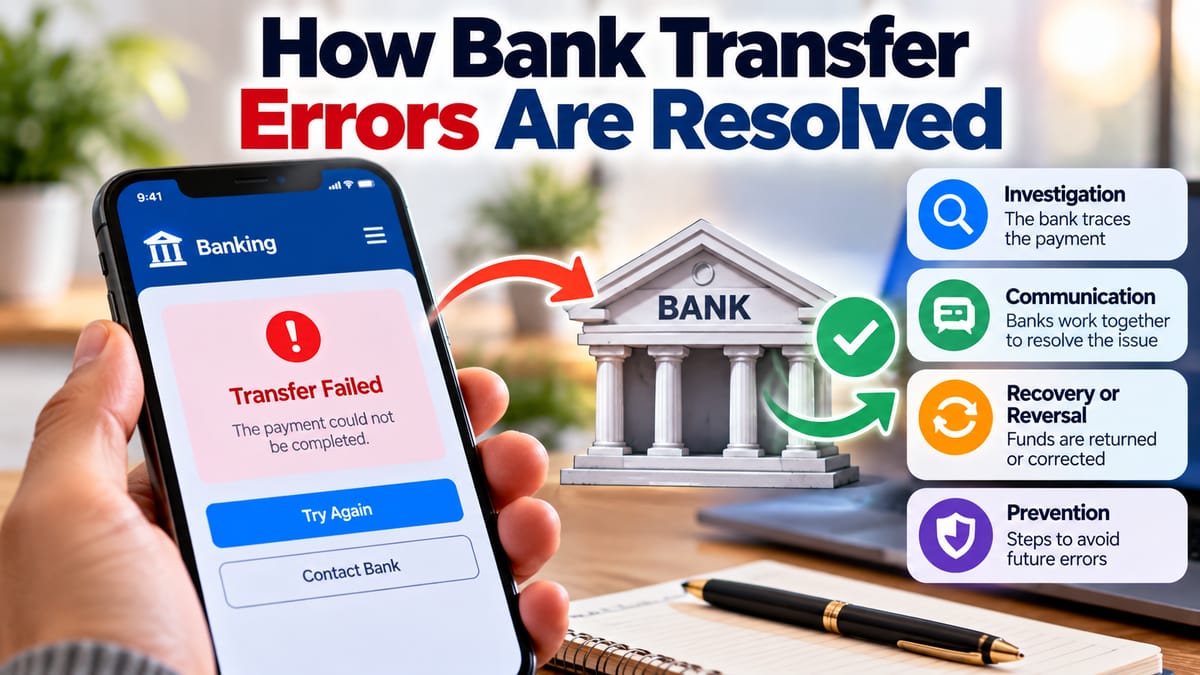
How Bank Transfer Errors Are Resolved
Bank transfers are designed to move money between accounts accurately and securely, but mistakes and processing problems can sometimes occur. A transfer may be sent to the wrong account, delayed, duplicated, rejected, reversed, or appear to disappear temporarily while banks investigate what happened.
When an error occurs, the resolution process usually depends on the type of problem, where the transfer is in the payment process, and which financial institutions or payment systems are involved.
Understanding how banks investigate and resolve transfer errors can make an unexpected payment problem easier to navigate. It can also help customers know what information to provide, what outcomes are possible, and when they should contact their bank.
What Is a Bank Transfer Error?
A bank transfer error occurs when a payment does not complete as intended.
The problem might involve:
- An incorrect account number
- A wrong recipient
- An incorrect transfer amount
- A duplicated payment
- A delayed transfer
- A rejected transaction
- A technical processing problem
- A missing or incorrect payment reference
- An unauthorized transfer
- A transfer that is returned to the sender
Not every delayed or unusual transaction is necessarily an error. Some transfers simply require additional processing time.
Understanding why bank transfers take time to complete can help distinguish normal processing delays from genuine problems.
Why Bank Transfer Errors Happen
Bank transfers pass through multiple stages and systems.
Depending on the type of payment, a transaction may involve:
- The sender’s bank
- A payment network or clearing system
- An intermediary institution
- The recipient’s bank
- The recipient’s account
An error at any stage can affect the final result.
Common causes include incorrect payment information, insufficient funds, account restrictions, technical interruptions, fraud controls, processing errors, or problems with the receiving account.
Incorrect Account Information
One of the most common transfer problems occurs when a sender enters incorrect recipient information.
Depending on the banking system, this could include:
- Incorrect account numbers
- Incorrect routing information
- Incorrect bank codes
- Incorrect branch information
- Incorrect international banking details
- A misspelled recipient name where name verification is required
The consequences depend on whether the payment system can identify the mistake before the transfer is completed.
What Happens When a Transfer Is Sent to the Wrong Account?
A bank generally cannot simply move money back from another customer’s account without following the applicable procedures.
If a transfer has been sent to the wrong recipient, the sending bank may need to contact the receiving institution and request recovery of the funds.
The process can depend on:
- Whether the transfer has already settled
- Whether the receiving account exists
- Whether the money remains in the account
- The applicable banking rules
- The type of payment
- The cooperation of the receiving institution or account holder
This is one reason customers should report an incorrect transfer as soon as they notice it.
Why Speed Matters When Reporting an Error
Time can matter significantly when attempting to recover incorrectly transferred funds.
If the recipient has not withdrawn or moved the money, recovery may be easier than if the funds have already been transferred elsewhere.
Customers should therefore contact their bank promptly when they discover that they have entered incorrect payment information or sent money to the wrong recipient.
The bank can then determine which recovery or investigation process applies.
How Banks Investigate Transfer Errors
When a customer reports a transfer problem, the bank may collect information about the transaction.
This can include:
- Transaction date
- Transfer amount
- Sender account
- Recipient information
- Transaction reference
- Payment method
- Time of submission
- Error message
- Confirmation details
The bank uses these details to trace the transaction through the relevant payment system.
Transaction References Help Banks Track Payments
A transaction reference or confirmation number can be particularly useful during an investigation.
It gives the bank a specific identifier that can be associated with the payment.
Customers should keep confirmation messages, receipts, screenshots, and transaction references when reporting a problem.
Providing complete information can help reduce unnecessary delays during the investigation.
How Digital Transfers Move Between Accounts
A transfer may look instantaneous from a customer’s perspective, but several processes can occur behind the scenes.
The sending institution receives the payment instruction, verifies relevant information, processes the transaction, and sends the payment through the appropriate network or system.
The receiving institution then processes the incoming payment and applies it to the appropriate account.
For a detailed explanation of this process, see How Digital Bank Transfers Move Money Between Accounts.
Delayed Transfers Are Not Always Errors
Customers sometimes report a transfer as an error simply because the money has not arrived yet.
However, bank transfers can take different amounts of time depending on the payment method, processing schedule, weekends, holidays, security checks, and other factors.
A transfer that is still within its expected processing window may not require an error correction.
Banks generally first determine whether the transaction is genuinely missing or simply still being processed.
Pending Transfers
A pending transaction has usually been received by the bank or payment system but has not yet reached its final state.
The bank may still be:
- Processing the payment
- Performing security checks
- Waiting for another institution
- Waiting for clearing
- Confirming transaction details
Customers should generally avoid sending a duplicate payment simply because the first transaction appears pending.
Doing so can create a second transfer and potentially result in duplicate payments.
Failed Transfers
A transfer can fail before reaching the recipient.
Possible reasons include:
- Insufficient funds
- Incorrect account details
- Account restrictions
- Technical problems
- Unsupported payment instructions
- Security checks
- Payment-network issues
When a transfer fails, the bank may provide an error message explaining the reason.
If money was temporarily deducted before the failure was recorded, the bank may need to reverse or release the funds.
Reversed Transfers
A reversed transfer is one that was initially processed but later returned or undone.
For example, a payment might be rejected by the receiving institution after being submitted.
The money may then be returned to the sender’s account.
The timing of a reversal depends on the payment system and the institutions involved.
Returned Payments
A bank may return a transfer when the receiving account cannot accept it.
Possible reasons include:
- Closed accounts
- Invalid account information
- Account restrictions
- Unsupported payment types
- Compliance requirements
- Incorrect payment instructions
The sender may receive the funds back after the return is processed.
A returned payment is different from a payment that has simply been delayed.
Duplicate Bank Transfers
Sometimes a customer or system may submit the same payment more than once.
This can happen when:
- A user presses a payment button repeatedly
- A transfer appears to fail and is submitted again
- A technical problem causes a duplicate instruction
- An automated system retries a transaction incorrectly
Banks can investigate transaction records to determine whether multiple payments were actually processed.
If a duplicate payment is confirmed, the appropriate correction depends on the payment type and circumstances.
Incorrect Transfer Amounts
A transfer may also contain the wrong amount.
For example, someone might intend to send $500 but accidentally enter $5,000.
If the transaction has not yet been processed, cancellation may sometimes be possible.
Once the payment has settled, recovery can be more complicated.
Customers should contact their bank immediately rather than waiting to see whether the recipient returns the excess funds voluntarily.
Bank Transfer Errors Caused by Technical Problems
Financial institutions rely on extensive technology infrastructure.
Temporary technical problems can affect:
- Online banking
- Mobile banking
- Payment processing
- Account balances
- Transaction notifications
- Payment networks
- Automated clearing systems
A technical problem may cause a transaction to appear delayed or incomplete even though the payment instruction was successfully submitted.
Banks can use internal transaction records to determine what happened.
Payment Systems and Transfer Investigations
Bank transfers operate within broader payment systems.
These systems define how payment instructions are exchanged, processed, cleared, and settled.
Understanding how payment systems work and how money moves between accounts provides useful context for understanding why resolving an error may involve more than the sender’s bank alone.
When multiple institutions are involved, each organization may need to confirm where the payment currently is in the process.
What Happens When a Bank Cannot Immediately Locate a Transfer?
A bank may open an investigation or payment trace when the transaction cannot immediately be explained.
The institution can review internal records and, when appropriate, communicate with another financial institution or payment network.
A payment trace may examine:
- Submission records
- Processing timestamps
- Account records
- Payment references
- Clearing information
- Settlement records
- Receiving-bank information
The purpose is to establish what happened to the transaction.
Bank Transfer Investigations Can Take Time
Resolving a transfer problem is not always immediate.
A bank may need to communicate with another financial institution, payment processor, or clearing system.
International payments can be particularly complicated because several institutions and jurisdictions may be involved.
The investigation may therefore take longer than a standard customer-service inquiry.
International Transfer Errors
International transfers can involve additional information and processing requirements.
Depending on the payment method, an international transfer may pass through intermediary banks before reaching the recipient.
Errors can therefore involve:
- Incorrect international account information
- Incorrect bank identifiers
- Currency differences
- Intermediary banks
- Compliance checks
- International payment rules
- Foreign-exchange processing
Tracing an international payment may require cooperation between multiple institutions.
Fraudulent Transfers Are Different From Mistakes
An unauthorized transfer is different from a transfer where the customer accidentally entered incorrect information.
If someone else initiated the transaction without authorization, the bank may classify the matter as potential fraud.
The investigation may then involve:
- Account-access records
- Authentication information
- Device activity
- Transaction history
- Security alerts
- Customer verification
- Fraud-monitoring systems
Customers should report suspected unauthorized transactions as quickly as possible.
For additional account-protection practices, see How to Protect Your Bank Account From Fraud.
What Information Should You Give the Bank?
When reporting a transfer problem, provide as much relevant information as possible.
Useful details may include:
- Your account information
- Transfer date
- Transfer amount
- Recipient details
- Transaction reference
- Confirmation number
- Description of what went wrong
- Screenshots or receipts
- Relevant error messages
- Any communication with the recipient
Accurate information can help the bank identify the transaction more quickly.
Keep Evidence of the Transfer
Customers should keep records of important transfers.
Useful records can include:
- Digital receipts
- Bank statements
- Confirmation emails
- Mobile-banking screenshots
- Transaction references
- Payment instructions
- Relevant messages with the recipient
These records can be useful if an investigation requires confirmation of what was submitted.
Can a Bank Cancel a Transfer?
Whether a transfer can be canceled depends largely on its status and payment method.
A payment that has not yet been processed may have more opportunities for cancellation than one that has already settled.
Some transfers may be effectively final once they reach a particular stage.
Customers should therefore contact their bank immediately if they realize a transfer needs to be stopped.
What Happens After a Transfer Is Settled?
Once a payment has settled, reversing it can become more difficult.
Settlement generally means that the payment has reached a completed stage within the relevant payment system.
If the payment was sent incorrectly, the bank may need to use a recovery or recall procedure rather than simply canceling the original transaction.
The specific procedure depends on the type of payment and applicable rules.
Bank-to-Bank Communication
Transfer investigations can require communication between financial institutions.
For example, the sender’s bank may contact the receiving bank to ask about a payment.
The receiving bank may then determine whether the funds are present, whether the account can accept the payment, or whether another action is required.
This communication is one reason customers may not receive an immediate resolution.
What Happens When the Recipient Cooperates?
If a payment was sent to the wrong person and the receiving institution confirms that the funds are available, recovery may be possible through the applicable procedures.
In some situations, the recipient may need to authorize the return.
The exact process varies according to the payment system, banking rules, and circumstances.
What If the Recipient Has Already Spent the Money?
Recovery can become more complicated if the recipient has already withdrawn or transferred the funds.
The sending bank may still investigate and pursue the available recovery process, but an immediate reversal may not be possible.
Customers should not attempt to personally threaten or pressure an unintended recipient. Communication should generally be handled through appropriate banking and legal channels.
Bank Errors and Customer Errors
A transfer problem can result from either customer actions or institutional problems.
Examples of customer-related errors include:
- Entering the wrong account number
- Sending the wrong amount
- Selecting the wrong recipient
- Submitting a transfer twice
Examples of bank or system-related problems can include:
- Incorrect processing
- Technical failures
- Duplicate system instructions
- Incorrect account posting
- Payment-system interruptions
Determining the cause helps determine the appropriate resolution.
How Banks Correct Posting Errors
Sometimes the transfer itself is valid, but the transaction is incorrectly reflected in an account.
For example, a deposit might not appear correctly in an account balance even though the payment was received.
Banks can review transaction records and account ledgers to identify discrepancies.
If an internal posting error is confirmed, the institution can make the appropriate correction according to its procedures.
Why Account Balances Can Be Confusing During an Investigation
A customer’s available balance may temporarily differ from what they expect.
Pending transactions, holds, reversals, or processing adjustments can affect displayed balances.
This does not necessarily mean that money has permanently disappeared.
Customers should review transaction details rather than relying solely on the headline account balance when investigating a transfer problem.
What Customers Should Not Do
When a transfer appears to have failed, avoid repeatedly submitting the same payment without first checking its status.
Doing so can result in:
- Duplicate transfers
- Additional fees
- Confusing transaction records
- Overdraft risks
- More complicated recovery
Instead, confirm whether the original payment is pending, completed, failed, or reversed.
Fees Related to Transfer Errors
Some transfer problems can result in fees, depending on the type of transaction and the reason for the problem.
Possible charges may relate to:
- Insufficient funds
- Returned payments
- International transfers
- Currency conversion
- Special investigation services
Whether a fee can be refunded depends on the bank’s policies and the circumstances.
Customers can ask the bank to explain any charge associated with a transfer problem.
How Long Does Resolution Take?
There is no universal resolution time.
Simple problems may be corrected relatively quickly, while complex investigations can take considerably longer.
Factors affecting resolution can include:
- Type of transfer
- Payment status
- Number of institutions involved
- Domestic or international processing
- Fraud concerns
- Incorrect recipient information
- Technical problems
- Required documentation
Customers should ask the bank for a case or reference number when an investigation is opened so they can follow up effectively.
Following Up With the Bank
If a problem remains unresolved, keep track of communications with the bank.
Record:
- Date of contact
- Time of contact
- Customer-service department
- Case number
- Information requested
- Expected next step
Keeping these details organized can make subsequent conversations easier.
When to Escalate a Transfer Problem
If a transfer error remains unresolved after ordinary customer-service channels have been used, customers may have additional escalation options.
Depending on the jurisdiction and type of institution, these can include:
- A bank’s formal complaints process
- A banking ombudsman
- A financial regulator
- A payment-system dispute process
- Appropriate legal channels
The available options vary by country and financial institution.
Preventing Bank Transfer Errors
The easiest transfer problem to resolve is often the one that never happens.
Before submitting a payment:
- Check the recipient’s details carefully.
- Confirm the amount.
- Verify the payment reference.
- Review the destination account.
- Check whether the transfer is domestic or international.
- Confirm any applicable fees.
- Avoid rushing through the confirmation screen.
For recurring payments, verify stored recipient information periodically.
Use Trusted Banking Devices and Networks
Customers should also protect the accounts they use to initiate transfers.
Avoid entering banking credentials into suspicious websites or applications.
Use official banking applications or trusted websites, keep devices updated, and protect login credentials.
Multi-factor authentication can provide an additional layer of protection against unauthorized account access.
Check Transfer Notifications
Many banks provide notifications when transfers are submitted, completed, rejected, or otherwise updated.
Enabling appropriate alerts can help customers identify unusual activity sooner.
A notification can also provide useful information when investigating a transfer that does not appear to have reached its destination.
Review Bank Statements Regularly
Regularly reviewing account statements can help identify transfer errors or unauthorized transactions.
Look for:
- Unexpected transfers
- Duplicate payments
- Incorrect amounts
- Unfamiliar recipients
- Unexpected fees
- Missing deposits
The sooner an unusual transaction is identified, the sooner the customer can contact the bank.
A Practical Response to a Transfer Error
If you discover that something went wrong with a bank transfer, a simple sequence can help:
Step 1: Check the Transaction Status
Determine whether the payment is pending, completed, failed, reversed, or returned.
Step 2: Review the Details
Confirm the amount, recipient information, date, and transaction reference.
Step 3: Avoid Sending Another Payment
Do not automatically submit a second transfer until the first transaction’s status is clear.
Step 4: Contact the Bank
Explain exactly what happened and provide the transaction information.
Step 5: Request a Reference Number
If the bank opens an investigation, keep the case or reference number.
Step 6: Follow Up
If the issue is not resolved within the expected timeframe, contact the bank again and reference the existing case.
Why Accurate Transfer Records Matter
Modern banking systems process enormous numbers of transactions.
Accurate records allow financial institutions to reconstruct the path of a payment and determine where a problem occurred.
Transaction records also support:
- Fraud investigations
- Customer disputes
- Reconciliation
- Regulatory requirements
- Payment tracing
- Error correction
For customers, maintaining their own records provides an additional layer of documentation.
Bank Transfer Errors Can Usually Be Traced
A transfer that appears to have disappeared is not necessarily gone permanently.
Banks and payment systems maintain records of transaction activity, allowing institutions to investigate many types of transfer problems.
The important distinction is between a payment that is still processing, a payment that failed or was returned, a transaction that was incorrectly posted, and a completed payment that was sent to the wrong destination.
Each situation can require a different resolution.
Making Transfers Safer and Easier to Manage
Bank transfers are an essential part of modern financial life, but they work within complex systems that can occasionally experience errors.
Customers can reduce the likelihood of problems by carefully checking payment details, keeping transaction records, using secure banking practices, and monitoring account activity.
When an error does occur, prompt reporting is often important. Providing accurate transaction information allows the bank to trace the payment, determine what happened, and identify the appropriate correction or recovery process.
Understanding the difference between a delay, failed payment, reversal, duplicate transaction, incorrect transfer, and unauthorized payment can also make it easier to communicate clearly with the bank and take the appropriate next step.