What Is the Difference Between Bank Transfers and Card Payments?
Bank transfers and card payments are two of the most common ways people move and spend money. Although both can be completed electronically and may appear nearly instant from a customer’s perspective, they work through different payment processes.
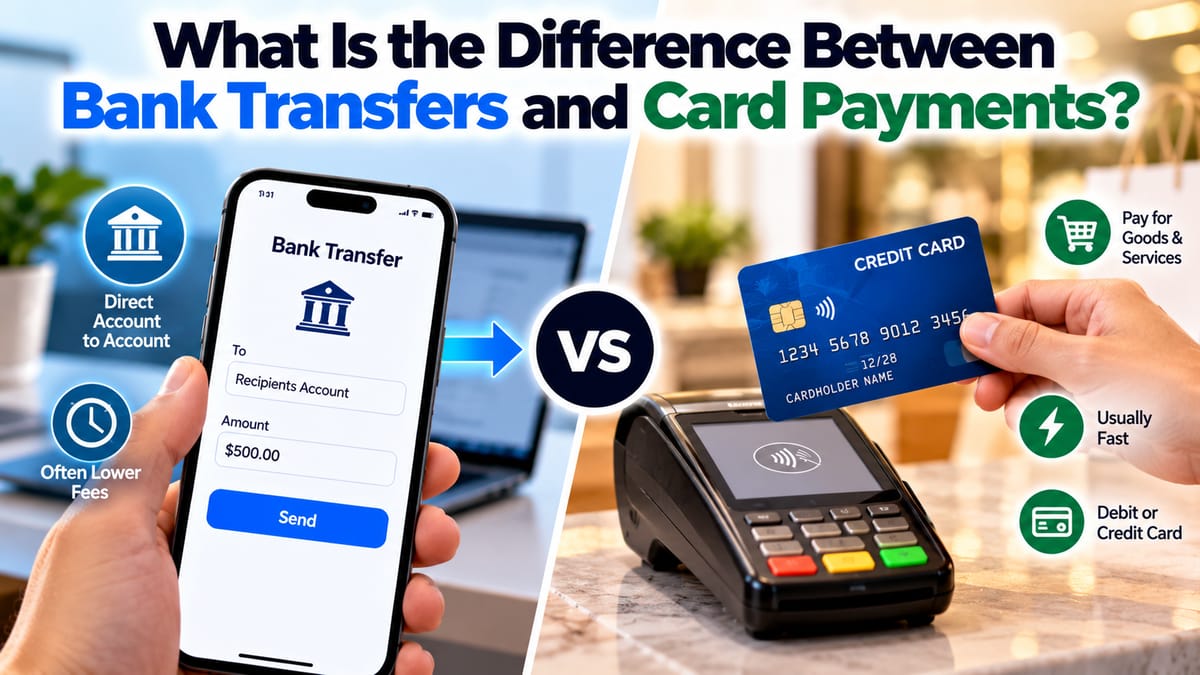
A bank transfer generally moves money directly from one bank account to another. A card payment, by contrast, uses a debit or credit card through a payment network that connects the customer, merchant, card issuer, and other financial institutions involved in the transaction.
Understanding the difference matters because the two methods can vary in speed, fees, security, consumer protections, and how transactions are authorized and settled.
What Is a Bank Transfer?
A bank transfer is a payment in which money moves from one bank account to another. The accounts may belong to the same person, different individuals, businesses, or organizations.
For example, someone might transfer money from their checking account to a friend’s account, pay a utility company, send money to a business, or move funds between their own accounts.
The exact process depends on the banking system and type of transfer being used. Some transfers are processed within the same bank, while others pass through external payment networks or clearing systems.
For a broader understanding of how different accounts function, the Complete Guide to Bank Accounts and Account Types explains the main types of bank accounts and how they are used.
Common Types of Bank Transfers
Bank transfers can take several forms, including:
- Internal transfers: Money moves between accounts at the same bank.
- Domestic transfers: Funds move between accounts held at different banks within the same country.
- International transfers: Money is sent between accounts in different countries.
- Recurring transfers: A customer authorizes regular payments, such as rent or loan payments.
- Business transfers: Companies use bank transfers to pay suppliers, employees, contractors, and other businesses.
The terminology and processing methods vary by country. Some systems use real-time payments, while others rely on clearing processes that may take longer.
What Is a Card Payment?
A card payment occurs when someone uses a debit, credit, or other payment card to purchase goods or services.
When a customer taps, inserts, or swipes a card, the transaction typically involves several parties. These can include:
- The customer
- The merchant
- The merchant’s payment processor or acquiring institution
- The card network
- The card issuer
The card network routes transaction information between the relevant financial institutions. The issuer then determines whether the transaction can be authorized based on factors such as available funds, credit availability, account status, and security checks.
Debit and credit cards can therefore provide different funding arrangements. A debit card generally draws money from an associated deposit account, while a credit card allows the customer to make purchases using an approved line of credit.
The Complete Guide to Credit Cards and How They Work provides more detail about credit limits, interest, billing cycles, and the way credit card transactions are handled.
The Main Difference Between Bank Transfers and Card Payments
The biggest difference is how the payment is initiated and where the money comes from.
With a bank transfer, the payment generally involves moving funds directly between bank accounts. With a card payment, the customer uses a payment card and the transaction is routed through a card payment network.
Consider two examples.
Suppose a customer sends $500 directly to a contractor’s bank account. That is a bank transfer.
Now suppose the same customer buys a $500 appliance from a retailer by tapping a credit card. That is a card payment. The transaction is authorized through the card payment system, and the customer’s credit account is charged rather than immediately transferring $500 directly to the retailer’s bank account.
The merchant subsequently receives funds through the card payment settlement process.
How Bank Transfers Move Money
A bank transfer begins with instructions from the sender. The sender typically provides information such as the recipient’s account details and the amount to be transferred.
The sending institution then processes the instruction and sends the necessary payment information through the relevant banking or payment infrastructure.
Depending on the type of transfer, the transaction may be processed almost immediately or may pass through one or more clearing and settlement stages.
The How Digital Bank Transfers Move Money Between Accounts explains this process in greater detail, including how digital instructions ultimately result in funds moving between accounts.
Bank transfers can be particularly useful when the recipient needs to receive money directly into a bank account rather than through a point-of-sale payment.
How Card Payments Move Through the Payment System
Card payments involve a more layered process.
When a customer presents a card, the merchant’s payment system sends transaction information for authorization. The request can pass through a payment processor and card network before reaching the institution that issued the card.
The issuer checks the transaction and sends an approval or decline response.
If approved, the merchant can generally complete the sale. However, the movement of funds between the relevant financial institutions is not necessarily completed at that exact moment.
The transaction may go through subsequent clearing and settlement processes.
The How Payment Systems Work and How Money Moves Between Accounts provides a broader look at the infrastructure that allows electronic payments to move between financial institutions.
Bank Transfers vs. Card Payments at a Glance
| Feature | Bank Transfers | Card Payments |
|---|---|---|
| Primary purpose | Moving money between accounts | Paying for goods and services |
| Funding source | Usually a bank account | Debit account or credit line |
| Typical recipient | Person, business, or account holder | Merchant or service provider |
| Payment network | Banking or transfer infrastructure | Card payment network |
| Common use | Sending money, bills, payroll, account transfers | Retail and online purchases |
| Authorization | Based on transfer instructions and account controls | Based on card authorization |
| Settlement | Depends on transfer system | Occurs through card payment infrastructure |
| Credit option | Usually no | Available with credit cards |
| Chargeback process | Depends on the transfer system | Card networks may provide dispute mechanisms |
| Merchant acceptance | Requires bank-transfer support | Widely supported where cards are accepted |
The exact characteristics can differ considerably depending on the country, financial institution, payment network, and type of transaction.
Which Is Faster?
Neither method is universally faster.
Some bank transfer systems can move money almost instantly, particularly where real-time payment infrastructure is available. Other transfers may take hours or several business days.
Card authorization, meanwhile, often happens within seconds. This allows a customer to receive an immediate response when making a purchase. However, authorization is not necessarily the same as final settlement.
A card transaction can therefore appear to happen instantly even though the underlying financial institutions complete their settlement processes later.
Timing can also be affected by weekends, holidays, international transfers, bank processing schedules, fraud checks, and technical issues.
Which Costs More?
Fees depend heavily on the financial institution and payment method.
Some bank transfers are free, particularly transfers between accounts at the same institution. Other transfers may involve service charges, especially international payments or certain expedited services.
Card payments can also involve multiple fees. A merchant may pay processing-related costs for accepting cards, while a cardholder could face fees for specific activities such as cash advances, foreign transactions, or certain account services.
Credit cards also introduce the possibility of interest charges when balances are not paid according to the account’s terms.
As a result, comparing the cost of a bank transfer with a card payment requires looking at the specific transaction rather than assuming one method is always cheaper.
Bank Transfers and Card Payments Have Different Risks
Both payment methods have security measures, but they also have different risks.
A bank transfer can be difficult to reverse once funds have been successfully sent, particularly if the sender authorized the transaction and the recipient’s account details were correct.
This makes it important to verify the recipient before sending money.
Card payments have their own risks, including stolen card details, fraudulent transactions, compromised online accounts, and unauthorized purchases. However, card payment systems commonly include mechanisms for reporting unauthorized transactions and disputing certain transactions.
Consumers should still review account activity regularly and respond quickly when they notice something unusual.
What Happens When a Payment Goes Wrong?
The process for resolving a problem depends on how the payment was made.
A bank transfer could be delayed, rejected, returned, sent to incorrect account information, or affected by technical problems. In some cases, a bank may be able to investigate or recall a transaction, although recovery is not guaranteed.
Card transactions can also be declined, duplicated, reversed, or disputed. A customer may be able to contact the card issuer or merchant when a transaction is unauthorized or does not match the goods or services received.
The distinction between an unauthorized transaction and a payment that a customer personally authorized is particularly important when determining what options may be available.
Bank Transfers Are Often Used for Larger or Direct Payments
Bank transfers are commonly suited to situations where money needs to be moved directly between accounts.
Examples include:
- Paying rent
- Sending money to family
- Paying contractors
- Transferring savings
- Paying invoices
- Making business-to-business payments
- Moving money between personal accounts
- Paying certain loans or financial obligations
Because the payment is tied directly to bank accounts, transfers can be useful when a merchant or recipient provides bank details instead of accepting cards.
Card Payments Are Designed for Convenient Purchases
Cards are particularly convenient for everyday purchases.
A customer can use a card at a physical store, online checkout, restaurant, hotel, or other merchant without manually entering the recipient’s bank account details for every transaction.
Contactless payments have made the process even faster. Mobile wallets can also allow compatible debit and credit cards to be used through smartphones and other devices.
For merchants, card acceptance can make it easier to serve customers who prefer not to use cash or direct bank transfers.
Debit Cards Bridge Some of the Differences
Debit cards can make the distinction between the two methods less obvious.
A debit card is connected to a bank account, so the purchase ultimately draws on money held in that account. Yet the payment still travels through the card payment infrastructure rather than functioning as a conventional account-to-account bank transfer.
This means a debit card purchase can use money from a bank account while still being processed as a card transaction.
The difference is therefore not simply whether the customer’s money is in a bank account. It is also about the payment channel and infrastructure used to authorize and process the transaction.
Credit Cards Work Differently From Bank Transfers
Credit cards create another important distinction.
When a customer makes a purchase using a credit card, the payment does not necessarily require the customer to have enough cash sitting in a bank account at that moment. Instead, the card issuer extends credit according to the customer’s approved terms.
The purchase increases the customer’s outstanding balance, which can later be repaid.
This makes credit cards fundamentally different from a standard bank transfer, where the sender generally instructs a financial institution to move existing funds from one account to another.
Why Merchants Accept Both Methods
Businesses may accept multiple payment methods because customers have different preferences and needs.
Cards can provide a quick checkout experience and work well for online and physical retail. Bank transfers can be useful for invoices, recurring payments, larger transactions, and customers who prefer account-to-account payments.
Offering multiple options can also help businesses accommodate different banking systems and customer expectations.
However, each payment method can involve different operational requirements, fees, settlement times, fraud controls, and reconciliation processes.
Bank Transfer or Card Payment: What Should You Use?
The appropriate option depends on the purpose of the payment.
A bank transfer may make sense when:
- You are sending money directly to another person’s account.
- You are paying an invoice using provided bank details.
- You are moving money between your own accounts.
- The recipient specifically requests a bank transfer.
- You want to use an account-to-account payment method.
A card payment may be more appropriate when:
- You are purchasing goods or services from a merchant.
- The business accepts cards but not direct transfers.
- You want a convenient checkout process.
- You are using a credit card’s available credit.
- You need to make a purchase through an online or physical card terminal.
Before sending money, check the recipient information, transaction amount, fees, and expected processing time.
Why Understanding the Difference Matters
Bank transfers and card payments may both look like simple digital transactions, but they rely on different systems and create different relationships between the customer, financial institutions, merchants, and payment networks.
A bank transfer primarily moves money between accounts. A card payment primarily authorizes a purchase through a card network, with the underlying funds or credit being settled through the financial institutions involved.
Knowing the distinction can make it easier to understand transaction timing, fees, security protections, payment disputes, and account activity. It can also help consumers and businesses choose the payment method that fits a particular transaction while recognizing that the exact rules and costs vary by bank, card issuer, payment network, and jurisdiction.