**What Financial Apps Do With Personal Financial Data
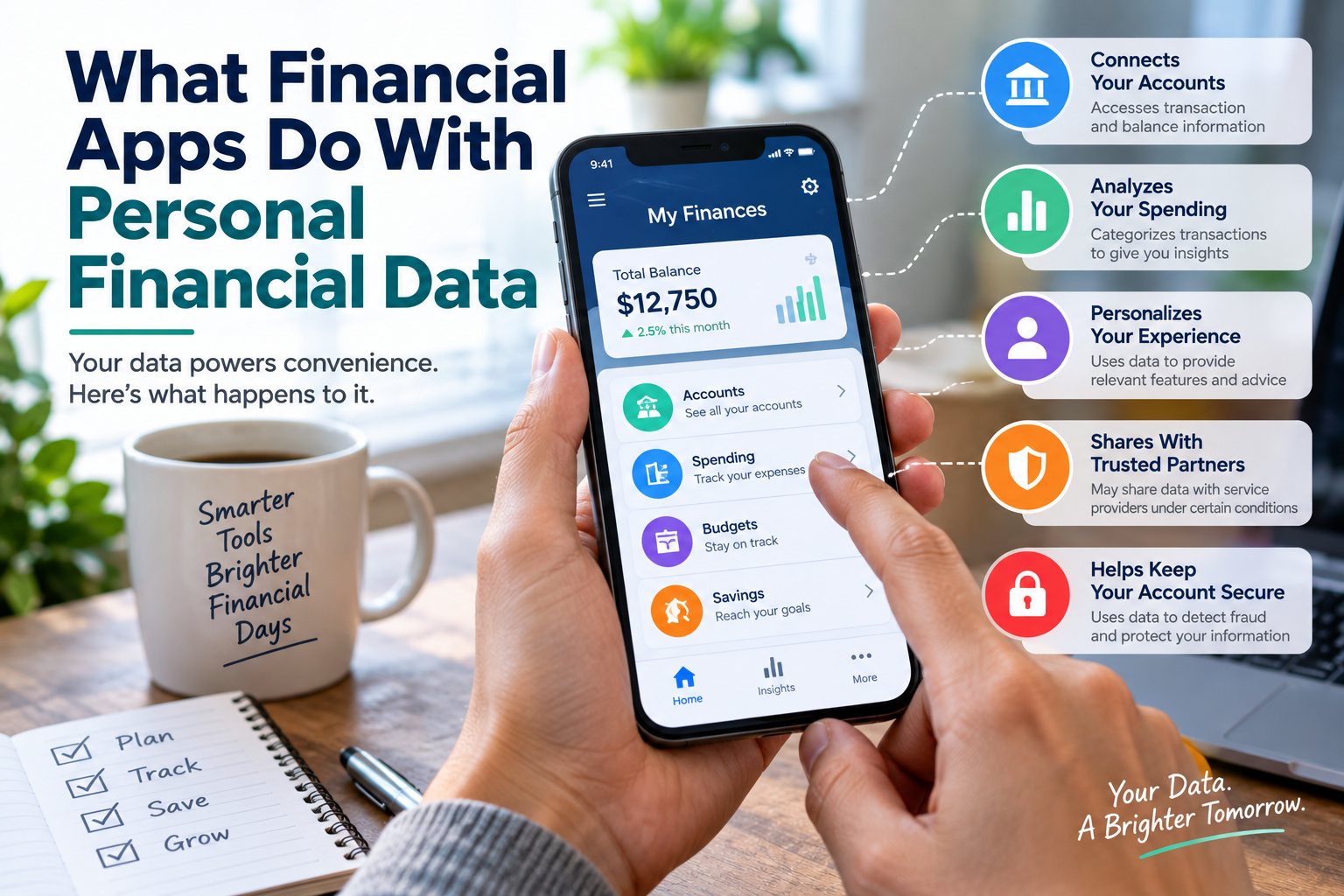
Financial apps can make everyday money management much easier. A single app may help users track expenses, monitor bank accounts, create budgets, calculate investments, manage bills, or understand their cash flow. Behind these convenient features, however, many financial apps process substantial amounts of personal financial information.
Depending on the service, an app may handle transaction histories, account balances, income information, spending patterns, contact details, device information, and other data needed to provide its features. Some apps may also share information with service providers or business partners under particular circumstances.
Understanding what happens to financial data can help users make more informed decisions about the tools they connect to their finances.
What Counts as Personal Financial Data?
Personal financial data includes information that can reveal something about a person’s financial circumstances or activities.
Examples can include:
- Bank account information
- Credit and debit card details
- Account balances
- Transaction histories
- Income information
- Bills and recurring payments
- Investment holdings
- Loan information
- Spending categories
- Financial goals
- Credit-related information
- Information about financial institutions
Some financial apps may collect additional information that is not strictly financial but can still contribute to a detailed user profile.
This may include an email address, phone number, IP address, device identifiers, location information, or information about how the app is used.
The exact information collected depends on the app, its features, the accounts a user connects, and the permissions granted.
Why Financial Apps Need Access to Data
Financial apps generally need some form of financial information to perform their primary functions.
An expense-tracking app, for example, needs transaction information to categorize spending. A budgeting application may need income and expense information to calculate available funds. An investment application needs account and transaction information to display portfolios or facilitate investment activity.
The Complete Guide to Financial Apps provides a broader look at the different types of applications available and the financial tasks they can support.
The important question is not simply whether an app accesses data. It is what data it accesses, why it needs that data, how it uses it, and what happens to the information afterward.
How Financial Apps Collect Information
Financial apps can obtain information in several ways.
One method is direct input. Users may enter their income, expenses, account information, financial goals, or other details themselves.
Another method is connecting an external financial account. Depending on the service and connection method, the app may receive financial information from a bank, card issuer, brokerage, or other institution.
Apps may also collect information automatically when users interact with them. This can include device information, log data, IP addresses, app activity, and information about how particular features are used.
As a result, the data collected by a financial app can extend beyond the numbers users deliberately enter.
What Happens When You Connect a Bank Account?
Connecting a bank account can allow an app to retrieve financial information automatically instead of requiring the user to enter every transaction manually.
The connection may provide information such as transaction dates, merchant descriptions, amounts, account balances, and other details permitted by the connection.
The exact information available depends on the financial institution, connection technology, permissions, and the app’s arrangements with its data providers.
Users should therefore examine the permissions associated with an account connection rather than assuming that an app receives only the minimum information needed for one specific feature.
Financial Data Can Reveal Spending Patterns
Transaction data can reveal considerably more than individual purchases.
Repeated transactions may show where someone shops, how frequently they travel, which subscriptions they maintain, how much they spend on particular categories, or when certain bills are normally paid.
Over time, these records can create a detailed picture of financial behavior.
For example, an expense-tracking tool might identify recurring expenses and categorize transactions automatically. A cash-flow tool may use historical transactions to help estimate upcoming financial activity.
These capabilities can be useful, but they also demonstrate why financial information deserves careful handling.
The role of these tools in household money management is explored further in How Expense Tracking and Cash Flow Tools Help Manage Household Finances.
Why Data Is Used for More Than Basic Functionality
A financial app may use data for several purposes beyond delivering its most obvious feature.
Depending on the company’s policies and applicable laws, information may be used to:
- Provide and maintain the service
- Personalize features
- Analyze product performance
- Detect fraud or suspicious activity
- Improve software
- Provide customer support
- Meet legal obligations
- Conduct analytics
- Communicate with users
- Develop new products or services
The privacy policy and terms associated with a specific service should explain its permitted uses.
This is why reading privacy documentation matters when selecting financial software.
Data Sharing With Service Providers
Financial technology companies often rely on third-party providers to operate their services.
A company may use outside providers for cloud hosting, analytics, customer support, security, payment processing, communications, identity verification, or other technical functions.
This does not necessarily mean those companies can freely use a person’s financial information for any purpose. Contracts, privacy policies, security controls, and applicable laws can restrict how information is handled.
Nevertheless, users should understand that information may pass through multiple systems rather than remaining entirely within the financial app itself.
Can Financial Apps Sell Personal Data?
Whether a particular financial app sells or otherwise shares personal data depends on its business practices, legal obligations, product design, and applicable privacy rules.
The word “sell” can also have specific legal meanings that differ between jurisdictions. Some privacy laws distinguish between selling personal information and other forms of sharing or transferring data.
Rather than assuming that every financial app either sells data or never shares it, users should examine the company’s privacy policy and relevant disclosures.
Look for sections describing:
- Data sharing
- Third parties
- Business partners
- Advertising
- Analytics
- Service providers
- Data sales or transfers
- Consumer privacy rights
- Data retention
These sections can reveal considerably more than a short privacy summary.
Financial Data and Advertising
Some financial services may use information to personalize communications or advertising, although practices differ substantially between companies.
Financial information can be particularly valuable for understanding consumer behavior because spending activity provides insights into interests, purchasing patterns, and financial priorities.
Users should pay attention to whether a service says it uses information for advertising, marketing, profiling, or personalized offers.
It is also useful to distinguish between advertising based on information collected by an app and advertisements supplied by an external advertising platform.
Data May Be Aggregated or De-Identified
Financial companies may sometimes use aggregated or de-identified information for analytical or business purposes.
Aggregated data combines information from multiple users so that the focus is on broader patterns rather than individual records.
De-identified data is processed to reduce the ability to associate the information with a particular person.
The effectiveness and definition of these processes can vary. Users should therefore read the specific company’s explanation rather than assuming that all de-identified information is permanently incapable of being connected to an individual.
How Long Financial Apps Keep Data
Data retention policies determine how long a company keeps information.
Some data may need to be retained for legitimate business or legal reasons. Financial services can also be subject to recordkeeping requirements, depending on the type of service and jurisdiction.
Other information may be retained for as long as an account remains active or for a period after the account is closed.
Users should look for information about retention, deletion, account closure, and data disposal when reviewing a financial app’s privacy practices.
Deleting an app from a phone does not necessarily mean that the company has deleted the associated account or historical financial information.
What Happens When You Close an Account?
Closing a financial app account and deleting personal information are not always the same thing.
A company may retain certain records after an account is closed because of legal, regulatory, fraud-prevention, accounting, or other legitimate requirements.
Some companies may provide processes for requesting deletion of information that does not need to be retained.
The available rights and procedures can vary by location and by the type of information involved.
Before closing an account, users can review the company’s data deletion policy and determine whether there are additional steps required to request deletion.
Security Is Different From Privacy
Privacy and security are closely related but represent different concerns.
Security concerns how a company protects information from unauthorized access, loss, theft, or misuse.
Privacy concerns how information is collected, used, shared, retained, and otherwise handled.
A financial app can have strong security controls while still collecting more information than a user expected. Conversely, a company may have a limited data collection policy but still need strong security measures to protect the information it does hold.
Users should consider both dimensions when evaluating a financial tool.
What Users Can Do to Reduce Data Exposure
People cannot always eliminate data sharing when using financial applications, but they can make deliberate choices about which services receive access to their information.
Practical steps include:
- Use financial apps from companies you understand and trust
- Read the privacy policy before connecting sensitive accounts
- Review the permissions requested by an app
- Avoid granting unnecessary access
- Use strong, unique passwords
- Enable multi-factor authentication when available
- Keep apps and devices updated
- Review connected accounts periodically
- Remove connections that are no longer necessary
- Monitor financial accounts for unusual activity
- Understand the company’s data deletion procedures
These steps can reduce unnecessary exposure while allowing users to benefit from financial technology.
Choosing a Financial App Requires More Than Comparing Features
Two apps can offer similar budgeting or tracking features while having substantially different approaches to data.
One service might collect information primarily to provide its core functions. Another may have a broader data ecosystem involving analytics, marketing, advertising, or third-party services.
This means privacy practices should be considered alongside price, functionality, security, usability, and compatibility.
The Complete Guide to Financial Tools and Calculators can help put different types of financial technology into context when deciding which tools are appropriate for particular financial tasks.
Read Financial Software Reviews Carefully
Reviews can help users understand whether an application is easy to use, reliable, well-designed, or suitable for particular financial needs.
However, a positive review does not necessarily tell you how a company handles personal financial information.
Privacy practices may not be obvious from an app’s interface or feature list.
When evaluating software, consider whether reviews discuss data practices, security, account connections, privacy controls, and customer support in addition to usability.
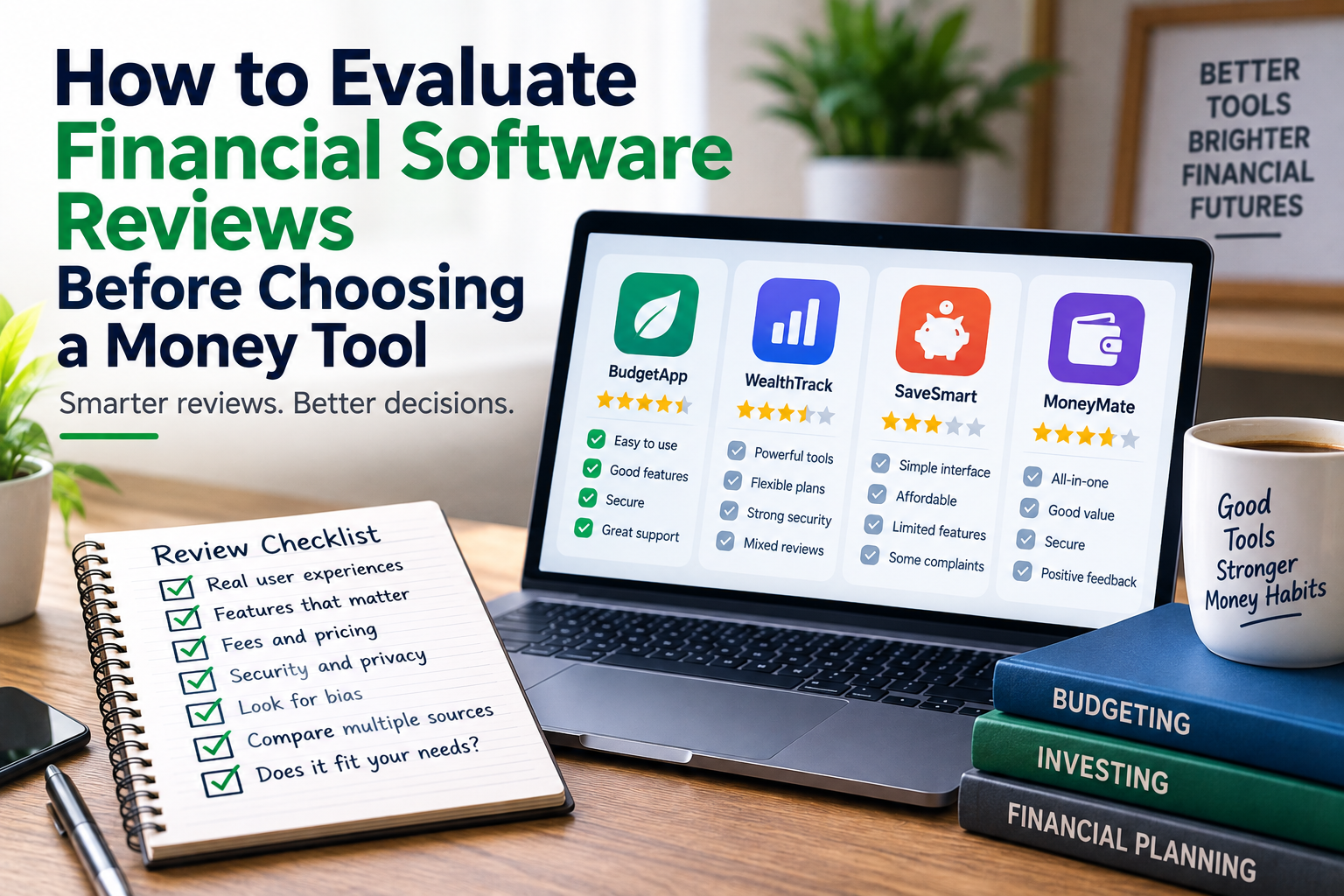
For a more structured approach, How to Evaluate Financial Software Reviews Before Choosing a Money Tool can help users assess reviews more critically.
Questions to Ask Before Connecting Financial Accounts
Before linking a bank, card, brokerage, or other financial account, it can be useful to ask several basic questions:
- What information will the app receive?
- Why does it need that information?
- How will the information be used?
- Will information be shared with third parties?
- Does the company use financial information for advertising or marketing?
- How long will information be retained?
- What happens if I disconnect the account?
- Can I request deletion of my information?
- What security measures protect the data?
- Who can I contact if I have a privacy concern?
The answers can help determine whether the service’s data practices match the user’s expectations.
Why Transparency Matters
Financial information is unusually sensitive because it can reveal aspects of a person’s economic life over long periods.
A useful financial app should make it reasonably clear what information it collects and why that information is needed.
Users should not have to rely entirely on assumptions based on an app’s name, reputation, or appearance. Privacy policies, permission screens, account-connection notices, and data controls provide more meaningful information about how the service actually operates.
Transparency also allows consumers to compare services based on something more important than convenience alone.
Making Financial Technology Work for You
Financial apps can simplify tasks that once required spreadsheets, paper records, or manual calculations. They can make spending easier to understand, automate financial tracking, and give users a clearer view of their money.
That convenience comes with a data trade-off.
The more financial information an app receives, the more important it becomes to understand what happens to that information after collection. Data may be stored, analyzed, shared with service providers, used to operate features, or handled in other ways described by the company’s policies.
The most informed approach is not necessarily to avoid financial apps altogether. Instead, users can choose tools carefully, limit unnecessary permissions, understand privacy and retention policies, and regularly review which services have access to their financial information.
A financial tool should ultimately be judged not only by what it can do with your money data, but also by how clearly it explains what it does with the data itself.