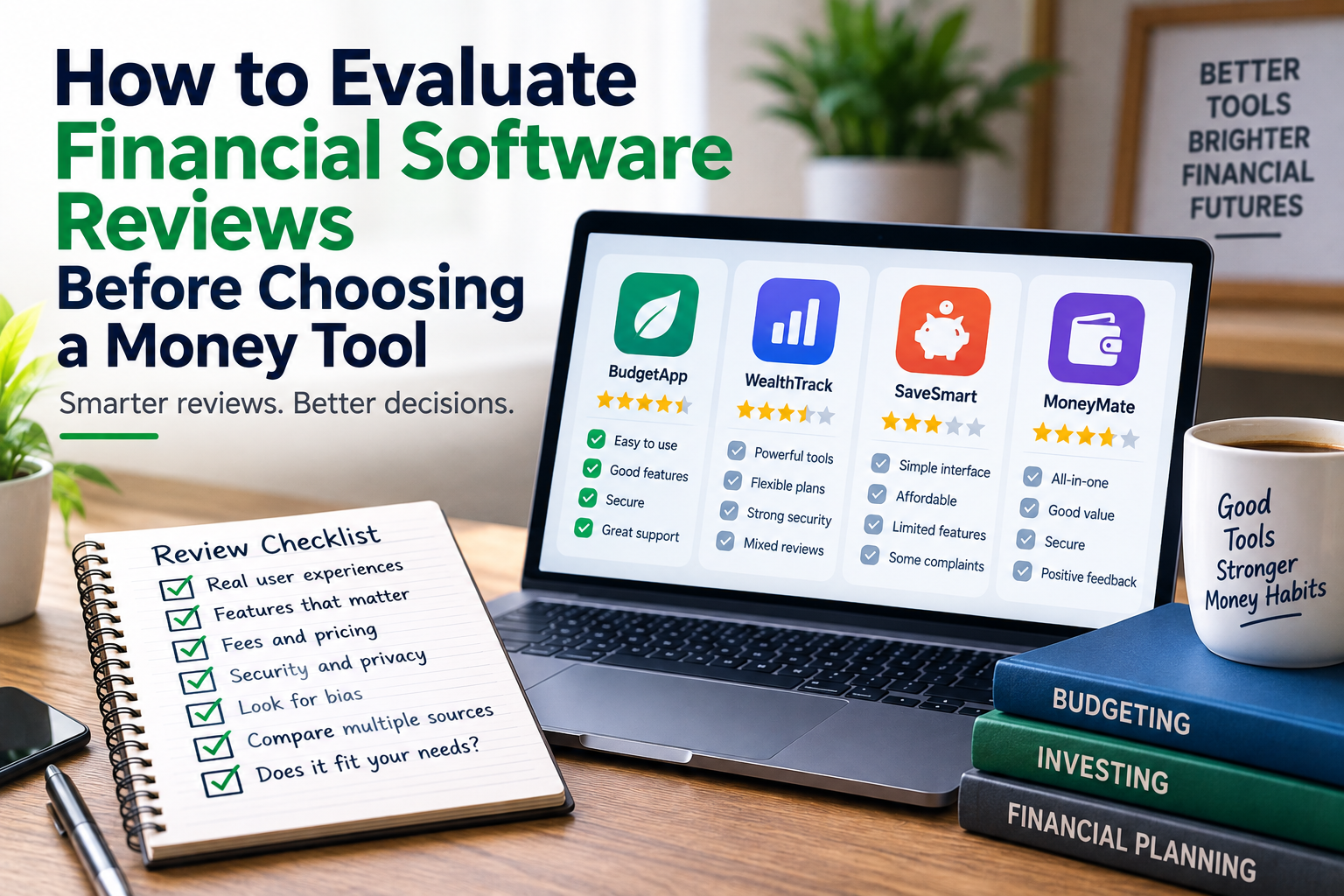
How to Evaluate Financial Software Reviews Before Choosing a Money Tool
Financial software can make everyday money management easier, but choosing the right tool is not always straightforward. Budgeting apps, expense trackers, investment platforms, tax software, debt-management tools, and financial calculators can all promise to simplify complicated decisions.
Reviews can help narrow down the choices, but not every review deserves equal weight. Some are based on limited testing, while others may be influenced by affiliate relationships, sponsorships, promotional incentives, or personal preferences.
Learning how to evaluate financial software reviews can help consumers separate useful evidence from marketing and choose a money tool that actually fits their needs.
Why Financial Software Reviews Matter
Financial tools can become part of a person’s regular financial routine. A budgeting application may receive information about spending habits, while investment software may display sensitive financial information. A tax application may handle personal records, and a financial calculator can influence decisions involving substantial amounts of money.
Because of this, selecting software should involve more than looking for the highest star rating.
A useful review should help answer practical questions:
- Does the tool solve the problem it claims to solve?
- Is it easy to use?
- What does it cost?
- What features are included?
- How reliable is it?
- How secure is the user’s information?
- Does it work with the financial accounts or services the user needs?
- Are there meaningful limitations?
- Is customer support available when something goes wrong?
A broader understanding of available financial software can be found in the Complete Guide to Financial Apps, which provides useful context for comparing different types of money applications.
Start by Identifying What the Review Actually Evaluates
Before trusting a review, determine what type of financial tool is being examined.
A budgeting app and an investment research platform should not be judged by exactly the same standards.
For example, a budgeting application might be evaluated on:
- Expense categorization
- Budget creation
- Account synchronization
- Spending reports
- Alerts
- Goal tracking
- Ease of use
An investment tool may require greater attention to:
- Market data
- Research features
- Trading functionality
- Account fees
- Security
- Portfolio analysis
- Available investments
A financial calculator has an entirely different purpose and may need to be evaluated primarily for accuracy, transparency, and flexibility.
The Complete Guide to Financial Tools and Calculators offers additional perspective on the different ways financial tools can support money decisions.
Look for Evidence of Real Testing
A strong software review should provide evidence that the reviewer actually used the product.
Look for descriptions of specific features, examples of the user experience, screenshots where appropriate, and explanations of how the tool performed during testing.
Be cautious when a review consists mostly of generic statements such as “easy to use,” “powerful features,” or “excellent value” without explaining why.
Detailed observations are more useful than vague praise.
For example, instead of simply saying that an app has excellent budgeting capabilities, a useful review might explain how quickly categories can be created, whether transactions are automatically classified correctly, and how easily mistakes can be corrected.
Pay Attention to Who Published the Review
The identity and purpose of the reviewer can affect how you interpret their assessment.
Potential sources include:
- Independent technology publications
- Personal finance websites
- Professional reviewers
- Consumer organizations
- Financial institutions
- Software companies
- Individual bloggers
- Influencers
- Affiliate websites
None of these sources is automatically reliable or unreliable.
The important question is whether the reviewer has a reason to favor a particular product and whether that relationship is disclosed.
A review published by a website that earns commissions when readers sign up for a recommended service should be evaluated differently from an independent comparison that does not receive compensation from the providers being reviewed.
Check for Affiliate Disclosures
Affiliate marketing is common in financial software reviews.
A website may receive a commission when a reader clicks a link or signs up for a product. This does not automatically make the review inaccurate, but the relationship is important information.
Look for disclosures explaining:
- Whether the reviewer receives commissions
- Which companies provide compensation
- Whether compensation affects rankings
- Whether products can pay for preferred placement
- Whether the reviewer maintains editorial independence
The presence of an affiliate relationship should encourage closer examination of the evidence rather than automatic rejection of the review.
Compare Multiple Reviews
One review rarely provides enough information to make a confident decision.
Read several reviews from different sources and look for areas of agreement and disagreement.
Suppose several independent reviewers praise an application’s budgeting interface but repeatedly mention limited customization. That pattern is more meaningful than a single review calling the software “highly customizable.”
Cross-checking reviews can help reveal:
- Common strengths
- Recurring complaints
- Missing features
- Performance problems
- Customer support issues
- Pricing changes
- Security concerns
- Differences between plans
Patterns across independent reviews are generally more useful than isolated opinions.
Separate Features From Actual Benefits
Financial software can advertise a long list of features, but more features do not necessarily mean a better tool.
A review should explain how those features help users.
For example, automatic transaction categorization may be valuable because it reduces manual data entry. Custom alerts may be useful because they help users monitor spending or account activity.
By contrast, a complicated feature that most users will never use may add complexity without providing much practical value.
When reading reviews, ask:
Does this feature solve a problem I actually have?
That question can prevent buyers from paying extra for capabilities they do not need.
Examine Pricing Carefully
Pricing is one of the most important parts of a financial software review.
A tool advertised as free may have limitations, advertisements, premium upgrades, or transaction-related costs. A paid application may include features that would require several separate subscriptions elsewhere.
Look beyond the headline price.
Check:
- Monthly subscription fees
- Annual subscription fees
- Free-plan limitations
- Trial periods
- Premium tiers
- Transaction fees
- Account fees
- Cancellation terms
- Additional charges for advanced features
A good review should make these costs easy to understand.
Evaluate Value Rather Than Price Alone
The cheapest financial tool is not necessarily the best choice.
A free application may lack features that are important to you, while a paid tool may save time or provide capabilities that justify its cost.
The reverse can also happen. Some expensive applications offer features that can be replicated by simpler and cheaper alternatives.
A useful review should therefore explain the relationship between cost and usefulness.
Consider whether the software:
- Saves meaningful time
- Improves organization
- Provides useful insights
- Reduces manual work
- Helps prevent avoidable mistakes
- Offers features you genuinely need
This is more informative than simply declaring one product “cheap” and another “expensive.”
Look Closely at Security Information
Security deserves special attention when evaluating financial software.
Financial applications may handle sensitive information, including account details, transaction histories, income information, or personal identification data.
A review should ideally discuss the security measures that are publicly documented by the provider.
Look for information about:
- Data encryption
- Authentication methods
- Multi-factor authentication
- Account access controls
- Data storage
- Privacy policies
- Security notifications
- Data-sharing practices
Avoid assuming that a polished interface or established brand automatically means that a particular application is secure.
Security claims should be examined alongside the company’s published policies and practices.
Consider Privacy Separately From Security
Security and privacy are related but not identical.
Security concerns how information is protected from unauthorized access. Privacy concerns how information is collected, used, shared, and retained.
A financial application might have strong technical security while still collecting more information than a user expects.
When reading a review, look for discussion of:
- What data the application collects
- Why the data is collected
- Whether information is shared with third parties
- Whether users can control data-sharing settings
- How long information is retained
- What happens when an account is closed
A responsible review should not ignore these questions simply because the application is convenient.
Check Account Integration
Many financial tools become more useful when they can connect with other accounts and services.
A budgeting app, for example, may need to connect with bank or credit accounts. Investment software may need access to brokerage information. Tax software may import financial records from other sources.
Reviews should identify which integrations are available and whether they work reliably.
Pay attention to limitations involving:
- Supported financial institutions
- Connection methods
- Synchronization frequency
- Manual account entry
- Imported transaction data
- Regional availability
A tool that works well in one country or with one financial institution may not provide the same experience elsewhere.
Look for Long-Term Reliability
A financial application may perform well during a short testing period but become less useful over time.
Long-term reviews can reveal problems that are difficult to identify during initial testing, such as:
- Frequent outages
- Abandoned features
- Poor updates
- Increasing prices
- Reduced functionality
- Synchronization problems
- Declining customer support
When possible, look for reviews written after extended use rather than relying entirely on first impressions.
Software also changes frequently, so pay attention to the publication date of a review. An assessment written several years ago may no longer accurately describe the current product.
Check Whether the Review Is Current
Financial software can change rapidly.
A provider may redesign its interface, introduce new features, remove existing capabilities, change pricing, or alter its account requirements.
Before relying on an older review, check when it was published and whether it has been updated.
This is particularly important when the review contains specific claims about:
- Pricing
- Available features
- Supported platforms
- Security controls
- Subscription plans
- Account integrations
- Free trials
Current information is generally more useful when making a purchasing decision.
Read the Negative Sections Carefully
One of the most useful parts of a financial software review can be the discussion of weaknesses.
No tool is perfect. A review that identifies limitations can help you determine whether those limitations matter to you.
Look for specific criticisms rather than generic statements.
For example, “the app has some limitations” provides little information. A more useful explanation might identify that advanced reporting is restricted to a premium plan or that a particular account type cannot be connected.
The severity of a weakness depends on the user.
A missing feature that is irrelevant to one person could be a deal-breaker for another.
Watch for Suspiciously Perfect Reviews
An unusually positive review is not necessarily false, but extreme praise should be examined carefully.
Potential warning signs include:
- No meaningful criticism
- Excessive promotional language
- Repeated manufacturer talking points
- Little evidence of actual testing
- Heavy emphasis on discounts or sign-up offers
- No comparison with alternatives
- Claims that seem difficult to verify
Likewise, extremely negative reviews should not automatically be treated as definitive evidence.
A balanced assessment generally provides a clearer picture of the product’s strengths and weaknesses.
Understand the Difference Between Ratings and Reasoning
A four-star rating tells you less than a well-explained assessment.
Two reviewers might give the same application four stars for completely different reasons. One might value its simplicity, while another might value its advanced reporting features.
Instead of focusing primarily on the numerical score, examine the reasoning behind it.
Ask:
- What did the reviewer value?
- What problems did they encounter?
- Who is the product designed for?
- What alternatives did they consider?
- What circumstances could make the product unsuitable?
This makes the review more relevant to your own situation.
Compare Reviews Against Your Priorities
Once you have gathered several reviews, create a short list of your most important requirements.
For example:
| Evaluation Area | Importance |
|---|---|
| Security | Very high |
| Monthly cost | High |
| Ease of use | High |
| Account integration | High |
| Reporting | Medium |
| Advanced features | Low |
| Mobile experience | Medium |
Then compare each product against those priorities.
This prevents a reviewer’s preferences from becoming your purchasing criteria.
A reviewer may consider advanced analytics essential, while you may only want a simple way to track household spending. Neither assessment is necessarily wrong; the products simply need to be judged against different requirements.
Consider the Complete Cost of Switching
Choosing financial software can create switching costs.
If you spend months building budgets, categorizing transactions, setting financial goals, or importing historical records, moving to another application later may take considerable effort.
Before choosing a tool, consider whether it allows you to export your information in a useful format.
Also investigate:
- Data portability
- Account cancellation
- Export options
- Historical data access
- Backup capabilities
- Migration support
A tool that makes it difficult to retrieve your own information may create unnecessary problems if you eventually decide to leave.
Use Broader Money-Management Criteria
Financial software should ultimately support a broader money-management strategy rather than become the strategy itself.
A budgeting application cannot compensate for an unrealistic budget. An investment dashboard cannot eliminate investment risk. A debt calculator cannot make unaffordable borrowing affordable.
The Complete Guide to Money Management Tools provides broader context for understanding how different tools can fit into everyday financial management.
The best software is therefore usually the one that makes good financial habits easier to maintain.
Compare Financial Tools Systematically
When several products appear similar, use a structured comparison rather than relying on whichever review sounds most convincing.
Evaluate each option across:
- Cost
- Features
- Security
- Privacy
- Reliability
- Ease of use
- Integrations
- Customer support
- Data portability
- Overall value
The principles in How to Compare Financial Products Based on Fees, Features, Security and Value can also be applied when comparing financial software and other money-related products.
A simple comparison table can make differences much easier to see.
Don’t Let Reviews Replace Your Own Research
Reviews are useful starting points, but they should not be the only source of information.
After identifying a promising tool, examine the provider’s current pricing, terms, privacy information, security documentation, and product specifications.
This is especially important when software will handle sensitive financial information.
A review can tell you what another person experienced. It cannot guarantee that your experience will be identical.
A Practical Review-Checking Process
A simple process can make financial software research more efficient:
- Define your financial goal. Decide what you want the tool to accomplish.
- Identify several candidates. Avoid choosing the first highly rated application you encounter.
- Read independent reviews. Look for detailed testing and balanced assessments.
- Check reviewer relationships. Look for sponsorship and affiliate disclosures.
- Compare recurring themes. Identify strengths and weaknesses mentioned by multiple sources.
- Verify current information. Check pricing, features, security, and availability directly with the provider.
- Evaluate privacy and security. Determine what information the tool handles and how it is protected.
- Calculate the real cost. Include subscriptions and other potential charges.
- Match features to your priorities. Ignore capabilities that do not solve a real problem for you.
- Review cancellation and data-export policies. Make sure you can leave without unnecessary difficulty.
This approach can turn a collection of online opinions into a more useful purchasing decision.
When a Simple Tool May Be Better
Sophisticated financial software is not automatically better.
Someone who only wants to monitor monthly spending may not need an application filled with investment analytics, complex forecasting, and dozens of dashboards.
A simple tool can sometimes be easier to understand and maintain.
The best choice is the one that provides enough functionality without introducing unnecessary complexity or expense.
Making Reviews Work for Your Decision
Financial software reviews are most useful when treated as evidence rather than instructions.
Look beyond star ratings and promotional claims. Examine who conducted the review, whether the product was actually tested, how current the information is, what weaknesses were identified, and whether the reviewer has a financial relationship with the provider.
Then compare those findings with your own priorities.
A good money tool should fit your financial goals, budget, technical comfort, privacy expectations, and need for security. Taking the time to evaluate reviews carefully can help you avoid choosing software simply because it is popular and instead select a tool that genuinely makes managing your money easier.