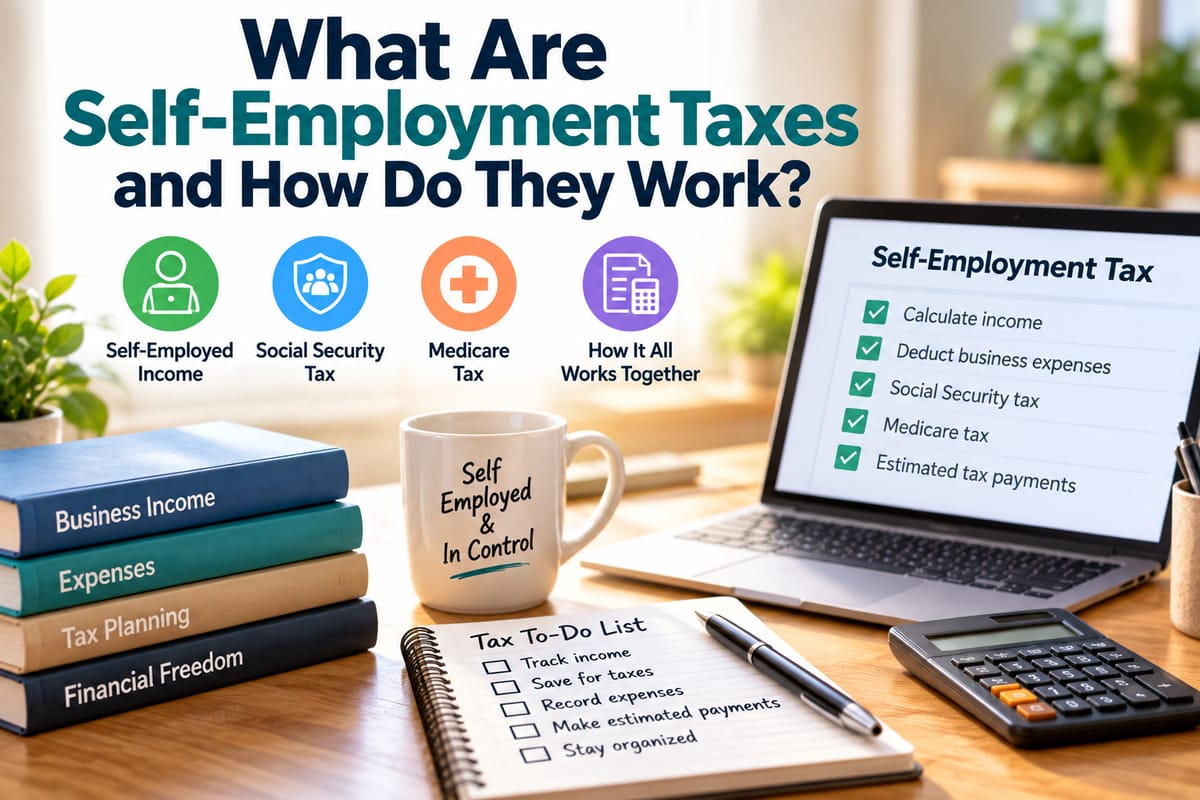
What Are Self-Employment Taxes and How Do They Work?
Self-employment can offer greater flexibility and independence, but it also changes how taxes are handled. Unlike traditional employees, self-employed workers generally do not have an employer withholding Social Security and Medicare taxes from each paycheck.
Instead, self-employed individuals are generally responsible for calculating and paying these taxes themselves.
Self-employment taxes are separate from federal income tax. A person may owe both based on their business or freelance income, which makes understanding the difference important when planning how much money to set aside throughout the year.
The rules discussed here generally refer to the U.S. federal tax system. State and local requirements can differ.
For broader background on how income becomes taxable, the Complete Guide to Income Taxes and Taxable Income explains the larger income-tax framework.
What Are Self-Employment Taxes?
Self-employment tax generally refers to Social Security and Medicare taxes paid by people who work for themselves.
Employees and employers normally share responsibility for these taxes. An employee has Social Security and Medicare taxes withheld from their wages, while the employer generally pays a matching portion.
A self-employed person does not have an employer making that matching payment on their behalf. Instead, the self-employed individual generally pays both the employee and employer portions through the self-employment tax system, subject to applicable rules and limits.
Self-employment tax is therefore different from ordinary federal income tax.
Who Generally Pays Self-Employment Tax?
Self-employment tax can apply to people who operate businesses or earn income independently.
Examples can include:
- Freelancers
- Independent contractors
- Sole proprietors
- Certain partners in partnerships
- Independent consultants
- Gig workers
- Some small-business owners
The tax treatment depends on the person’s business structure, income, and circumstances.
Someone who earns money from occasional activities may have different tax obligations from someone operating an ongoing business.
Self-Employment Tax vs. Income Tax
One of the most important distinctions is that self-employment tax and income tax are not the same thing.
Federal income tax is generally based on taxable income and applicable tax rates.
Self-employment tax generally covers Social Security and Medicare taxes associated with self-employment earnings.
A self-employed person can therefore face both taxes on the same underlying business activity.
For example, a freelancer might earn income from providing services. After allowable business expenses and applicable adjustments are considered, the resulting income can affect the person’s federal income tax liability. The person’s net earnings from self-employment can also be used to determine self-employment tax.
How Self-Employment Income Is Calculated
Self-employment tax is generally based on net earnings from self-employment rather than simply the total amount of money received from customers.
This distinction is important.
Imagine a freelance designer receives $70,000 from clients during a year but spends $15,000 on legitimate business expenses. The person’s business income is not simply treated as $70,000 of profit.
Allowable business expenses can reduce business income before the relevant tax calculations are made.
The exact calculation involves specific tax rules and adjustments, so keeping accurate business records is essential.
Why Business Expenses Matter
Self-employed workers often have expenses that employees do not encounter in the same way.
Depending on the business and applicable tax rules, expenses can include items such as:
- Business equipment
- Software
- Professional services
- Advertising
- Business insurance
- Office expenses
- Certain travel expenses
- Supplies
- Other ordinary and necessary business costs
Not every expense is automatically deductible, and different rules can apply depending on the type of expense.
Keeping receipts, invoices, bank records, and other documentation can make it easier to establish the nature and amount of legitimate business expenses.
The Social Security Portion
Self-employment tax includes a Social Security component.
However, Social Security taxes are subject to an annual wage base. Once a taxpayer’s applicable earnings exceed the Social Security wage base for a particular year, the Social Security portion does not continue indefinitely on every additional dollar of earnings.
The applicable wage base can change from year to year.
This means a self-employed person’s tax calculation can look different depending on the amount and type of earnings during the year.
The Medicare Portion
The other major component is Medicare tax.
Unlike the Social Security portion, Medicare taxes generally do not have the same annual wage-base limitation.
Additional Medicare tax rules can also apply to certain higher-income taxpayers once applicable thresholds are reached.
As a result, higher levels of self-employment income can create additional Medicare-related considerations.
Why the 15.3% Figure Is Often Mentioned
Self-employment tax is commonly associated with a combined Social Security and Medicare rate of 15.3% before considering the specific calculation rules and applicable limits.
That figure represents the combined employee and employer portions of Social Security and Medicare taxes.
However, it should not be interpreted as meaning that a self-employed person simply takes 15.3% of gross revenue and sends that amount to the government.
The actual calculation involves net earnings, statutory limits, deductions, and other rules.
The Deduction for Part of Self-Employment Tax
Because self-employed individuals effectively pay both portions of Social Security and Medicare taxes, federal tax rules generally provide a deduction for the employer-equivalent portion of self-employment tax when calculating adjusted gross income.
This does not eliminate the self-employment tax itself.
Instead, it recognizes the employer-equivalent portion when determining federal income-tax calculations.
Understanding this distinction can help explain why the self-employment tax calculation and income-tax calculation do not simply operate as one combined formula.
How Freelancers Encounter Self-Employment Taxes
Freelancers often receive payments directly from clients rather than receiving traditional employee wages.
A freelance writer, designer, photographer, programmer, consultant, or other independent worker may receive payments throughout the year without the same payroll withholding that applies to employees.
That means the freelancer needs to account for taxes when managing incoming revenue.
The Complete Guide to Freelancing and Independent Work provides broader context on the financial and operational considerations that come with working independently.
Independent Contractors and Form 1099
Businesses commonly report certain payments made to independent contractors using information returns such as Form 1099-NEC when applicable.
Receiving a 1099 does not itself create the tax obligation. The underlying income and the person’s status determine the relevant tax treatment.
It is also possible for a self-employed person to receive income that is not reported on a 1099 and still have a tax obligation.
The important principle is that taxpayers generally need to keep track of their total business income rather than relying solely on tax forms received from customers or clients.
Estimated Tax Payments
Employees generally have taxes withheld from their paychecks throughout the year.
Self-employed people often need to make estimated tax payments instead.
Estimated payments can help cover expected federal income tax and self-employment tax during the year.
The amount and timing of required payments depend on the taxpayer’s circumstances and applicable rules.
Failing to make sufficient payments during the year can potentially result in an amount due when the tax return is filed and, in some circumstances, an underpayment penalty.
Why Cash-Flow Planning Matters
Self-employed workers may receive payments at irregular intervals.
One month might produce several large client payments, while another might generate very little revenue.
Taxes, however, still need to be planned for.
Setting aside a portion of business income for taxes can help prevent a large unexpected bill later.
A separate savings account can make this easier by keeping money intended for tax payments apart from funds available for everyday business or personal spending.
Keeping Business and Personal Money Separate
Separating business and personal finances can make tax management easier.
A dedicated business bank account can help organize:
- Client payments
- Business expenses
- Tax savings
- Contractor payments
- Software subscriptions
- Equipment purchases
- Other business transactions
This separation can also simplify bookkeeping and make it easier to identify the financial activity associated with the business.
The exact requirements depend on the business structure and jurisdiction, but good financial organization is valuable regardless of the type of self-employment.
Recordkeeping Is Essential
Accurate records are particularly important for self-employed taxpayers.
Useful records can include:
- Sales invoices
- Receipts
- Bank statements
- Expense records
- Mileage records where relevant
- Contracts
- Payment processor statements
- Equipment purchase records
- Tax payment confirmations
Good records help establish how much the business earned and what expenses it incurred.
They can also make it easier to prepare tax returns and respond to questions about reported income or deductions.
How Tax Brackets Affect Self-Employed People
Self-employment tax is not the same as federal income tax, and federal income tax is generally calculated using the applicable tax brackets.
A person’s taxable income can place different portions of income into different marginal tax brackets.
Understanding How Tax Brackets and Marginal Rates Work can help explain why earning more money does not mean every dollar is automatically taxed at the highest rate that applies to the taxpayer.
This distinction is particularly important for self-employed people whose income can fluctuate significantly from year to year.
Business Structure Can Affect Tax Treatment
Not every self-employed person operates under the same legal or tax structure.
A person may operate as a sole proprietor, partnership, corporation, or another business structure.
The structure can affect how income is reported and how various employment-related taxes apply.
For example, an individual operating as a sole proprietor generally reports business activity differently from an owner of a corporation.
Choosing a business structure involves legal, administrative, financial, and tax considerations, so the appropriate structure depends on the individual’s circumstances.
Self-Employment Taxes for Small Businesses
Small-business owners need to distinguish between revenue, business profit, taxable income, payroll taxes, and self-employment taxes.
The rules can become more complicated when a business has employees, multiple owners, inventory, significant equipment, or a formal corporate structure.
The How Taxes Work for Self-Employed People and Small Businesses guide provides additional context on how taxation can affect independent workers and small businesses.
What Happens When Income Changes?
Self-employed income can vary considerably.
A freelancer may have a particularly profitable year followed by a slower period. A contractor may receive several large projects at once, while a small business may experience seasonal changes in revenue.
Because tax obligations are tied to income, significant changes can affect estimated payments and year-end tax liability.
Regularly reviewing income and expenses can therefore be more useful than waiting until tax-filing season to assess the situation.
Can Self-Employment Tax Be Reduced?
Self-employed taxpayers cannot simply choose to exclude self-employment income from the tax calculation.
However, legitimate business expenses and applicable deductions can affect taxable income and the overall tax picture.
The key distinction is between reducing taxable income through legitimate tax provisions and simply failing to report income.
Good tax planning focuses on understanding the rules and documenting qualifying expenses rather than attempting to conceal income.
Common Self-Employment Tax Mistakes
Several mistakes can make tax season more difficult for independent workers.
Treating Revenue as Profit
Receiving $100,000 from customers does not necessarily mean the business generated $100,000 of profit.
Business expenses and applicable tax rules need to be considered.
Spending Tax Money
Using money reserved for taxes to cover personal or business expenses can leave a taxpayer short when payments are due.
Ignoring Estimated Payments
Waiting until the end of the year to think about taxes can create cash-flow problems and potentially lead to underpayment issues.
Poor Recordkeeping
Missing receipts or failing to track business expenses can make tax preparation unnecessarily difficult.
Confusing Income Tax With Self-Employment Tax
These are separate components of the tax system, and both may need to be considered.
Planning Throughout the Year
Self-employment taxes are easier to manage when they are treated as part of regular financial planning rather than an annual surprise.
A self-employed person can periodically review:
- Total business revenue
- Business expenses
- Net business income
- Estimated tax obligations
- Payments already made
- Retirement contributions
- Available deductions and credits
- Cash reserved for future taxes
Regular reviews can help identify changes before they become difficult to manage.
When Professional Help May Be Useful
Some self-employed tax situations are relatively straightforward, while others become complicated quickly.
Professional tax advice may be useful when a person has multiple businesses, employees, substantial investment activity, significant deductions, international income, a complex business structure, or other circumstances that require specialized knowledge.
A qualified tax professional can help interpret applicable rules and identify documentation requirements.
The Bigger Picture for Independent Workers
Self-employment taxes are one part of the financial responsibilities that come with working independently.
A self-employed person may need to manage income taxes, self-employment taxes, estimated payments, business expenses, retirement savings, insurance, bookkeeping, and cash flow without the payroll infrastructure that supports traditional employees.
The good news is that these responsibilities can be incorporated into a regular financial routine.
Understanding how the different pieces fit together makes it easier to estimate obligations, maintain appropriate records, and avoid treating every dollar received from a customer as money available for personal spending.
Building a More Predictable Tax Routine
Self-employment taxes can seem complicated because several tax concepts operate at the same time. Business income, allowable expenses, self-employment tax, federal income tax, estimated payments, deductions, and tax brackets all play different roles.
The most important distinction is that self-employed people generally need to account for Social Security and Medicare taxes themselves rather than relying on an employer to handle the employer and employee portions through payroll.
By tracking income and expenses throughout the year, setting aside money for taxes, understanding estimated payments, and keeping thorough records, independent workers can make tax obligations a more predictable part of managing their businesses.
Self-employment may provide greater control over how a person works and earns money, but that independence also comes with greater responsibility for understanding and planning for the taxes connected to that income.