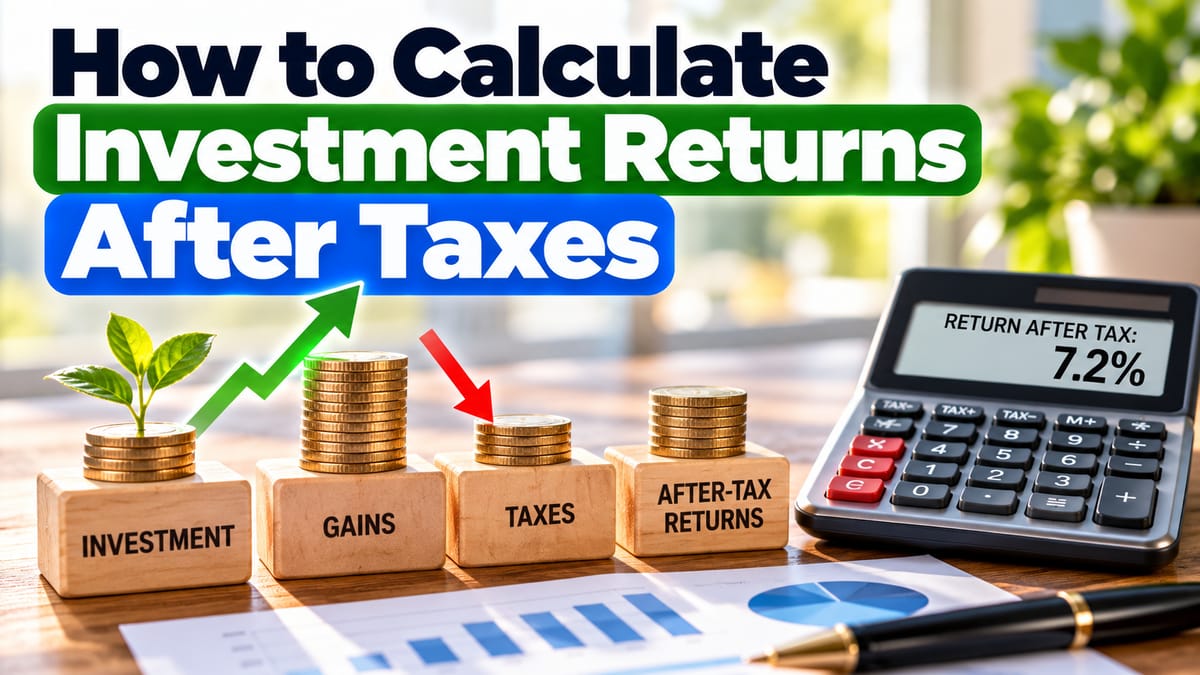
How to Calculate Investment Returns After Taxes
Investment returns are often presented as percentages, but the number shown on an investment statement is not always the amount an investor ultimately gets to keep. Taxes can reduce interest income, dividends, and capital gains, making the after-tax return an important measure of actual investment performance.
Calculating investment returns after taxes helps investors compare opportunities more realistically, understand the effect of selling an asset, and see how tax costs can influence long-term wealth accumulation. A portfolio that produces a higher pre-tax return is not necessarily the one that leaves an investor with more money after taxes.
The calculation does not have to be complicated. Once the type of investment income, applicable tax treatment, investment costs, and holding period are understood, investors can estimate how much of their return remains after taxes.
What Is an After-Tax Investment Return?
An after-tax investment return is the portion of an investment’s gain that remains after applicable taxes have been accounted for.
A basic calculation is:
After-tax return = Pre-tax return − Tax impact
For example, suppose an investment earns a 10% return during a year and the applicable tax rate on that income is 20%. A simplified calculation would be:
10% × (1 − 20%) = 8%
The estimated after-tax return would therefore be 8%.
This simplified example assumes that the entire return is taxed at the same rate. Real-world investments can be more complicated because different types of income may receive different tax treatment.
Interest, dividends, short-term gains, and long-term capital gains may not necessarily be taxed in the same way. Understanding those distinctions is essential when calculating an investment’s true after-tax performance.
Why Pre-Tax Returns Can Be Misleading
An investment’s advertised or reported return usually describes performance before considering an investor’s personal tax situation.
Consider two hypothetical investments:
- Investment A earns 9% before taxes.
- Investment B earns 8% before taxes.
At first glance, Investment A appears to produce the larger return. But suppose Investment A generates income that is taxed more heavily, while Investment B receives more favorable tax treatment.
The difference in after-tax results could be considerably smaller than the pre-tax figures suggest.
This is why investors should distinguish between investment performance and money retained after taxes.
Taxes are particularly important when investments are held for many years. Even relatively small annual tax differences can compound over time, potentially affecting the amount available for future investment.
The broader tax treatment of investment income and gains is explained in How Investment Income and Capital Gains Are Taxed, which can help provide context before performing an after-tax calculation.
The Basic Formula for Calculating After-Tax Returns
A simplified after-tax return formula is:
After-tax return = Pre-tax return × (1 − effective tax rate)
For example:
- Pre-tax return: 7%
- Effective tax rate: 25%
Calculation:
7% × (1 − 0.25) = 5.25%
The estimated after-tax return is 5.25%.
The same concept can be applied to a dollar amount.
Suppose an investment of $20,000 generates a $1,400 return during the year.
The pre-tax return is:
$1,400 ÷ $20,000 = 7%
If $350 of tax applies to that return:
$1,400 − $350 = $1,050
The investor keeps $1,050 after tax.
The after-tax return is therefore:
$1,050 ÷ $20,000 = 5.25%
This calculation provides a more useful picture of the actual increase in the investor’s wealth.
Step 1: Determine the Investment’s Pre-Tax Return
The first step is identifying how much the investment earned before taxes.
The return might come from several sources, including:
- Interest
- Dividends
- Capital appreciation
- Capital gains from selling
- Distributions
- Other investment income
For a straightforward investment, the basic return can be calculated as:
Investment gain ÷ Original investment × 100
For example, if someone invests $10,000 and the investment grows to $10,800:
$800 ÷ $10,000 × 100 = 8%
The pre-tax return is 8%.
However, investors should be careful when calculating returns for investments that produce income during the holding period. A complete return calculation may need to include both price appreciation and income received.
Step 2: Identify What Type of Return Was Generated
Not all investment returns are necessarily taxed in the same manner.
An investment could produce:
- Interest income
- Dividend income
- Short-term capital gains
- Long-term capital gains
- Tax-exempt income in certain circumstances
- A combination of several income types
This distinction matters because the applicable tax rate may vary according to the type of income and the investor’s circumstances.
For example, an investor may receive dividends during the year and also sell shares for a capital gain. Treating the entire amount as one type of taxable return could produce an inaccurate estimate.
A more precise calculation separates each component before applying the relevant tax treatment.
Step 3: Calculate the Taxable Portion
The next step is determining how much of the investment return is actually subject to tax.
Suppose an investment generates:
- $600 in interest
- $400 in dividends
- $1,000 in capital gains
The total investment return is $2,000, but the tax calculation should not automatically assume that all $2,000 is taxed identically.
The investor needs to determine the applicable treatment for each component.
The taxable amount can also be affected by factors such as investment losses, deductions, exemptions, account structure, and other applicable rules.
For this reason, the simplest after-tax return formula is best viewed as an estimate rather than a universal tax calculation.
Step 4: Apply the Appropriate Tax Rate
Once the taxable amount has been identified, apply the relevant effective tax rate.
Suppose an investor has $5,000 of taxable investment income and the effective tax rate applicable to that income is 20%.
The estimated tax would be:
$5,000 × 20% = $1,000
The amount remaining after tax would be:
$5,000 − $1,000 = $4,000
The investor’s after-tax return therefore reflects the $4,000 retained rather than the original $5,000 pre-tax gain.
In more complicated situations, several tax rates may need to be applied separately to different portions of the investment return.
Step 5: Account for Investment Costs
Taxes are not the only factor that can reduce an investment’s net return.
Investors may also encounter:
- Management fees
- Fund expenses
- Trading costs
- Account fees
- Advisory charges
- Other transaction-related expenses
For a more complete calculation, these costs should be deducted alongside taxes.
A simplified formula becomes:
Net after-tax return = Pre-tax return − taxes − investment costs
For example, suppose a portfolio earns 8% before taxes, has an estimated tax impact of 1.5 percentage points, and incurs investment costs equal to 0.5%.
The approximate net return would be:
8% − 1.5% − 0.5% = 6%
This 6% figure may be more useful for long-term planning than the original 8% headline return.
Calculating After-Tax Returns on Capital Gains
Capital gains require particular attention because taxes can arise when an investment is sold for more than its tax basis.
Suppose an investor purchases shares for $15,000 and later sells them for $21,000.
The gain is:
$21,000 − $15,000 = $6,000
If the applicable tax rate on the gain is 15%, a simplified tax estimate would be:
$6,000 × 15% = $900
The gain after that estimated tax would be:
$6,000 − $900 = $5,100
The original $15,000 investment would therefore become $20,100 after accounting for the simplified tax calculation.
The resulting after-tax return would be:
$5,100 ÷ $15,000 × 100 = 34%
This illustrates why an investment’s gain should not automatically be treated as the amount an investor gets to keep.
Unrealized Gains and Realized Gains Are Different
Another important distinction is whether an investment gain has actually been realized.
An investment may increase in value without being sold. In that situation, an investor may have an unrealized gain.
For example, shares purchased for $10,000 could rise in market value to $13,000. The investor has an unrealized gain of $3,000.
If the shares are sold for $13,000, the gain becomes realized.
The tax consequences of realizing that gain depend on applicable rules and the investor’s circumstances.
This distinction is important when estimating after-tax returns because a portfolio’s current market value does not necessarily equal the amount an investor would have after selling and paying any applicable taxes.
How Holding Periods Can Affect the Calculation
The length of time an investment is held can affect its tax treatment in some tax systems.
For example, certain jurisdictions distinguish between shorter-term and longer-term capital gains. An investor therefore needs to consider both the size of the gain and how long the asset was held.
Suppose two investors each make a $5,000 gain:
- Investor A realizes the gain after a relatively short holding period.
- Investor B holds the investment for a longer period before selling.
Even though their pre-tax gains are identical, their after-tax results could differ if different tax rates apply.
This is one reason tax planning should be considered before an investment is sold rather than after the transaction has already occurred. Investors can explore this issue further in How to Plan Taxes Before Selling Investments.
Comparing Investments Using After-Tax Returns
After-tax returns can be particularly useful when comparing investments with different tax characteristics.
Imagine two investments:
| Investment | Pre-Tax Return | Estimated Tax Rate | Approx. After-Tax Return |
|---|---|---|---|
| A | 8% | 25% | 6% |
| B | 7% | 10% | 6.3% |
Investment A has the higher pre-tax return, but Investment B produces the higher simplified after-tax return in this hypothetical example.
This does not mean one investment is universally preferable. Risk, liquidity, diversification, time horizon, fees, inflation, and other factors also matter.
The calculation simply demonstrates why comparing headline returns alone can leave out an important part of the picture.
How Taxes Affect Compound Growth
The impact of taxes can become more significant as an investment portfolio compounds.
Suppose an investor starts with $50,000 and earns an average annual return of 8% before taxes.
If taxes reduce the effective annual return to 6%, the difference may seem modest in a single year. Over several decades, however, the difference can become substantial because each year’s return has an opportunity to generate additional returns.
For example, using a simplified annual compounding model:
$50,000 × (1.08)^20 ≈ $233,048
At a 6% annual after-tax return:
$50,000 × (1.06)^20 ≈ $160,357
The difference in this hypothetical example is more than $72,000.
These figures are illustrative rather than forecasts. Actual investment results can vary substantially, and taxes may not reduce returns by a constant percentage every year.
Still, the example demonstrates an important principle: taxes can affect not only today’s investment income but also the future growth of money that remains invested.
The relationship between taxation and long-term compounding is explored in greater detail in How Taxes Affect Long-Term Wealth Building.
Nominal Returns Versus After-Tax Returns
Investors should also distinguish between nominal returns and returns after accounting for other economic factors.
A nominal investment return does not necessarily tell the full story because purchasing power can change over time.
For example, an investment might generate a 7% annual return, but if inflation averages 3%, the investor’s purchasing power is not increasing at the same rate as the nominal account balance.
Taxes can further reduce the amount available for future spending or reinvestment.
This creates several different ways to evaluate investment performance:
- Pre-tax nominal return: investment growth before taxes.
- After-tax nominal return: growth after applicable taxes.
- Real return: return adjusted for inflation.
- After-tax real return: return after both taxes and inflation are considered.
For long-term financial planning, understanding these distinctions can help investors avoid assuming that account growth automatically translates into the same increase in purchasing power.
How to Calculate a Multi-Year After-Tax Return
For a simple investment where the same after-tax return is assumed each year, the future value can be estimated using compound growth:
Future value = Initial investment × (1 + after-tax return)^number of years
Suppose an investor starts with $25,000 and estimates an annual after-tax return of 5%.
After 10 years:
$25,000 × (1.05)^10 ≈ $40,722
If the estimated after-tax return were instead 6%:
$25,000 × (1.06)^10 ≈ $44,771
The difference is more than $4,000.
This is why even a seemingly small change in after-tax returns can matter when an investment plan stretches across many years.
Reinvested Income Can Change the Calculation
Many investors reinvest dividends, interest, or other distributions rather than withdrawing them.
When income is reinvested, taxes can affect the amount available for reinvestment.
For example, if an investment produces $1,000 of taxable income and $200 goes toward taxes, only $800 remains from that income for reinvestment, assuming no other factors apply.
Over time, repeatedly reinvesting smaller amounts can lead to a different portfolio value than reinvesting the entire pre-tax distribution.
A detailed investment plan should therefore consider whether returns are:
- Withdrawn
- Reinvested before taxes
- Reinvested after taxes
- Held in a tax-advantaged structure
- Generated primarily through appreciation rather than current income
Use After-Tax Returns When Building Long-Term Investment Goals
After-tax return calculations can also improve the assumptions used in a long-term investment strategy.
An investor planning for retirement, education expenses, a home purchase, or another major financial objective needs a realistic estimate of how quickly invested assets could grow.
Using a pre-tax return assumption without considering taxes can result in an overly optimistic projection.
A more useful planning process begins with the investor’s:
- Starting investment amount
- Expected return
- Expected investment income
- Applicable tax treatment
- Investment costs
- Expected holding period
- Contribution schedule
- Reinvestment strategy
- Inflation assumptions
- Financial goal
For investors developing this broader framework, How to Build an Investment Plan for Long-Term Goals provides a useful foundation for connecting investment decisions with specific future objectives.
Common Mistakes When Calculating After-Tax Returns
Using the Wrong Tax Rate
One of the most common mistakes is applying a single tax rate to every type of investment income without checking whether the income is actually treated that way.
Ignoring Investment Expenses
An investment can lose part of its return to management fees, fund expenses, trading costs, or other charges. Leaving those costs out can overstate the amount an investor actually keeps.
Forgetting About Realized Gains
A portfolio may show substantial gains on paper, but the tax consequences can change when assets are sold.
Treating Every Year as Identical
Tax circumstances can change from year to year. Income levels, investment transactions, losses, deductions, and applicable tax rules may all affect the final calculation.
Focusing Only on the Tax Bill
The goal is not necessarily to minimize taxes at any cost. Selling an investment simply to avoid one type of tax could create other financial consequences.
Ignoring Compounding
A tax cost today can also affect the amount available to compound in future years. Long-term calculations should account for this effect when appropriate.
A Simple After-Tax Return Worksheet
Investors can organize the calculation with a basic worksheet:
| Item | Amount |
|---|---|
| Initial investment | $25,000 |
| Investment value before tax | $28,000 |
| Pre-tax gain | $3,000 |
| Estimated taxes | $450 |
| Investment costs | $100 |
| Net gain | $2,450 |
| After-tax return | 9.8% |
The exact numbers will differ for every investment and tax situation, but the structure makes the calculation easier to follow.
For portfolios containing multiple investments, it can be useful to perform the calculation separately for each asset before looking at the portfolio as a whole.
Why After-Tax Returns Matter for Financial Decisions
Calculating after-tax returns gives investors a clearer view of how much their investments may contribute to their actual financial objectives.
Taxes are only one component of investment decision-making, but they can influence the amount of money available for reinvestment and future spending. The effect can become more noticeable over long periods because taxes can reduce the capital available to compound.
A practical approach is to start with the investment’s pre-tax return, identify the type of income or gain being generated, determine the applicable tax treatment, subtract relevant investment costs, and then use the resulting after-tax figure in long-term projections.
The calculation should remain an estimate when the investor’s tax situation is complex. Tax rules can depend on jurisdiction, income level, account type, transaction details, and other circumstances, so professional tax advice may be appropriate for significant investment decisions.
Turning Investment Returns Into a More Realistic Financial Picture
An investment’s headline return tells only part of the story. What ultimately matters for personal wealth is the amount that remains available to reinvest, spend, or contribute toward future goals after the relevant costs and taxes have been considered.
By making after-tax returns part of the investment planning process, investors can build projections around a more realistic measure of portfolio growth. Over short periods the difference may appear modest, but over decades, even small changes in the amount retained and compounded can have a meaningful effect on the value of a long-term investment strategy.