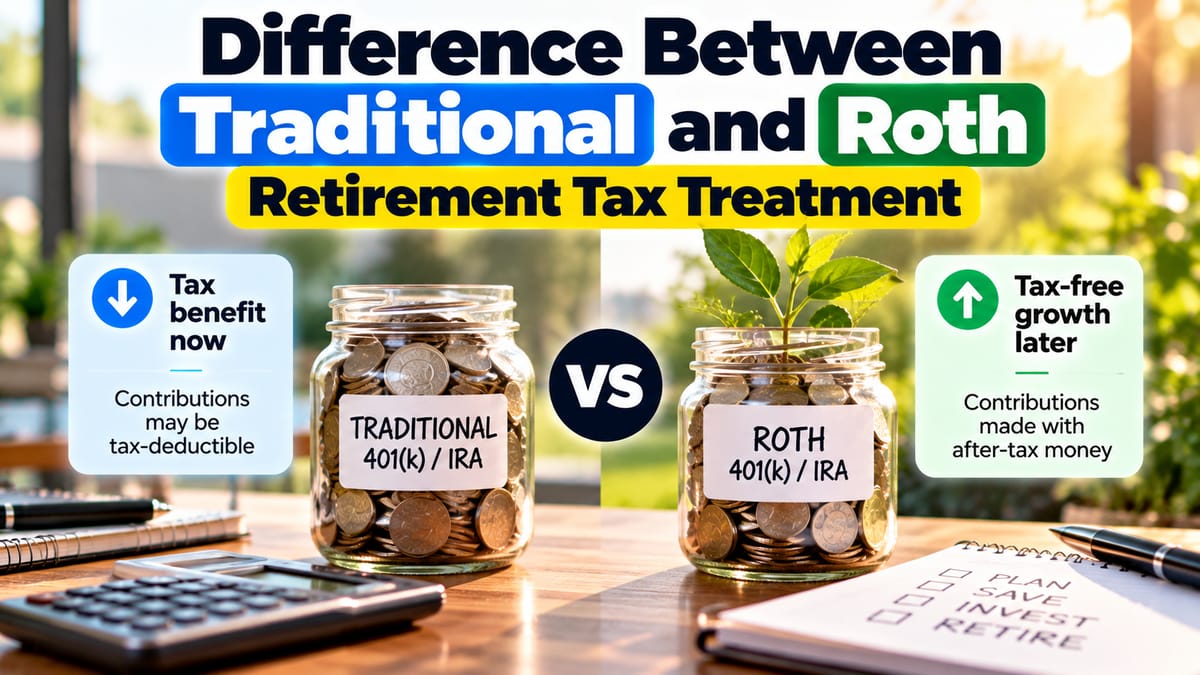
Difference Between Traditional and Roth Retirement Tax Treatment
Choosing between a traditional retirement account and a Roth retirement account is partly a decision about when you want to pay taxes.
Traditional and Roth accounts can both provide valuable ways to save for retirement, but their tax treatment is fundamentally different. Traditional accounts generally provide tax benefits when money goes in, while Roth accounts generally provide their primary tax benefit when qualified money comes out.
That distinction can affect how much you contribute today, how your retirement savings grow, how withdrawals are taxed, and how much money you ultimately have available to spend during retirement.
The differences can also become more important as income, tax rates, investment returns, and retirement needs change over time.
What Are Traditional and Roth Retirement Accounts?
Traditional and Roth are two broad tax treatments used for certain retirement savings accounts.
With a traditional retirement account, contributions may provide a tax deduction or other tax benefit depending on the account type and the individual’s circumstances. Investments can generally grow without current taxation on each transaction inside the account, while withdrawals are generally subject to ordinary income tax under applicable rules.
With a Roth retirement account, contributions are generally made with money that has already been taxed. Qualified withdrawals can then generally be taken tax-free.
The central distinction can be summarized simply:
Traditional: potential tax benefit now, taxes later.
Roth: taxes now, potential tax-free qualified withdrawals later.
The precise rules vary depending on the specific type of account, contribution eligibility, income, age, and other circumstances.
For a broader overview of personal tax planning, Complete Guide to Personal Taxes and Tax Planning provides additional context on how taxes fit into broader financial decisions.
How Traditional Retirement Tax Treatment Works
Traditional retirement accounts generally provide their main tax advantage when contributions are made.
For example, suppose an eligible worker contributes $6,000 to a traditional retirement account. Depending on the specific account and applicable rules, some or all of that contribution may reduce taxable income for the year.
The money can then remain invested within the account.
Taxes generally are not imposed each time an investment inside the account generates interest, dividends, or capital appreciation. Instead, taxation generally occurs when money is withdrawn.
This creates a tax-deferred structure.
What Does Tax-Deferred Mean?
Tax-deferred does not mean tax-free.
It generally means that taxes on certain income or investment growth are postponed until a later point.
For a traditional retirement account, this can allow more money to remain invested during the accumulation period.
For example, an investment inside a traditional account may generate returns without the investor having to pay current income taxes on every transaction occurring inside the account.
Eventually, however, withdrawals generally become taxable according to the rules applicable to the account.
How Roth Retirement Tax Treatment Works
Roth accounts generally take the opposite approach.
Contributions are made with money that has already been included in taxable income.
Because the taxes are generally paid before the money enters the Roth account, qualified withdrawals can generally be made without additional federal income tax.
This can be particularly valuable when an investor expects to have substantial retirement savings and wants greater certainty about the tax treatment of qualified withdrawals.
The key concept is that the Roth tax benefit generally occurs later, rather than at the time of contribution.
Traditional vs. Roth Tax Treatment at a Glance
| Feature | Traditional Account | Roth Account |
|---|---|---|
| Contributions | Generally made before tax or may be deductible, depending on account and circumstances | Generally made with after-tax money |
| Tax benefit | Primarily potentially received upfront | Primarily received on qualified withdrawals |
| Investment growth | Generally tax-deferred within the account | Generally tax-free within the account if rules are met |
| Qualified withdrawals | Generally taxable as ordinary income | Generally tax-free |
| Main tax question | What will my tax rate be when I withdraw? | What is my tax rate when I contribute? |
| Tax planning focus | Current tax reduction and future taxable withdrawals | Current tax payment and future tax-free qualified withdrawals |
This comparison is a general framework. Specific rules differ between account types and individual circumstances.
The Difference Between Tax Deductions and Tax-Free Withdrawals
One of the most important differences between traditional and Roth accounts is the type of tax advantage they provide.
A traditional account may provide a tax deduction for eligible contributions.
A Roth account generally does not provide the same upfront deduction.
Instead, the potential advantage of a Roth account comes from the ability to make qualified withdrawals without federal income tax.
These benefits occur at different points in time.
Traditional Account
The simplified sequence is:
Income → Potential deduction → Contribution → Tax-deferred growth → Taxable withdrawal
Roth Account
The simplified sequence is:
Taxed income → Contribution → Tax-free qualified growth and withdrawal
Understanding this timing difference is essential when comparing the two account types.
Why Your Tax Bracket Matters
Your current and expected future tax rates can influence the relative appeal of traditional and Roth tax treatment.
A traditional contribution may provide a larger immediate benefit when it reduces taxable income during a year when your marginal tax rate is relatively high.
A Roth contribution does not generally provide that same upfront deduction. Instead, the potential benefit comes from avoiding future income tax on qualified withdrawals.
Understanding how marginal rates work is therefore an important part of the comparison. How Tax Brackets and Marginal Rates Work explains why a person’s marginal tax rate is not necessarily the same as the percentage of their entire income that they pay in tax.
An Example of Traditional Tax Treatment
Imagine a worker earns $80,000 and makes an eligible $5,000 contribution to a traditional retirement account.
If the contribution reduces taxable income, the immediate tax benefit depends on the individual’s applicable tax circumstances.
The $5,000 remains invested inside the retirement account.
Suppose it eventually grows to $20,000.
If the individual later withdraws the $20,000 and the withdrawal is taxable, the entire taxable distribution may generally be included in income according to the applicable rules.
The original contribution was not permanently tax-free. The tax advantage was primarily received earlier.
An Example of Roth Tax Treatment
Now imagine the same worker contributes $5,000 to a Roth account.
The contribution generally does not provide an upfront federal income-tax deduction.
Suppose the $5,000 eventually grows to $20,000.
If the withdrawal meets the applicable requirements for a qualified Roth distribution, the $20,000 can generally be withdrawn without federal income tax.
The investor effectively paid taxes before the contribution and potentially avoids additional federal income tax on qualified withdrawals later.
Why the Tax Timing Can Matter So Much
The difference between traditional and Roth accounts is not simply about whether taxes are paid.
It is about when the taxes are paid and what amount is ultimately exposed to taxation.
Consider an investment that grows substantially over several decades.
With a traditional account, eligible contributions may reduce taxable income today, but withdrawals in retirement can generally be taxable.
With a Roth account, contributions generally receive no upfront deduction, but qualified withdrawals can generally be tax-free.
This means tax treatment can influence the amount of retirement income that is available for spending.
Traditional Accounts and Tax-Deferred Compounding
Tax deferral can be valuable because money that would otherwise be paid in current taxes can potentially remain invested.
Suppose an investor contributes $10,000 to a traditional retirement account.
If that money earns returns over many years, the investment can continue compounding within the account without the investor generally paying current federal income tax on each year’s internal investment transactions.
The tax is generally deferred until money is withdrawn.
This does not guarantee a particular investment result, but tax deferral can change the timing of taxation and the amount of capital that remains invested during the accumulation period.
Roth Accounts and Tax-Free Qualified Growth
Roth accounts generally provide a different form of compounding advantage.
Once eligible money is inside the account, investment growth can accumulate without the investor generally paying federal income tax on qualified withdrawals.
This can be particularly significant when an investment has many years to compound.
Suppose a Roth contribution of $10,000 eventually grows to $50,000.
If the distribution is qualified, the investor may generally receive the full $50,000 without federal income tax.
That means the tax benefit can apply not only to the original contribution but also to the investment growth.
What Is a Qualified Roth Withdrawal?
Tax-free Roth withdrawals are subject to rules.
A distribution generally needs to meet the requirements for being considered qualified before the earnings can receive the full tax-free treatment.
Factors such as the account’s age and the individual’s age or circumstances can affect whether a distribution qualifies.
Because Roth rules can be detailed, investors should not assume that every withdrawal from every Roth account is automatically tax-free.
The distinction between contributions and investment earnings can also matter when evaluating a particular distribution.
Traditional Retirement Withdrawals
Withdrawals from traditional retirement accounts are generally taxable as ordinary income to the extent applicable rules require.
This means that retirement planning needs to account for the possibility that the amount shown in an account statement is not necessarily the amount available to spend after taxes.
For example, a traditional retirement account with a balance of $500,000 is not necessarily equivalent to $500,000 of tax-free retirement spending.
The eventual tax liability depends on factors such as:
- Withdrawal amount
- Other income
- Filing status
- Applicable tax rates
- Deductions
- Account type
- Applicable retirement distribution rules
This is one reason retirement planning should focus on after-tax resources rather than account balances alone.
Required Minimum Distributions and Traditional Accounts
Certain traditional retirement accounts are subject to required minimum distribution rules once an individual reaches applicable ages under current law.
These rules can require withdrawals even when the account owner would prefer to leave the money invested.
Required distributions can affect taxable income during retirement.
They may therefore influence:
- Tax brackets
- Medicare-related costs
- Social Security taxation in applicable circumstances
- Estate planning
- Charitable giving strategies
- The timing of other withdrawals
The specific rules and ages can change, so retirement planning should use the rules applicable to the individual’s circumstances and tax year.
Roth Accounts and Required Distributions
Roth treatment can differ depending on whether the account is held within an employer-sponsored retirement plan or is an individual Roth account.
Some Roth arrangements can be subject to different distribution rules than others.
This distinction is another reason investors should evaluate the specific account rather than assuming every traditional or Roth account follows exactly the same rules.
Traditional and Roth Accounts in Different Tax Environments
The choice between traditional and Roth treatment becomes particularly interesting when investors consider the possibility that their tax rate could change over time.
An individual may have:
- A high income during working years
- A lower income during retirement
- A temporarily low-income year
- Significant income later in life
- Multiple retirement income sources
These changes can affect the relative value of paying taxes today versus deferring them.
There is no universal tax rate that applies to every investor throughout their lifetime.
What If Your Tax Rate Is Higher Today?
If an investor is currently in a relatively high marginal tax bracket, a traditional contribution may provide a potentially valuable upfront tax deduction if the contribution qualifies.
The investor receives the tax benefit during a year when the contribution reduces taxable income.
The trade-off is that taxable withdrawals may occur later.
This approach can make sense as part of a broader tax strategy when the investor expects a lower tax rate during retirement, although future tax rates are inherently uncertain.
What If Your Tax Rate Is Lower Today?
An investor currently in a lower tax bracket may place greater value on Roth treatment if they expect to have higher taxable income later.
Instead of receiving a relatively small tax benefit today, the investor pays current taxes and potentially receives tax-free qualified withdrawals in retirement.
Again, this depends on the individual’s circumstances and expectations.
No one can know with certainty what future tax laws and personal income levels will be decades from now.
Diversifying Tax Treatment
Retirement diversification does not necessarily mean holding different investments in different industries.
It can also mean holding assets with different tax treatments.
For example, a person could have retirement savings spread across:
- Traditional accounts
- Roth accounts
- Taxable investment accounts
Each account type can have different tax characteristics.
Having different sources of retirement funds can provide flexibility when deciding where to withdraw money from in a particular year.
For example, an individual might withdraw taxable income from a traditional account while using Roth funds for another expense, depending on the circumstances and applicable rules.
Why Tax Diversification Can Matter
Tax diversification can help reduce dependence on a single future tax scenario.
Suppose all of a person’s retirement savings are in traditional accounts.
Future withdrawals could generate substantial taxable income.
By contrast, someone with both traditional and Roth assets may have more flexibility over the tax character of withdrawals.
This does not eliminate taxes, but it can provide additional planning options.
The broader relationship between taxes, investment growth, and long-term financial outcomes is explored in How Taxes Affect Long-Term Wealth Building.
Traditional vs. Roth: A Simplified Example
Consider two investors who each have $10,000 available for retirement savings.
Investor A places $10,000 into a traditional account.
Investor B places $10,000 of after-tax money into a Roth account.
Assume both investments eventually grow to $40,000.
The account balances are identical.
The tax outcomes may not be.
Investor A may owe income tax on a taxable traditional withdrawal.
Investor B may potentially withdraw the $40,000 tax-free if the Roth distribution is qualified.
However, there is an important issue that makes simple comparisons difficult: the traditional investor may have received an upfront tax deduction that the Roth investor did not receive.
A fair comparison therefore needs to consider what happened to the tax savings from the traditional contribution.
Reinvesting the Traditional Tax Savings
Suppose the traditional contribution creates $2,000 of immediate tax savings.
If the investor spends those savings, the comparison with a Roth contribution is different than if the investor also invests the $2,000.
If the $2,000 is invested and grows over the same period, it can potentially offset some or all of the future tax difference.
This illustrates why comparing account balances alone can be misleading.
A complete comparison should consider:
- Initial contribution
- Tax savings
- Whether tax savings are invested
- Investment returns
- Future tax rates
- Withdrawal timing
- Account rules
- Retirement income needs
Roth Conversions
A Roth conversion is another strategy that can change the tax treatment of retirement savings.
In a Roth conversion, eligible money from a traditional retirement account is moved into a Roth account.
The amount converted is generally included in taxable income under applicable rules, subject to specific circumstances.
The investor effectively chooses to pay tax on the converted amount now in exchange for the potential future tax treatment of Roth assets.
This can be useful in some tax-planning situations, but a conversion can also create a substantial tax bill.
Careful planning is therefore important.
When Roth Conversions May Receive Attention
Roth conversions can become particularly relevant during periods when an individual’s taxable income is temporarily lower.
For example, someone who has stopped working but has not yet begun taking substantial retirement income may have a different tax situation than during their peak earning years.
A conversion during a lower-income period could potentially result in a different tax outcome than a conversion during a high-income year.
However, the strategy needs to account for the individual’s complete tax situation.
How Retirement Income Affects Tax Planning
Retirement income can come from multiple sources.
These may include:
- Traditional retirement accounts
- Roth retirement accounts
- Taxable investments
- Pensions
- Social Security
- Business income
- Rental income
- Annuities
- Other assets
The tax treatment of each source can differ.
This makes retirement tax planning more complicated than simply asking whether someone has enough money saved.
The timing and tax character of income can be just as important as the account balance.
Why Retirement Planning Should Include Taxes
A retirement plan that ignores taxes may overestimate the amount of money available for spending.
For example, an investor may calculate that a portfolio can support a certain annual withdrawal based on its balance.
But if much of the portfolio is held in taxable traditional accounts, withdrawals may create an income-tax liability.
A more complete plan considers the amount available after applicable taxes.
For guidance on the broader retirement planning process, How to Plan for Retirement Successfully provides a framework for considering retirement income, savings, goals, and other financial factors.
Common Mistakes When Comparing Traditional and Roth Accounts
Looking Only at Today’s Tax Rate
Current taxes matter, but so do potential future tax rates.
Assuming Future Tax Rates
Future tax law is uncertain. Projections should therefore be treated as scenarios rather than guarantees.
Ignoring the Traditional Tax Deduction
The upfront tax benefit can be a significant part of the traditional-account calculation.
Spending the Tax Savings
If the tax savings from a traditional contribution are spent rather than invested, the long-term comparison changes.
Ignoring Withdrawal Rules
Account-specific distribution rules can affect the eventual tax treatment.
Focusing Only on Account Balances
Two accounts with identical balances can have very different after-tax values.
Forgetting Other Retirement Income
Pensions, Social Security, taxable investments, and other income sources can affect a retiree’s tax situation.
Assuming Roth Means Everything Is Always Tax-Free
Roth accounts have specific rules governing qualified and nonqualified distributions.
How to Compare Traditional and Roth Contributions
A useful comparison can begin with several questions:
- What is my current marginal tax rate?
- Do I qualify for a deduction on a traditional contribution?
- What tax rate might apply to my retirement income?
- How much retirement income will I need?
- Do I expect other taxable income in retirement?
- Will I invest any traditional-account tax savings?
- How long will the money remain invested?
- Do I value greater tax-free income flexibility in retirement?
- What account-specific distribution rules apply?
- Would a combination of traditional and Roth savings provide useful diversification?
The answers can help frame the decision without relying on a single assumption about the future.
A Practical Way to Think About the Difference
The traditional-versus-Roth decision can be viewed as a choice between two broad tax strategies.
Traditional Strategy
Reduce potential taxes today → invest → defer taxation → pay applicable taxes during withdrawals
Roth Strategy
Pay applicable taxes today → invest → potentially withdraw qualified distributions tax-free
Neither structure eliminates the economic cost of taxes altogether.
Instead, they place the primary tax benefit at different points in time.
Why Time Horizon Matters
The longer money remains invested, the more important tax treatment can become.
A retirement account may hold investments for decades.
During that period, investment returns can compound on both the original contribution and previous gains.
Tax treatment can therefore influence the amount of wealth available at retirement and the amount of income that can eventually be withdrawn.
This is particularly relevant for younger investors who may have a long accumulation period ahead of them.
Tax Treatment and Long-Term Wealth
Taxes are one part of a larger financial system that includes savings, investment returns, inflation, spending, and time.
A seemingly small difference in after-tax returns can compound over many years.
For example, two investors could have identical investments but different account structures. If their tax treatment differs, the amount they ultimately retain could also differ.
This is why tax planning should be integrated with investment planning rather than treated as an issue that only matters during tax filing season.
Can You Have Both Traditional and Roth Accounts?
Yes, depending on the applicable account rules and eligibility requirements, an individual can have both traditional and Roth retirement savings.
Using both can provide tax diversification.
For example, a person might contribute to a traditional account during high-income years while also building Roth assets.
Later in retirement, having both types of accounts could provide different withdrawal options.
The appropriate combination depends on contribution limits, income, account eligibility, employer plans, and individual financial goals.
The Importance of Reviewing the Strategy Over Time
A retirement strategy does not have to remain identical throughout a person’s working life.
Changes in:
- Income
- Employment
- Tax rates
- Family circumstances
- Retirement timing
- Investment balances
- Financial goals
- Legislation
can change the circumstances surrounding traditional and Roth savings.
Periodic reviews can help investors determine whether their existing tax mix still matches their objectives.
Building a Retirement Strategy Around Tax Timing
The most important difference between traditional and Roth retirement tax treatment is the timing of the tax benefit.
Traditional accounts generally shift the primary tax benefit toward the present by potentially reducing taxable income today, while Roth accounts generally shift the primary benefit toward the future through potentially tax-free qualified withdrawals.
That distinction makes tax planning an important part of retirement planning rather than an afterthought.
By considering current income, potential future tax rates, investment growth, retirement income sources, withdrawal rules, and the value of tax diversification, investors can build a retirement strategy around a clearer understanding of what their account balances may actually mean after taxes.