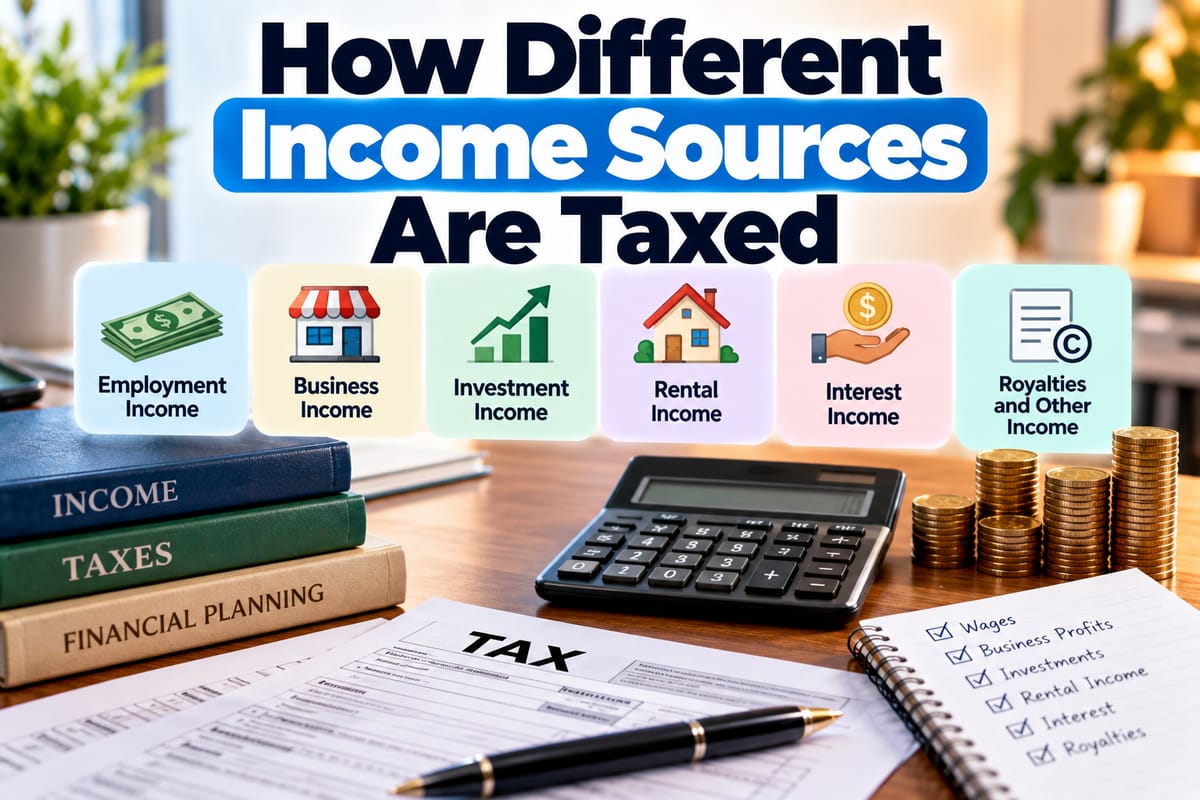
How Different Income Sources Are Taxed
Income can come from many different places. A person might receive wages from an employer, interest from a savings account, dividends from investments, profits from a business, rental income from property, or gains from selling investments.
Although all of these sources can contribute to a household’s financial resources, they are not necessarily taxed in the same way.
The tax treatment of income depends on factors such as the type of income, how it was earned, when it was received, the taxpayer’s overall financial circumstances, and the rules of the jurisdiction involved. Some income may be taxed as ordinary income, some may receive different treatment, and some forms of income may qualify for deductions, exclusions, credits, or other special rules.
Understanding these distinctions can make personal financial planning easier and help people avoid treating every dollar of income as though it has identical tax consequences.
Why the Source of Income Matters
Taxes are generally based not only on how much money someone receives but also on what that money represents.
For example, an employee’s wages represent compensation for work. Interest represents earnings from lending or depositing money. A capital gain represents an increase in the value of an asset that becomes realized through a sale or other taxable event.
These different categories can have different tax rules.
That is why someone earning $50,000 from employment does not necessarily face exactly the same tax treatment as someone receiving $50,000 from a combination of investment gains, interest, rental income, and business profits.
The distinction becomes particularly important when planning how to earn, save, invest, and withdraw money.
Employment Income
For many people, wages and salaries are their primary source of income.
Employment income can include:
- Regular wages
- Salaries
- Bonuses
- Commissions
- Overtime pay
- Certain taxable employee benefits
- Other compensation
Employers may withhold taxes from employees’ paychecks throughout the year.
The amount withheld is generally based on information provided by the employee and applicable withholding rules. The final tax liability is determined when the individual’s overall income and tax situation are calculated.
Employment income is often subject to both income taxes and, depending on the jurisdiction, payroll or social insurance taxes.
How Tax Brackets Affect Employment Income
A common misunderstanding is that moving into a higher tax bracket means all income is suddenly taxed at the higher rate.
Under a progressive marginal tax system, different portions of taxable income can be taxed at different rates.
The How Tax Brackets and Marginal Rates Work guide provides a broader explanation of this structure.
This distinction matters when evaluating raises, bonuses, additional work, or other increases in taxable income.
A higher marginal rate generally applies only to the portion of income falling within the relevant bracket, rather than automatically applying to every dollar earned.
Self-Employment Income
Self-employed people generally have a different tax situation from traditional employees.
A self-employed person may receive income directly from customers or clients rather than through an employer’s payroll system.
Examples include:
- Freelance work
- Consulting
- Independent contracting
- Professional services
- Online businesses
- Trades
- Small business activities
Business income is generally calculated after considering eligible business expenses under the applicable tax rules.
Self-employed individuals may also have additional tax responsibilities that employees do not face in the same way.
The How Taxes Work for Self-Employed People and Small Businesses guide explores these issues in greater detail.
Business Profits
A business can generate revenue without all of that revenue representing taxable profit.
For example, a business might receive $100,000 in sales but spend money on:
- Supplies
- Rent
- Equipment
- Advertising
- Professional services
- Employee wages
- Insurance
- Business software
Depending on the applicable rules, qualifying expenses may reduce the amount of business income subject to tax.
The tax treatment can also depend on the legal structure of the business.
Sole proprietorships, partnerships, corporations, and other structures can have different tax rules.
Interest Income
Interest is another common source of income.
People may earn interest from:
- Savings accounts
- Certificates of deposit
- Bonds
- Money market accounts
- Loans
- Other interest-bearing investments
Interest income is often taxable, although specific rules can vary depending on the source and jurisdiction.
For example, certain types of government or municipal debt may receive preferential tax treatment under particular tax systems.
The amount of interest earned may also appear on tax documents provided by banks or financial institutions.
Dividend Income
Dividends are payments made by companies or other investments to shareholders.
Dividend taxation can depend on the type of dividend and the applicable tax rules.
Some tax systems distinguish between different categories of dividends and apply different rates or treatment.
Investors should therefore avoid assuming that every dividend is taxed identically to wages or interest.
Dividend income can also become part of broader tax planning when investors hold substantial portfolios or rely on investments for retirement income.
Capital Gains
A capital gain can occur when an investment or other capital asset is sold for more than its relevant tax basis.
For example, suppose an investor purchases shares for $10,000 and later sells them for $15,000.
The difference may represent a capital gain, subject to the applicable rules.
The tax treatment can depend on factors such as:
- The type of asset
- Purchase price
- Sale price
- Holding period
- Tax basis
- Applicable tax rates
- The taxpayer’s overall situation
The How Investment Income and Capital Gains Are Taxed guide provides additional context on these differences.
Short-Term and Long-Term Investment Gains
Some tax systems distinguish between assets held for shorter and longer periods.
Under systems that use such a distinction, the length of time an investment was held can affect the tax treatment of a gain.
This means two investors could sell identical assets for the same profit but potentially face different tax consequences if they held the assets for different periods.
The applicable holding-period rules should be checked before making investment decisions based on expected tax treatment.
Rental Income
Property owners can receive rental income from residential or commercial property.
The tax calculation for rental income can be more complicated than simply reporting the total amount of rent collected.
Depending on the jurisdiction and circumstances, certain expenses may be deductible or otherwise considered when calculating taxable rental income.
Potential expenses can include:
- Property management
- Repairs
- Insurance
- Property taxes
- Interest
- Maintenance
- Depreciation or similar allowances
The exact treatment varies significantly by tax jurisdiction and property type.
Income From Royalties
Royalties can represent another form of income.
A person might receive royalties from:
- Books
- Music
- Patents
- Copyrighted works
- Mineral rights
- Licensing agreements
- Other intellectual property
The tax treatment depends on the nature of the royalty and the applicable rules.
Someone receiving recurring royalty payments should keep detailed records of the amounts received and related expenses.
Pension and Retirement Income
Retirement can involve several different income sources.
A retiree may receive:
- Pension payments
- Retirement-account distributions
- Annuities
- Investment income
- Rental income
- Part-time employment income
- Government retirement benefits
These sources do not necessarily receive identical tax treatment.
Some retirement benefits may be partially taxable, while withdrawals from particular retirement accounts may be taxed according to the rules governing those accounts.
The timing of retirement income can therefore become an important part of long-term tax planning.
Social or Government Benefits
Government benefits can have their own tax rules.
Depending on the country and program, some benefits may be fully taxable, partially taxable, or excluded from income.
The treatment can also depend on the recipient’s other income.
This means retirees should consider government benefits alongside other income sources rather than assuming that the amount received automatically represents the amount available to spend after taxes.
Annuity Income
Annuities can provide regular payments in exchange for an initial investment or other arrangement.
The tax treatment of annuity payments can depend on how the annuity was purchased, the source of the funds, and the applicable tax rules.
In some situations, a portion of each payment may represent a return of previously invested money rather than entirely new taxable income.
Because annuity taxation can be complicated, documentation and professional guidance can be useful when determining the taxable portion of payments.
Income From a Side Business
A side business can create additional income alongside a person’s regular employment.
Examples include:
- Freelancing
- Online selling
- Consulting
- Photography
- Tutoring
- Repair services
- Content creation
- Professional services
One important consideration is that additional income can affect a person’s overall tax situation.
Someone with a full-time job who earns additional business income may need to account for the combined effect rather than treating the side income as completely separate.
Gig and Platform Income
People increasingly earn money through digital platforms and gig work.
Examples include:
- Delivery services
- Ride-sharing
- Online marketplaces
- Freelance platforms
- Digital services
- Short-term rentals
The fact that income is received through an app or online platform does not necessarily change its tax character.
Records should generally be maintained for both income and potentially deductible business expenses where applicable.
Foreign Income
People who earn income from outside their home country may face additional tax considerations.
Foreign income can include:
- Overseas employment
- Foreign business profits
- International investments
- Rental income from foreign property
- Foreign interest
- Foreign dividends
Some jurisdictions tax residents on worldwide income, while others use different approaches.
International income can also involve reporting requirements, foreign tax credits, treaties, currency conversion, and other issues.
Anyone with significant foreign income should understand the rules applicable to their residency and tax status.
Taxable and Nontaxable Income
Not every payment received by a person is necessarily taxable income.
Some tax systems exclude particular categories of money from taxable income or provide special treatment.
Examples can vary considerably by jurisdiction and may include certain:
- Gifts
- Inheritances
- Insurance proceeds
- Scholarships
- Government benefits
- Employer-provided benefits
- Reimbursements
The distinction between receiving money and having taxable income is therefore important.
People should not assume that every deposit into a bank account is automatically taxable, nor should they assume that an unusual payment is automatically tax-free.
Deductions Can Change Taxable Income
Taxable income is not always identical to gross income.
Depending on the tax system, individuals may be able to reduce taxable income through deductions or other adjustments.
Potential deductions can relate to areas such as:
- Business expenses
- Certain investment expenses
- Retirement contributions
- Property-related expenses
- Education
- Charitable contributions
Eligibility depends on the specific rules.
A deduction should not be claimed simply because an expense appears financially related to earning income.
The applicable requirements need to be satisfied.
Tax Credits Are Different From Deductions
Tax credits and deductions work differently.
A deduction generally reduces the amount of income subject to tax.
A tax credit generally reduces the tax liability itself, subject to the rules governing that credit.
Some credits may be refundable, while others may only reduce tax owed to a particular point.
Understanding the difference can make tax planning easier and prevent people from comparing deductions and credits as though they were interchangeable.
How Different Income Sources Work Together
The most important point about multiple income sources is that they generally do not exist in isolation.
Consider someone who receives:
- A salary from employment
- Interest from savings
- Dividends from investments
- Rental income
- Capital gains from selling investments
The tax calculation may consider these sources together while applying different rules to each category.
This means that earning additional money from one source can affect the individual’s overall tax position even if the new income is taxed differently from existing income.
Why Record-Keeping Matters
Multiple income sources create more opportunities for record-keeping problems.
Useful records can include:
- Pay statements
- Bank statements
- Investment statements
- Dividend records
- Rental records
- Business invoices
- Expense receipts
- Property records
- Brokerage transaction histories
- Tax documents
Keeping organized records throughout the year is generally easier than attempting to reconstruct an entire year’s financial activity shortly before filing.
How to Manage Taxes Across Different Income Sources
The first step is to identify every source of income.
The next is to determine how each category is treated under the applicable tax rules.
The How to Manage Taxes on Different Income Sources provides a practical framework for thinking about this process.
A basic review can include:
- Listing all income sources.
- Categorizing each source.
- Estimating annual amounts.
- Identifying potentially deductible expenses.
- Tracking taxes already withheld or paid.
- Reviewing investment transactions.
- Checking applicable tax thresholds.
- Planning for income that does not have automatic withholding.
- Keeping supporting documentation.
- Reviewing the overall position before the end of the tax year.
Why Income Without Withholding Requires Attention
Employees often have taxes withheld from their paychecks.
Other types of income may not receive the same treatment.
A freelancer, landlord, investor, or business owner may need to make separate tax payments during the year depending on the applicable rules.
Failing to plan for this can result in an unexpected tax bill.
People with income sources that do not involve regular withholding should understand their payment obligations and avoid waiting until the filing deadline to discover how much they owe.
Income Timing Can Matter
The timing of income can sometimes influence tax planning.
A person may have some control over when certain transactions occur, particularly when dealing with investments, business activity, or retirement distributions.
For example, selling an investment before the end of a tax year can create a taxable event in that year.
Similarly, receiving certain business income or completing a transaction at a particular time can affect the year in which income is recognized.
The rules governing income recognition are specific, so timing decisions should be based on the applicable tax rules rather than assumptions.
Why Tax Planning Is Different From Tax Preparation
Tax preparation generally involves calculating and reporting what happened during a particular tax year.
Tax planning looks ahead.
Planning can involve questions such as:
- How much taxable income am I likely to receive?
- Which income sources have withholding?
- Do I need to set money aside for taxes?
- Could an investment sale create a significant gain?
- Are there business expenses that need to be documented?
- How might an additional income source affect my overall tax position?
Thinking about these questions before the end of the year can provide more opportunities to make informed financial decisions.
Common Mistakes With Multiple Income Sources
Several mistakes occur frequently when people have more than one type of income.
Assuming All Income Is Taxed the Same Way
Different categories can have different rules and rates.
Ignoring Side Income
Small amounts of additional income can still create tax obligations.
Spending Money That Should Have Been Set Aside
Income without withholding can leave a tax bill at the end of the year.
Losing Track of Investment Transactions
Multiple purchases and sales can make it difficult to calculate gains accurately without proper records.
Mixing Business and Personal Expenses
Using the same accounts for personal and business activity can make record-keeping more difficult.
Forgetting About Rental Expenses
Property income should be evaluated together with applicable expenses and tax rules.
Waiting Until Filing Season
By filing time, opportunities for many planning decisions may already have passed.
A More Complete View of Personal Income
Understanding how different income sources are taxed is ultimately about seeing the entire financial picture.
A salary, business profit, investment gain, rental payment, dividend, and interest payment can all contribute to a person’s financial resources, but they can enter the tax system through different rules.
That distinction matters for anyone building a budget, investing for the future, starting a business, purchasing rental property, or preparing for retirement.
The more varied a person’s income becomes, the more useful it can be to track each source separately while also considering how they interact within the overall tax calculation.
Building a Tax-Aware Income Strategy
Different income sources can create both opportunities and additional responsibilities.
The key is to understand what each source represents, how it is taxed, which expenses or deductions may apply, and how the different categories interact.
Rather than waiting until a tax return is due, taxpayers can monitor income throughout the year, maintain accurate records, set aside money for taxes where necessary, and review significant financial decisions before they occur.
A clear understanding of income categories does not eliminate taxes, but it can make the financial planning process more predictable and help households make better-informed decisions about earning, saving, investing, and spending.