What a Personal Financial Dashboard Does
Managing personal finances can become complicated when information is spread across multiple bank accounts, credit cards, savings accounts, investment platforms, loans, and financial services.
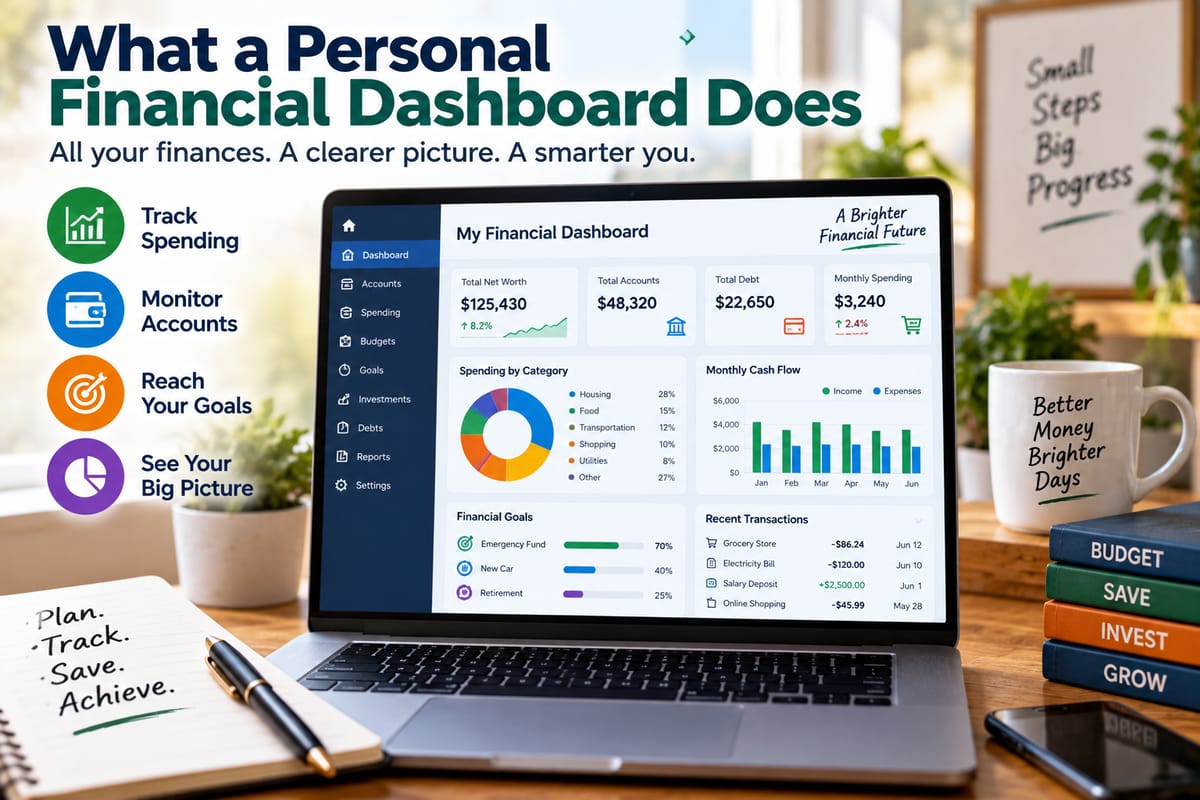
A personal financial dashboard brings some of that information together in one place. Instead of checking several accounts separately, users can often see balances, spending, income, savings, debts, investments, and other financial information through a single interface.
The purpose is not simply to display numbers. A well-designed dashboard can help users understand their overall financial position, identify patterns, monitor progress toward goals, and make everyday money management more organized.
What Is a Personal Financial Dashboard?
A personal financial dashboard is a digital interface that organizes financial information into a centralized view.
Depending on the platform, it may display:
- Bank account balances
- Credit card balances
- Income
- Expenses
- Savings
- Investments
- Loans and other debts
- Net worth
- Cash flow
- Financial goals
- Spending categories
- Account activity
Some dashboards connect directly to financial institutions, while others require users to enter information manually.
The amount of information available depends on the software and the accounts that can be connected.
Why Financial Dashboards Are Useful
Financial information can be difficult to understand when it is scattered across different services.
Someone might have money in a checking account, savings account, retirement account, brokerage account, and several credit cards. Looking at each account separately provides only part of the overall picture.
A dashboard can combine available information and organize it into categories.
This can make it easier to answer questions such as:
- How much money do I have available?
- How much am I spending each month?
- How much debt do I have?
- How much am I saving?
- How are my investments performing?
- Has my net worth changed?
- Am I making progress toward my financial goals?
How Financial Dashboards Gather Information
A dashboard needs financial data before it can display meaningful information.
Depending on the platform, information may come from:
- Connected bank accounts
- Credit card accounts
- Investment accounts
- Loan accounts
- Manually entered transactions
- Uploaded financial records
- Other supported financial services
When accounts are connected, the platform may periodically retrieve updated information.
Some services may require users to reconnect accounts from time to time, particularly when security credentials or connection permissions change.
Account Aggregation
Account aggregation is one of the main functions behind many financial dashboards.
It allows information from multiple financial accounts to be displayed together.
For example, a user could connect a bank account, credit card, investment account, and loan account. The dashboard may then show information from each account in a consolidated interface.
This does not necessarily mean the accounts are combined into one financial account. Instead, the dashboard provides a centralized way to view information from separate accounts.
What a Dashboard Can Show About Spending
Spending analysis is a common feature.
A dashboard may organize transactions into categories such as:
- Housing
- Transportation
- Groceries
- Restaurants
- Utilities
- Entertainment
- Shopping
- Insurance
- Healthcare
- Subscriptions
Users can then review how much money is being spent in different areas.
Some platforms allow users to customize categories or correct transactions that have been classified incorrectly.
This can make spending data more useful because automatic categorization is not always perfect.
Tracking Income and Cash Flow
A financial dashboard can also help users understand the movement of money into and out of their accounts.
Income might include:
- Salaries
- Business income
- Freelance payments
- Investment income
- Interest
- Other recurring deposits
Expenses represent money leaving accounts.
Comparing the two can provide a simplified view of cash flow.
For example, if income consistently exceeds expenses, the difference may be available for saving, investing, debt repayment, or other financial goals.
How Dashboards Track Savings
Many financial dashboards allow users to monitor savings balances over time.
A user may track:
- Emergency savings
- Short-term goals
- Vacation funds
- Education savings
- Home-related savings
- Retirement contributions
Some platforms can show progress toward a specific savings target.
This can turn a general intention such as “save more money” into a measurable goal.
Monitoring Debt
Debt information can also be incorporated into a financial dashboard.
Depending on the accounts supported, users may be able to see:
- Credit card balances
- Personal loans
- Student loans
- Auto loans
- Mortgages
- Interest rates
- Minimum payments
Having this information in one place can make it easier to understand the overall amount owed.
It can also help users monitor whether balances are increasing or decreasing over time.
What Net Worth Means on a Financial Dashboard
Net worth provides a broader snapshot of financial position.
It is generally calculated by comparing total assets with total liabilities.
Assets can include:
- Cash
- Savings
- Investments
- Property
- Other financial assets
Liabilities can include:
- Credit card debt
- Mortgages
- Personal loans
- Student loans
- Other debts
A dashboard can calculate an estimated net worth when it has sufficient account information.
For a more detailed explanation of the process, see How Net Worth Tracking Actually Works.
Why Net Worth Can Change
Net worth is not a fixed number.
It can change because of:
- Saving money
- Paying down debt
- Investment gains
- Investment losses
- Changes in property values
- New borrowing
- Major purchases
- Changes in cash balances
A dashboard can make these changes easier to observe over time.
However, changes in net worth do not always represent spendable cash. Someone may have substantial assets but limited accessible money.
Tracking Investments
Some financial dashboards can connect to investment accounts and display portfolio information.
Depending on the platform, users may see:
- Account balances
- Investment holdings
- Asset allocations
- Contributions
- Withdrawals
- Investment performance
The level of detail varies between services.
Investment information may also update at different times depending on the platform and the financial institution supplying the data.
Financial Goals and Progress Tracking
Goal tracking is another feature found in some dashboards.
A user might create goals for:
- Building emergency savings
- Paying down debt
- Saving for a major purchase
- Increasing retirement savings
- Building an investment portfolio
The dashboard may compare current progress with a target amount or deadline.
This can make financial planning more tangible because users can see whether their actions are moving them toward a defined objective.
Alerts and Notifications
Some dashboards provide notifications when certain financial events occur.
Examples include:
- Low account balances
- Large transactions
- Unusual spending
- Upcoming bills
- Changes in account balances
- Budget limits
- Goal milestones
Alerts can make a dashboard more useful as an ongoing monitoring tool rather than something that is opened only occasionally.
Users should still configure notifications carefully because excessive alerts can make important information easier to overlook.
Budgeting Features
Some dashboards include budgeting tools that compare planned spending with actual spending.
A user might set a monthly spending target for groceries, transportation, entertainment, or other categories.
The dashboard can then show how much has already been spent.
This can help users identify areas where spending is higher or lower than expected.
Budgeting features differ significantly between platforms, so users should understand what the software actually tracks before relying on it for financial planning.
Financial Dashboards and Financial Apps
Personal financial dashboards are often built into broader financial applications.
A financial app may combine dashboard features with budgeting, bill management, investment tracking, savings tools, credit monitoring, or other services.
The Complete Guide to Financial Apps provides a broader look at how these applications can support different aspects of financial management.
The dashboard is essentially the central view, while the individual features provide the tools for analyzing and acting on the information.
Financial Dashboards and Money Management Tools
A dashboard can also be part of a broader money management system.
Money management tools may help users:
- Track expenses
- Create budgets
- Monitor cash flow
- Manage bills
- Track savings
- Monitor debt
- Analyze financial goals
The Complete Guide to Money Management Tools explores the wider range of digital resources available for organizing personal finances.
A dashboard brings many of these information streams together, but it does not necessarily replace every specialized financial tool.
Data Accuracy Matters
A financial dashboard is only as useful as the information it receives.
Problems can occur when:
- Accounts fail to synchronize
- Transactions are delayed
- Balances are outdated
- Transactions are categorized incorrectly
- An account becomes disconnected
- Investment prices update at different times
Users should occasionally compare dashboard information with their actual financial accounts.
This is particularly important before making decisions based on a balance or transaction that may not yet be current.
Privacy and Security Considerations
Financial dashboards can contain highly sensitive information.
Users should consider how a service handles:
- Account credentials
- Financial data
- Transaction information
- Encryption
- Authentication
- Data sharing
- Third-party integrations
- Account access permissions
Strong passwords and multi-factor authentication can provide additional protection when supported.
Users should also review the privacy and security information provided by the financial service before connecting sensitive accounts.
What a Dashboard Cannot Do
A financial dashboard can organize information, but it does not automatically solve financial problems.
Seeing that spending is higher than income does not by itself determine which expenses should change.
Similarly, seeing an investment decline does not automatically tell an investor what action should be taken.
Dashboards are primarily information and monitoring tools. The quality of financial decisions still depends on the user’s goals, circumstances, financial knowledge, and the quality of the information being considered.
Using Dashboards With Financial Calculators
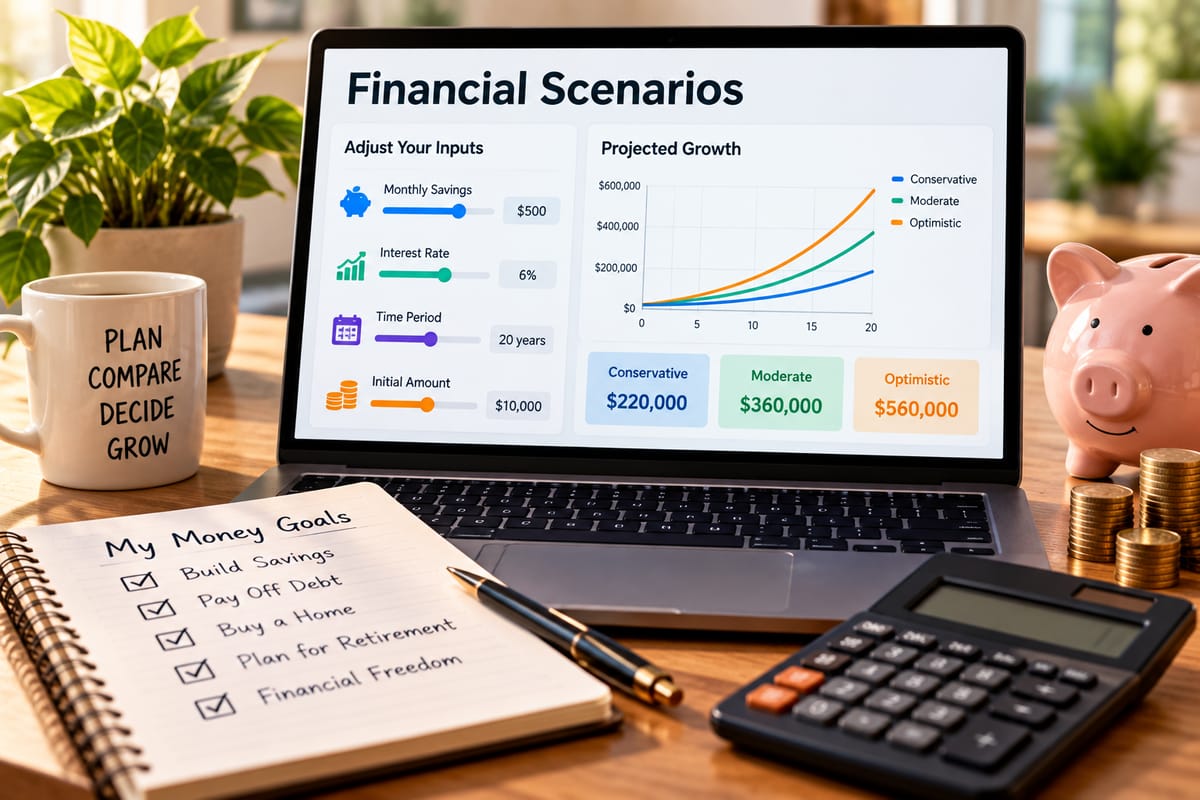
A dashboard provides a picture of current financial information, while calculators can help explore potential future scenarios.
For example, a financial calculator might estimate:
- Loan payments
- Compound growth
- Savings requirements
- Retirement projections
- Investment returns
- Debt repayment timelines
These tools can complement the information shown in a dashboard.
The Complete Guide to Financial Tools and Calculators provides a broader overview of how financial calculators and related tools can support financial planning.
How Often Should a Financial Dashboard Be Reviewed?
There is no single schedule that works for everyone.
Some people may find it useful to check their dashboard weekly, while others may review it monthly.
A regular review can help users notice:
- Unexpected spending
- Changes in income
- New recurring charges
- Growing or declining debt
- Savings progress
- Changes in investment balances
- Account connection problems
Checking too frequently can also encourage users to focus excessively on short-term changes, particularly when monitoring investments.
The appropriate frequency depends on what the dashboard is being used to monitor.
Choosing a Personal Financial Dashboard
When evaluating a financial dashboard, users can consider:
- Which accounts can be connected
- How frequently information updates
- Budgeting capabilities
- Investment tracking
- Net worth tracking
- Goal-setting features
- Security controls
- Privacy policies
- Ease of use
- Availability of alerts
- Reporting options
- Subscription costs
A dashboard that supports only a few of a user’s important accounts may be less useful than one that provides broader coverage.
Making Better Use of a Financial Dashboard
A dashboard becomes more valuable when users establish a routine for reviewing the information.
A simple process might involve:
- Checking account connections.
- Reviewing recent transactions.
- Looking at spending patterns.
- Monitoring savings progress.
- Reviewing outstanding debt.
- Checking investment balances when relevant.
- Updating financial goals.
- Investigating unusual changes.
The purpose is not to stare at financial numbers every day. It is to create a clearer picture of what is happening and use that information to support more deliberate financial decisions.
Turning Scattered Numbers Into a Clearer Financial Picture
A personal financial dashboard provides a centralized view of financial information that might otherwise be scattered across numerous accounts and services.
By bringing together balances, spending, income, debt, savings, investments, and net worth information, it can make personal finances easier to monitor and understand.
The most useful dashboard is not necessarily the one with the largest number of features. It is the one that provides accurate, relevant information in a format that helps users understand their financial position and track progress toward their goals.
Used alongside appropriate budgeting, financial planning, and investment tools, a personal financial dashboard can become a practical part of an organized approach to managing money.