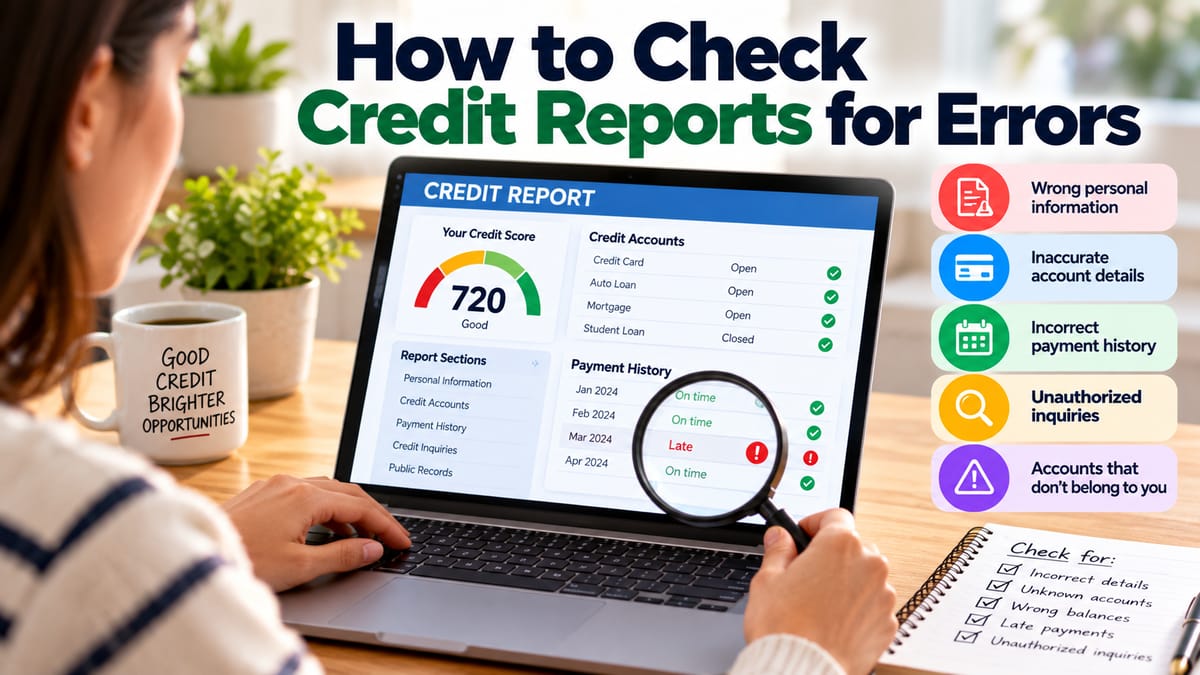
How to Check Credit Reports for Errors
Credit reports contain information that lenders, creditors, and other authorized organizations may use to evaluate a person’s credit history. Because these reports can influence access to credit and other financial products, it is important to make sure the information they contain is accurate.
Errors can happen for many reasons. A payment may be reported incorrectly, an account may appear under the wrong name, a balance may be outdated, or an unfamiliar account may indicate identity theft.
Checking a credit report is therefore more than simply looking at a credit score. The report itself contains the underlying information that can affect how creditworthiness is assessed.
Regularly reviewing that information can help consumers identify inaccuracies early and take appropriate steps to have legitimate errors corrected.
What Is a Credit Report?
A credit report is a record of information related to a person’s borrowing and repayment history.
Depending on the reporting system and jurisdiction, a credit report may contain information such as:
- Personal identifying information
- Credit accounts
- Loan balances
- Credit limits
- Payment history
- Account opening dates
- Account status
- Delinquent accounts
- Collections information
- Credit inquiries
- Public-record information where applicable
The exact information included varies by credit reporting system.
A Complete Guide to Credit Scores and Credit Reports provides broader context about how credit reports relate to credit scores and why the information recorded on them matters.
Why Credit Report Accuracy Matters
A credit report can contain information that affects how lenders understand a person’s credit history.
An incorrect late payment, inflated balance, or account that does not belong to the consumer could potentially affect credit decisions.
Errors may also create confusion when someone applies for a loan, credit card, mortgage, or another financial product.
Reviewing a report allows consumers to identify problems before they become more difficult to investigate.
Common Types of Credit Report Errors
Not all credit report mistakes look the same.
Some are simple administrative errors, while others can involve accounts or activity that the consumer does not recognize.
Common examples include:
- Incorrect personal information
- Wrong account numbers
- Duplicate accounts
- Incorrect account balances
- Incorrect credit limits
- Payments incorrectly reported as late
- Accounts incorrectly listed as open
- Closed accounts reported as active
- Accounts belonging to another person
- Incorrect dates
- Incorrect collection information
- Unauthorized credit inquiries
- Fraudulent accounts
Understanding the different types of errors makes it easier to know what to look for during a review.
Start With Your Personal Information
The first section to check is often the personal information.
Look for inaccuracies in details such as:
- Full name
- Former names where applicable
- Address
- Previous addresses
- Date of birth
- Other identifying information
A minor formatting difference may not necessarily be significant, but incorrect identifying information can sometimes indicate that information belonging to another person has been mixed into a report.
If unfamiliar names, addresses, or other major identifying details appear, investigate them rather than assuming they are harmless.
Review Every Credit Account
Do not stop after checking the personal information section.
Go through each account listed on the report and compare it with your own records.
Look for:
- Credit cards
- Personal loans
- Student loans where applicable
- Auto loans
- Mortgages
- Lines of credit
- Retail credit accounts
- Other reported credit obligations
Ask whether you recognize each account.
If an account is unfamiliar, there may be an innocent explanation, such as a lender using a different company name. However, an account that remains unexplained deserves further investigation.
Check Account Statuses
Each credit account may have a status describing its current or historical condition.
Depending on the reporting system, statuses may include terms such as:
- Open
- Closed
- Current
- Delinquent
- Paid
- In collections
- Charged off
Review whether the status accurately reflects what happened to the account.
For example, if a loan was paid off and closed, but the report still shows it as active with an outstanding balance, that information may need to be investigated.
Compare Reported Balances With Your Records
Balances can change over time, so the date associated with a reported balance matters.
Compare credit report information with recent statements, account records, and payment confirmations.
Pay attention to:
- Outstanding balances
- Credit limits
- Payment amounts
- Account status
- Dates information was reported
A difference does not automatically mean the report is wrong. The credit report may contain information from a previous reporting date.
Still, large or persistent discrepancies should be investigated.
Check Payment History Carefully
Payment history is one of the most important areas to review.
Look for whether payments have been reported as:
- On time
- Late
- Missed
- Delinquent
- In collection
If a payment was made on time but the report shows it as late, gather documentation that supports your position.
Useful records may include:
- Bank statements
- Payment confirmations
- Account statements
- Electronic receipts
- Emails from the creditor
- Transaction histories
Keeping financial records can make it easier to investigate disputed information.
Look for Duplicate Accounts
Sometimes the same debt can appear more than once.
Duplicate reporting can be confusing because the consumer may believe they have more debt than they actually do.
However, not every similar-looking entry is necessarily a duplicate. A debt may have been transferred or sold, resulting in related information appearing under different reporting entities.
If two entries appear to represent the same obligation, compare the account numbers, balances, dates, creditor information, and status before assuming an error exists.
Check Credit Inquiries
Credit reports can also contain inquiries associated with applications for credit.
Review the inquiries and ask whether you recognize them.
An unfamiliar inquiry does not always mean someone opened an account in your name. There can be legitimate explanations, including certain forms of authorized review or multiple inquiries associated with shopping for credit.
Still, unexplained inquiries should be investigated, particularly when they appear alongside unfamiliar accounts.
Pay Attention to Collections Information
Collection accounts deserve careful attention.
Check whether:
- The debt belongs to you
- The amount appears accurate
- The account has been reported correctly
- The dates appear consistent
- The account is duplicated elsewhere
- The account status is accurate
Collection reporting can be complicated, particularly when debts have changed hands.
Keep documentation related to debts and payments so you can compare the report with your own records.
Watch for Signs of Identity Theft
One of the most serious reasons to review a credit report is to identify activity that you did not authorize.
Warning signs can include:
- Credit accounts you never opened
- Loans you do not recognize
- Unfamiliar addresses
- Credit inquiries you cannot explain
- Collection accounts related to unfamiliar debts
An unfamiliar account should not automatically be treated as identity theft, but it should be investigated.
If identity theft is suspected, consumers may need to take additional steps to protect their financial accounts and personal information.
Compare Multiple Credit Reports When Available
Different credit reporting agencies may receive information from different sources or may update information at different times.
As a result, reports may not always look identical.
Comparing reports can reveal differences that might otherwise be overlooked.
For example, an account could appear on one report but not another, or information such as a balance or payment status could be updated at different times.
Differences do not automatically indicate an error, but they can provide useful information about how your credit history is being reported.
Use Credit Monitoring Tools Carefully
Credit monitoring services can make it easier to notice changes in credit information.
They may alert users when certain events occur, such as:
- New accounts
- New inquiries
- Changes to account information
- Report updates
- Changes in credit scores
The How Credit Monitoring Tools Track and Explain Credit Health guide provides additional context about what these services monitor and how they can help consumers follow changes over time.
Monitoring can be useful, but it should complement—not replace—periodic review of the underlying credit report.
Understand the Difference Between a Credit Report and a Credit Score
A credit score is a numerical calculation based on information in a credit report.
The report contains the underlying information, while a scoring model uses selected information from that report to calculate a score.
This distinction matters when checking for errors.
A consumer might notice that a score has changed, but the score alone does not necessarily reveal which piece of information caused the change.
Reviewing the report provides a much more detailed picture.
What to Do When You Find an Error
Finding an error is only the first step.
The next step is to determine where the incorrect information originated and gather supporting documentation.
Depending on the situation, the consumer may need to contact:
- The credit reporting agency
- The creditor or lender that supplied the information
- A collection agency
- Another organization responsible for the reported information
Provide a clear explanation of what appears to be incorrect and include relevant supporting documentation.
Keep copies of correspondence, documents, confirmation numbers, and other records related to the dispute.
Document the Problem Clearly
A clear dispute is easier to understand than a vague complaint.
Instead of simply saying that information is incorrect, identify the specific problem.
For example:
The account is listed as having a late payment in March, but payment records show that the required payment was made before the stated due date.
The supporting documentation should correspond directly to the issue being raised.
Keep records of when the dispute was submitted and any responses received.
Do Not Send Original Documents Unless Necessary
When providing documentation, it is generally safer to retain original records.
Use copies or other appropriate reproductions unless an organization specifically requires an original document.
Financial records can be valuable for resolving future questions, so maintaining an organized archive can be useful.
Documents might include:
- Statements
- Receipts
- Payment confirmations
- Loan agreements
- Correspondence
- Account closure notices
- Identity verification records
Follow Up on Disputed Information
A dispute should not necessarily be treated as finished simply because it was submitted.
Keep track of:
- The date the dispute was filed
- What information was challenged
- Which organization received it
- Supporting documentation provided
- Responses received
- Any changes made to the report
If the issue remains unresolved, review the response carefully and determine what additional steps may be available under the applicable credit reporting rules.
Be Careful With Credit Repair Claims
Consumers should be cautious about organizations promising to remove all negative information from a credit report.
Accurate negative information generally cannot simply be erased because someone dislikes it.
A legitimate dispute focuses on information that is inaccurate, incomplete, outdated, or otherwise improperly reported under applicable rules.
Be particularly cautious about services that:
- Guarantee a specific credit score increase
- Promise to remove every negative item
- Ask consumers to dispute information they know is accurate
- Demand large fees before providing meaningful services
- Encourage consumers to provide false information
Consumers can often begin the process of reviewing and disputing inaccurate information themselves.
Organize Credit Records Regularly
Credit report checking becomes easier when financial records are organized.
Consider keeping a folder containing:
- Recent account statements
- Loan documents
- Payment confirmations
- Credit agreements
- Account closure records
- Important correspondence
Digital records can be organized into clearly labeled folders, while paper documents can be stored in a dedicated financial file.
The goal is to make it easy to verify information when questions arise.
How Often Should You Check Your Credit Report?
There is no single schedule that works for everyone.
People who are preparing to apply for major credit may want to review their reports beforehand. Others may prefer periodic reviews throughout the year.
More frequent monitoring may also be useful after:
- Suspected identity theft
- Unauthorized account activity
- A major financial transaction
- Closing a significant account
- Disputing inaccurate information
- Changes in personal circumstances
Regular reviews make it more likely that errors will be discovered before they become a larger problem.
Credit Tools Can Make Monitoring Easier
Credit reports are only one part of managing credit.
Other tools can help consumers organize information, monitor changes, understand scores, estimate borrowing costs, and track financial obligations.
The Complete Guide to Credit Tools provides a broader look at the different tools that can support credit management.
The key is to understand what each tool actually does rather than assuming that every service provides the same information.
What If You Have Never Had Credit Before?
People with little or no credit history may find the process unfamiliar.
Without much previous borrowing activity, a credit report may contain relatively little information.
That does not mean there is necessarily an error.
For people beginning their credit journey, understanding how accounts are reported can be useful from the beginning. The How to Build Credit From Scratch for the First Time guide explains the broader process of establishing a credit history.
A Simple Credit Report Review Checklist
When checking a credit report, work through the information systematically.
Personal information
- Is your name accurate?
- Are addresses recognizable?
- Are other identifying details correct?
Accounts
- Do you recognize every account?
- Are account numbers correct?
- Are balances reasonable?
- Are credit limits accurate?
- Are account statuses correct?
Payment history
- Are payments reported correctly?
- Are any late payments unfamiliar or inaccurate?
- Do your records support the reported history?
Collections
- Do you recognize the debts?
- Are the amounts and dates consistent?
- Are there duplicate entries?
Inquiries
- Do you recognize the organizations listed?
- Can you explain each inquiry?
Other information
- Is anything unfamiliar?
- Are there inconsistencies between reports?
- Has recently corrected information been updated?
Working through the report section by section can make the process less overwhelming.
Make Credit Report Reviews a Regular Financial Habit
Checking a credit report does not have to be complicated.
The most important step is simply to look beyond the headline credit score and examine the information that supports it. Reviewing personal details, accounts, balances, payment history, inquiries, and collections can reveal problems that might otherwise remain unnoticed.
When an error is found, documenting the issue and contacting the appropriate reporting organization or creditor can create a clear path toward correction.
Credit reports are records of financial history, not permanent judgments. Reviewing them regularly gives consumers an opportunity to understand what is being reported, identify inaccuracies, and keep their financial information as accurate as possible.