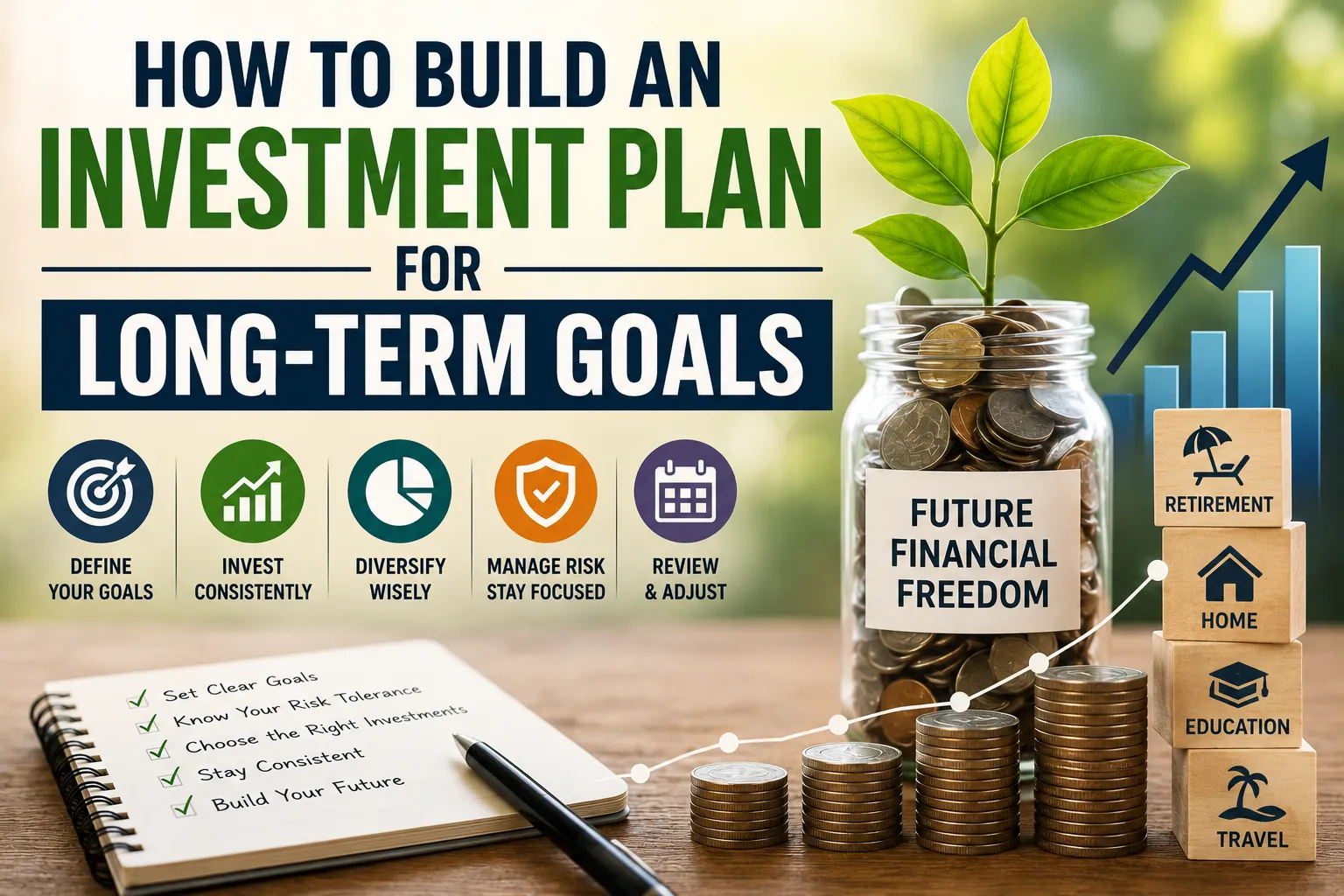
How to Build an Investment Plan for Long-Term Goals
Building wealth over the long term is rarely about finding one perfect investment. It is more often about creating a clear plan, investing consistently, managing risk, and giving your money enough time to grow.
Whether the goal is retirement, buying a home, paying for education, building financial independence, or creating a future source of income, an investment plan can turn a broad financial ambition into a series of measurable decisions.
A strong investment strategy starts with understanding how different markets, asset classes and investment choices work together. For a broader overview, see this complete guide to financial markets and how they work.
A good investment plan also needs to be flexible. Your income, expenses, family circumstances, investment horizon, and tolerance for market losses can change over time.
Here is how to build one.
**## **Start With a Specific Financial Goal****
The first step is deciding **what you are investing for**.
“Build wealth” is a useful ambition, but it is too broad to create an effective investment strategy.
Instead, turn the ambition into a measurable target.
For example:
-
Save $500,000 for retirement
-
Build $100,000 toward a home purchase
-
Accumulate $50,000 for a child’s education
-
Create a portfolio that can eventually generate supplemental income
-
Build a long-term financial safety net
The more specific the goal, the easier it becomes to determine how much you need to invest and what level of risk may be appropriate.
**## **Give Every Goal a Time Horizon****
Your **time horizon** is the amount of time you have before you expect to need the money.
This is one of the most important factors in investment planning.
Consider three broad categories:
| Goal timeframe | Example | General consideration |
| —– | —– | —– |
| Short term | Money needed within a few years | Greater emphasis on preserving capital |
| Medium term | Several years away | Balance growth and stability |
| Long term | Retirement decades away | Greater capacity to tolerate market volatility |
There is no universal portfolio that works for every goal.
Asset allocation should take both **time horizon and risk tolerance** into account. Someone investing for a goal decades away may have more ability to withstand temporary market declines than someone who needs the money soon.
This distinction is crucial.
Money needed soon generally cannot afford the same level of market volatility as money that will remain invested for decades.
**# **Calculate How Much You Need to Invest****
Once you know the goal and deadline, estimate the amount required.
Suppose your long-term objective is to accumulate **$500,000**.
You need to consider:
-
Your current investment balance
-
How much you can contribute regularly
-
How long you will invest
-
Your expected investment return
-
Inflation
-
Investment costs and taxes
The future value of an investment is not determined solely by how much you contribute.
**Contributions + time + investment returns + compounding = potential future value**
Regular investing and time can allow compound growth to become increasingly powerful.
**### **Why Starting Earlier Matters****
Consider two investors who contribute the same amount of money.
The investor who begins earlier generally gives those contributions more time to potentially earn returns, and those returns can themselves generate additional returns.
This is the basic principle of **compound growth**.
It does not guarantee a particular outcome, because investments fluctuate and returns are uncertain. But time can be a powerful component of a long-term investment strategy.
**# **Build a Strong Financial Foundation First****
Investing should fit into your overall financial plan.
Before committing substantial amounts of money to long-term investments, consider whether you have enough cash available for emergencies and whether expensive debt needs attention.
For many households, that means creating a foundation that includes:
-
A workable household budget
-
Emergency savings
-
Appropriate insurance
-
A plan for high-interest debt
-
Retirement contributions
-
Long-term investments
This can reduce the likelihood that you will have to sell long-term investments at an inconvenient time because of an unexpected financial emergency.
**# **Understand Your Risk Tolerance****
Every investment carries some degree of risk.
Your **risk tolerance** describes both your ability and willingness to accept potential losses in exchange for the possibility of higher returns.
There are two important dimensions.
**### **Financial ability to take risk****
Can you financially withstand a significant decline without being forced to sell?
Someone with a stable income, substantial emergency savings, and a decades-long time horizon may have greater capacity to tolerate volatility.
**### **Emotional willingness to take risk****
How will you react if your portfolio falls substantially?
An investor may theoretically have a long enough time horizon to tolerate a market downturn but still panic and sell because the losses feel unbearable.
A successful investment plan needs to account for both.
**# **Match Investments to Your Time Horizon****
A common mistake is choosing investments based solely on their historical returns.
Instead, ask:
**When will I need this money?**
If retirement is 30 years away, temporary market fluctuations may be easier to tolerate.
If you need the money for a major purchase next year, a substantial market decline shortly before the purchase could create a serious problem.
Investors with shorter horizons generally need to be more cautious about risky investments because they may not have enough time to wait for a market recovery.
The investment strategy should therefore evolve as the goal approaches.
**# **Understand Asset Allocation****
**Asset allocation** is the process of dividing your portfolio among different asset categories.
Common categories include:
-
Stocks
-
Bonds
-
Cash and cash equivalents
-
Other investments
The appropriate mix depends on your objectives, time horizon, and risk tolerance.
For example, an investor pursuing a long-term retirement goal may have a greater allocation to growth-oriented assets than someone saving for a purchase that is only a few years away.
There is no single allocation that is right for everyone.
**# **Diversification Can Reduce Concentration Risk****
Putting all your money into one company, industry, asset type, or investment strategy can expose your portfolio to unnecessary concentration risk.
**Diversification** involves spreading investments across different assets and, where appropriate, across different sectors, industries, geographic regions, and securities.
The goal is not to eliminate losses.
Diversification cannot guarantee that your portfolio will rise or remain positive when markets fall.
Instead, it can reduce the impact that one poorly performing investment has on the overall portfolio.
**### **A Simple Example****
Imagine two portfolios.
**Portfolio A:**
- 100% invested in one company
**Portfolio B:**
- Spread across many companies and asset classes
If the single company in Portfolio A experiences a severe problem, the entire portfolio can be heavily affected.
Portfolio B may still decline if markets fall, but the damage from one company-specific event can be less significant.
**# **Choose Investments Based on the Goal****
Once you understand your time horizon, risk tolerance, and desired asset allocation, you can evaluate specific investment choices.
Depending on your circumstances and jurisdiction, long-term portfolios may include investments such as:
-
Broad-market index funds
-
Mutual funds
-
Exchange-traded funds
-
Individual stocks
-
Bonds
-
Government securities
-
Retirement accounts
-
Other diversified investment vehicles
The important question is not simply:
**“Which investment will make the most money?”**
A better question is:
**“Which investment approach is appropriate for this particular goal, time horizon, risk level, and financial situation?”**
Investors considering fixed-income assets should also understand how bond markets work before deciding what role bonds should play in a portfolio. The complete guide to bond markets provides additional context.
**# **Consider Tax-Advantaged Accounts****
Taxes can affect how quickly an investment portfolio grows.
Certain accounts may provide tax advantages depending on where you live and your eligibility.
For U.S. investors, examples include:
-
401(k) plans
-
403(b) plans
-
Individual retirement accounts
-
Health savings accounts
-
529 education accounts
Employer-sponsored retirement plans may also provide matching contributions.
The rules governing contributions, withdrawals, taxation, and eligibility vary by account.
**# **Don’t Ignore Investment Fees****
Investment fees may appear small, but they can have a meaningful effect on long-term wealth because costs reduce the amount of money that remains invested.
Possible costs can include:
-
Expense ratios
-
Trading commissions
-
Account fees
-
Advisory fees
-
Fund-level costs
-
Transaction-related expenses
When comparing investments, look beyond headline performance.
Two investments with similar returns can produce different results for investors if one carries substantially higher costs.
**# **Automate Your Contributions****
Consistency can be easier when investing becomes part of your normal financial routine.
Instead of deciding every month whether to invest, you can establish an automatic contribution schedule when your account and financial circumstances allow it.
For example, you might invest:
-
Every payday
-
Monthly
-
Quarterly
-
A fixed percentage of income
Regular investing can help remove some emotional decision-making from the process.
It also means you continue contributing during both strong and weak market periods rather than waiting for a supposedly perfect time to invest.
**# **Understand Dollar-Cost Averaging****
Regularly investing a fixed amount of money is often called **dollar-cost averaging**.
When prices are higher, your fixed contribution buys fewer shares.
When prices are lower, it buys more shares.
This does not guarantee a profit or eliminate investment risk.
Its main advantage is that it provides a systematic approach to investing rather than requiring you to predict market movements.
For long-term investors, a consistent contribution strategy can also make it easier to maintain discipline.
**# **Rebalance Your Portfolio****
Your portfolio can drift away from its intended asset allocation over time.
Imagine you originally selected:
-
70% stocks
-
30% bonds
If stocks significantly outperform bonds, the portfolio could eventually become much more heavily weighted toward stocks.
That may leave you taking more risk than originally intended.
**Rebalancing** means bringing the portfolio back toward its desired allocation.
The frequency and method of rebalancing depend on the individual’s strategy.
**# **Review Your Investment Plan Regularly****
A long-term plan should not mean ignoring your finances for decades.
Your circumstances can change.
Review the plan when there is a major change in:
-
Income
-
Employment
-
Family circumstances
-
Debt
-
Investment goals
-
Time horizon
-
Risk tolerance
-
Retirement plans
For example, someone who changes their retirement date may need to reconsider the amount of investment risk they are taking.
Similarly, someone who receives a substantial income increase may be able to increase contributions.
**# **Avoid Building a Plan Around Market Predictions****
One of the biggest challenges for investors is the temptation to constantly predict what the market will do next.
Markets can rise, fall, and move unpredictably.
A long-term investment plan should therefore be designed around factors you can control.
You can control:
-
How much you save
-
How consistently you invest
-
How diversified you are
-
How much risk you accept
-
How much you pay in fees
-
Which accounts you use
-
How often you review your plan
You cannot reliably control:
-
Tomorrow’s stock market
-
The next recession
-
Interest-rate movements
-
Individual company surprises
-
Short-term market sentiment
Understanding volatility can make this principle easier to apply. Investors who want to explore why markets can experience sudden price movements can read how stock market volatility works and what causes market volatility.
**# **Protect Your Investment Plan From Emotional Decisions****
Fear and excitement can both influence financial decisions.
A market surge can make investors believe they are missing out.
A sharp decline can create the urge to sell everything.
Neither reaction necessarily reflects the long-term investment objective.
A written investment plan can provide a reference point during difficult periods.
Before making a major change, ask:
-
Has my financial goal changed?
-
Has my time horizon changed?
-
Has my ability to tolerate risk changed?
-
Has my financial situation changed?
-
Or am I simply reacting to market movements?
If the answer is the last question, pausing before making a major decision may be worthwhile.
**# **Protect Against Investment Scams****
A long-term investment plan is only useful if the money is invested responsibly.
Be skeptical of opportunities promising:
-
Guaranteed high returns
-
Little or no risk
-
Secret investment strategies
-
Urgent decisions
-
Guaranteed profits
-
Exclusive access
-
Pressure to transfer money immediately
Research investments thoroughly and check the background of investment professionals.
If you work with a financial professional, verify their registration and disciplinary history through appropriate regulatory resources.
**# **A Simple Investment Plan Example****
Imagine a 35-year-old investor wants to build retirement savings over several decades.
A basic planning process could look like this:
**### **Goal****
Build a retirement portfolio large enough to support future living expenses.
**### **Time horizon****
Approximately 30 years.
**### **Financial foundation****
Maintain emergency savings and address expensive debt.
**### **Contributions****
Invest a consistent percentage of income.
**### **Portfolio****
Use a diversified mix appropriate for the investor’s risk tolerance and long-term horizon.
**### **Tax strategy****
Use eligible tax-advantaged retirement accounts where appropriate.
**### **Maintenance****
Review the portfolio periodically and rebalance when necessary.
**### **Adjustment****
Gradually reconsider the level of risk as retirement approaches.
This is not a universal portfolio recommendation. It demonstrates the process of connecting a financial objective to a long-term investment strategy.
**# **Common Investment Planning Mistakes****
Even a well-intentioned investor can make avoidable mistakes.
**## **Investing without a defined goal****
Without a goal, it is difficult to determine how much risk is appropriate.
**## **Taking too much risk****
Higher potential returns generally come with greater potential losses.
**## **Taking too little risk****
Being excessively conservative over a very long period can make it harder to keep pace with inflation and reach ambitious goals. The appropriate level of risk depends on the goal and time horizon.
**## **Ignoring diversification****
A portfolio concentrated in a few investments can expose an investor to unnecessary risk.
**## **Chasing recent performance****
An investment that performed exceptionally well recently may not continue doing so.
**## **Paying unnecessary fees****
Higher costs can reduce long-term returns.
**## **Constantly changing strategies****
Frequent changes can undermine a disciplined investment approach.
**## **Forgetting about taxes****
The after-tax result is more relevant to your financial goals than the headline investment return.
**# **How to Track Progress Toward Your Goal****
You do not need to check your portfolio every day.
Instead, focus on meaningful measurements.
Track:
-
Current portfolio value
-
Total contributions
-
Investment costs
-
Asset allocation
-
Progress toward the target
-
Remaining time until the goal
-
Changes in your financial circumstances
You can also use compound-interest and savings calculators to estimate how regular contributions and different assumptions might affect future outcomes.
Remember that projections are estimates, not guarantees.
**# **What If You Have Multiple Financial Goals?****
Many households have several goals at the same time.
For example:
-
Emergency savings
-
Buying a home
-
Children’s education
-
Retirement
-
Starting a business
Each goal can have a different time horizon and risk requirement.
Instead of putting all your investments into one portfolio without a purpose, consider organizing your finances around individual goals.
For example:
| Goal | Time horizon | General priority |
| —– | —– | —– |
| Emergency fund | Immediate | Liquidity and stability |
| Home purchase | Short/medium term | Capital preservation becomes important |
| Education | Medium/long term | Balance growth and stability |
| Retirement | Long term | Growth and diversification become more important |
The exact strategy depends on your circumstances.
**# **The Role of Inflation in Long-Term Planning****
Inflation can reduce the purchasing power of money over time.
Suppose you need $50,000 today to fund a particular goal.
If the cost of that goal rises over the next 20 years, you may need substantially more than $50,000 when the time arrives.
This is one reason long-term investment planning cannot focus solely on preserving today’s dollar amount.
Your plan should consider the future purchasing power of the money you are trying to accumulate.
**# **Build the Plan Around Your Behavior****
The best investment strategy on paper is not necessarily the best strategy for you.
A theoretically optimal portfolio that causes you to panic during every market decline may be less effective than a diversified approach you can comfortably maintain.
A successful long-term plan should therefore be:
-
Understandable
-
Affordable
-
Diversified
-
Consistent
-
Flexible
-
Appropriate for your risk tolerance
-
Aligned with your goals
The right asset allocation is personal and depends on both the financial objective and the investor’s willingness and ability to accept risk.
**# **A Practical Investment Planning Checklist****
Before putting your long-term plan into action, ask:
-
Have I clearly defined my financial goal?
-
Do I know when I will need the money?
-
Have I estimated how much I need?
-
Do I have an emergency fund?
-
Have I addressed high-interest debt?
-
Do I understand my risk tolerance?
-
Is my portfolio appropriately diversified?
-
Am I using suitable investment accounts?
-
Do I understand the fees?
-
Have I established a consistent contribution strategy?
-
Do I know when I will review and rebalance my portfolio?
-
Have I considered inflation and taxes?
-
Have I researched the investments I am buying?
-
Have I checked the credentials of any financial professional I use?
This checklist can help turn broad investment principles into practical decisions.
**## **Turning Long-Term Goals Into an Investment Habit****
A long-term investment plan does not have to be complicated.
The essential process is to **define the goal, establish the time horizon, understand your financial position, determine an appropriate level of risk, choose a diversified investment strategy, contribute consistently, control costs, and review the plan as your circumstances change**.
The power of long-term investing comes less from predicting exactly what markets will do next and more from giving a disciplined strategy enough time to work.
Compounding can reward consistency, while diversification and appropriate asset allocation can help manage risk. But no investment strategy can guarantee that a financial goal will be reached.
For that reason, the strongest plan is one that is realistic enough to maintain through both good markets and difficult ones—and flexible enough to evolve as your life changes.