How Tax Brackets and Marginal Rates Work
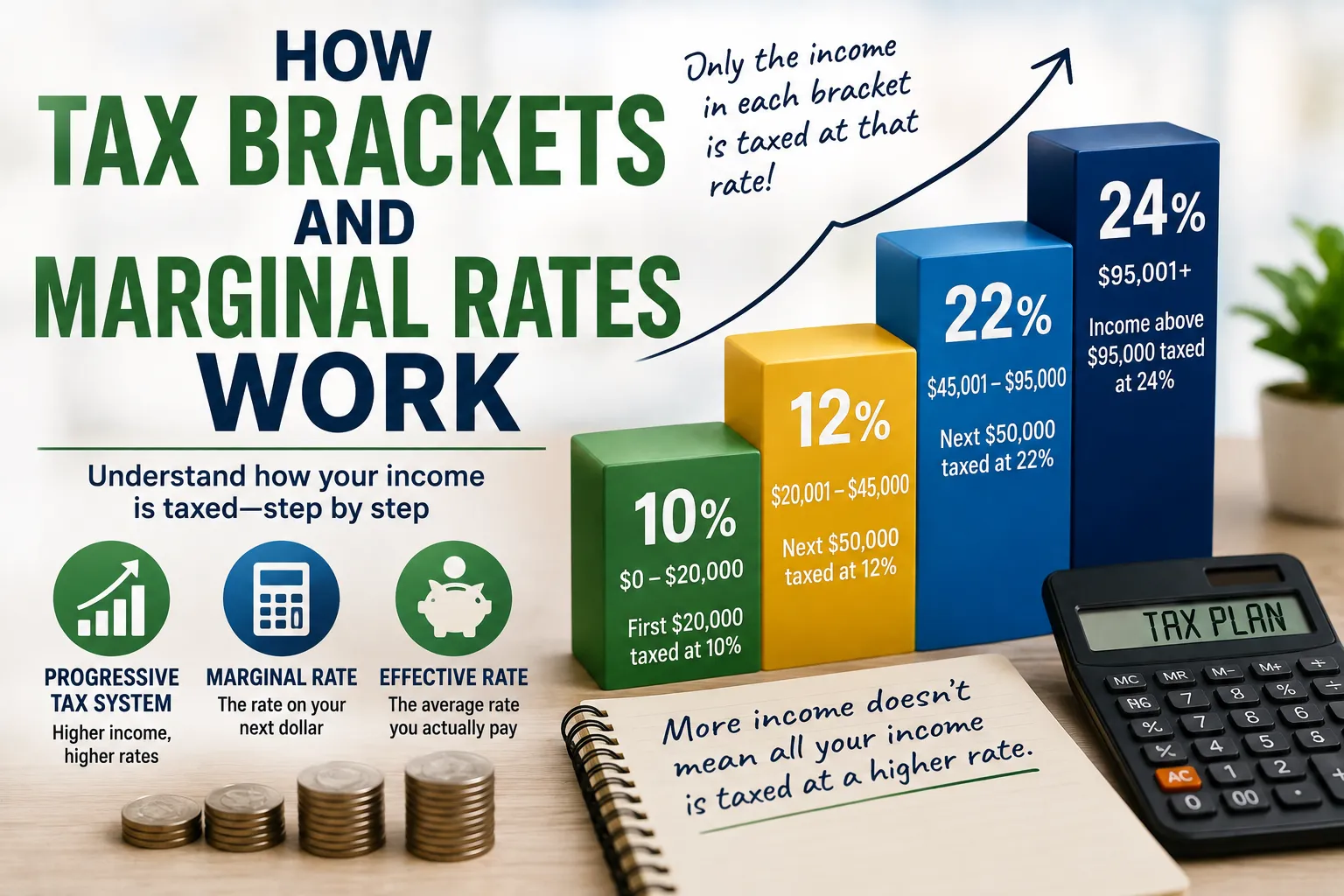
Tax brackets are one of the most misunderstood parts of the income tax system. People sometimes hear that moving into a higher tax bracket means all of their income will suddenly be taxed at a higher rate. In a marginal tax system, that is generally not how it works.
Instead, different portions of taxable income are taxed at different rates. The highest rate that applies to a taxpayer’s income is known as the marginal tax rate, while the percentage of total taxable income actually paid in income tax is the effective tax rate.
Understanding the difference can make it easier to interpret a paycheck, evaluate a raise, estimate a tax bill and make better financial decisions.
For a broader explanation of how tax rules fit together across income, deductions, credits and tax planning, see the Complete Guide to Personal Taxes and Tax Planning.
What Is a Tax Bracket?
A tax bracket is a range of taxable income associated with a particular tax rate.
Under a progressive income tax system, higher portions of taxable income are taxed at progressively higher rates.
For example, imagine a simplified tax system with three brackets:
| Taxable income | Tax rate |
|---|---|
| First $20,000 | 10% |
| Next $30,000 | 20% |
| Income above $50,000 | 30% |
If someone has $60,000 of taxable income, they do not pay 30% on the entire $60,000.
Instead:
- The first $20,000 is taxed at 10%.
- The next $30,000 is taxed at 20%.
- The final $10,000 is taxed at 30%.
The system is designed so that the higher rate applies only to the income that falls within that higher bracket.
What Does Marginal Tax Rate Mean?
Your marginal tax rate is the tax rate applied to your next dollar of taxable income.
If your highest applicable tax bracket is 24%, your marginal federal income tax rate is generally 24%.
That does not mean you pay 24% of every dollar you earn.
Only the portion of taxable income that falls within the relevant bracket is taxed at that rate.
This distinction is especially important when evaluating a salary increase.
If earning an additional $1,000 pushes part of your income into a higher bracket, only the portion that crosses into the higher bracket is generally subject to the higher rate.
Why Moving Into a Higher Bracket Does Not Tax Everything at the Higher Rate
Consider a simplified example.
Suppose the tax brackets are:
- $0–$20,000: 10%
- $20,001–$50,000: 20%
- Above $50,000: 30%
Now suppose your taxable income increases from $49,000 to $51,000.
The additional $2,000 does not cause the entire $51,000 to suddenly be taxed at 30%.
Instead, only the $1,000 above the $50,000 threshold falls into the 30% bracket.
The first portions of income remain taxed at their lower rates.
This is the central concept behind marginal taxation.
Marginal Rate Versus Effective Tax Rate
The two terms sound similar but describe different things.
Marginal Tax Rate
Your marginal tax rate is the rate applied to the next dollar of taxable income.
Effective Tax Rate
Your effective tax rate represents the overall percentage of taxable income that goes toward income tax.
Suppose a taxpayer has $60,000 of taxable income and pays $10,000 in federal income tax.
The effective tax rate would be:
$10,000 ÷ $60,000 = 16.7%
The taxpayer could have a marginal rate of 30% while having an effective rate of only 16.7%.
That is not contradictory.
The marginal rate applies to the highest portion of income, while the effective rate considers the entire tax calculation.
Taxable Income Is Not Always the Same as Salary
Another source of confusion is the difference between gross income and taxable income.
A person’s salary may be $80,000, but that does not necessarily mean the tax brackets are applied directly to $80,000.
Tax calculations can involve various adjustments, deductions and other rules that determine taxable income.
For federal income taxes, taxpayers generally begin with income and then apply the rules that determine what portion is ultimately subject to tax.
This means that knowing someone’s salary alone is not always enough to determine their actual income tax liability.
For a broader explanation of how different forms of income can affect the tax calculation, see the Complete Guide to Income Taxes and Taxable Income.
Standard Deductions Can Change the Calculation
Many taxpayers use a standard deduction rather than itemizing individual deductions.
A deduction reduces the amount of income subject to income tax.
For example, if someone has $70,000 of qualifying income and a hypothetical $15,000 deduction, taxable income could be reduced to $55,000, depending on the applicable tax rules.
The tax brackets would then be applied to the taxable amount rather than the original $70,000.
The actual U.S. standard deduction changes over time and varies according to filing status, so taxpayers should use the figures applicable to the tax year being calculated.
Tax Credits Work Differently From Deductions
Tax deductions and tax credits are often confused.
A deduction reduces taxable income.
A tax credit generally reduces the tax owed directly.
For example, if a taxpayer has $5,000 in calculated income tax and qualifies for a $1,000 tax credit, the credit could reduce the tax liability to $4,000, subject to the specific rules governing that credit.
Because credits reduce tax directly, they can have a different impact from deductions.
For a more detailed explanation of how these two tools work, see the Complete Guide to Tax Deductions and Credits.
Filing Status Matters
Tax brackets are not necessarily identical for everyone.
In the United States, federal income tax brackets depend partly on filing status.
Common filing statuses include:
- Single
- Married filing jointly
- Married filing separately
- Head of household
The income thresholds associated with tax rates can differ among these categories.
That means two households with the same total income can potentially face different federal income tax calculations depending on their circumstances and filing status.
Brackets Apply to Taxable Income
When people discuss “being in the 24% bracket,” they are generally referring to taxable income reaching the range associated with that marginal rate.
This is different from saying someone earns enough money to have an entire salary taxed at 24%.
A progressive tax system divides taxable income into portions.
Each portion is then taxed according to the applicable rate.
The calculation can therefore be thought of as a series of layers rather than one rate applied to everything.
A Simple Example of Progressive Taxation
Imagine a hypothetical system:
| Income portion | Rate |
|---|---|
| First $15,000 | 10% |
| Next $25,000 | 15% |
| Next $40,000 | 20% |
| Above $80,000 | 25% |
Suppose someone has $100,000 of taxable income.
Their hypothetical tax would be:
- $15,000 × 10% = $1,500
- $25,000 × 15% = $3,750
- $40,000 × 20% = $8,000
- $20,000 × 25% = $5,000
Total tax:
$18,250
The effective tax rate would be:
$18,250 ÷ $100,000 = 18.25%
The marginal rate is 25%, but the effective rate is only 18.25%.
This illustrates why the highest tax bracket does not represent the percentage of total income paid in tax.
What Happens When You Get a Raise?
A common concern is that a raise could leave someone with less money because it pushes them into a higher tax bracket.
Under a progressive marginal system, simply entering a higher bracket does not normally make the entire income subject to the new higher rate.
Suppose a taxpayer earns $79,000 and receives a $5,000 raise.
If the next bracket begins at $80,000, only the portion of taxable income above that threshold would be taxed at the higher marginal rate.
The rest remains subject to the lower rates.
A higher salary can therefore still increase after-tax income even when some additional income is taxed at a higher rate.
Why Raises Can Still Feel Smaller Than Expected
Although moving into a higher bracket does not tax all income at the higher rate, the additional earnings can still be reduced by several types of deductions and taxes.
A paycheck may reflect:
- Federal income tax withholding
- State or local income tax
- Social Security taxes
- Medicare taxes
- Retirement contributions
- Health insurance premiums
- Other payroll deductions
As a result, the amount added to a paycheck after a raise can be significantly smaller than the gross increase in salary.
That does not mean the entire raise was taxed at the highest income tax bracket.
Tax Brackets and Payroll Withholding Are Different
Another important distinction is between tax liability and tax withholding.
Your tax liability is the amount of tax you ultimately owe under the tax rules.
Withholding is money taken from your paycheck during the year and sent toward your expected tax obligation.
At tax-filing time, the amount withheld is compared with the tax actually owed.
If too much was withheld, you may receive a refund.
If too little was withheld, you may owe additional tax.
A refund therefore does not necessarily mean you paid less tax overall. It generally means more money was withheld during the year than was ultimately required.
Why Tax Brackets Are Adjusted
Tax brackets can change from year to year.
In the United States, federal income tax brackets are generally adjusted for inflation.
This helps prevent inflation alone from automatically pushing taxpayers into higher brackets as nominal wages and prices increase.
Without adjustments, a worker could earn a larger dollar salary simply because prices have risen while having little or no increase in real purchasing power.
Inflation adjustments help address that issue.
Bracket Creep Explained
The phenomenon of rising into higher tax brackets because income increases faster than bracket thresholds is often referred to as bracket creep.
Imagine that prices rise significantly and an employee receives a pay increase primarily to keep up with inflation.
If tax thresholds did not adjust, more of the employee’s nominal income could move into higher brackets even though their purchasing power had not increased substantially.
Inflation indexing is intended to reduce this effect for federal income tax brackets.
State Income Taxes Can Work Differently
Federal tax brackets are only part of the overall picture.
Some states impose their own income taxes, and the structure varies considerably.
A state may use:
- Progressive tax brackets
- A flat income tax rate
- No broad individual income tax
- Different deductions and credits
- Different treatment of particular types of income
Someone evaluating their total tax burden therefore needs to consider both federal and applicable state or local rules.
Different Types of Income Can Be Taxed Differently
Not all income is necessarily taxed under the same rules.
For many taxpayers, ordinary wages and other ordinary income are subject to ordinary income tax rates.
Certain investment income can be subject to different federal tax rules.
For example, qualified dividends and long-term capital gains may receive preferential federal tax treatment when the applicable requirements are met.
This means that a taxpayer’s overall tax situation cannot always be understood simply by looking at their salary.
Why Investment Income Adds Complexity
Suppose someone earns income from both employment and investments.
Their wages may be included in ordinary taxable income, while qualifying long-term capital gains may be taxed under separate rates.
The interaction between different types of income can make tax planning more complicated.
Investors should therefore avoid assuming that their marginal wage tax rate automatically applies to every dollar of investment income.
For more detail on the tax treatment of interest, dividends, capital gains and investment accounts, see how investment income and capital gains are taxed.
Tax Brackets and Retirement Contributions
Retirement contributions can also affect taxable income depending on the type of account and contribution.
For example, qualifying contributions to certain traditional retirement arrangements can potentially reduce taxable income under applicable rules.
That can affect how much income falls into each tax bracket.
Roth contributions generally work differently because contributions are made with after-tax money rather than providing the same type of upfront deduction.
The choice between traditional and Roth retirement savings involves more than tax brackets, but understanding marginal rates is an important part of the decision.
Why Marginal Rates Matter in Tax Planning
Marginal tax rates can be useful when making financial decisions because they help estimate the tax effect of additional taxable income or deductions.
For example, a taxpayer considering a deductible contribution may want to understand which portion of income the deduction could affect.
Similarly, someone considering additional taxable earnings can estimate the rate that may apply to the additional income.
Tax planning is therefore not simply about finding the lowest possible tax rate.
It is about understanding how different decisions affect taxable income and the overall tax calculation.
Deductions Become More Valuable at Higher Marginal Rates
The tax value of a deduction can depend on the taxpayer’s marginal rate.
Suppose a hypothetical $1,000 deduction reduces income that would otherwise have been taxed at 24%.
The federal income tax reduction associated with that portion could be approximately:
$1,000 × 24% = $240
If the same deduction reduced income taxed at 12%, the corresponding reduction could be approximately $120.
This is why marginal tax rates matter when evaluating deductions.
The exact result depends on the taxpayer’s full tax situation and the specific deduction.
Credits Can Be Especially Powerful
Tax credits can have a direct impact on tax liability.
A $1,000 qualifying credit can potentially reduce tax owed by $1,000, subject to the rules governing the particular credit.
Some credits are refundable, meaning they may provide a benefit beyond reducing tax liability, while others are nonrefundable and generally cannot reduce tax below zero.
Because credits vary significantly, taxpayers should examine the eligibility requirements rather than assuming every credit works the same way.
Tax Brackets Do Not Tell the Whole Financial Story
A person’s tax bracket is only one piece of their financial picture.
Two people in the same marginal bracket can have very different:
- Gross incomes
- Taxable incomes
- Deductions
- Tax credits
- Investment income
- State taxes
- Payroll taxes
- Retirement contributions
- Household expenses
As a result, tax bracket information should not be interpreted as a complete measure of someone’s tax burden.
Common Tax-Bracket Mistakes
Several misconceptions appear repeatedly.
“If I enter a higher bracket, all my income is taxed at that rate.”
Generally false under a progressive marginal tax system.
“My tax bracket is my effective tax rate.”
Not necessarily. Your marginal rate and effective rate measure different things.
“A tax refund means I paid no taxes.”
A refund generally means you had more tax withheld or paid during the year than your final calculated liability.
“A deduction and a credit are the same.”
They are not. A deduction generally reduces taxable income, while a credit generally reduces tax directly.
“A higher salary can make me poorer because of taxes.”
A higher marginal rate on additional income does not normally erase the value of the entire raise.
A Better Way to Think About Your Tax Rate
Instead of asking, “What tax rate do I pay?”, it can be more useful to ask three separate questions:
- What is my marginal tax rate?
- What is my effective tax rate?
- What other taxes and deductions affect my take-home income?
The answers provide a much clearer picture.
Someone might have a 24% marginal federal income tax rate but pay a considerably lower percentage of taxable income in federal income tax overall.
Their paycheck could also reflect payroll taxes, state taxes and other deductions.
Using Tax Brackets to Make Better Decisions
Understanding marginal tax rates can make financial decisions less intimidating.
A raise does not automatically make every dollar more expensive to tax.
A deductible contribution does not necessarily save money at your highest rate for every dollar.
A tax credit is not the same as a deduction.
And a tax bracket is not the same thing as the percentage of income ultimately paid in federal income tax.
The most useful habit is to think of the tax system in layers.
Your income enters the calculation, adjustments and deductions can reduce taxable income, different portions of that taxable income fall into different brackets, and credits can then reduce the resulting tax liability.
Where Tax Brackets Fit Into a Bigger Financial Plan
Tax brackets are ultimately a tool for understanding how the tax system interacts with income.
Knowing your marginal rate can help you evaluate raises, bonuses, retirement contributions, investment decisions and other financial choices. Knowing your effective rate can help you understand the broader tax burden represented by your income tax bill.
It is also useful to think about tax planning throughout the year rather than waiting until a return is due. A year-round approach can help taxpayers respond when income, deductions, investments or family circumstances change.
Most importantly, understanding how progressive taxation works can prevent one of the most common tax misconceptions: earning enough to enter a higher bracket does not generally mean your entire income is suddenly taxed at that higher rate.
Once the difference between marginal and effective tax rates becomes clear, tax brackets stop looking like arbitrary thresholds and start making sense as layers within a larger calculation. That knowledge can help households make more informed financial decisions and avoid costly misunderstandings when planning for taxes.