How to Build a Personal Money Toolset
Managing money becomes easier when the right information is available at the right time. Instead of relying on scattered bank statements, notes, spreadsheets, calculators, and financial apps, people can build a personal money toolset that brings their most important financial tasks into a more organized system.
A personal money toolset does not need to be complicated. For one person, it might consist of a budgeting spreadsheet, an expense tracker, a savings calculator, and a banking app. Someone with more complex finances might also use investment tracking, net worth software, debt calculators, tax tools, and a personal financial dashboard.
The goal is not to collect as many financial tools as possible. It is to choose tools that answer useful questions and make everyday money decisions easier to understand.
What Is a Personal Money Toolset?
A personal money toolset is a collection of financial tools used to organize, analyze, and manage different parts of a person’s finances.
These tools can help with:
- Budgeting
- Expense tracking
- Cash flow management
- Saving
- Debt repayment
- Investing
- Net worth tracking
- Financial planning
- Calculations
- Record keeping
- Financial decision-making
Some tools may be standalone applications, while others may be features included within a bank account or financial platform.
Why Build a Personal Money Toolset?
Money management involves many different questions.
You might want to know:
- Where did my money go this month?
- How much can I save?
- Can I afford a particular purchase?
- How quickly can I repay a debt?
- How much will my savings grow?
- What is my current net worth?
- How much should I set aside for an upcoming expense?
- How will a change in income affect my budget?
One tool rarely answers all of these questions effectively.
A personal money toolset allows different tools to perform different jobs while giving you a clearer overall view of your finances.
Start With Your Financial Goals
Before choosing tools, identify what you are trying to accomplish.
Your priorities might include:
- Building an emergency fund
- Reducing debt
- Controlling spending
- Saving for a home
- Planning for education
- Preparing for retirement
- Managing irregular income
- Tracking investments
- Understanding household cash flow
Your goals should determine which tools you need.
For example, someone primarily trying to control monthly spending may benefit more from expense tracking than from an advanced investment analytics platform.
Use a Budgeting Tool
A budgeting tool helps organize expected income and expenses.
It can show:
- Monthly income
- Fixed expenses
- Variable expenses
- Savings contributions
- Debt payments
- Discretionary spending
- Remaining cash
A simple spreadsheet can perform this role, although dedicated budgeting applications may automate some tasks.
The important thing is that the tool makes your financial priorities visible.
Add an Expense Tracker
A budget describes what you plan to spend. An expense tracker shows what you actually spent.
This distinction matters.
Suppose a household budgets $400 for dining and entertainment but spends $550. The expense tracker reveals the difference between the plan and reality.
Expense tracking can categorize spending into areas such as:
- Housing
- Food
- Transportation
- Utilities
- Entertainment
- Shopping
- Healthcare
- Education
- Debt payments
- Savings
The How Expense Tracking and Cash Flow Tools Help Manage Household Finances guide provides additional information about using these tools to understand household finances.
Understand Cash Flow
Cash flow focuses on the movement of money into and out of your accounts over time.
This can be especially important when income and expenses occur on different schedules.
For example, someone might receive income twice a month while rent, insurance, utilities, subscriptions, and loan payments are withdrawn on different dates.
A cash flow tool can help identify periods when the account balance may become unusually low even if total monthly income is sufficient.
Create a Savings Calculator
A savings calculator can help translate a financial goal into a regular contribution.
Suppose you want to save $6,000 over 12 months and are starting from zero.
A simple calculation is:
$6,000 ÷ 12 = $500 per month
More advanced calculators can incorporate:
- Starting balance
- Regular contributions
- Interest or investment returns
- Contribution frequency
- Time horizon
This can help turn a broad goal into a specific savings target.
Add a Debt Repayment Tool
Debt calculators can help estimate how payment amounts and interest affect repayment timelines.
Useful inputs may include:
- Current balance
- Interest rate
- Minimum payment
- Additional payment
- Payment frequency
A calculator can demonstrate how making additional payments could affect the projected repayment period, although actual results depend on the terms of the specific debt.
Use Financial Calculators for Specific Decisions
Financial calculators can answer focused questions without requiring a complete financial management platform.
Examples include:
- Loan payment calculators
- Mortgage calculators
- Compound interest calculators
- Savings calculators
- Retirement calculators
- Debt payoff calculators
- Investment return calculators
- Inflation calculators
The Complete Guide to Financial Tools and Calculators provides a broader look at the different types of calculators available and what they can help users evaluate.
Build a Personal Financial Dashboard
Once you have several financial tools, a dashboard can bring important information together.
A personal financial dashboard might display:
- Account balances
- Monthly spending
- Savings progress
- Debt balances
- Investments
- Net worth
- Upcoming bills
- Financial goals
The What a Personal Financial Dashboard Does guide explains how dashboards can organize financial information into a more centralized view.
A dashboard does not necessarily replace the individual tools. Instead, it can make their most important outputs easier to review.
Add Net Worth Tracking
Net worth provides a broader view of financial position.
A simplified calculation is:
Net worth = Total assets − Total liabilities
Assets can include:
- Cash
- Savings
- Investments
- Property
- Other valuable assets
Liabilities can include:
- Mortgages
- Credit card balances
- Student loans
- Auto loans
- Personal loans
- Other debts
The How Net Worth Tracking Actually Works guide provides more detail about calculating and monitoring net worth.
Understand the Difference Between Balance and Net Worth
An account balance tells you how much money is currently in a particular account.
Net worth provides a much broader picture.
For example, someone might have $20,000 in a savings account but also owe $150,000 on a mortgage.
Looking only at the savings balance does not show the person’s complete financial position.
This is why a personal money toolset should ideally include both short-term cash information and broader financial measurements.
Track Recurring Bills
Recurring bills can be easy to overlook when they are automatically charged.
A toolset can include a recurring-bill tracker showing:
| Bill | Frequency | Amount | Payment date |
|---|---|---|---|
| Rent | Monthly | $1,200 | 1st |
| Internet | Monthly | $60 | 10th |
| Insurance | Monthly | $100 | 15th |
| Streaming | Monthly | $15 | 20th |
The amounts will vary by household.
The purpose is to make recurring commitments visible so they can be incorporated into cash flow planning.
Add a Subscription Tracker
Subscriptions can represent relatively small individual expenses that become significant when combined.
A subscription tracker can help identify:
- Active services
- Monthly cost
- Annual cost
- Renewal dates
- Services no longer being used
Reviewing subscriptions periodically can help prevent forgotten recurring charges from remaining in a household budget indefinitely.
Consider an Investment Tracking Tool
People with investments may want a separate tool for monitoring their portfolio.
An investment tracker can show:
- Holdings
- Current values
- Contributions
- Asset allocation
- Historical performance
- Dividends or distributions
- Investment transactions
Investment tracking should support understanding and record keeping rather than encourage constant reactions to short-term market movements.
Add an Asset Allocation Tool if Necessary
Investors with multiple asset types may use tools that show how their portfolio is distributed.
For example, a portfolio might contain:
- Stocks
- Bonds
- Cash
- Real estate investments
- Other assets
An allocation tool can help show whether the current portfolio differs from the investor’s intended structure.
The usefulness of such a tool depends on the complexity of the person’s investment strategy.
Build a Tool for Irregular Expenses
Not every expense occurs monthly.
Examples include:
- Insurance premiums
- Property taxes
- School expenses
- Annual subscriptions
- Vehicle maintenance
- Home repairs
- Holiday spending
A sinking-fund or irregular-expense tracker can divide an expected annual cost into smaller regular contributions.
For example, if an annual expense is expected to cost $1,200, setting aside approximately $100 per month creates a dedicated reserve.
Include a Financial Calendar
A financial calendar can organize important dates.
It might include:
- Paydays
- Rent or mortgage payments
- Loan payments
- Insurance renewals
- Tax deadlines
- Subscription renewals
- Savings transfers
- Investment contributions
This can be particularly useful for people managing multiple accounts or irregular income.
Choose Automation Carefully
Automation can reduce repetitive financial tasks.
Depending on the tools available, you may be able to automate:
- Savings transfers
- Bill payments
- Account updates
- Expense categorization
- Investment contributions
- Budget notifications
Automation can save time, but automated transactions should still be monitored.
An automatic payment can still cause an overdraft if insufficient funds are available, and an automatic subscription can continue even after it is no longer useful.
Avoid Using Too Many Tools
More financial tools do not necessarily mean better financial management.
Using five different applications that duplicate the same functions can make finances harder to understand.
Too many tools can lead to:
- Duplicate information
- Conflicting balances
- Multiple notifications
- Unnecessary subscriptions
- More maintenance
- Confusion about which figures are current
A smaller collection of reliable tools may be easier to maintain.
Look for Tools That Work Together
When possible, choose tools that complement one another.
For example:
Banking app → Expense tracker → Budget → Financial dashboard
Or:
Investment accounts → Portfolio tracker → Net worth tracker
The exact arrangement depends on your financial situation.
The goal is to reduce manual duplication while maintaining enough control to verify that the information is accurate.
Keep a Manual Backup
Automation can make financial management easier, but maintaining some independent records can be useful.
A simple spreadsheet or document can record:
- Major account balances
- Debt balances
- Important financial goals
- Insurance information
- Recurring obligations
- Major assets
- Important financial dates
This provides a backup reference if an application changes, becomes unavailable, or displays incorrect information.
Review Data for Accuracy
Financial tools are only as useful as the information they contain.
Check periodically for:
- Duplicate transactions
- Missing transactions
- Incorrect categories
- Outdated account balances
- Closed accounts
- Incorrect debt balances
- Incorrect investment values
Automated financial tools can reduce manual work, but they do not eliminate the need for occasional verification.
Protect Financial Information
Personal money tools often contain highly sensitive information.
Good security practices include:
- Using strong passwords
- Enabling multifactor authentication where available
- Keeping devices updated
- Avoiding unnecessary account sharing
- Reviewing connected accounts
- Monitoring financial transactions
- Removing access from services no longer used
Before connecting financial accounts to an application, understand what information the service can access and how the connection works.
Decide What Information You Actually Need
Not every financial metric is useful to every person.
For example, someone focused on reducing debt may need:
- Debt balances
- Interest rates
- Minimum payments
- Repayment timelines
- Monthly cash flow
Someone focused on investing may need:
- Portfolio allocation
- Contributions
- Holdings
- Investment performance
- Account balances
The toolset should reflect the decisions you need to make.
Build Around Financial Questions
A useful way to choose financial tools is to start with questions rather than applications.
Ask:
“Where is my money going?”
Use an expense tracker.
“Can I afford this payment?”
Use a budgeting or cash flow tool.
“How quickly can I repay this debt?”
Use a debt calculator.
“How much progress am I making?”
Use goal tracking.
“What is my overall financial position?”
Use net worth tracking.
“What does my financial picture look like in one place?”
Use a personal dashboard.
This approach prevents the toolset from becoming a collection of applications without a clear purpose.
Create a Simple Financial Workflow
A personal money toolset works best when the tools fit into a repeatable routine.
For example:
Daily or Weekly
Review recent transactions and unusual account activity.
Monthly
Review:
- Spending
- Income
- Budget performance
- Savings
- Upcoming bills
Quarterly
Review:
- Debt progress
- Savings goals
- Net worth
- Investments
- Recurring subscriptions
Annually
Review:
- Financial goals
- Major expenses
- Insurance
- Investment strategy
- Long-term plans
- Overall financial organization
The exact frequency can be adjusted to personal needs.
Separate Tracking From Decision-Making
A financial tool can tell you what happened without telling you what you should do.
For example, an expense tracker might show that transportation spending increased by 20%.
The tool provides the information.
You then need to determine why the change occurred and whether anything should change.
This distinction helps prevent financial software from being treated as a substitute for judgment.
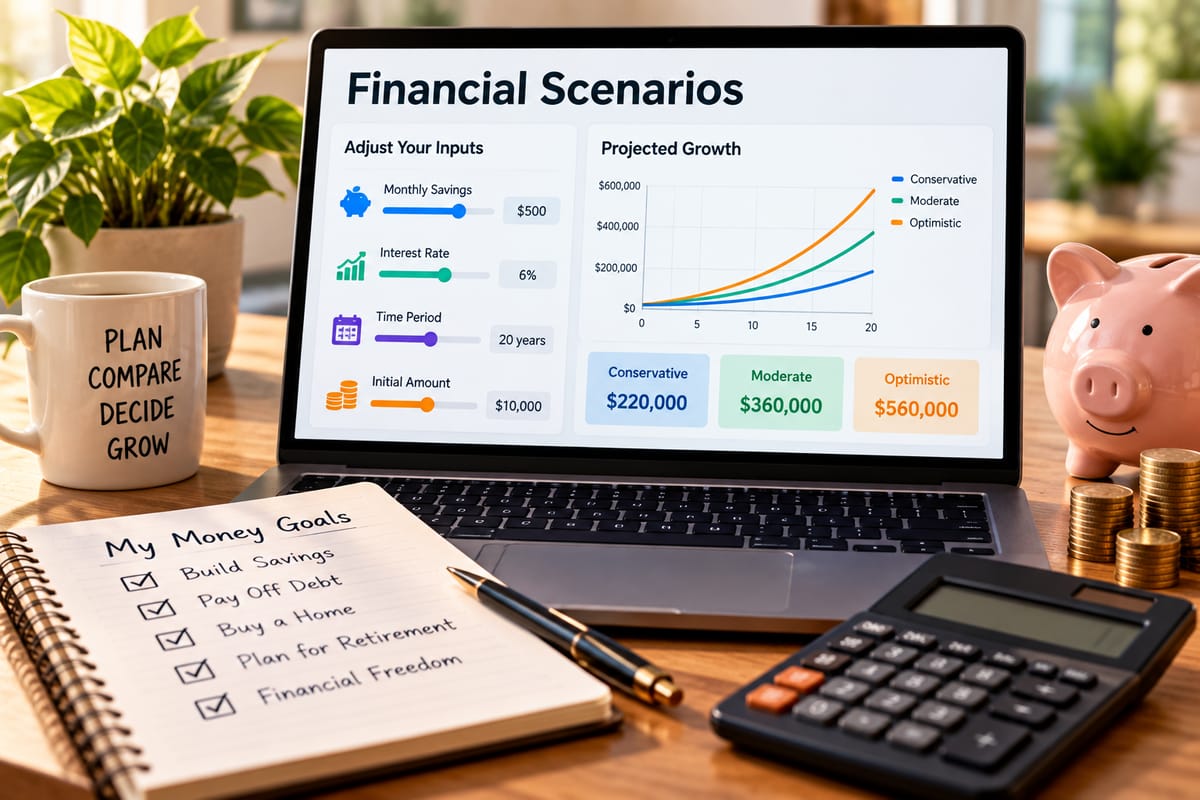
Use Tools to Test Scenarios
Some financial tools allow users to model hypothetical situations.
For example, you could examine what might happen if:
- Savings contributions increase
- A debt payment increases
- Income changes
- A major purchase occurs
- A loan has a different interest rate
- Retirement contributions change
Scenario analysis can make abstract financial decisions easier to understand.
However, projections are estimates rather than guarantees. Actual outcomes can differ from assumptions.
Don’t Ignore Cash Flow Just Because Net Worth Is Growing
A household can have valuable assets and still experience short-term cash flow problems.
For example, someone may own property or investments while having insufficient cash available to cover an upcoming bill.
This is why a complete personal money toolset should ideally distinguish between:
- Cash available now
- Monthly cash flow
- Assets
- Liabilities
- Net worth
Each measurement answers a different financial question.
Make the Toolset Easy to Maintain
A toolset that requires hours of manual data entry every week may eventually become difficult to maintain.
Look for ways to simplify the process.
You can:
- Automate recurring entries
- Use consistent categories
- Remove unnecessary metrics
- Consolidate duplicate tools
- Review financial information on a regular schedule
- Keep only tools that provide useful information
Simplicity can be a major advantage.
Review the Toolset Periodically
Your financial needs can change.
A tool that was useful when you were paying off debt may become less important after the debt is cleared.
Likewise, buying a home, starting a business, changing jobs, investing, or preparing for retirement can create new financial information needs.
Review your toolset periodically and ask:
- Is this tool still useful?
- Am I actually using it?
- Does it provide information I need?
- Is there duplication?
- Is the information accurate?
- Is the cost justified?
A Basic Personal Money Toolset
Someone starting from scratch could begin with five core tools:
- Budgeting tool — plans income and expenses.
- Expense tracker — records actual spending.
- Savings calculator or goal tracker — measures progress toward financial targets.
- Debt tracker — monitors balances and repayment progress.
- Net worth tracker — provides a broader view of assets and liabilities.
A financial dashboard can then bring the most important information together.
More advanced tools can be added only when they solve a specific problem.
An Example of a Connected Money Toolset
Consider a household that wants to improve its financial organization.
It might use:
Banking app
Tracks account balances and transactions.
↓
Expense tracker
Categorizes spending.
↓
Budgeting tool
Compares actual spending with planned spending.
↓
Savings tracker
Measures progress toward emergency and other savings goals.
↓
Debt tracker
Monitors loans and repayment progress.
↓
Net worth tracker
Combines assets and liabilities.
↓
Financial dashboard
Provides a summarized view of the overall financial position.
The individual tools each have a specific role rather than attempting to do everything.
When a Spreadsheet May Be Enough
Not everyone needs a specialized financial application.
A spreadsheet can be sufficient for someone who wants to track:
- Income
- Expenses
- Savings
- Debt
- Net worth
Spreadsheets can also be customized extensively.
Their main disadvantage is that information may need to be entered and updated manually.
For someone with relatively simple finances, however, that may not be a significant problem.
When Specialized Tools Become Useful
More specialized financial tools may become valuable when finances become more complex.
Examples include:
- Multiple bank accounts
- Several credit cards
- Multiple investment accounts
- Rental properties
- Business income
- Irregular income
- Complex debt
- Multiple savings goals
The key is to add complexity only when it provides a practical benefit.
The Goal Is Better Financial Visibility
A personal money toolset should ultimately make financial information easier to understand.
It can help answer three broad questions:
Where am I now?
Use account balances, expenses, debts, assets, and net worth.
Where am I going?
Use goals, budgets, savings plans, and debt repayment projections.
What could happen next?
Use calculators and scenario-planning tools to explore potential outcomes.
When these functions work together, financial decisions can become more structured and less dependent on guesswork.
Building a Money Toolset That Grows With You
A personal money toolset does not have to be built all at once. Start with the financial questions that matter most, choose simple tools that answer those questions, and add new capabilities as your financial situation becomes more complex.
The most useful toolset is not necessarily the largest one. It is the one that gives you accurate, understandable information about spending, cash flow, savings, debt, assets, and goals without creating unnecessary administrative work.
By combining practical tracking tools with calculators, dashboards, and regular financial reviews, you can create a system that turns scattered financial information into a clearer picture of where your money is going and how your financial plans are progressing.