How to Budget With Irregular Income
Creating a household budget is easier when the same amount of money arrives on the same day every month. For freelancers, contractors, commission-based workers, seasonal employees, business owners, and households with multiple income sources, however, monthly income can change considerably.
An irregular income does not make budgeting impossible. It simply requires a different approach.
Instead of building a budget around a fixed paycheck, households with variable earnings can focus on essential expenses, minimum income expectations, cash reserves, flexible spending limits, and longer-term financial goals. The objective is to create a system that works during both strong and weak income months.
What Is Irregular Income?
Irregular income is money that does not arrive in a consistent amount or on a predictable schedule.
Examples can include:
- Freelance payments
- Sales commissions
- Business profits
- Seasonal wages
- Contract work
- Tips
- Bonuses
- Gig-work earnings
- Royalties
- Performance-based compensation
- Multiple income sources that fluctuate throughout the year
Some people have income that varies every month, while others experience predictable seasonal patterns.
For example, a freelancer might earn substantially more in some months because of large projects, while a seasonal worker may earn most of their annual income during a particular part of the year.
Understanding the pattern is an important first step toward building a workable budget.
Why Budgeting With Irregular Income Is Different
Traditional budgeting often starts with a simple calculation: expected monthly income minus expected monthly expenses.
That approach can become problematic when income changes significantly from month to month.
If a household earns unusually high income in one month, it may be tempting to increase spending immediately. When income falls the following month, the household may then struggle to cover regular bills.
The solution is to separate income timing from spending needs.
Rather than spending based entirely on what came in this month, households can use stronger income periods to prepare for future months.
Start by Calculating Essential Expenses
Before deciding how much to spend, determine the minimum amount needed to keep the household operating.
Essential expenses can include:
- Housing
- Utilities
- Groceries
- Transportation
- Insurance
- Minimum debt payments
- Healthcare costs
- Childcare
- Essential household supplies
These expenses create the foundation of the budget.
The first goal is to ensure that even a lower-income month has a plan for covering the most important obligations.
Calculate Your Minimum Monthly Income
Instead of budgeting around an optimistic income estimate, look at actual earnings over a longer period.
Review the previous six to twelve months if reliable records are available.
Calculate:
- Lowest monthly income
- Highest monthly income
- Average monthly income
- Typical monthly income
- Seasonal patterns
- Income sources
- Timing of major payments
Using a conservative income figure can make the budget more resilient.
For example, someone who earns between $2,000 and $5,000 per month might build their basic spending plan around a lower figure rather than assuming they will consistently earn $5,000.
The exact approach depends on the household’s circumstances, but the principle is straightforward: build recurring commitments around income that is reasonably dependable, not income that only appears during unusually strong months.
Create a Base Budget
A base budget covers the expenses that need to be paid regardless of how much income arrives.
It might include:
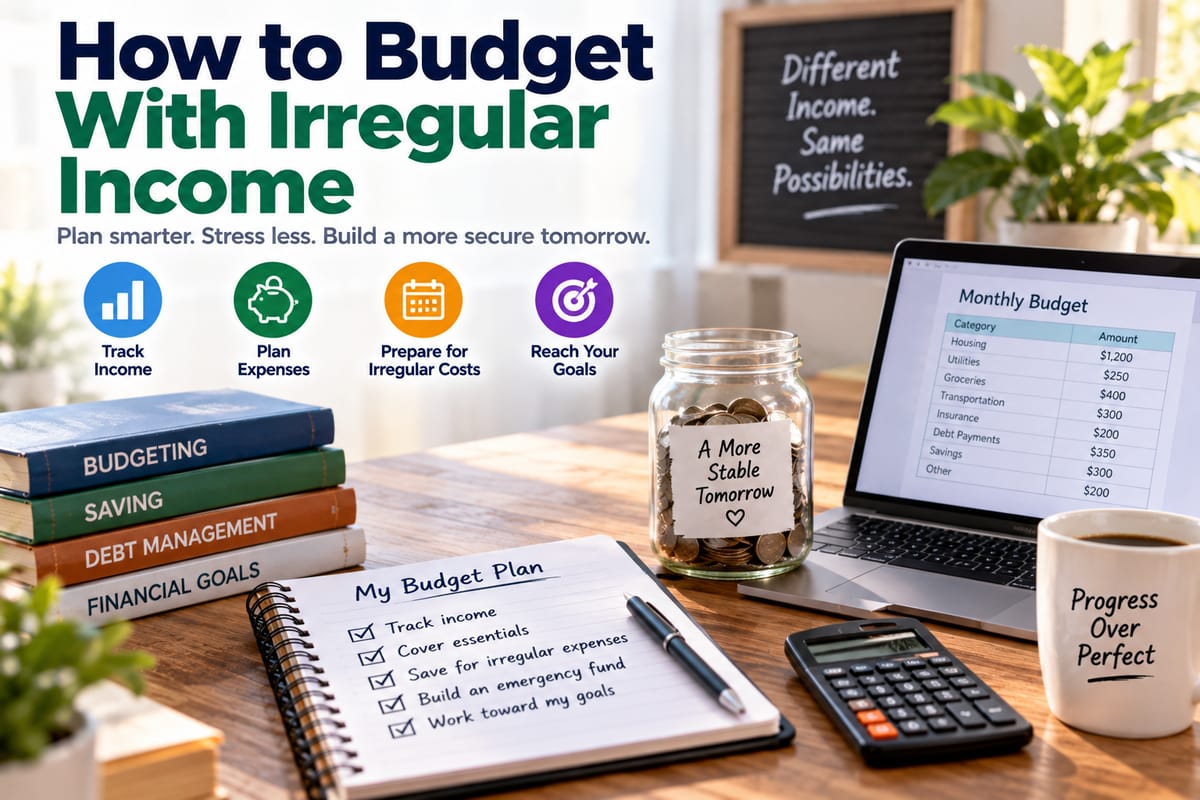
| Category | Monthly Amount |
|---|---|
| Housing | $1,000 |
| Utilities | $200 |
| Groceries | $450 |
| Transportation | $250 |
| Insurance | $150 |
| Debt minimums | $200 |
| Essential household costs | $150 |
| Total | $2,400 |
The numbers will vary from household to household. The purpose is to establish a clear minimum spending level.
When income is higher than this amount, the surplus can be directed toward savings, irregular expenses, debt reduction, or other financial priorities.
Separate Essential and Flexible Spending
Not every expense has the same level of urgency.
Essential expenses generally need to be paid regardless of income. Flexible spending can often be adjusted when earnings are lower.
Flexible categories may include:
- Entertainment
- Dining out
- Nonessential shopping
- Travel
- Hobbies
- Subscriptions
- Optional upgrades
- Recreational activities
Separating these categories gives households more control during weaker months.
When income falls, flexible spending can be reduced without immediately affecting housing, food, utilities, or other essential obligations.
Build a Cash Buffer
An emergency fund is particularly useful when income fluctuates.
Someone with a variable income may need a larger cash reserve than someone whose paycheck is highly predictable because the risk of an unusually weak month is greater.
The cash buffer can help cover essential expenses when income temporarily falls below normal levels.
Rather than viewing savings as money that should always be invested or spent toward a goal, part of the balance can serve as a financial shock absorber.
Use Strong Months Strategically
Irregular income can create unusually strong months.
The temptation may be to increase spending immediately, especially after several months of lower earnings.
Instead, consider giving extra income specific jobs.
For example, additional money could be divided between:
- Emergency savings
- Upcoming annual expenses
- Debt repayment
- Retirement savings
- Tax reserves
- Household goals
- Necessary purchases
This approach can turn high-income months into preparation for lower-income periods.
Create an Income Smoothing System
One useful strategy is to treat variable income as though it were a regular paycheck.
Instead of spending directly from every payment, the household can direct income into a central account or reserve and then transfer a planned amount for regular household spending.
For example, suppose income varies considerably throughout the year. The household could build a cash reserve during stronger months and use that reserve to maintain a more consistent spending amount during weaker months.
This can make everyday budgeting feel more predictable even when earnings are not.
For more ideas on handling fluctuations, how to manage uneven household cash flow explores ways households can organize money when income and expenses do not arrive evenly.
Plan for Taxes When Income Is Not Automatically Withheld
Some irregular-income workers are responsible for setting aside their own taxes.
This creates an important budgeting category that should not be confused with disposable income.
If taxes are likely to be owed later, part of each payment should be reserved for that obligation.
The appropriate amount depends on the individual’s tax situation and jurisdiction, so professional tax advice may be appropriate when the situation is complicated.
The key budgeting principle is simple: money reserved for future taxes should not be treated as available spending money.
Budget for Irregular Expenses
Some expenses are predictable even though they do not occur every month.
Examples include:
- Annual insurance payments
- Property taxes
- Vehicle maintenance
- School expenses
- Holiday spending
- Home repairs
- Medical expenses
- Professional fees
- Membership renewals
- Annual subscriptions
These costs can cause problems when they are treated as surprises.
A household can estimate the annual cost and divide it across the year.
For example, if an expense is expected to cost $1,200 annually, setting aside approximately $100 per month creates a dedicated reserve for that expense.
The approach is explained further in how families can budget for irregular expenses.
Use Sinking Funds
A sinking fund is money set aside gradually for a known future expense.
Separate sinking funds can be created for categories such as:
- Car repairs
- Home maintenance
- Holidays
- School costs
- Insurance
- Technology replacement
- Medical expenses
Sinking funds can be particularly useful for irregular-income households because they reduce the chance that a large expense will have to be funded entirely from one month’s income.
Build a Family Budget Around Priorities
If multiple people share household finances, everyone should understand the basic spending priorities.
A family budget can identify:
- Essential household expenses
- Debt obligations
- Emergency savings
- Irregular expenses
- Short-term goals
- Long-term goals
- Flexible spending
How to build a family budget provides additional guidance for organizing household income and expenses around shared financial responsibilities.
A clear structure can also reduce disagreements because household members have a common understanding of where money needs to go first.
Avoid Lifestyle Inflation
One of the biggest challenges associated with irregular income is lifestyle inflation.
When earnings rise, it can feel reasonable to upgrade housing, vehicles, entertainment, dining, travel, or other areas of life.
The problem is that higher expenses can become permanent while higher income may not be.
If income subsequently falls, the household may still be responsible for the larger commitments.
A safer approach is to treat unusually strong income as an opportunity to strengthen savings and financial stability before permanently increasing recurring expenses.
Decide What Happens to Extra Income
A written rule for surplus income can make irregular budgeting easier.
For example, a household might decide that money above its monthly base budget will be allocated among several priorities.
A hypothetical structure could be:
- 30% to emergency savings
- 25% to irregular expenses
- 20% to debt reduction
- 15% to long-term investments
- 10% to discretionary spending
These percentages are only an example. Every household has different priorities, obligations, tax circumstances, and financial goals.
The important point is to decide what happens to surplus income before it arrives.
Give Every Income Payment a Job
Variable income can feel unpredictable when payments are viewed individually.
A payment of $1,500 might appear to be available for spending, but some of that money may actually need to cover future taxes, annual bills, savings, or household expenses.
Assigning each payment to specific categories can prevent accidental overspending.
A simple system might divide every incoming payment into:
- Current expenses
- Taxes
- Emergency savings
- Irregular expenses
- Long-term goals
- Flexible spending
The percentages can change depending on the household’s needs.
Adjust the Budget When Income Changes
A budget for irregular income should be reviewed regularly.
If earnings have changed significantly, revisit:
- Essential expenses
- Savings targets
- Debt payments
- Discretionary spending
- Tax reserves
- Irregular expense funds
- Financial goals
A budget should reflect current circumstances rather than becoming a document that is created once and never updated.
Set Spending Limits for Lower-Income Months
It can help to define what happens when income falls below the normal level.
For example, the household may temporarily:
- Reduce restaurant spending
- Pause nonessential purchases
- Delay optional projects
- Reduce entertainment spending
- Use existing sinking funds for planned expenses
- Avoid taking on new recurring commitments
Having these decisions already established can reduce financial stress when a weak month arrives.
Protect Long-Term Financial Goals
Variable income should not automatically mean abandoning long-term goals.
Savings for retirement, education, a home purchase, or another major objective can continue during strong months even if contributions need to vary.
The important thing is to avoid making long-term commitments that depend on income remaining unusually high.
How families can set, prioritize and achieve household financial goals offers a broader framework for turning household priorities into specific financial objectives.
Handle Debt Carefully
Debt can become particularly difficult when income is unpredictable.
A fixed monthly payment may remain unchanged even when earnings decline.
Before taking on new debt, consider whether the payment can still be managed during a below-average income period.
When income is strong, extra money may be used to reduce high-cost debt, depending on the household’s overall financial strategy.
The priority should be maintaining enough cash flow to cover essential obligations while avoiding unnecessary increases in fixed monthly commitments.
Keep a Separate Emergency Reserve
An emergency fund and an income buffer can serve slightly different purposes.
An emergency fund may be intended for unexpected expenses such as major repairs, urgent medical costs, or other financial emergencies.
An income buffer can help smooth normal fluctuations in earnings.
Some households may combine these functions, while others prefer separate accounts or categories.
The right structure depends on how unpredictable the income is and how large the household’s financial obligations are.
Track Income as Well as Spending
Traditional budgeting often emphasizes expenses, but irregular-income households need to monitor earnings closely too.
Track:
- Payment dates
- Payment amounts
- Income sources
- Outstanding invoices
- Seasonal changes
- Expected future payments
This can provide an early warning when upcoming income may not be sufficient to cover planned expenses.
For freelancers and business owners, tracking outstanding payments can be particularly important because earned income and received cash are not always the same thing.
Don’t Budget Based on Money You Have Not Received
Expected income can be useful for planning, but it should not always be treated as available cash.
A client may pay late. A commission may be smaller than expected. A contract may be delayed.
When possible, base immediate spending decisions on money that has actually arrived rather than relying entirely on expected payments.
This creates a more conservative cash-flow system.
Review the Budget at the End of Each Month
At the end of each month, compare actual results with the plan.
Ask:
- How much income arrived?
- Which expenses were higher than expected?
- Which expenses were lower?
- Did savings increase?
- Did any irregular expenses arise?
- Were taxes adequately reserved?
- Is next month’s cash position comfortable?
The goal is not to create a perfect forecast. It is to learn from actual results and improve the next budget.
Look at the Year as a Whole
Monthly budgeting is useful, but irregular-income households should also think annually.
A household may have several low-income months followed by several strong months.
Looking only at one month can therefore create a misleading picture.
An annual view can reveal:
- Seasonal income patterns
- Annual expenses
- Tax obligations
- Expected bonuses
- School or holiday costs
- Major maintenance expenses
- Long-term savings opportunities
This broader perspective can make variable income much easier to manage.
A Simple Framework for Irregular-Income Budgeting
A practical system can be organized into five steps:
1. Determine the Minimum
Calculate the amount needed to cover essential monthly expenses.
2. Build a Reserve
Use stronger income periods to establish an emergency fund and income buffer.
3. Plan for Irregular Costs
Create sinking funds for predictable expenses that occur less frequently.
4. Assign Surplus Income
Decide in advance how additional earnings will be divided among savings, debt, goals, and discretionary spending.
5. Review and Adjust
Compare the budget with actual income and expenses regularly and make changes when circumstances shift.
This approach creates a system that does not depend on every month looking the same.
Making Variable Income More Predictable
Irregular income does not have to result in irregular financial habits.
The most useful strategy is often to create predictability on the spending side even when earnings remain unpredictable. Essential expenses can be identified, reserves can absorb fluctuations, irregular costs can be planned in advance, and surplus income can be assigned to specific goals.
A household may never know exactly how much money will arrive next month, but it can still know which expenses come first, how much cash should remain available, and what should happen when income is higher than expected.
That structure turns variable earnings from a constant budgeting problem into something that can be managed deliberately over time.