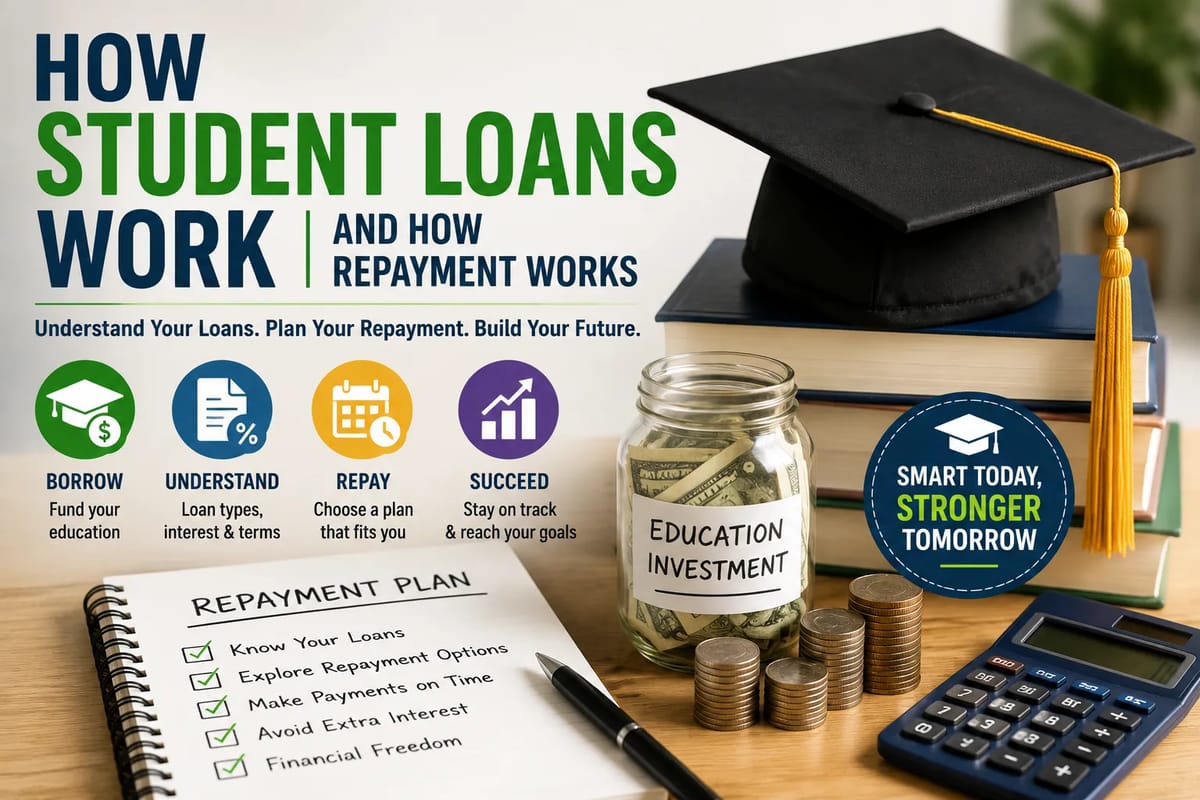
How Student Loans Work and How Repayment Works
Student loans can make higher education possible when savings, scholarships, grants, and other financial aid are not enough to cover the cost. But borrowing money for school also creates a financial obligation that can follow a borrower for years after graduation.
Understanding how student loans work before borrowing—and how repayment works afterward—can make the debt much easier to manage.
A student loan is essentially borrowed money that must generally be repaid with interest. The details can vary considerably depending on whether the loan is federal or private, when it was issued, the type of loan, the interest rate, and the repayment plan.
For U.S. borrowers, federal student loan rules are also changing. As of 2026, new federal repayment options include the Repayment Assistance Plan (RAP) and the Tiered Standard Plan, while eligibility for other plans can depend on when a loan was first disbursed.
Student loans are one part of the broader credit and borrowing landscape covered in the Complete Guide to Credit Tools.
What Is a Student Loan?
A student loan is money borrowed to help pay for education and related expenses.
Depending on the loan program, borrowed funds may help cover expenses such as:
- Tuition
- Fees
- Books
- Supplies
- Housing
- Transportation
- Other eligible education-related costs
Unlike grants and many scholarships, student loans generally have to be repaid.
The amount borrowed is known as the principal. Interest is the cost charged for borrowing the money.
Over time, a borrower generally pays back:
Principal + interest = total loan repayment
The longer a loan remains outstanding, the more opportunity there is for interest to accumulate.
Federal Versus Private Student Loans
There are two broad categories of student loans in the United States: federal student loans and private student loans.
Federal student loans
Federal loans are part of the federal student aid system.
They generally provide standardized federal protections and repayment options, although the specific benefits available depend on the type of loan and the borrower’s circumstances.
Federal borrowers can use their federal student aid account to review loan information and explore available repayment options.
Private student loans
Private student loans are offered by banks, credit unions, online lenders, and other financial institutions.
Their terms can vary significantly.
Depending on the lender and loan agreement, private loans may have different:
- Interest rates
- Fees
- Repayment periods
- Deferment policies
- Cosigner requirements
- Hardship options
Borrowers should therefore read the loan agreement carefully before accepting private student debt.
How Student Loan Interest Works
Interest is one of the most important concepts to understand.
Suppose someone borrows $20,000 at an annual interest rate of 5%.
The borrower does not simply repay the original $20,000.
Interest accumulates according to the terms of the loan, increasing the total amount that must eventually be paid.
A simplified example illustrates the idea.
If $20,000 were subject to a 5% annual rate, the initial annual interest calculation would be roughly:
$20,000 × 5% = $1,000
Actual student loan interest calculations can be more complicated because interest may accrue daily and payments affect the outstanding balance.
What Is Principal?
The principal is the amount borrowed.
For example, if a student takes out:
- $10,000 for the first year
- $8,000 for the second year
- $7,000 for the third year
the total principal borrowed would be $25,000, assuming none of the loans had yet been repaid.
The balance shown on a loan account can differ from the original principal because interest, payments, fees, and other adjustments may affect the amount owed.
What Happens While You Are In School?
Student loan repayment does not necessarily begin immediately after the money is borrowed.
For many federal Direct Subsidized and Direct Unsubsidized Loans, borrowers generally have a six-month grace period after graduating, leaving school, or dropping below half-time enrollment before required payments begin.
However, the exact rules depend on the loan type.
Some loans can accumulate interest while the borrower is in school.
That means a student can graduate owing more than the amount originally borrowed if accrued interest is added to the balance under the applicable rules.
What Is a Grace Period?
A grace period is a period after certain qualifying events—such as leaving school—during which required loan payments are temporarily delayed.
For many Direct Subsidized and Direct Unsubsidized Loans, the grace period is six months.
A grace period should not automatically be interpreted as a period when interest stops accumulating.
Whether interest accrues depends on the specific loan.
Borrowers should check their individual loan details rather than assuming all student loans work the same way.
What Happens When Repayment Begins?
When a borrower enters repayment, the loan servicer provides information about the required payment.
The billing information generally includes:
- Payment amount
- Due date
- Outstanding balance
- Interest information
- Instructions for making payments
Borrowers should review their loan account and contact their servicer before payments become due.
Borrowers should also make sure their contact information is current so they do not miss important notices.
How Monthly Student Loan Payments Work
A monthly student loan payment generally goes toward the amount owed under the terms of the loan and repayment plan.
Payments can be applied toward outstanding interest and principal.
For example, if a payment is $400, the entire $400 does not necessarily reduce the principal by $400.
Some of the payment may first cover accrued interest.
This is one reason understanding interest is so important.
What Is a Student Loan Repayment Plan?
A repayment plan determines how a borrower makes payments and how long it may take to repay the debt.
Different plans can produce very different monthly payments and total interest costs.
Some plans provide:
- Fixed monthly payments
- Payments that increase over time
- Payments based partly on income
- Longer repayment periods
The best option depends on factors such as income, loan balance, family circumstances, career plans, and eligibility.
Standard Repayment
The traditional Standard Repayment Plan generally uses fixed monthly payments designed to repay eligible loans within a defined period.
For many federal loans, the standard term is 10 years, although consolidation loans can have different terms.
One major advantage of a shorter repayment period is that borrowers generally pay less interest than they would with a much longer repayment period, assuming the same balance and interest rate.
The trade-off is a potentially higher monthly payment.
Income-Driven Repayment
Income-driven repayment plans calculate payments using factors such as income and family size.
The purpose is to make payments more manageable when a borrower’s income is relatively low compared with their debt.
Income-driven repayment plans use income and family size to determine monthly payment amounts, although eligibility and terms vary by plan.
Because federal student loan rules are changing, borrowers should check their current eligibility rather than relying on older information about a particular repayment plan.
The Repayment Assistance Plan
A significant change in the federal student loan system in 2026 is the introduction of the Repayment Assistance Plan (RAP).
Under current federal guidance, RAP is an income-driven option in which payments are based on adjusted gross income and the number of dependents claimed on federal taxes.
The plan can also include an interest subsidy and principal match.
Federal loan servicer information says remaining balances may be forgiven after 30 years under RAP, or sooner in qualifying circumstances such as Public Service Loan Forgiveness.
Eligibility depends on the borrower’s loans and other circumstances.
The Tiered Standard Repayment Plan
The Tiered Standard Plan is another new federal repayment option available under the 2026 changes.
It uses fixed monthly payments, with the repayment period determined partly by the borrower’s outstanding balance.
According to current federal loan-servicer guidance, repayment periods can range from 10 to 25 years depending on the amount owed.
This can provide borrowers with a longer repayment period when their balance is larger.
However, a longer repayment period can also mean paying interest over a longer period.
Why Loan Disbursement Date Matters
Student loan rules are not always determined solely by what type of loan someone has.
The date a loan was first disbursed can also affect repayment-plan eligibility.
For example, current federal guidance distinguishes between borrowers whose Direct Loans were first disbursed before July 1, 2026, and those with loans first disbursed on or after that date.
This makes it particularly important to check the actual details of an individual loan.
An article published several years ago may describe a repayment option that no longer applies to a particular borrower.
What Happened to the SAVE Plan?
Student loan borrowers may still encounter older information about the Saving on a Valuable Education (SAVE) Plan.
Current federal loan-servicer information states that a court order on March 10, 2026, ended the SAVE Plan. Borrowers affected by the change are being directed to explore other repayment options.
This is a good example of why borrowers should verify repayment information through current government resources instead of relying on outdated social media posts, videos, or articles.
What Happens If You Cannot Afford Your Payment?
A borrower who cannot afford a scheduled payment should not simply ignore the bill.
Depending on the circumstances and loan type, possible options can include:
- Changing repayment plans
- Applying for an income-driven plan
- Deferment
- Forbearance
- Other available forms of temporary relief
Borrowers having difficulty making payments should contact their loan servicer to discuss available options.
Interest may continue accumulating during some periods of deferment or forbearance, so borrowers should understand the financial consequences before choosing temporary relief.
What Happens If You Miss a Student Loan Payment?
Missing a payment can eventually have serious consequences.
A missed payment generally causes the loan to become delinquent.
Federal student loan delinquency can be reported to the three major national credit bureaus when the loan is delinquent for 90 days or more.
If a federal loan remains delinquent for 270 days, it can enter default under the applicable rules.
Default can result in additional collection consequences and can damage a borrower’s credit.
The key lesson is simple:
If you cannot afford a payment, contact the servicer before the problem becomes larger.
How Student Loans Affect Credit
Student loans can become part of a borrower’s credit history.
Making payments on time can help demonstrate responsible credit management, while serious delinquency and default can damage credit.
For a broader explanation of how credit histories, scores and reports work, see the Complete Guide to Credit Scores and Credit Reports.
This matters because credit history can affect future financial decisions involving:
- Credit cards
- Auto loans
- Mortgages
- Personal loans
- Insurance in some circumstances
- Other forms of credit
Student loan repayment should therefore be viewed as part of a broader financial plan.
Can You Pay Student Loans Early?
In many cases, borrowers can make extra payments or pay their loans off early.
Federal loan-servicer guidance states that borrowers can make payments above the required amount without a penalty and can provide directions for how overpayments should be allocated.
Paying extra can reduce the principal more quickly and potentially reduce the amount of interest paid over the life of the loan.
However, borrowers should consider their entire financial situation before directing every available dollar toward student debt.
Building an emergency fund and addressing higher-interest debt can sometimes be more financially important.
How Extra Payments Can Save Interest
Consider a simplified example.
Imagine a borrower owes:
$30,000 at 6% interest.
If the borrower pays only the required minimum, the loan may remain outstanding for many years.
If the borrower makes additional principal payments, the balance can decline faster.
A smaller balance means future interest calculations are based on a smaller amount.
The general principle is:
Lower principal → less interest accumulating over time.
The exact savings depend on the interest rate, repayment plan, payment schedule, and how additional payments are applied.
Should You Use Autopay?
Automatic payments can help borrowers avoid accidentally missing due dates.
Federal Student Aid currently says that eligible federal Direct Loan borrowers enrolled in auto pay can receive a 1% interest-rate reduction under the temporary benefit beginning July 1, 2026, with enrollment by September 30, 2026, qualifying for the benefit through June 30, 2028, under the stated terms.
Borrowers should verify eligibility before assuming the reduction applies to their particular loan.
Autopay can also make budgeting easier because the payment occurs automatically.
However, borrowers should make sure sufficient money is available in the linked account.
What Is Loan Forgiveness?
Loan forgiveness means that some or all of a qualifying remaining loan balance is canceled under a specific program.
Forgiveness is not automatic simply because someone has made payments for several years.
Eligibility depends on the program.
One example is Public Service Loan Forgiveness (PSLF), which can provide forgiveness to qualifying borrowers who meet the program’s requirements.
Other federal programs can have different requirements.
Borrowers should verify current eligibility through official federal sources.
Student Loan Consolidation
Consolidation combines certain federal student loans into a single federal Direct Consolidation Loan.
It can simplify repayment by giving the borrower one loan rather than multiple eligible federal loans.
However, consolidation can also change the repayment structure and may affect certain benefits.
It should therefore not be treated as automatically beneficial.
Borrowers should compare:
- Current interest rates
- Outstanding balances
- Repayment plans
- Forgiveness eligibility
- Monthly payments
- Total repayment costs
before consolidating.
Student Loan Refinancing
Refinancing is different from federal consolidation.
A borrower may refinance student debt through a private lender, potentially obtaining a different interest rate or repayment term.
A lower interest rate can reduce borrowing costs.
However, refinancing federal student loans with a private lender can mean giving up certain federal protections and benefits.
Potentially lost benefits can include access to certain federal repayment programs or federal relief options.
For that reason, refinancing should be evaluated based on the entire financial picture rather than interest rate alone.
Common Student Loan Mistakes
Student loan borrowers can make expensive mistakes without realizing it.
Borrowing more than necessary
Loans should generally be treated as debt rather than free financial aid.
Ignoring interest
A loan’s interest rate has a major effect on the total amount repaid.
Choosing a repayment plan without comparing alternatives
A lower monthly payment does not necessarily mean a lower total cost.
Ignoring changing federal rules
Repayment programs can change, so old information may no longer apply.
Missing payments without contacting the servicer
Communication can open the door to repayment options before delinquency becomes more serious.
Making extra payments without checking allocation
Borrowers with multiple loans should understand where additional payments are being applied.
Refinancing without considering federal benefits
A lower private interest rate may come at the cost of federal protections.
How to Create a Student Loan Repayment Strategy
A practical repayment strategy starts with understanding exactly what you owe.
Step 1: List every loan
Record:
- Current balance
- Interest rate
- Loan type
- Servicer
- Monthly payment
- Repayment plan
Step 2: Check your federal account
Federal borrowers can use their federal student aid account to review their federal loan information and repayment options.
Step 3: Compare repayment plans
Consider both monthly affordability and total repayment cost.
Step 4: Build student debt into your budget
Treat the payment as a recurring financial obligation.
Step 5: Decide whether extra payments make sense
Compare the loan’s interest rate with other financial priorities.
Step 6: Monitor changes
Federal student loan rules can change, so review official information when major policy changes affect your loan type.
A Simple Example of Student Loan Repayment
Imagine a graduate has:
- $40,000 in student debt
- 6% interest
- A fixed repayment plan
A longer repayment period could reduce the required monthly payment, making the loan easier to fit into a tight budget.
However, the borrower could pay more total interest over the life of the loan.
A shorter repayment period could produce higher monthly payments but reduce the amount of time interest accumulates.
This illustrates one of the most important student loan trade-offs:
Lower monthly payments can sometimes mean higher total borrowing costs.
The best repayment plan is therefore not necessarily the one with the smallest monthly payment.
For borrowers comparing loan payment amounts and repayment periods, a Complete Guide to Loan Calculators can provide a useful framework for understanding how different assumptions affect repayment.
Questions to Ask Before Borrowing Student Loans
Before taking out a student loan, consider:
- How much do I actually need to borrow?
- What is the interest rate?
- Is the interest fixed or variable?
- When does repayment begin?
- Will interest accumulate while I am in school?
- What will my estimated monthly payment be?
- What repayment options will I have?
- Does the loan have origination fees?
- What happens if I cannot make payments?
- Could scholarships, grants, work-study, savings, or other resources reduce the amount I need to borrow?
The goal is not necessarily to avoid all student debt.
It is to understand the cost before accepting it.
Student Loans Are Part of a Larger Financial Picture
Student debt does not exist in isolation.
A borrower may eventually need to balance loan payments with:
- Rent or mortgage payments
- Transportation
- Emergency savings
- Retirement contributions
- Credit card debt
- Family expenses
- Insurance
- Other financial goals
A repayment strategy that looks good on paper can become difficult if it leaves no room for unexpected expenses.
That is why affordability matters alongside interest cost.
When student debt is one of several outstanding obligations, understanding how to manage household debt and pay off multiple debts can help put the repayment decision into a broader household-finance context.
Where Borrowers Should Get Current Information
Student loan rules can change, particularly for federal loans.
Borrowers should use official sources to check their current situation.
Federal Student Aid provides information about federal student loans, repayment plans, loan accounts, and other federal student aid programs.
Borrowers should also communicate directly with their loan servicer when they need information about a specific account.
Avoid paying a third party simply to access federal repayment information that is available directly through official government resources.
Understanding the Debt Before Repayment Begins
Student loans can be useful financial tools, but they are still debt.
The amount borrowed, interest rate, repayment period, and repayment plan all influence how much a borrower ultimately pays.
For federal borrowers in 2026, the repayment landscape is particularly important to understand because new options such as RAP and the Tiered Standard Plan are now part of the system, while some older programs have changed or ended.
The smartest approach is to know the exact loans you have, understand how interest works, compare available repayment options, and act early if payments become difficult.
Building a Manageable Student Loan Plan
Repaying student loans is ultimately a long-term budgeting exercise.
The objective is not simply to make the next payment. It is to create a repayment strategy that fits your income, protects your credit, controls unnecessary interest costs, and leaves enough room for other important financial goals.
For borrowers, the most useful habit is to stay informed. Check your loan balance, understand your repayment plan, read notices from your servicer, and verify major policy changes through official sources.
A student loan can take years to repay, but understanding how the loan works, how interest accumulates, how payments are applied, and how repayment options differ can make that journey far more predictable.