How New Credit Users Can Avoid Mistakes
Using credit for the first time can open the door to greater financial flexibility, but it also introduces responsibilities that may be unfamiliar to new borrowers.
A first credit card, personal loan or other borrowing arrangement can affect a person’s finances for months or years. Small mistakes, such as missing a payment, borrowing more than necessary or failing to understand fees, can become expensive over time.
The good news is that most common credit mistakes are avoidable.
New credit users who understand how borrowing works, keep track of payments and borrow within their means can establish healthier financial habits from the beginning.
Understanding Credit Before Using It
Credit allows a person to use borrowed money with an agreement to repay it, usually according to specific terms and potentially with interest and fees.
Credit can take many forms, including:
- Credit cards
- Personal loans
- Auto loans
- Mortgages
- Student loans
- Lines of credit
- Retail financing
Each type works differently.
Before opening an account or accepting a loan, new users should understand the interest rate, fees, repayment requirements, consequences of missed payments and other important terms.
A useful starting point is learning how credit information is recorded and evaluated. The Complete Guide to Credit Scores and Credit Reports provides broader information about the systems used to track credit activity.
Mistake 1: Treating Available Credit Like Free Money
One of the most common mistakes new credit users can make is confusing available credit with available income.
If a credit card has a $2,000 limit, that does not mean the user has an additional $2,000 to spend without consequences.
Every purchase made with borrowed money creates an obligation.
For example, someone earning $2,500 per month might receive a credit card with a $5,000 limit. The larger credit limit does not change their income or make a $5,000 spending spree affordable.
A useful rule is to think about whether a purchase could realistically be paid for without creating financial strain.
Mistake 2: Missing Payment Due Dates
Payment history is an important part of credit management.
Missing payments can result in fees, additional interest and potentially negative credit-reporting consequences, depending on the account and circumstances.
New users should establish a reliable system for remembering due dates.
Options include:
- Calendar reminders
- Banking-app alerts
- Automatic payments
- Written payment schedules
- Personal finance applications
Automation can reduce the risk of forgetting a payment, but account balances should still be monitored to ensure that scheduled payments can be completed successfully.
Mistake 3: Paying Only Attention to the Minimum Payment
Credit card statements generally show a minimum amount that must be paid by the due date.
Although making at least the required payment can keep an account from becoming past due, paying only the minimum can allow a balance to remain outstanding for a long period.
Interest can accumulate while the balance remains unpaid.
New credit users should therefore understand the difference between the minimum payment and paying the statement balance in full.
When financially possible, paying the full statement balance on a credit card can help avoid interest on purchases under terms that provide a grace period.
The exact terms vary by card, so users should read their card agreement and statement carefully.
Mistake 4: Not Understanding Interest Rates
An interest rate determines how much borrowing can cost.
Credit cards may use annual percentage rates, while installment loans may present interest rates alongside other costs.
A new borrower should understand:
- The stated interest rate
- The annual percentage rate where applicable
- Whether the rate is fixed or variable
- How interest is calculated
- When interest begins accruing
- Whether promotional rates expire
- What happens after a promotional period
A low introductory rate can be useful, but it should not be mistaken for the permanent cost of borrowing.
Mistake 5: Ignoring Fees
Interest is not the only potential cost associated with credit.
Depending on the product, users may encounter fees for:
- Late payments
- Cash advances
- Foreign transactions
- Balance transfers
- Annual membership
- Loan origination
- Returned payments
- Certain account services
Not every credit product has all of these fees.
The important habit is to understand the fee schedule before using an account.
A credit product with a slightly different interest rate might have a substantially different overall cost once fees and other terms are considered.
Mistake 6: Applying for Too Much Credit Too Quickly
New users may be tempted to apply for multiple credit cards or loans shortly after entering the credit system.
Having several accounts is not automatically a problem, but opening accounts without a clear purpose can make finances harder to manage.
Every new account may create another payment date, balance, fee structure and set of terms to monitor.
A simpler approach can be to establish good habits with one or a small number of appropriate accounts before taking on additional credit.
Mistake 7: Spending to Improve a Credit Score
A credit score should not become a reason to purchase things that are not affordable.
People sometimes assume that they need to carry a balance or make unnecessary purchases to build credit.
That is generally an unhelpful approach.
Using credit responsibly means borrowing for purchases or expenses that fit within an individual’s financial circumstances, not spending simply to generate account activity.
Building credit is a long-term process based on responsible account management.
Mistake 8: Carrying a Balance Unnecessarily
A credit card does not generally require a user to carry debt from one month to another to establish a credit history.
Carrying a balance can result in interest charges.
For example, someone who charges $500 and then pays the full statement balance according to the card’s terms may avoid purchase interest during a grace period. Someone who carries the balance may pay interest until the debt is reduced or eliminated.
The exact rules depend on the card agreement.
Understanding these terms can prevent new users from paying interest unnecessarily.
Mistake 9: Using Credit for Everyday Expenses Without a Plan
Credit cards can be convenient for groceries, transportation, subscriptions and other routine expenses.
The problem occurs when spending becomes disconnected from the user’s ability to repay.
Before using a credit card for regular expenses, it can help to establish a budget.
If a person normally spends $300 per month on groceries, charging those purchases to a credit card does not make them less expensive. It simply changes when the money leaves the person’s bank account.
Credit should support a spending plan rather than replace one.
Mistake 10: Ignoring Credit Statements
Credit statements contain important information.
A statement can show:
- Current balance
- Minimum payment
- Payment due date
- Recent transactions
- Interest charges
- Fees
- Available credit
- Promotional terms
Reviewing statements regularly can help identify unauthorized transactions and unexpected charges.
It also gives users a clearer picture of how their borrowing is being used.
Even people who use automatic payments should continue reviewing their statements.
Mistake 11: Not Checking Credit Reports
Credit reports contain information about credit accounts and payment activity.
Reviewing them periodically can help users identify inaccurate information or activity they do not recognize.
New credit users should become familiar with their credit reports rather than treating them as something that only matters when applying for a major loan.
Understanding how credit reports and scores work can make the entire borrowing system easier to navigate.
Mistake 12: Closing Old Accounts Without Considering the Consequences
Closing a credit account is sometimes appropriate, but it should not necessarily be an automatic response to paying off a balance.
Depending on the situation, closing an account can affect available credit and other aspects of a person’s credit profile.
The potential effect depends on the individual’s broader credit history and the specific account.
Before closing an older account, it can be useful to understand why the account is being closed and whether there are fees or other considerations involved.
Mistake 13: Using Cash Advances Without Understanding the Cost
A credit card cash advance can provide access to money, but it may carry different terms from ordinary purchases.
Cash advances can involve additional fees and may begin accruing interest immediately rather than receiving the same grace-period treatment as purchases.
For that reason, new users should review the card’s cash-advance terms before using this feature.
A cash advance should not automatically be treated as equivalent to withdrawing money from a checking account.
Mistake 14: Using One Credit Account to Pay Another
Moving debt between accounts can sometimes be part of a legitimate debt-management strategy, but repeatedly using new credit to cover existing obligations can create a cycle of borrowing.
For example, charging one credit card to pay another is not a sustainable way to eliminate debt.
If someone is consistently unable to meet payments from available income, the underlying financial problem needs to be addressed rather than simply moved to another account.
Mistake 15: Co-Signing Without Understanding the Responsibility
A person who co-signs certain forms of credit may become responsible for the debt if the primary borrower fails to meet the agreement’s obligations.
Co-signing for a friend or relative can therefore have significant financial consequences.
Before agreeing to co-sign, a person should understand the legal and financial responsibilities involved and consider whether they could manage the obligation if necessary.
Mistake 16: Using Credit Without an Emergency Plan
Unexpected expenses can put pressure on a new credit user.
A medical bill, vehicle repair, job interruption or urgent household expense can quickly turn available credit into debt.
Building an emergency fund when possible can reduce the need to rely exclusively on credit during unexpected situations.
Even a modest reserve can provide an additional layer of financial flexibility.
Mistake 17: Not Learning How Credit Cards Work
Credit cards can look simple from the outside, but their terms can be surprisingly detailed.
New users should understand concepts such as:
- Credit limits
- Billing cycles
- Statement balances
- Current balances
- Minimum payments
- Due dates
- Grace periods
- Interest charges
- Cash advances
- Balance transfers
- Annual fees
The Complete Guide to Credit Cards and How They Work provides a broader explanation of these features and how they fit together.
Understanding the mechanics of an account makes it easier to use the product deliberately rather than discovering its rules through costly mistakes.
Mistake 18: Borrowing More as Income Increases
An increase in income can make additional borrowing appear more affordable.
But higher earnings do not automatically make every new debt obligation sensible.
New credit users should consider whether additional borrowing supports a genuine need or simply increases lifestyle spending.
A useful approach is to allow income increases to strengthen savings and financial stability rather than automatically increasing debt.
Mistake 19: Falling for Credit Repair Promises
People who are new to credit may encounter services promising extremely fast improvements to their credit scores.
Some legitimate companies provide financial education or assistance with specific credit-related services, but consumers should be cautious about promises that sound unrealistic.
No company should be treated as capable of magically removing accurate negative information simply because a customer pays a fee.
Understanding credit reports personally can help consumers recognize questionable claims.
Mistake 20: Failing to Create a Credit Strategy
Credit should fit into a broader financial plan.
Instead of opening accounts simply because they are available, new users can consider what role credit should play in their finances.
Possible goals might include:
- Establishing a credit history
- Financing a necessary purchase
- Preparing for a future mortgage or auto loan
- Managing short-term cash flow
- Accessing rewards responsibly
- Building financial flexibility
The goal should determine the type and amount of credit used.
How to Build Credit Carefully From the Beginning
People who are completely new to borrowing can start with relatively simple habits.
These include:
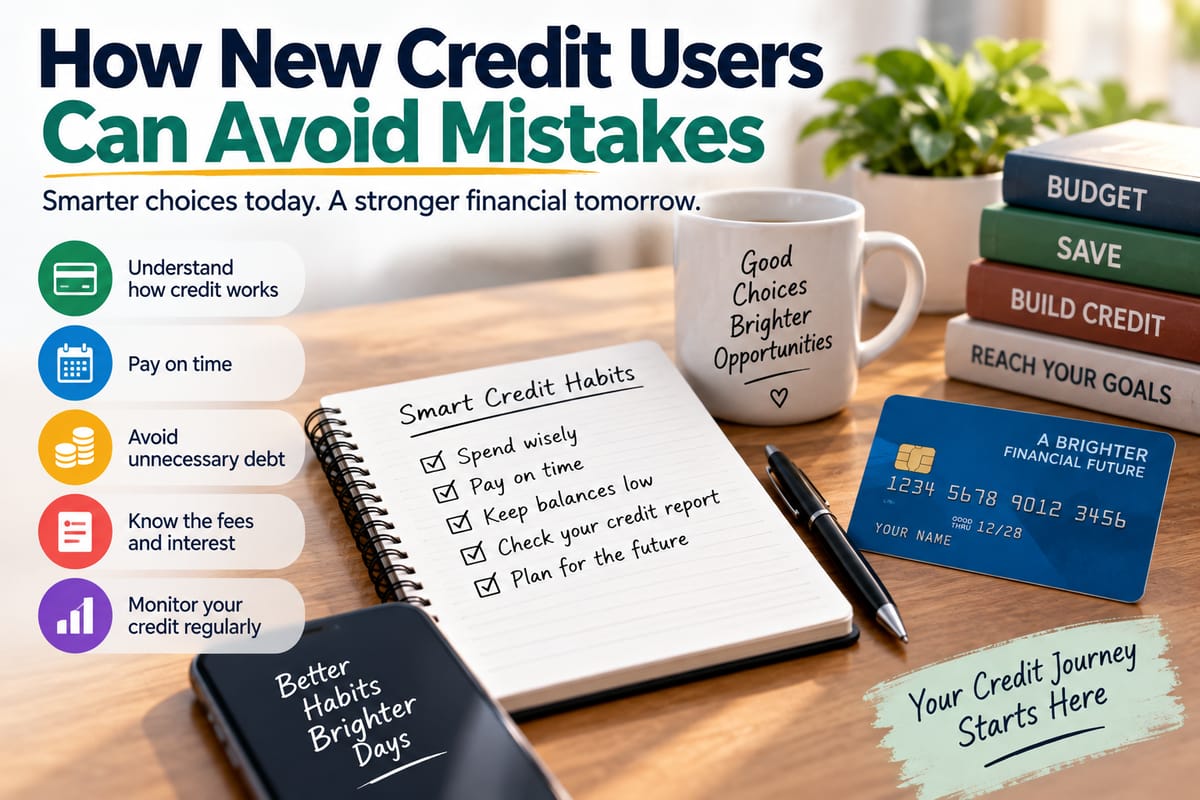
- Open credit accounts only when there is a clear purpose.
- Read the terms before agreeing.
- Keep track of payment due dates.
- Pay on time.
- Avoid borrowing more than the budget can support.
- Review statements regularly.
- Monitor credit reports for errors.
- Understand interest and fees.
- Keep debt manageable.
- Reassess credit needs as financial circumstances change.
For people starting with little or no credit history, How to Build Credit From Scratch for the First Time offers additional guidance on establishing a credit history responsibly.
Using Credit Tools Wisely
Technology has made it easier to monitor credit and organize borrowing.
Depending on the financial institution or service, credit tools may include:
- Credit-score monitoring
- Budgeting applications
- Payment reminders
- Debt calculators
- Credit-report access
- Spending alerts
- Account-management dashboards
- Loan repayment calculators
These tools can make credit management easier, but they do not replace financial judgment.
A credit-score notification, for example, can show that a score changed, but the user still needs to understand what information contributed to that change.
The Complete Guide to Credit Tools provides a broader overview of tools that can help consumers monitor and manage their credit.
A Simple Routine for New Credit Users
Credit management does not need to take hours every week.
A simple monthly routine can include:
Once a week
Check account balances and recent transactions.
Before each due date
Confirm that the required payment is scheduled or has been made.
Once a month
Review the statement and compare spending with the household budget.
Periodically
Review credit reports and check for unfamiliar or inaccurate information.
When circumstances change
Reassess borrowing, especially after a change in income, employment, housing costs or major financial obligations.
This routine can make credit management a normal financial habit instead of something that only receives attention when there is a problem.
What Responsible Credit Use Looks Like
Responsible credit use is less about having a perfect financial record and more about consistently managing borrowing within realistic limits.
A responsible user knows what they owe, understands when payments are due and recognizes how interest and fees affect the cost of borrowing.
They also understand that credit is a financial tool rather than an extension of income.
For new users, developing these habits early can make future borrowing easier to understand and potentially reduce unnecessary costs.
Credit can be useful when managed carefully, but the strongest foundation is not simply having access to more borrowing. It is knowing when to use credit, how much to borrow and how to repay it without putting the rest of the financial plan under unnecessary pressure.