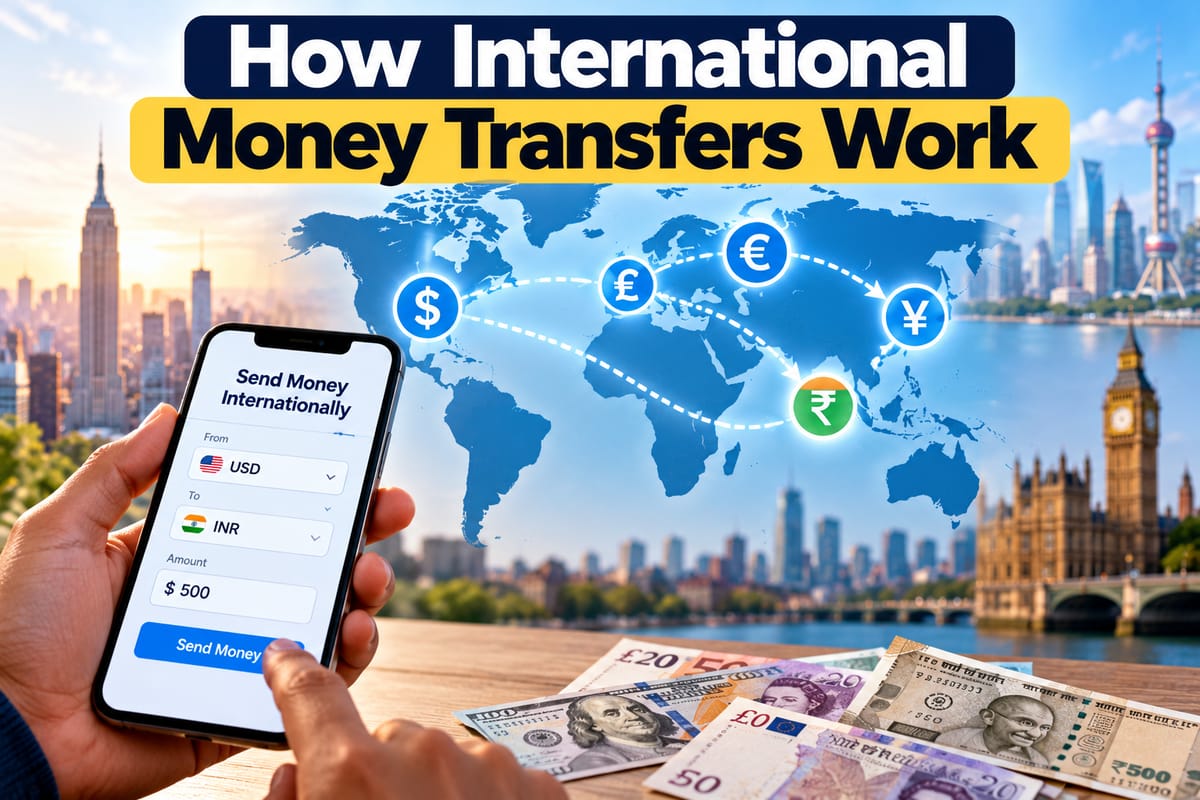
How International Money Transfers Work
International money transfers allow individuals and businesses to move funds from one country to another. Whether someone is sending money to family overseas, paying an international supplier, receiving income from abroad, or moving money between their own accounts in different countries, the basic process involves several financial institutions and payment systems working together.
Unlike a simple transfer between two accounts at the same bank, an international transfer may involve currency conversion, intermediary banks, payment networks, compliance checks, and different settlement systems.
Understanding how the process works can help people make sense of transfer times, exchange rates, fees, and the information required to send money across borders.
What Is an International Money Transfer?
An international money transfer is a transaction in which funds are moved from an account or payment service in one country to a recipient in another country.
The transfer can involve:
- Bank accounts
- Money transfer companies
- Digital payment platforms
- Payment networks
- Intermediary banks
- Foreign exchange providers
- Correspondent banking relationships
The sender generally provides information about the recipient, chooses the amount and currency, and authorizes the transaction. The financial institutions involved then process the payment and arrange for the recipient to receive the funds.
The exact process depends on the countries involved, the currencies being used, the payment provider, and the type of transfer.
How Money Moves Across Borders
International transfers can look simple from the customer’s perspective. A person enters a recipient’s details, confirms the amount, and waits for the money to arrive.
Behind the scenes, several steps may take place.
A simplified process looks like this:
Sender → Sending institution → Payment network or intermediary → Receiving institution → Recipient
If currency conversion is required, an exchange-rate calculation is incorporated into the process.
For example, someone sending money in one currency to a recipient who receives another currency may have the original amount converted before the recipient’s account is credited.
The Role of Payment Systems
International transfers rely on financial infrastructure that allows institutions to communicate payment instructions and settle transactions.
The broader mechanics are explained in How Payment Systems Work and How Money Moves Between Accounts, which explores how payment systems connect financial institutions and facilitate the movement of funds.
Different payment systems can have different processing procedures, settlement arrangements, costs, and operating hours.
This is one reason why an international transfer is not always instantaneous even when the sender can initiate it online within seconds.
Bank-to-Bank International Transfers
One traditional method involves transferring funds from one bank account to another.
The sender typically provides information such as:
- Recipient’s name
- Recipient’s account number
- Bank name
- Bank address where required
- Relevant bank identification information
- Destination country
- Transfer amount
- Currency
The banks then use their payment relationships and relevant networks to route the transaction.
In some cases, the sending bank and receiving bank do not have a direct relationship. An intermediary institution may therefore be involved.
What Are Correspondent Banks?
Correspondent banks are financial institutions that provide services to another bank, often allowing transactions to take place across borders.
They can play an important role when two banks do not maintain a direct relationship.
For example, a transfer might follow a structure such as:
Sender’s bank → Correspondent bank → Receiving bank
More than one intermediary can sometimes be involved.
Each additional institution can potentially introduce another processing stage, fee, or source of delay.
How Digital Bank Transfers Work
Digital interfaces have made international transfers easier for customers to initiate.
A person may be able to enter recipient details through a banking application or online banking platform without visiting a branch.
However, the digital interface does not necessarily mean that the underlying movement of funds is instantaneous.
The How Digital Bank Transfers Move Money Between Accounts guide explains the broader mechanics of digital transfers and how financial institutions process electronic payment instructions.
International transfers still have to pass through the relevant banking and payment infrastructure.
Currency Conversion
Currency conversion is one of the most important differences between domestic and international transfers.
Suppose a sender has money in one currency while the recipient needs to receive another. The transfer provider must determine how much of the destination currency the recipient will receive.
The calculation can depend on:
- Exchange rate
- Amount being transferred
- Conversion fee
- Provider’s pricing model
- Timing of the transaction
- Destination currency
For example, if a sender transfers 1,000 units of Currency A and the applicable exchange rate is 0.90 units of Currency B for each unit of Currency A, the converted amount before applicable fees would be:
1,000 × 0.90 = 900 units of Currency B
The actual amount received can differ if the provider applies a fee or uses an exchange rate that includes a margin.
Why Exchange Rates Matter
Exchange rates determine how much value moves from one currency into another.
Even a relatively small difference in the exchange rate can affect the amount received when transferring a substantial sum.
For example, consider a transfer of 2,000 units of a source currency.
At one exchange rate:
2,000 × 0.85 = 1,700 destination currency units
At another rate:
2,000 × 0.82 = 1,640 destination currency units
The difference is 60 destination currency units before considering fees.
This is why comparing only the advertised transfer fee can give an incomplete picture of the total cost.
Transfer Fees and Exchange-Rate Margins
International money transfer providers can generate revenue in several ways.
Potential costs include:
- Upfront transfer fees
- Currency conversion fees
- Exchange-rate margins
- Receiving fees
- Intermediary bank charges
- Additional service charges
A transfer advertised as having a low or zero upfront fee may still involve a less favorable exchange rate.
The amount the recipient ultimately receives is therefore often more useful for comparing services than the headline transfer fee alone.
Why International Transfers Can Take Time
International transfers can involve multiple processing stages.
The transaction may need to pass through:
- The sender’s financial institution
- A payment or messaging network
- One or more intermediary institutions
- The recipient’s financial institution
- Currency conversion or settlement processes
The Why Bank Transfers Take Time to Complete guide explains some of the broader reasons bank transfers can take longer than expected.
International transfers can also be affected by weekends, public holidays, banking hours, time-zone differences, compliance reviews, and differences between payment systems.
Business Days and Banking Hours
A transfer initiated outside normal processing hours may not begin moving through certain stages until the next available processing period.
For example, a transaction initiated late on a Friday may encounter a weekend before the next banking processing window.
Different countries may also observe different public holidays.
This means the number of calendar hours between sending and receiving a payment does not always correspond directly to the number of banking processing hours involved.
Why Some Transfers Are Reviewed
Financial institutions are required to operate within regulatory and compliance frameworks.
As a result, certain international transactions may be subject to additional checks.
These checks can involve:
- Customer identification
- Transaction monitoring
- Sanctions screening
- Anti-money-laundering procedures
- Verification of recipient information
- Reviews of unusual transaction patterns
- Regulatory reporting requirements
A transfer that requires additional review may take longer than a straightforward transaction.
A delay does not necessarily mean that something is wrong with the payment. It can simply indicate that additional processing is required.
Information Required for an International Transfer
The information required depends on the countries and institutions involved.
A sender may need to provide:
- Recipient’s full name
- Recipient’s account details
- Recipient’s bank information
- Destination country
- Currency
- Transfer amount
- Purpose of payment in some circumstances
- Additional identification information where required
Entering incorrect recipient information can cause delays or prevent the payment from reaching the intended account.
For larger or business-related transfers, additional documentation may sometimes be required.
What Happens if the Recipient Information Is Wrong?
International payments can be difficult to reverse once processing has begun.
If an account number, bank identifier, recipient name, or other important information is incorrect, the transfer may be delayed, rejected, returned, or potentially credited to an unintended account depending on the circumstances and payment system.
Senders should therefore carefully review recipient details before confirming a transfer.
International Transfers for Individuals
Individuals use international transfers for many reasons, including:
- Supporting family members
- Paying tuition
- Paying overseas bills
- Sending money while traveling
- Purchasing goods or services
- Receiving freelance income
- Moving personal savings
- Managing expenses in another country
The most appropriate transfer method can depend on the amount, destination, urgency, currency, and available services.
International Transfers for Businesses
Businesses also use international payments to manage cross-border financial activity.
Common examples include:
- Paying overseas suppliers
- Receiving payments from international customers
- Paying contractors
- Funding foreign operations
- Purchasing inventory
- Managing international payroll
- Transferring money between corporate accounts
For businesses, exchange rates and transaction fees can become particularly important because repeated international payments can produce substantial cumulative costs.
How Global Interest Rates Can Influence Transfers
Interest rates do not directly determine every individual international transfer, but changes in global interest rates can influence currencies, capital flows, borrowing conditions, and broader financial markets.
The relationship is explored in How Global Interest Rates Affect Countries.
For someone sending money internationally, changes in currency markets can affect how much the recipient ultimately receives after conversion.
This is one reason the cost of an international transfer can change even when the sender transfers the same amount of money.
The Difference Between Transfer Speed and Settlement
A customer may receive confirmation that a transfer has been initiated before the recipient actually has access to the funds.
These are different stages.
Initiation means the sender has authorized the transaction.
Processing means financial institutions and payment systems are handling the payment instructions.
Settlement involves the financial obligations between participating institutions being completed.
Receipt occurs when the recipient’s institution makes the funds available to the recipient.
A payment can therefore be successfully initiated without being immediately available to the recipient.
International Money Transfer Services
Consumers can choose from several types of providers.
These may include:
- Traditional banks
- Specialized money transfer companies
- Digital financial platforms
- Payment applications
- Foreign exchange providers
Each can use different infrastructure and pricing models.
When comparing providers, it is useful to examine the total amount the recipient receives, the estimated delivery time, available currencies, transfer limits, customer support, and any applicable fees.
How to Compare International Transfer Costs
A useful comparison should consider the complete transaction rather than one advertised feature.
Look at:
1. Transfer Fee
Determine whether the provider charges a fixed fee, percentage-based fee, or another type of transaction charge.
2. Exchange Rate
Check the rate being offered for the currency conversion.
3. Amount Received
Calculate how much the recipient will actually receive after fees and conversion.
4. Delivery Time
Consider how quickly the recipient needs access to the funds.
5. Additional Charges
Check whether receiving banks or intermediary institutions may charge additional amounts.
6. Transfer Limits
Some providers impose minimum or maximum transaction amounts.
Why the Recipient’s Amount Matters Most
Suppose two services offer to transfer the same amount.
Provider A
- Transfer fee: $10
- Exchange-rate cost: $20
- Total estimated cost: $30
Provider B
- Transfer fee: $3
- Exchange-rate cost: $40
- Total estimated cost: $43
Although Provider B advertises the lower transfer fee, the overall transaction could be more expensive.
This demonstrates why comparing the final amount delivered can be more useful than comparing a single fee.
Security and Fraud Prevention
International transfers should be treated as financial transactions requiring careful attention.
Before sending money, verify:
- The recipient’s identity
- Account details
- The transfer provider
- The destination
- The purpose of the payment
- Any unexpected requests for additional funds
People should be particularly cautious when someone pressures them to make an urgent international transfer or asks them to send money to an unfamiliar account.
Once funds have been transferred, recovering them may be difficult depending on the payment method and circumstances.
Keep Records of International Transfers
Maintaining transaction records can make it easier to track payments and resolve problems.
Useful records can include:
- Transaction confirmation
- Transfer reference number
- Amount sent
- Currency
- Exchange rate
- Fees
- Recipient information
- Date of transfer
- Expected delivery time
Businesses may also need records for accounting, tax, or regulatory purposes.
Why International Money Transfers Are More Complex Than They Appear
An international transfer may look like a simple digital transaction, but several systems can operate behind the scenes.
The process can involve financial institutions, payment networks, currency markets, compliance systems, and settlement mechanisms.
The sender typically sees only a few steps on a screen, while the underlying infrastructure handles the movement and accounting required to deliver the funds.
This layered system helps explain why transfer times, costs, and exchange rates can vary.
Understanding the Full Cost of Moving Money
International money transfers combine several elements that are easy to overlook when focusing only on the initial fee.
The total financial impact can depend on the transfer charge, exchange rate, intermediary costs, receiving fees, and timing of the transaction. Delivery speed can also vary depending on the payment systems and financial institutions involved.
Understanding these components makes it easier to evaluate international transfers based on what ultimately matters: how much money reaches the recipient, how long the transaction takes, and what the sender pays to make it happen.
By checking the exchange rate, total fees, expected delivery time, recipient details, and applicable requirements before confirming a payment, individuals and businesses can approach international money transfers with a clearer understanding of how their money moves across borders.