How Do Banks Create and Lend Money?
The way banks create and lend money is one of the most important—and frequently misunderstood—parts of the modern financial system.
When a customer deposits money into a bank account, it may seem as though the bank simply stores that money in a vault until the customer needs it. In reality, commercial banking is built around a more complex system involving deposits, loans, payments, reserves, capital, risk management, and central-bank policy.
Banks can create new deposit money when they make loans. At the same time, they must operate within financial, regulatory, and liquidity constraints that limit how much lending they can safely undertake.
Understanding this process helps explain where much of the money used in everyday economies comes from, why borrowing costs change, and how banks influence economic activity.
What Does It Mean When a Bank Creates Money?
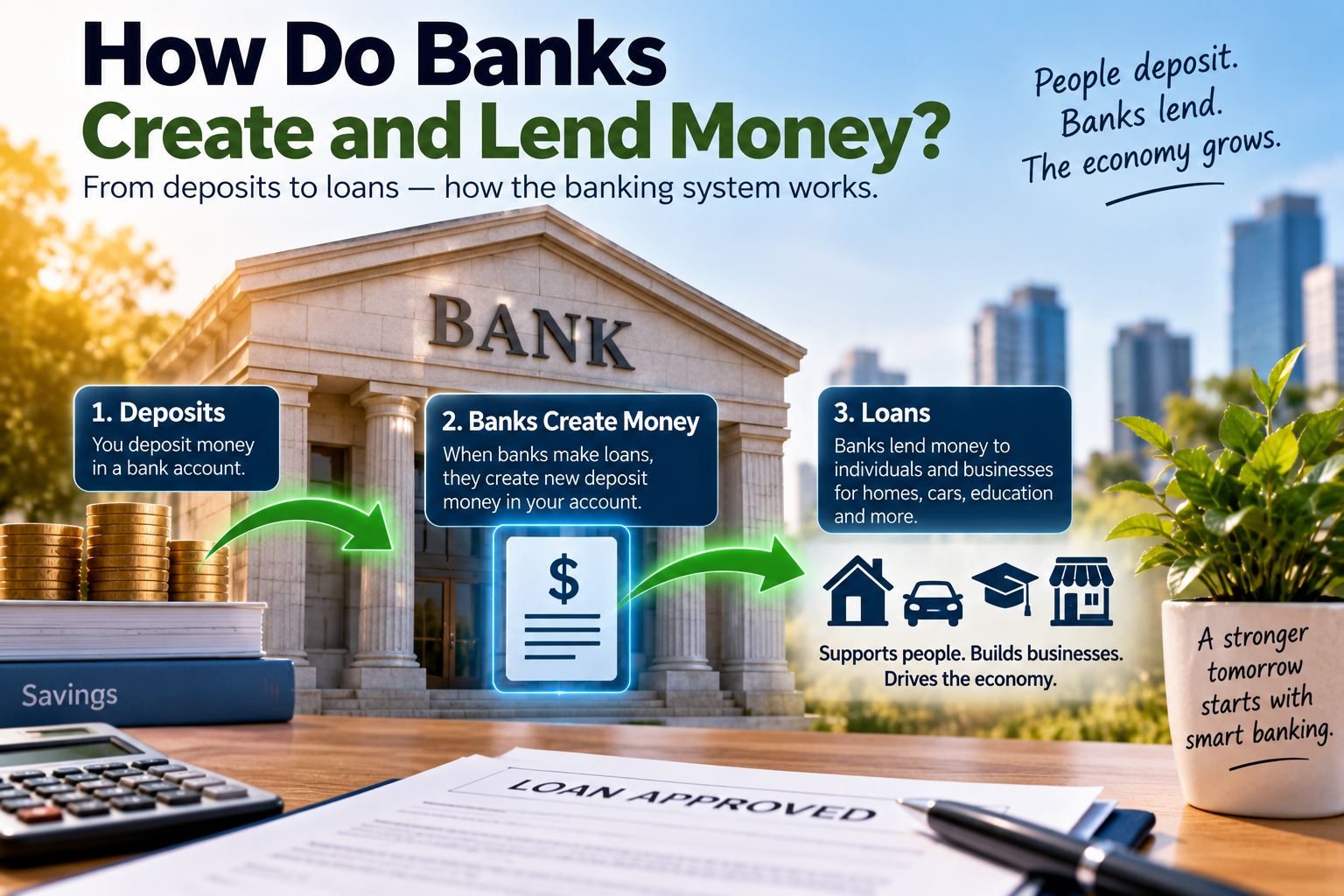
Commercial banks create money primarily by creating deposits when they issue loans.
Suppose a customer is approved for a $20,000 loan. The bank does not necessarily take $20,000 in physical cash from a vault and hand it to the borrower.
Instead, the bank can credit the borrower’s deposit account by $20,000.
The borrower now has a bank deposit that can be spent, transferred, or withdrawn according to the account’s terms. At the same time, the bank records the $20,000 loan as an asset because the borrower owes that amount to the bank.
The result is an increase in the amount of bank-deposit money in circulation.
This is one of the central mechanisms behind modern money creation.
Banks Do Not Simply Lend Out Every Dollar Deposited
A common explanation of banking suggests that banks take deposits from customers and then lend those exact deposits to other customers.
While deposits provide banks with important funding, modern commercial banking is not simply a system in which one customer’s deposited dollar is physically passed to another customer as a loan.
When a bank approves a loan, it generally creates a corresponding deposit.
The bank therefore expands both sides of its balance sheet:
- Asset: The borrower owes the bank money.
- Liability: The bank owes the borrower the balance in their deposit account.
This balance-sheet relationship is fundamental to understanding how bank lending works.
A Simple Example of Bank Money Creation
Imagine a bank approves a $100,000 mortgage.
The bank records:
| Bank Balance Sheet | Change |
|---|---|
| Loan asset | +$100,000 |
| Customer deposit liability | +$100,000 |
The borrower now has $100,000 in their account.
The bank has not necessarily transferred $100,000 of existing customer cash into that account. Instead, the loan has created a new deposit.
When the borrower spends the money, it may move to another bank.
For example, the borrower could use the $100,000 to purchase a home. The seller’s bank receives the payment, while the original bank must settle the transaction through the banking and payment system.
This is where the distinction between bank deposits and central-bank money becomes important.
What Is Bank Money?
Most of the money people use every day exists as deposits at commercial banks.
Checking accounts, savings accounts, and many other deposit accounts represent claims customers have against their banks.
People can use those deposits to:
- Pay bills
- Transfer money
- Purchase goods
- Receive salaries
- Make investments
- Withdraw cash
- Send payments to other people
Different account types serve different purposes. Understanding those differences is useful when considering how banks fund themselves and how customers interact with the financial system. A broader overview is available in the [Complete Guide to Bank Accounts and Account Types]Complete Guide to Bank Accounts and Account Types.
What Happens When a Bank Loan Is Repaid?
Money creation through lending also has an important reverse process.
When a borrower repays the principal on a bank loan, the corresponding bank deposit money is generally removed from the banking system’s balance sheet.
For example, suppose a borrower owes $50,000 in principal.
As that principal is repaid, the bank reduces the outstanding loan asset and the customer’s deposit balance is reduced accordingly.
This means bank lending can create deposit money, while repayment of loan principal can reduce it.
Interest payments work somewhat differently because interest represents income to the bank rather than repayment of the principal itself.
Why Banks Make Loans
Banks lend money because lending can generate revenue.
A bank typically earns interest and fees from loans while paying costs associated with deposits, funding, employees, technology, facilities, regulatory requirements, and risk management.
The difference between the interest a bank earns on assets and the interest it pays on certain liabilities is an important component of banking profitability.
Banks therefore have an incentive to identify borrowers who are likely to repay.
This makes credit assessment a central part of commercial banking.
How Banks Decide Who Gets a Loan
Before approving a loan, a bank generally evaluates the borrower’s ability and willingness to repay.
Depending on the type of credit, factors may include:
- Income
- Employment
- Existing debts
- Credit history
- Assets
- Collateral
- Business cash flow
- Loan purpose
- Debt-to-income measures
- Economic conditions
A mortgage applicant, for example, may be evaluated differently from a business seeking a working-capital facility.
The bank’s objective is to balance potential interest income against the possibility that the borrower will fail to repay.
Why Banks Cannot Create Unlimited Money
The fact that banks can create deposits through lending does not mean they can create unlimited amounts of money without consequences.
Several constraints influence how much banks can lend.
Creditworthy Borrowers
Banks need borrowers who are willing and able to take on debt.
If demand for loans falls, banks cannot simply force households and businesses to borrow.
Capital Requirements
Banks must maintain sufficient capital relative to their assets and risks.
Capital provides a financial buffer against losses.
If a bank makes too many risky loans and those loans fail, its capital can absorb some of the resulting losses.
Liquidity
Banks must also be able to meet payment obligations and customer withdrawals.
A bank can be profitable on paper while still experiencing serious liquidity problems if it cannot obtain cash or other readily available funding when needed.
Regulation
Banking institutions operate under extensive regulatory frameworks designed to promote financial stability and protect depositors and the broader financial system.
Interest Rates
Borrowing costs influence demand for credit.
Higher interest rates can discourage some households and businesses from taking loans, while lower rates can encourage borrowing.
The Role of Central Banks
Commercial banks operate within a broader monetary system overseen in many countries by a central bank.
Central banks influence financial conditions through monetary policy, interest rates, liquidity operations, and other mechanisms.
For example, when a central bank raises its policy interest rate, borrowing and funding conditions throughout the economy can change.
This can affect mortgage rates, business loans, consumer credit, savings returns, and investment decisions.
The relationship is explored in greater detail in [How Central Banks Affect Commercial Banks]How Central Banks Affect Commercial Banks.
What Are Bank Reserves?
Bank reserves are a form of money held by commercial banks at the central bank.
They are different from the deposits customers see in their ordinary bank accounts.
When banks make payments to one another, reserves can be used to settle obligations between financial institutions.
For example, if a customer of Bank A sends money to a customer of Bank B, the banks need a mechanism to settle the resulting obligation.
The payment system and banking infrastructure make this possible.
How Money Moves Between Banks
Suppose you have $2,000 in Bank A and send $500 to someone who banks with Bank B.
Your deposit decreases by $500.
The recipient’s deposit at Bank B increases by $500.
Behind the scenes, the two banks must settle the payment.
The movement of customer deposits and the settlement of obligations between banks are different but interconnected processes.
This is why payment infrastructure is such an important part of modern banking. For a broader explanation, see [How Payment Systems Work and How Money Moves Between Accounts]How Payment Systems Work and How Money Moves Between Accounts.
What Happens When Banks Receive Deposits?
Deposits are important sources of funding and provide banks with stable relationships with customers.
When people deposit money, the bank records the deposit as a liability because the institution generally owes that money to the customer.
The bank can then use its balance sheet to support lending and other activities, subject to applicable liquidity, capital, risk, and regulatory constraints.
Deposits also provide customers with convenient payment services.
This combination—safe and accessible accounts alongside lending and payment services—is one of the fundamental functions of commercial banking.
How Loans Support the Real Economy
Bank lending can have a significant impact on economic activity.
A household might borrow to purchase a home.
A business might borrow to:
- Purchase equipment
- Expand production
- Hire employees
- Buy inventory
- Open another location
- Manage short-term cash flow
When banks provide credit to viable borrowers, that financing can allow economic activity to occur sooner than it otherwise might.
However, excessive or poorly managed lending can create problems.
If borrowers take on debts they cannot afford, defaults can rise. Large-scale credit losses can weaken banks and potentially affect the wider economy.
Mortgages and Long-Term Lending
Mortgages provide a useful example of how bank lending works over an extended period.
A bank may create a deposit when a mortgage is originated. The borrower then uses the funds to purchase property, while the bank records the mortgage as an asset.
Over many years, the borrower makes payments that include principal and interest.
As principal is repaid, the outstanding loan balance declines.
The bank’s income from interest helps cover its costs and generate a return, while the repayment of principal reduces the borrower’s debt.
Business Loans Work in a Similar Way
Business lending follows the same basic balance-sheet principles but can involve more complicated risk assessments.
A company might request a loan to purchase machinery or expand operations.
The bank considers the company’s revenue, expenses, cash flow, existing obligations, assets, industry conditions, and repayment prospects.
If approved, the bank provides financing under agreed terms.
The business can then use the funds to make investments that might increase its productive capacity.
In this way, banking connects financial resources with households and businesses that need capital.
What Happens When a Bank Makes a Risky Loan?
Creating money through lending does not guarantee that the newly created loan will be repaid.
If a borrower defaults, the bank may have to recognize a loss.
For example, if a bank has a $100,000 loan and expects the borrower to repay it but the borrower becomes unable to pay, the bank may need to reduce the value of that asset.
If losses become large enough, they can reduce the bank’s capital.
This is why lending decisions, risk management, loan-loss provisions, collateral, and capital requirements are so important.
Digital Banking Has Changed How Lending Works
The underlying mechanics of bank money creation have existed for a long time, but technology has dramatically changed how customers interact with banks.
Today, people can apply for loans, open accounts, transfer money, deposit checks, monitor balances, and receive financial notifications through computers and smartphones.
Digital banking has also made banking services faster and more accessible.
The technology behind these services is discussed in [How Digital Banking and Online Banking Work]How Digital Banking and Online Banking Work.
However, digital interfaces do not fundamentally eliminate the underlying balance-sheet relationships between banks, borrowers, and depositors.
Why Interest Rates Matter So Much
Interest rates influence both sides of the banking business.
When borrowing rates rise, loans become more expensive for customers.
A higher mortgage rate can increase the cost of purchasing a home, while higher business borrowing costs can influence whether companies expand or delay investment.
At the same time, higher rates can increase the returns available on some types of deposits and other interest-bearing products.
Central-bank decisions can therefore influence commercial banks and their customers throughout the economy.
Can Banks Create Physical Cash?
Commercial banks can provide customers with physical cash, but they do not create banknotes in the same way they create deposit money through lending.
Physical currency is generally issued under the authority of a country’s central monetary institution.
When customers withdraw cash from their bank accounts, the composition of money changes.
The customer’s bank deposit decreases while the amount of physical currency held by the customer increases.
The total amount and form of money in the economy can therefore change without a commercial bank simply printing its own notes.
What Happens When People Deposit Cash?
Imagine someone deposits $1,000 in cash into a bank account.
The customer gives the bank physical currency and receives a $1,000 deposit claim.
The customer’s form of money has changed from physical cash to a bank deposit.
The bank’s balance sheet also changes.
The institution receives an asset in the form of cash while recording a corresponding liability to the customer.
This illustrates an important distinction: not every increase in a bank deposit represents new money creation through lending. Deposits can also arise when existing money moves between forms or between institutions.
Why Confidence Is Essential to Banking
Banking depends heavily on trust.
Customers expect to be able to access their deposits when they need them. Banks, meanwhile, depend on borrowers making payments and on functioning financial markets and payment systems.
If confidence in a bank collapses, customers may attempt to withdraw large amounts of money quickly.
Because banks do not keep every customer deposit sitting in physical cash, sudden large-scale withdrawals can create liquidity pressures.
This is one reason banking regulation, deposit protection arrangements, central-bank facilities, and liquidity management are important components of modern financial systems.
Does Bank Lending Always Increase Inflation?
Not necessarily.
Bank lending can increase the amount of deposit money in circulation, but the effect on prices depends on broader economic conditions.
If newly created credit finances productive economic activity, it can support increased production and investment.
If credit grows rapidly while the supply of goods and services cannot keep pace with demand, it can contribute to upward pressure on prices.
Inflation has many potential causes, including supply shocks, demand conditions, fiscal policy, monetary policy, wages, commodity prices, and expectations.
Bank lending is therefore one part of a much larger economic picture.
What Happens When the Economy Slows?
During an economic downturn, banks may become more cautious about lending.
Businesses may also become less willing to borrow because they expect weaker sales.
Households may delay mortgages, vehicle purchases, or other major borrowing decisions.
This can create a feedback effect.
Lower credit demand and tighter lending standards can reduce borrowing, investment, and spending, potentially reinforcing economic weakness.
Conversely, easier financial conditions can encourage borrowing and investment when households and businesses are confident about the future.
Why Banking Matters to Ordinary Households
The process of money creation may sound like something relevant only to economists and financial professionals, but it affects everyday financial decisions.
Mortgage rates influence housing costs.
Credit-card interest rates affect the cost of carrying balances.
Business lending can influence employment and investment.
Savings rates influence the returns available on deposits.
Payment systems determine how quickly money can move between people and businesses.
Understanding these relationships can help consumers make more informed decisions about borrowing, saving, and managing their finances.
A Simple Way to Think About Modern Banking
A useful way to visualize the banking system is as a network of interconnected balance sheets.
Customers hold deposits.
Banks hold loans and other assets.
Borrowers owe money to banks.
Banks owe deposit balances to customers.
Central banks provide the monetary infrastructure and influence financial conditions.
Payment systems allow money and financial claims to move between participants.
When a commercial bank makes a loan, it creates a deposit alongside the loan asset. When the loan principal is repaid, that deposit money is generally reduced.
The system therefore continuously creates, transfers, and extinguishes financial claims.
The Bigger Picture Behind Every Bank Loan
Banks create and lend money through a balance-sheet process that connects borrowers, depositors, payment systems, and the wider monetary system.
When a commercial bank approves a loan, it can create a new deposit for the borrower while recording the loan as an asset. That money can then move through the economy as borrowers purchase homes, businesses invest, workers receive payments, and consumers buy goods and services.
The process is constrained by credit demand, capital, liquidity, regulation, risk, interest rates, and the broader economic environment.
Understanding these mechanics makes it easier to see why banks are much more than places where people store money. They are central participants in the creation and movement of the deposit money used throughout modern economies—and their lending decisions can influence everything from household finances to business investment and economic growth.