How Banks Make Money From Interest, Fees and Financial Services
Banks play a central role in the modern economy by holding deposits, providing loans, processing payments, and offering a wide range of financial products. While customers may think of a bank mainly as a place to keep money or borrow it, banks operate as businesses and need to generate revenue from these activities.
One of the most important sources of bank income is interest. Banks can also earn money through account and transaction fees, investment services, payment processing, foreign exchange, card services, and other financial products.
The exact mix varies between banks, but the basic business model is built around providing useful financial services while earning revenue from lending, transactions, and managing money.
How Banks Earn Interest Income
Interest income is one of the fundamental ways banks make money.
When a bank provides a loan, the borrower normally agrees to repay the amount borrowed plus interest. The interest compensates the bank for providing funds, taking credit risk, and tying up capital for a period of time.
Banks can earn interest from products such as:
- Mortgages
- Personal loans
- Credit cards
- Business loans
- Auto loans
- Lines of credit
- Commercial real estate financing
- Certain investment and securities holdings
For example, suppose a bank provides a $200,000 mortgage at an annual interest rate of 6%. The borrower pays interest as part of the loan’s repayment structure. The bank receives that interest income over the life of the loan, although its actual profitability depends on funding costs, operating expenses, credit losses, capital requirements, and other factors.
This is why a bank’s lending business cannot be evaluated simply by looking at the interest rate charged to borrowers.
The Difference Between Lending Rates and Funding Costs
Banks generally do not obtain all of the money they lend from a single source.
They may fund their activities through customer deposits, wholesale funding, issued debt, equity, and other sources. These sources have costs associated with them.
A bank may pay interest to customers who hold certain types of deposit accounts while charging higher interest rates to borrowers.
The difference between interest earned on assets and interest paid on liabilities is closely related to the concept of net interest income.
For example:
- A bank earns 7% on a portfolio of loans.
- It pays an average of 3% on certain interest-bearing deposits and other funding.
- The difference contributes to the bank’s interest margin before other expenses and losses.
The actual calculation is more complicated because banks hold many different assets and liabilities with different rates, maturities, and risks.
What Is Net Interest Margin?
Net interest margin, commonly abbreviated as NIM, is an important measure of banking profitability.
It broadly reflects the difference between the interest a bank earns from interest-generating assets and the interest it pays on funding, relative to the size of its earning assets.
A higher margin can provide more room for a bank to generate interest-based profits, although a high margin does not automatically mean a bank is financially stronger.
Competition, loan defaults, funding costs, economic conditions, interest-rate movements, and regulatory requirements can all affect margins.
This is one reason How Central Banks Affect Commercial Banks is important for understanding the broader banking system. Changes in monetary policy can influence borrowing costs, deposit rates, liquidity conditions, and ultimately bank profitability.
Why Banks Pay Interest on Deposits
Banks do not simply collect deposits without providing anything in return.
Depending on the account, customers may receive interest on money held at the bank. Savings accounts, certificates of deposit, fixed-term deposits, and some other products can provide interest or similar returns.
Banks have an economic reason for offering these products.
Deposits can provide a source of funding that banks can use to support lending and other activities. Customers, meanwhile, receive convenient access to their money and may earn interest depending on the account.
Different accounts have different features, rates, restrictions, and purposes. A detailed overview can be found in the Complete Guide to Bank Accounts and Account Types.
Banks Also Make Money From Fees
Interest is only one part of the banking business.
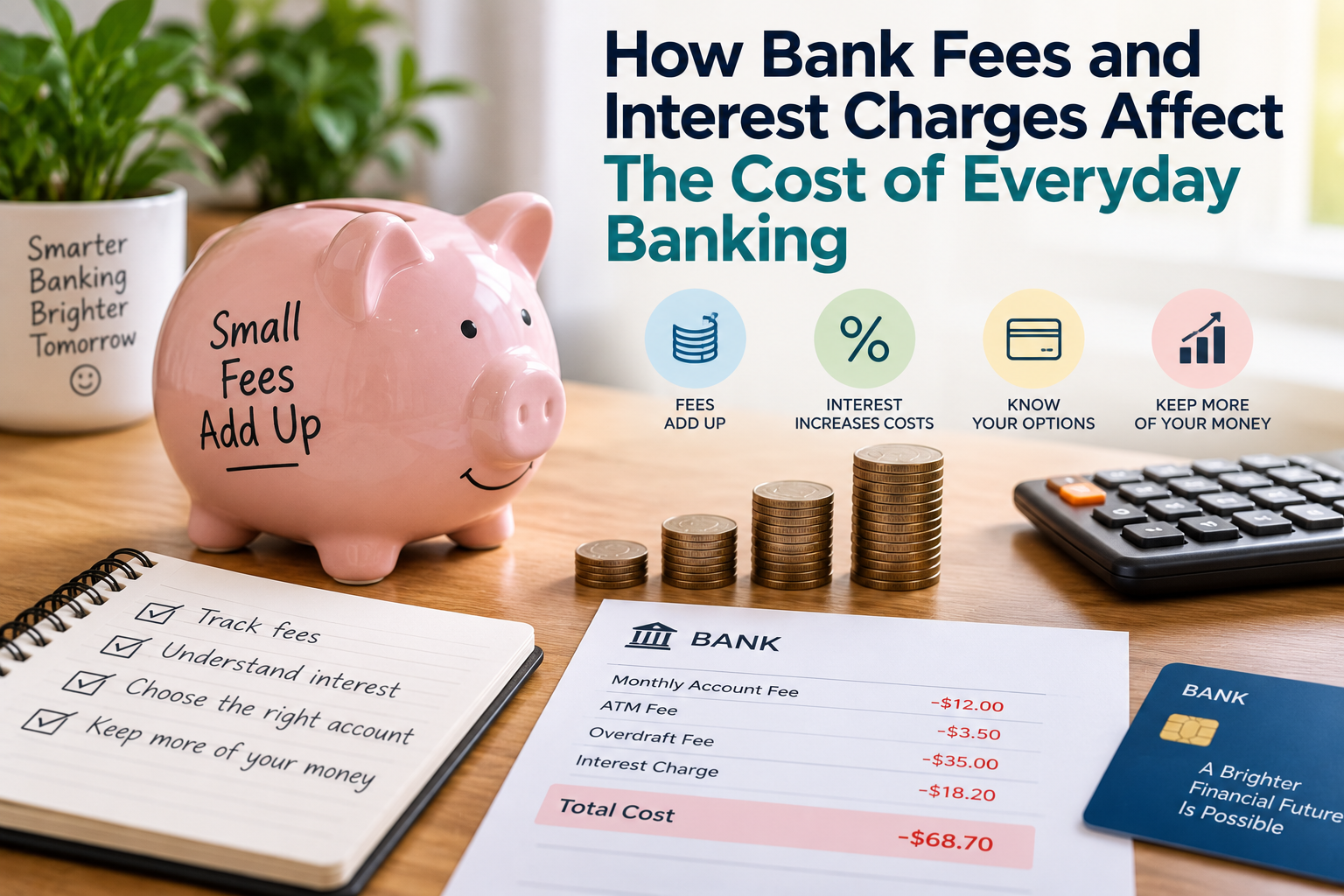
Banks can charge fees for specific services, account features, transactions, or situations that require additional processing or administration.
Common examples include:
- Monthly account fees
- ATM fees
- Overdraft fees
- Wire transfer fees
- Foreign transaction fees
- Certain card-related fees
- Check-related fees
- Account closure or special service fees
- Investment management fees
- Loan origination or administration fees
The size and structure of these charges vary considerably between financial institutions.
For customers, understanding these charges can make it easier to compare accounts and avoid unnecessary expenses. Banking Fees Explained: Types and How to Avoid Them explores the different types of fees and strategies consumers can use to reduce them.
Account Fees Can Provide Recurring Revenue
Some banking services generate revenue repeatedly rather than through a single transaction.
For example, a financial institution may charge a monthly maintenance fee for a particular account. Other accounts may waive the fee if the customer meets conditions such as maintaining a minimum balance or receiving qualifying direct deposits.
From the bank’s perspective, recurring fees can provide a relatively predictable source of revenue.
However, competition has pushed many financial institutions to offer low-fee or no-fee accounts, particularly in markets where customers can easily switch banks or use digital alternatives.
Credit Cards Create Several Sources of Revenue
Credit cards can generate income through multiple channels.
When customers carry balances, the bank or card issuer can earn interest on those balances. Depending on the product, customers may also pay annual fees, late fees, balance-transfer fees, cash-advance fees, or foreign transaction fees.
Banks and card issuers can also receive interchange revenue associated with card transactions. In simplified terms, merchants’ payment transactions involve fees that are distributed among participants in the payment network.
Credit cards therefore combine lending and payment services into a single product.
For customers, the interest rate can be particularly important because carrying a balance for a long period can make borrowing significantly more expensive.
Banks Earn Money From Payment Services
Everyday payments create another major area of banking activity.
When customers transfer money, make card payments, deposit checks, receive direct deposits, or send electronic payments, banks and other financial institutions help move and settle those transactions.
Some payment services generate direct fees, while others support broader customer relationships.
Payment infrastructure also creates opportunities for banks to provide additional services to businesses, including:
- Merchant payment processing
- Payroll services
- Business checking
- Cash management
- Electronic transfers
- Treasury services
- Automated payment solutions
Understanding the infrastructure behind these transactions provides useful context. How Payment Systems Work and How Money Moves Between Accounts explains how funds move between accounts and how different parts of the payment system interact.
Foreign Exchange Can Generate Revenue
Banks also facilitate transactions involving different currencies.
Customers may need to exchange money when traveling, sending funds internationally, importing goods, exporting products, or conducting international business.
A bank can earn revenue from foreign exchange through transaction fees or the difference between the rates at which currencies are bought and sold.
Foreign exchange services can become particularly important for banks serving multinational corporations and customers who regularly conduct cross-border transactions.
Investment and Wealth Management Services
Many banks offer services beyond traditional deposits and loans.
Customers with significant assets may receive access to investment management, financial planning, brokerage, retirement planning, and wealth management services.
These services can generate revenue through:
- Management fees
- Advisory fees
- Brokerage commissions in applicable arrangements
- Account fees
- Product-related compensation where permitted
- Other service charges
The importance of these activities varies by institution. A traditional retail bank may rely heavily on deposits and lending, while a large financial group may have substantial investment and wealth-management operations.
Business Banking Can Be Highly Diverse
Businesses often need more financial services than individual consumers.
A commercial banking customer may use a bank for loans, deposits, payment processing, payroll, foreign exchange, cash management, credit facilities, and other services.
For example, a company might maintain operating accounts, borrow money to purchase equipment, use a business credit card, process customer payments, and exchange currencies through the same financial institution.
Each relationship can create different revenue opportunities for the bank.
This is one reason banks often seek long-term relationships with business customers rather than focusing on a single product.
Banks Make Money From Loans in More Ways Than Interest
Interest is usually the most obvious revenue associated with lending, but loans can generate other charges as well.
Depending on the type of loan and the jurisdiction, borrowers may encounter fees related to:
- Loan origination
- Application processing
- Documentation
- Certain account services
- Early repayment
- Late payments
- Specialized loan administration
Not every fee applies to every loan, and regulations can restrict or govern certain charges.
The overall economics of lending depend on much more than the headline interest rate.
What Happens When Borrowers Do Not Repay?
Bank lending involves risk.
If a borrower fails to repay a loan, the bank may lose some or all of the money it expected to recover. Banks therefore set aside provisions or reserves related to expected credit losses and use underwriting processes to assess borrowers before extending credit.
A bank that charges high interest but experiences substantial loan losses may not be profitable.
This makes credit risk management a fundamental part of the banking business.
Banks consider factors such as:
- Borrower income
- Existing debt
- Credit history
- Collateral
- Business performance
- Cash flow
- Loan purpose
- Broader economic conditions
The objective is to price and manage loans in a way that balances potential returns against the possibility of losses.
Why Banks Care About Interest Rates
Interest rates influence both sides of a bank’s balance sheet.
When rates rise, banks may be able to earn more from certain loans and investments. At the same time, they may have to pay more to attract or retain deposits.
When rates fall, borrowing may become cheaper, potentially increasing loan demand. But banks may face pressure on the interest income they can generate.
The effect is therefore not always straightforward.
The speed at which rates change can also matter because loans and deposits may reprice at different times.
Digital Banking Has Changed the Business Model
Online and mobile banking have transformed how banks deliver services.
Customers can now open accounts, transfer money, deposit checks, apply for loans, manage cards, and monitor transactions without visiting a branch.
Digital banking can reduce certain operating costs while allowing banks to serve large numbers of customers through automated systems.
At the same time, digital competition has made it easier for consumers to compare financial products and switch providers.
Traditional banks now compete not only with other banks but also with online banks, fintech companies, payment providers, and specialized financial platforms.
Why Banks Offer Free Services
A bank may provide certain services for free even though those services still have economic value.
A free checking account, for example, can attract customers who later use other profitable products such as credit cards, mortgages, personal loans, investment services, or business accounts.
This is sometimes described as a relationship-based business model.
The bank does not necessarily need to make money from every individual service. Instead, it may generate revenue from the customer’s broader relationship over time.
Cross-Selling Helps Banks Increase Revenue
Banks often offer multiple products to the same customer.
Someone who opens a checking account might eventually need:
- A savings account
- A credit card
- A mortgage
- An auto loan
- An investment account
- Insurance-related services
- A business account
Providing several products can increase the value of the customer relationship while making it more convenient for the customer to manage finances in one place.
However, customers should still compare products independently rather than assuming that using one institution for everything will always produce the lowest costs.
How Banks Balance Revenue With Regulation
Banks operate in heavily regulated environments because they play such an important role in the financial system.
Rules can address capital, liquidity, consumer protection, lending practices, reporting, anti-money-laundering requirements, and other areas.
Regulation can increase the cost of operating a bank, but it also helps establish standards intended to protect depositors, consumers, and the broader financial system.
Banks therefore have to balance profitability with risk management and regulatory requirements.
The Business Model Behind a Typical Bank
A simplified bank business model might look like this:
Customers deposit money → the bank manages those funds and other sources of funding → the bank provides loans and financial services → borrowers pay interest and customers pay certain fees → the bank pays funding and operating costs → the remaining income contributes to profitability.
The real system is considerably more complex.
Banks also hold securities and other assets, manage liquidity, maintain capital, absorb credit losses, pay employees, operate technology systems, maintain branches and infrastructure, and comply with extensive regulatory requirements.
Profit is what remains after these and other expenses are taken into account.
What Determines Whether a Bank Is Profitable?
Several factors can determine how successful a bank is financially.
Interest margins
The difference between what a bank earns on assets and what it pays for funding can have a major effect on profitability.
Loan quality
Low levels of credit losses can support profitability, while widespread defaults can significantly reduce earnings.
Fee income
Fees from accounts, payments, cards, investment services, and other products can diversify revenue.
Operating costs
Technology, employees, branches, cybersecurity, compliance, and infrastructure all require significant investment.
Economic conditions
Employment, inflation, interest rates, property markets, business activity, and consumer confidence can influence both loan demand and repayment behavior.
Competition
Customers can compare rates and fees more easily than ever, putting pressure on banks to remain competitive.
Why Understanding Bank Revenue Matters
Understanding how banks make money can help consumers make better financial decisions.
For example, knowing that a bank may earn money from both interest and fees makes it easier to evaluate the true cost of a financial product. A loan with a low advertised rate may have additional charges, while an account offering an attractive interest rate may have conditions that customers need to understand.
It also explains why banks offer certain products, waive some fees, encourage customers to use multiple services, and compete aggressively for deposits and borrowers.
The Bottom Line for Customers
Banks make money through a combination of interest income, fees, payment services, investment activities, foreign exchange, and other financial services. Lending remains central to many banks, but modern financial institutions typically operate much broader businesses.
For customers, the most important lesson is that the advertised price of a banking product is only part of the picture. Interest rates, account requirements, fees, penalties, service features, and the overall relationship can all affect the real value of a financial product.
Understanding where a bank earns its revenue makes it easier to understand why financial products are priced the way they are—and gives consumers a stronger foundation for comparing their options.