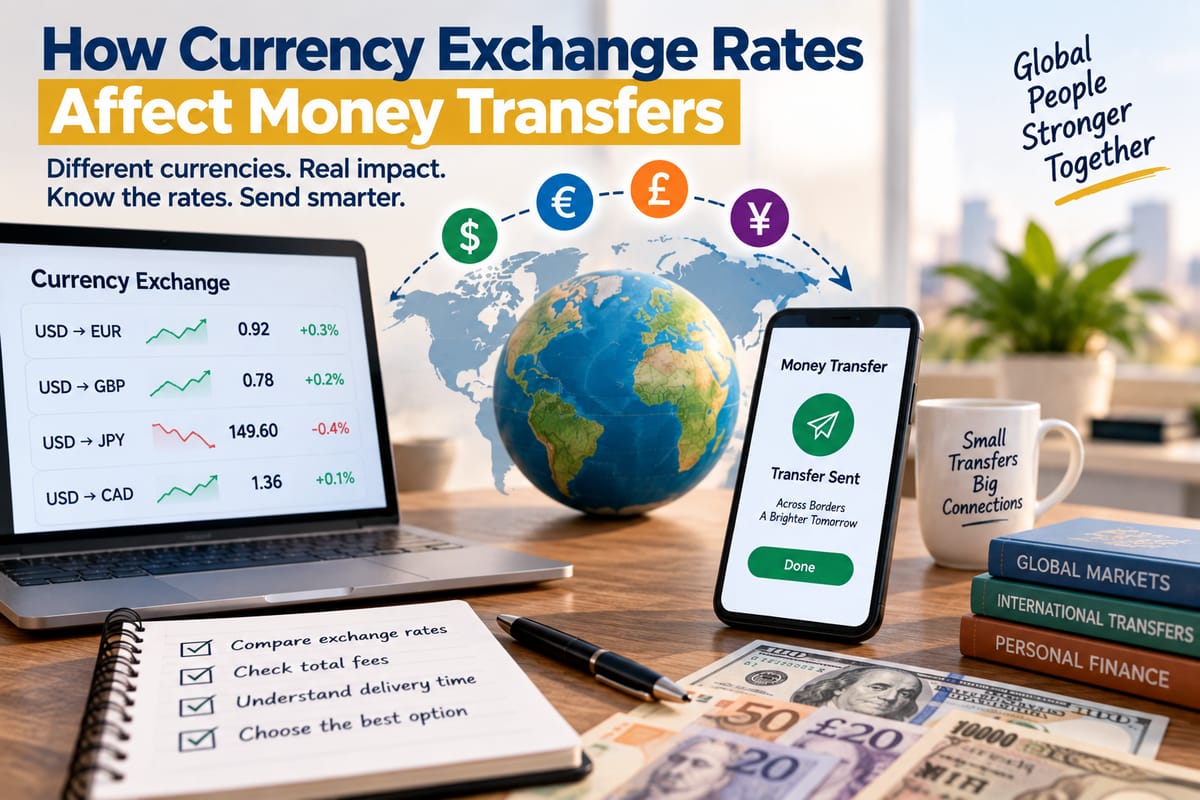
How Currency Exchange Rates Affect Money Transfers
Sending money across borders involves more than simply transferring one amount from one account to another. When the sender and recipient use different currencies, the exchange rate can significantly affect how much money ultimately arrives.
Exchange rates change continuously as currencies gain or lose value relative to one another. Banks, money-transfer services, and other financial providers may also use different exchange rates or add fees to international transactions.
Understanding how exchange rates work can help people estimate the value of international transfers, compare transfer options, and recognize why the amount sent may differ from the amount received.
What Is a Currency Exchange Rate?
A currency exchange rate describes how much one currency is worth relative to another.
For example, if a hypothetical exchange rate says that 1 U.S. dollar equals 100 units of another currency, converting $100 would produce approximately 10,000 units of that currency before considering fees or any provider-specific adjustments.
Exchange rates are not fixed permanently. They can change throughout the day as conditions in financial markets change.
The Complete Guide to Financial Markets and How They Work provides broader context on how financial markets operate and why prices of financial assets and currencies can change.
Why Exchange Rates Matter for Money Transfers
When money crosses borders, it may need to be converted from the sender’s currency into the recipient’s currency.
Suppose someone sends money from an account denominated in one currency to a recipient whose account uses another.
The transfer provider must determine how much of the destination currency the recipient will receive.
If the exchange rate changes between the time a transfer is planned and the time it is processed, the final amount can potentially be different.
Even when the exchange rate does not change significantly, the provider’s own exchange-rate margin can affect the amount received.
The Difference Between the Market Rate and the Transfer Rate
One of the most important concepts for consumers is that the exchange rate shown in financial news or currency markets may not be the same rate offered by a bank or money-transfer provider.
A market or reference rate represents the exchange relationship between currencies under particular market conditions.
A provider may offer customers a different rate and include a margin in the conversion.
For example, if the market exchange rate suggests that one currency is worth a certain amount of another, a provider might give the customer a slightly less favorable rate.
That difference can represent part of the provider’s revenue from the transaction.
Exchange Rates Can Change Before a Transfer Is Completed
Currency markets can move while a transfer is being arranged or processed.
The amount a recipient receives may therefore depend on when the exchange is actually executed.
Some providers lock in an exchange rate for a specific period. Others determine the rate when the transaction is processed.
Consumers should check the provider’s terms to understand when the applicable exchange rate is established.
This can be particularly important for larger transfers because even a relatively small exchange-rate movement can create a noticeable difference in the destination amount.
How Transfer Fees Affect the Amount Received
Exchange rates are only one part of the cost of an international transfer.
A provider may also charge:
- Transfer fees
- Currency-conversion fees
- Service charges
- Receiving fees
- Intermediary-bank fees
- Withdrawal fees
Some services advertise a low transfer fee but use a less favorable exchange rate.
Others may offer a competitive exchange rate while charging a more visible transaction fee.
For this reason, consumers should compare the total amount the recipient receives, rather than focusing on the advertised transfer fee alone.
A Simple Example of Exchange-Rate Impact
Imagine a person wants to send $1,000 to someone whose account is denominated in another currency.
If the applicable exchange rate produces 150,000 units of the destination currency, the recipient would receive approximately that amount before fees and other adjustments.
If the exchange rate changes so that the same $1,000 converts to 147,000 units, the recipient receives 3,000 fewer units.
The sender still transferred $1,000, but the purchasing power of that money in the destination currency changed.
This illustrates why exchange rates matter even when the amount sent remains exactly the same.
Why Exchange Rates Move
Currency values can change for many reasons.
Factors can include:
- Interest-rate expectations
- Inflation
- Economic growth
- Trade flows
- Political developments
- Central-bank decisions
- Investor demand
- Commodity prices
- Market confidence
- Global economic conditions
No single factor determines exchange rates in every situation.
Expectations can also matter. Currency markets respond not only to current economic conditions but also to expectations about what may happen in the future.
Interest Rates Can Influence Currency Values
Interest rates are one factor that can influence currency markets.
When interest rates change, the relative attractiveness of financial assets denominated in different currencies can also change.
Investors may adjust their holdings in response to changes in expected returns, potentially affecting demand for a currency.
The broader relationship between interest rates and economies is discussed in How Global Interest Rates Affect Countries.
Interest rates are only one influence among many, however, and exchange rates can respond to multiple factors at the same time.
Inflation Can Affect Exchange Rates
Differences in inflation between countries can also influence currency values over time.
When prices rise more quickly in one economy than another, the relative purchasing power of its currency can change.
Markets may respond to these differences through expectations about monetary policy, economic conditions, and future currency values.
For someone sending money internationally, these broader economic developments can eventually affect how much the recipient receives after conversion.
Central Banks and Currency Markets
Central banks can influence currency markets through monetary policy.
Changes to policy rates, communication about future policy, and other monetary measures can affect financial-market expectations.
A central bank’s decisions may therefore influence the relative value of its currency.
However, exchange rates are determined through complex interactions among domestic and international market participants, so a central-bank decision does not guarantee a particular currency movement.
How Digital Transfers Move Money
International money transfers can involve several financial institutions and payment systems.
The process may involve:
- The sender initiating the transfer.
- The sending institution verifying the transaction.
- The payment being routed through the relevant financial network.
- Currency conversion taking place when required.
- Funds being delivered to the recipient’s institution.
- The recipient’s institution crediting the destination account.
How Digital Bank Transfers Move Money Between Accounts provides additional context on how electronic transfers move funds between financial accounts.
International transactions can involve additional steps because multiple currencies and financial institutions may be involved.
Why International Transfers Can Take Time
An international transfer is not always instantaneous.
Processing time can depend on:
- The sending institution
- The receiving institution
- Payment networks
- Time zones
- Weekends and holidays
- Currency conversion
- Compliance checks
- Intermediary institutions
- The type of transfer
Why Bank Transfers Take Time to Complete explains some of the factors that can affect the timing of electronic bank transfers.
The longer a transaction takes to complete, the more important it may be to understand when the exchange rate is actually determined.
Fixed and Floating Exchange Rates
Most major currencies operate under systems where their market values fluctuate.
This means their exchange rates can move based on supply and demand and other economic factors.
Some currencies operate under fixed or managed exchange-rate arrangements in which authorities seek to maintain the currency around a particular level or within a certain range.
The type of exchange-rate system can therefore affect how much currency values fluctuate.
Why the Amount Sent Can Differ From the Amount Received
There are several reasons why a recipient might receive less than expected.
These can include:
- Exchange-rate differences
- Transfer fees
- Conversion margins
- Intermediary-bank charges
- Receiving-bank fees
- Taxes or other applicable charges
- Changes in the exchange rate during processing
The transfer provider should normally provide information about applicable costs and the expected amount received, but consumers should review the transaction details carefully.
How Exchange-Rate Margins Work
A currency provider may earn revenue by applying a margin to the exchange rate.
For example, suppose the market reference rate would convert a particular amount into 100,000 units of the destination currency.
A provider might offer an exchange rate that results in 98,000 units instead.
The difference may represent part of the provider’s conversion margin.
This is why a transfer advertised as having “no fee” can still involve a cost through the exchange rate.
Why Comparing the Final Amount Matters
When comparing money-transfer services, consumers should focus on the amount that actually reaches the recipient.
Consider two hypothetical providers:
Provider A
- Lower visible transfer fee
- Less favorable exchange rate
- Recipient receives: 98,000 units
Provider B
- Higher visible transfer fee
- More favorable exchange rate
- Recipient receives: 99,200 units
Provider B may result in a larger amount reaching the recipient despite charging a higher upfront fee.
The exact outcome depends on the transfer amount, currencies, rates, and fees.
The broader principle is to compare the total transaction rather than one cost in isolation.
Exchange Rates Matter More for Large Transfers
A small exchange-rate difference may have little effect on a small transfer.
For a large transaction, however, even a modest difference can translate into a substantial amount of money.
For example, a difference equivalent to 1% on a $10,000 transfer represents $100 before considering other factors.
This is why people transferring larger amounts may pay particular attention to the offered exchange rate, transaction fees, and timing.
Timing Can Matter
Some people attempt to time transfers around expected currency movements.
However, exchange rates are influenced by many unpredictable factors, and future movements cannot be known with certainty.
For routine transfers, the practical priority may simply be understanding the rate being offered and the total cost of the transaction.
For larger transfers, consumers may consider whether their provider offers tools such as rate alerts, scheduled transfers, or other features that help them manage timing.
Recurring International Transfers
People who regularly send money internationally face currency-rate exposure repeatedly.
Examples include:
- Supporting family members abroad
- Paying overseas workers
- Paying international suppliers
- Covering foreign education expenses
- Paying overseas mortgages
- Funding investments
- Receiving income from another country
For recurring transfers, small differences in exchange rates and fees can accumulate over time.
Keeping records of transfer costs and received amounts can help identify the true cost of the service.
Businesses Face Currency-Exchange Risk Too
Businesses that operate across borders can be particularly sensitive to currency movements.
A company may invoice customers in one currency while paying employees, suppliers, or contractors in another.
If exchange rates move between the time revenue is received and expenses are paid, the company’s effective costs can change.
International businesses may therefore use financial strategies designed to manage currency exposure.
The appropriate approach depends on the organization’s size, cash flows, currencies involved, and financial objectives.
What Consumers Should Check Before Sending Money
Before initiating an international transfer, check:
- The exchange rate being offered
- The amount the recipient will receive
- The total transfer fee
- Any additional intermediary or receiving fees
- When the exchange rate becomes fixed
- Expected delivery time
- Cancellation rules
- Limits on the transaction
- Available payment methods
- Whether the recipient must pay a fee to access the money
These details can make the actual cost of a transfer much clearer.
Keep Records of International Transfers
Save transaction confirmations for important transfers.
Records can include:
- Amount sent
- Currency
- Exchange rate
- Fees
- Recipient amount
- Date and time
- Transaction reference
- Provider
Maintaining these records can help when comparing services or investigating a problem with a transfer.
They can also be useful for personal financial records and, where relevant, tax or business documentation.
Exchange Rates Are Only One Part of the Transfer
Currency exchange rates can have a substantial effect on international money transfers, but they are not the only factor determining the final amount received.
Transfer fees, exchange-rate margins, processing times, intermediary charges, and receiving-bank policies can all influence the outcome.
A useful way to evaluate a transfer is therefore to look at the complete transaction: how much money leaves the sender’s account, what exchange rate is applied, what fees are deducted, how long the transfer takes, and how much ultimately reaches the recipient.
Understanding these elements can make international money transfers easier to compare and can help consumers recognize why the value of a transfer may change even when the amount originally sent stays the same.