How Bank Withdrawals Actually Work
Withdrawing money from a bank account seems simple. A customer requests a specific amount, receives the money, and sees the account balance decrease.
Behind that straightforward transaction, however, is a system involving account records, authentication, transaction processing, cash management, payment networks, and fraud controls.
Whether money is withdrawn from an ATM, collected at a bank branch, or transferred electronically to another account, the basic purpose is the same: the bank records a reduction in the customer’s available funds and provides the requested access to those funds through an authorized channel.
Understanding how withdrawals work can make everyday banking easier to navigate and can also explain why some transactions are immediate while others take longer to complete.
What Is a Bank Withdrawal?
A bank withdrawal occurs when money is removed from a customer’s bank account and made available to the account holder or transferred according to their instructions.
The withdrawal can take several forms.
Common examples include:
- Taking cash from an ATM
- Taking cash from a bank branch
- Transferring money to another account
- Using an account-linked service to move funds
- Making certain payments directly from an account
When cash is withdrawn, physical currency changes hands. When funds are transferred electronically, there may be no physical movement of money at the moment the customer initiates the transaction.
Instead, financial institutions update their records and communicate through payment systems that allow balances and obligations between institutions to be settled.
For a broader explanation of the different accounts people use to hold and access money, see the Complete Guide to Bank Accounts and Account Types.
What Happens When You Withdraw Cash From an ATM?
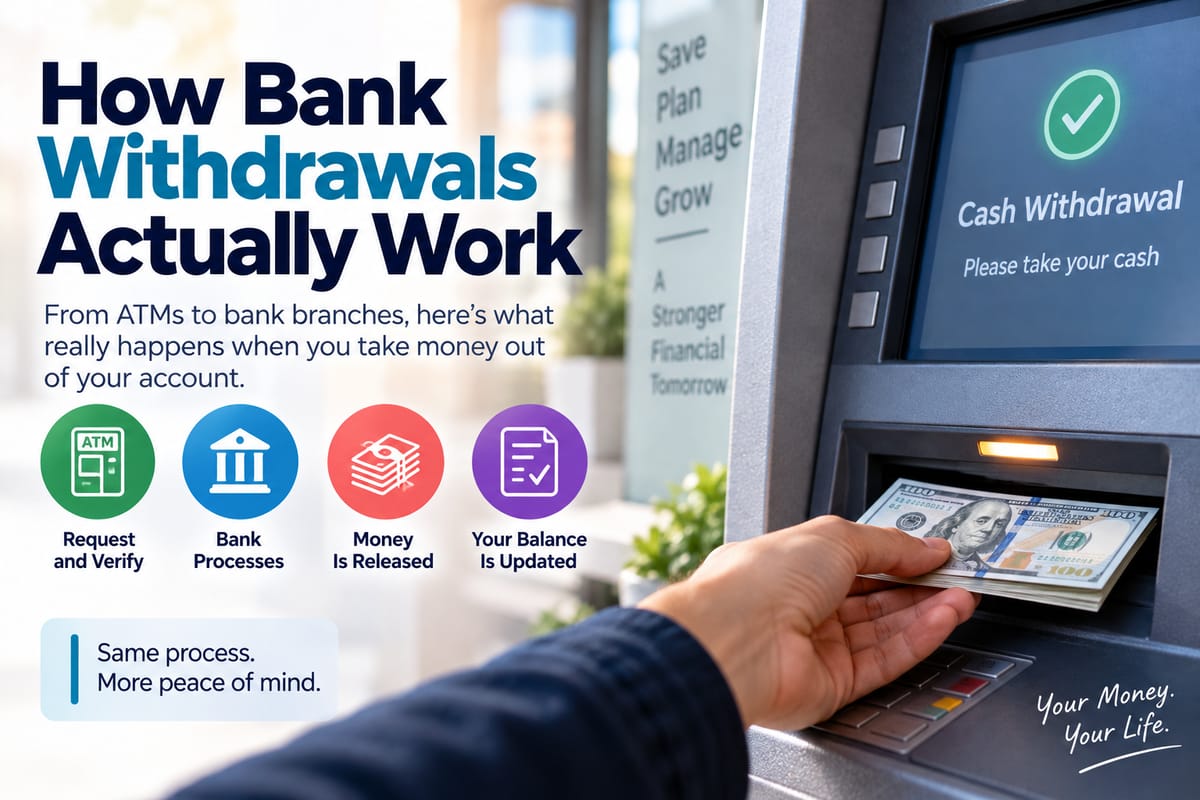
An ATM withdrawal involves several steps that happen within seconds.
A simplified process looks like this:
- The customer inserts or taps their card or uses another supported authentication method.
- The ATM identifies the associated account or card.
- The customer provides authentication, such as a PIN or another security method.
- The customer selects the withdrawal option and enters an amount.
- The banking system checks whether the transaction can be authorized.
- If approved, the ATM dispenses the requested cash.
- The transaction is recorded against the customer’s account.
- The available balance is adjusted to reflect the withdrawal.
The ATM itself is primarily a physical interface for accessing banking services. The bank’s systems determine whether the requested transaction can be authorized.
How the Bank Checks a Withdrawal
Before approving a withdrawal, the banking system can evaluate several factors.
These may include:
- Whether the account or card is active
- Whether the authentication information is correct
- Whether sufficient funds are available
- Whether the requested amount falls within applicable limits
- Whether the transaction appears unusual
- Whether the card or account has restrictions
- Whether the ATM or transaction channel is authorized
If the required conditions are satisfied, the transaction can be approved.
If they are not, the withdrawal may be declined.
This process is designed to make sure money is not released simply because someone has access to a card or account number.
What Is an Available Balance?
One of the most important concepts in banking is the difference between the balance shown in an account and the amount that is actually available for withdrawal.
A customer’s account may contain transactions that are pending, holds that temporarily restrict funds, or deposits that have not yet become fully available.
As a result, the amount shown in an account does not always mean that exactly the same amount can be withdrawn immediately.
Banks use available-balance calculations to determine how much money can generally be accessed through particular transaction channels.
This is why a withdrawal can sometimes be declined even when the customer believes the account contains enough money.
Why Are There Withdrawal Limits?
Banks and ATM operators may impose limits on how much money can be withdrawn over a particular period.
Limits can apply to:
- Individual transactions
- Daily ATM withdrawals
- Cash withdrawals at branches
- Certain electronic transfers
- Specific account types
Limits can serve several purposes.
They can reduce potential losses if a card or account credential is compromised, help manage cash availability at ATMs, and provide an additional control around unusually large transactions.
The exact limits depend on the financial institution, account, card, transaction type, and applicable rules.
How Bank Branch Withdrawals Work
A withdrawal at a bank branch generally involves more direct interaction with banking staff.
The customer may need to provide information or identification that allows the institution to verify that the person requesting the withdrawal is authorized to access the account.
The bank employee then enters or processes the transaction through the institution’s banking system.
If the transaction is approved, cash can be provided to the customer and the account record is updated.
Branch withdrawals can be useful when a customer needs a larger amount of cash, requires assistance, or has a transaction that cannot be completed through an ATM.
Why Identification May Be Required
Banks need to protect customer accounts from unauthorized access.
Depending on the type and size of a transaction, customers may be asked to provide identification, authentication information, or other documentation.
The exact requirements vary by institution and jurisdiction.
Security procedures are intended to establish that the person requesting access is authorized to do so and to help financial institutions comply with applicable banking and financial-crime controls.
What Happens to Your Account Balance After a Withdrawal?
Once a withdrawal is successfully processed, the bank records the transaction.
For a simple example, suppose an account has an available balance of $1,000 and the customer withdraws $200.
The account’s available funds would generally be reduced by the amount of the completed withdrawal, leaving $800 available, assuming there are no other pending transactions, holds, fees, or restrictions.
The important point is that the bank does not simply remove a physical stack of cash from a personal storage compartment labeled with the customer’s name.
Modern banking relies heavily on electronic records that track balances and transactions.
Does the Bank Keep Your Exact Cash on Hand?
Not necessarily.
A bank does not generally need to hold the exact amount of every customer’s account balance as physical cash in its vault.
Customers’ deposits are recorded as financial claims against the bank, while banks manage their assets, liabilities, liquidity, and payment obligations as part of their overall operations.
When someone requests physical cash, the bank or ATM provides currency from its available cash supply while the customer’s account record is reduced.
This distinction helps explain why modern banking can support millions of transactions without keeping every deposited dollar, shilling, pound, or other currency unit physically stored for each individual customer.
How Electronic Withdrawals Differ From Cash Withdrawals
Not every withdrawal results in physical cash.
A customer can instruct a bank to move money from one account to another electronically. In that case, the customer’s balance decreases while another account receives a corresponding credit, subject to the payment system and processing arrangements involved.
Electronic transactions may pass through multiple systems before they are finally settled.
For a closer look at this process, How Digital Bank Transfers Move Money Between Accounts explains how electronic transfers move funds between accounts.
How Payment Systems Fit Into Bank Withdrawals
Banking transactions do not operate in isolation.
Financial institutions use payment systems to communicate transaction information and settle obligations between banks and other participants.
For example, when a customer uses a card issued by one institution at an ATM operated by another institution, multiple parties may be involved in authorizing and processing the transaction.
The systems involved need to determine:
- Which account is being accessed
- Whether the transaction is authorized
- Which institution should provide the cash
- Which institution should ultimately bear the financial obligation
- How the participating institutions will settle the transaction
The wider structure behind these processes is explained in How Payment Systems Work and How Money Moves Between Accounts.
What Happens When You Use Another Bank’s ATM?
A customer may withdraw money from an ATM that does not belong to their own bank.
In this situation, the transaction can involve the customer’s bank, the ATM operator, and a card or payment network.
The ATM receives the customer’s request and sends transaction information through the appropriate network.
The customer’s bank can then determine whether the transaction should be approved.
If approved, the ATM dispenses cash and the participating institutions later handle the associated financial settlement.
Depending on the account and transaction arrangement, a fee may also apply.
Why ATM Fees Exist
ATM transactions can involve costs for operating and maintaining the machine, processing transactions, managing cash, and maintaining connections to payment networks.
Some institutions charge customers for using certain ATMs, particularly when the ATM is operated by another financial institution or network.
The amount and structure of any fee depend on the institutions and services involved.
Customers should check their bank’s fee schedule to understand when withdrawal charges may apply.
What Happens When a Withdrawal Is Declined?
A declined withdrawal does not necessarily mean that the customer’s money has disappeared.
There can be several reasons for a declined transaction.
For example:
- Insufficient available funds
- Incorrect PIN
- Exceeded withdrawal limit
- Card restrictions
- Suspicious transaction detection
- Account restrictions
- ATM malfunction
- Network communication problems
- Cash availability problems at the ATM
The precise reason may not always be displayed on the ATM screen for security reasons.
If a transaction repeatedly fails, contacting the bank can help determine whether the issue involves the account, card, transaction limits, or the ATM itself.
Why an ATM Might Not Have Enough Cash
An ATM can only dispense the physical currency that has been loaded into it.
Even if a customer’s account contains enough money, the machine may not have enough cash available to fulfill a large withdrawal.
ATMs also need to manage different denominations.
For example, an ATM might have plenty of smaller notes but not enough larger denominations to provide the exact amount requested.
The customer may therefore be asked to enter a different amount or use another ATM or withdrawal method.
How Banks Protect Withdrawals From Fraud
Security controls are an important part of withdrawal processing.
Banks can use multiple layers of protection, including:
- PIN authentication
- Card security features
- Transaction limits
- Fraud detection systems
- Account monitoring
- Device and location signals
- Transaction alerts
- Temporary card blocking
- Additional identity verification
These systems can look for transaction patterns that differ from a customer’s normal activity.
A transaction that appears unusual may receive additional scrutiny or be temporarily declined.
Why Withdrawal Alerts Are Useful
Many banks allow customers to receive notifications when transactions occur.
A withdrawal alert can help customers quickly identify activity they do not recognize.
For example, a customer might receive a notification shortly after an ATM withdrawal is completed.
If the customer did not make that transaction, the alert provides an opportunity to contact the bank promptly.
Keeping transaction notifications enabled can therefore be a useful part of monitoring an account.
How Mobile and Online Banking Changed Withdrawals
Digital banking has expanded the ways people can access and move their money without visiting a branch.
Customers can often:
- View account balances
- Transfer funds
- Pay bills
- Manage cards
- Review transaction histories
- Set transaction alerts
- Deposit checks or initiate supported deposits
- Manage account settings
These services rely on secure digital systems connected to the bank’s underlying infrastructure.
For a broader explanation of the technology behind these services, How Digital Banking and Online Banking Work explores how customers interact with banks through digital channels.
Cash Withdrawal Versus Account Transfer
A cash withdrawal and an electronic transfer both reduce funds available to the customer, but they are operationally different.
With a cash withdrawal, physical currency is delivered to the customer.
With an electronic transfer, the money is represented through changes to account records and payment-system instructions.
The customer may never physically handle the money.
This distinction is increasingly important as electronic payments become a larger part of everyday financial activity.
Can a Withdrawal Be Reversed?
Whether a withdrawal can be reversed depends on the type of transaction and what happened.
A completed cash withdrawal generally cannot simply be undone like editing a document. If an unauthorized withdrawal occurred, the customer normally needs to report it to the financial institution and follow its investigation and dispute procedures.
Electronic transactions can have different reversal, cancellation, or dispute processes depending on the payment method and circumstances.
Customers should contact their bank as soon as possible when they identify a transaction they did not authorize.
Why Pending Transactions Matter
Some banking transactions are initially shown as pending rather than completed.
A pending transaction may temporarily affect the amount of money available to the customer even though final processing has not yet occurred.
This can matter when someone attempts another withdrawal shortly afterward.
For example, a customer might see a transaction reflected in the available balance before the transaction has fully settled through all relevant systems.
Understanding pending transactions can help explain why an account’s available funds may differ from the balance a customer expected.
What Happens When a Withdrawal Is Larger Than Usual?
Large withdrawals may receive additional scrutiny.
A bank may have specific procedures for substantial cash withdrawals, including advance notice, additional identification, or other requirements.
These measures can help the institution manage physical cash availability and comply with applicable financial controls.
Customers who need a particularly large amount of cash may therefore benefit from contacting their bank in advance rather than assuming that an ATM or branch will immediately be able to provide the entire amount.
Why Withdrawal Records Matter
Every completed withdrawal creates a transaction record.
Depending on the banking service, customers may be able to see information such as:
- Date
- Time
- Amount
- Transaction type
- ATM or merchant location
- Reference information
- Applicable fees
Transaction histories provide an important record of how money moves through an account.
Reviewing them regularly can help customers identify unexpected charges, recognize spending patterns, and detect potentially unauthorized activity.
The Role of Banks in Managing Cash
Physical cash remains an important part of banking even as digital transactions become increasingly common.
Banks and ATM operators need to forecast cash demand, transport currency securely, refill machines, manage different denominations, and maintain sufficient liquidity for customers who want cash.
This means a seemingly simple ATM withdrawal depends on a much larger operational system.
The customer sees only a few seconds of the process, but numerous systems and controls may operate behind the scenes.
A Withdrawal Is More Than Money Coming Out
A bank withdrawal is fundamentally a change in the financial records associated with an account, accompanied by a way for the customer to access or direct those funds.
For cash withdrawals, the process involves authentication, authorization, account updates, ATM or branch operations, and cash management. For electronic withdrawals and transfers, payment networks and settlement systems can become part of the process.
Understanding these mechanisms makes everyday banking transactions easier to interpret. It also explains why banks use withdrawal limits, transaction alerts, identity verification, fraud monitoring, and other safeguards.
What appears to be a simple request for cash is actually one small part of a complex financial infrastructure designed to keep account access, transaction records, and money movement working together.