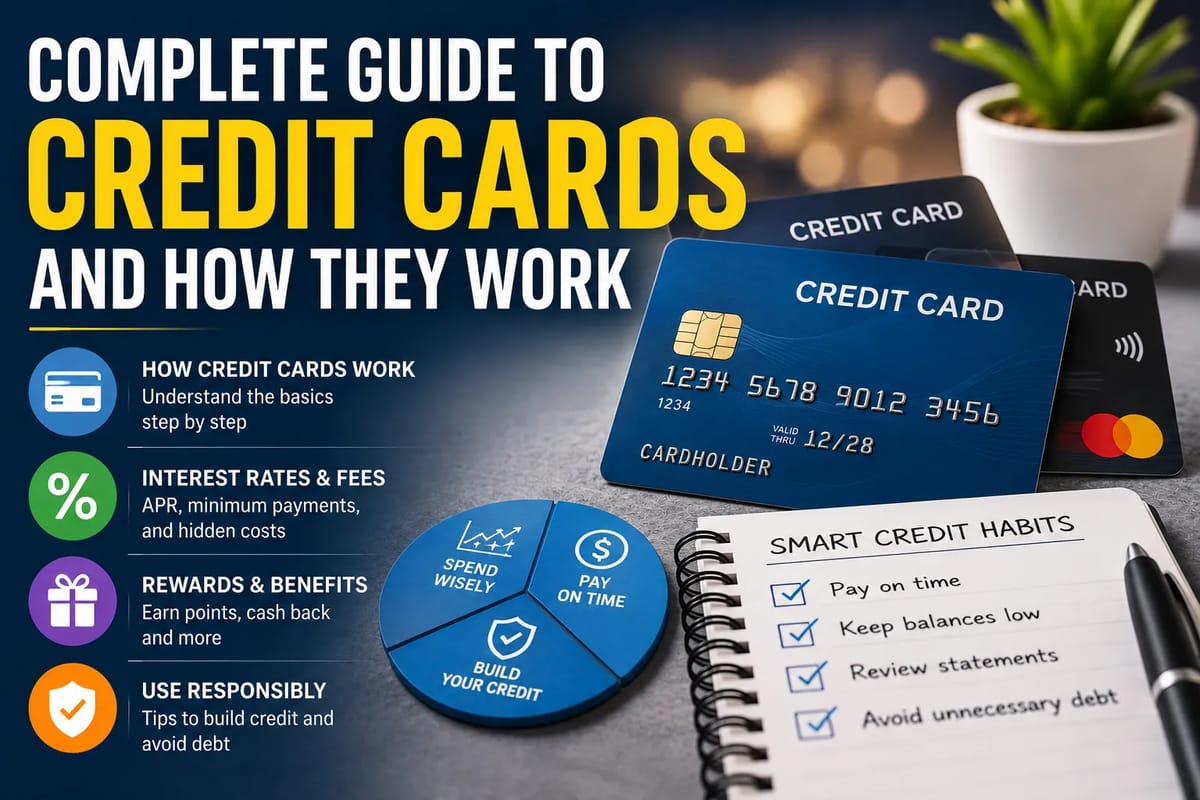
Complete Guide to Credit Cards and How They Work
Credit cards are among the most widely used financial products in modern banking. They can make everyday purchases more convenient, provide access to short-term credit, offer rewards, and—when managed responsibly—help establish a strong credit history.
They can also become expensive surprisingly quickly.
The difference usually comes down to how the card is used.
A person who pays their statement balance in full each month may be able to use a credit card primarily as a payment tool while avoiding interest on eligible purchases. Someone who repeatedly carries balances, misses payments, uses cash advances, or overlooks fees can end up paying substantially more than the original purchase price.
Understanding how credit cards work is therefore more important than simply knowing how to swipe, tap, or enter a card number online.
This guide explains credit cards from the ground up, including credit limits, billing cycles, APR, minimum payments, grace periods, rewards, fees, balance transfers, cash advances, credit scores, and strategies for using cards responsibly.
Note: Credit-card rules, fees, consumer protections, and eligibility requirements vary by country and issuer. Examples involving specific regulatory rules in this article refer primarily to the U.S. system; check your card agreement and local financial regulations for the rules that apply to you.
What Is a Credit Card?
A credit card is a revolving line of credit provided by a financial institution.
Instead of taking out a new loan every time you make a purchase, you receive a predetermined credit limit and can borrow against that limit as you spend.
For example, suppose a card has a credit limit of $5,000.
If you make a $500 purchase, your available credit may fall to approximately $4,500. If you later repay $500, that available credit generally becomes available again.
This is one of the major differences between a credit card and an installment loan.
With an installment loan, you typically borrow a fixed amount and repay it according to a predetermined schedule.
With a credit card, the credit line can generally be reused as you repay what you owe.
For a broader explanation of how credit products fit together, see the Complete Guide to Credit Tools.
How a Credit Card Transaction Works
A typical credit-card purchase involves several parties.
These can include:
- You, the cardholder
- The merchant
- The merchant’s payment processor
- The card network
- Your card issuer
When you tap or enter your card details, the transaction is authorized through the payment network.
If approved, the transaction is eventually posted to your card account.
You then owe the card issuer according to the terms of your card agreement.
The process happens quickly from the customer’s perspective, but several financial institutions and payment systems may be involved behind the scenes.
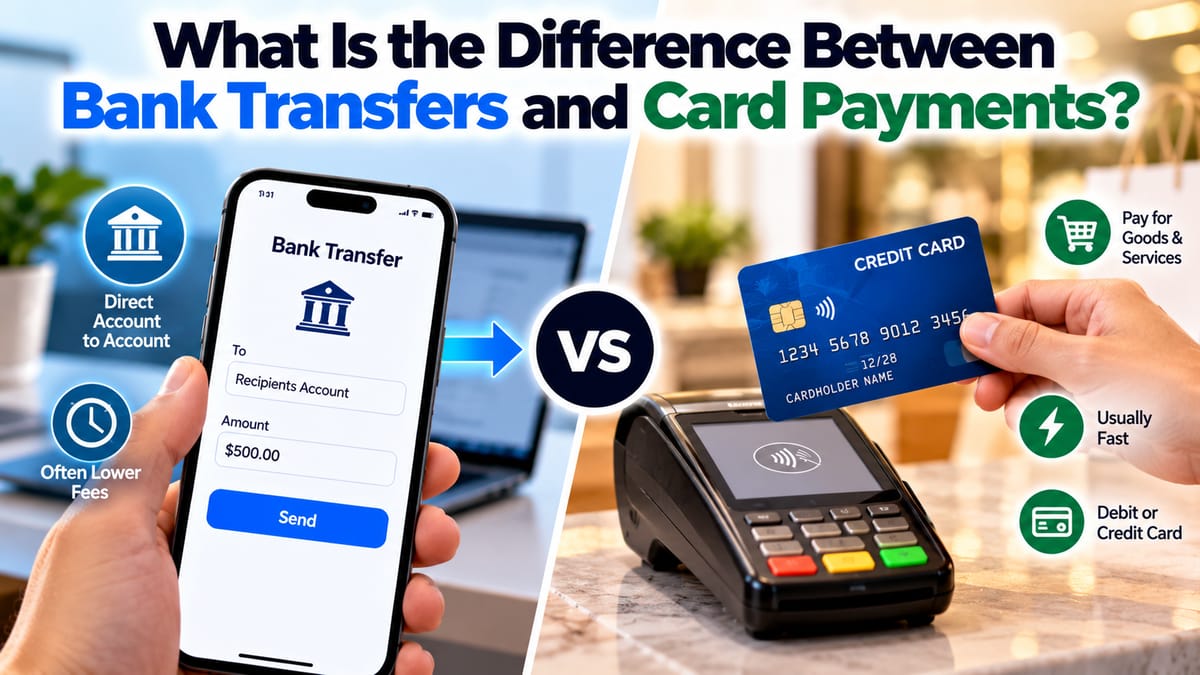
Credit Card vs. Debit Card
The two cards may look similar, but they work differently.
Credit Card
You borrow money from the card issuer and repay it later.
Debit Card
Money is generally taken directly from your bank account when you make a purchase.
This distinction matters because credit cards can create debt, while debit-card spending normally uses money you already have available.
Credit cards can also provide benefits such as rewards, dispute rights, and credit-building opportunities depending on the card and jurisdiction.
What Is a Credit Limit?
Your credit limit is the maximum amount the issuer allows you to borrow on the card at one time.
A card might have a limit of:
- $500
- $2,000
- $10,000
- $25,000
- Or considerably more
The limit is generally determined using information such as your credit history, income, existing debts, application information, and the issuer’s own underwriting criteria.
A higher credit limit does not mean you can afford to spend more.
It simply means the lender is willing to make more credit available to you under the card’s terms.
Available Credit vs. Credit Limit
These terms are easy to confuse.
Suppose your card has a $5,000 limit.
If you owe $1,500, your available credit may be approximately $3,500, although pending transactions and other account activity can affect the exact figure.
As you make payments, available credit generally increases again.
What Is a Billing Cycle?
A billing cycle is the period during which your card transactions are accumulated for a statement.
At the end of the cycle, the issuer generates a statement showing information such as:
- Purchases
- Payments
- Credits
- Fees
- Interest
- Current balance
- Minimum payment
- Payment due date
The exact length and dates vary by issuer.
Understanding your billing cycle makes it easier to understand why a purchase made on one day may appear on one statement while another purchase appears on the next.
What Is a Credit Card Statement?
Your statement is essentially a financial report for the billing period.
It may show:
- Previous balance
- New purchases
- Payments
- Refunds
- Fees
- Interest charges
- Promotional balances
- Minimum payment
- Statement balance
- Payment due date
Read it regularly.
A quick review can help you spot unauthorized transactions, unexpected fees, billing errors, or subscriptions you forgot about.
Statement Balance vs. Current Balance
These are not always the same.
Statement Balance
The amount shown as owed at the end of the most recent billing cycle.
Current Balance
The amount currently owed, which may include transactions made after the statement closed.
If you pay your statement balance in full by the due date, you can generally avoid interest on eligible purchases when your card has a grace period and you qualify for it.
What Is APR?
APR stands for Annual Percentage Rate.
It represents the annualized cost of borrowing and is one of the most important numbers to understand when comparing credit cards.
A card might have an APR of:
- 15%
- 20%
- 25%
- 30%
- Or another rate depending on the issuer and borrower
The actual rate offered to you depends on the card and your financial profile.
A Credit Card Can Have Multiple APRs
Do not assume every transaction on your card has the same interest rate.
A card may have separate rates for:
- Purchases
- Cash advances
- Balance transfers
- Promotional balances
- Other transaction categories
The applicable rates should be explained in the card agreement and account disclosures.
Some cards charge substantially different rates for cash advances compared with ordinary purchases.
Fixed vs. Variable APR
A credit card’s interest rate may be fixed or variable depending on the product.
A variable APR can change based on an underlying index and the terms of the agreement.
Do not assume that an introductory rate will remain indefinitely.
Promotional rates generally have an expiration date and specific conditions.
What Is a Grace Period?
A grace period is the time between the end of a billing cycle and the payment due date during which you may avoid interest on eligible purchases if you pay the required balance in full.
Credit-card companies are not universally required to provide a grace period, but many cards offer one for purchases.
The important point is that a grace period is not the same thing as simply having a few extra weeks to pay without consequences.
Its availability depends on the card’s terms and whether you meet the requirements.
How to Avoid Interest on Purchases
For cards that provide a grace period, one of the simplest strategies is:
Pay the statement balance in full and on time every month.
If you do this consistently, you may be able to use the card without paying interest on eligible purchases.
This is one reason credit cards can function as convenient payment tools rather than expensive borrowing products.
However, the exact rules depend on your card agreement.
What Happens When You Carry a Balance?
Suppose you owe $1,000 and pay only $100.
The remaining balance can generally continue accruing interest according to your card’s terms.
If you continue making new purchases while carrying the balance, those purchases may also become subject to interest depending on whether you still have a grace period.
The result can be a cycle in which the debt becomes increasingly difficult to eliminate.
For strategies focused specifically on reducing multiple debts, see How to Manage Household Debt and Pay Off Multiple Debts.
How Credit Card Interest Is Calculated
Many card issuers calculate interest on a daily basis, often using an average daily balance.
A simplified illustration:
Imagine a card with a $1,000 balance and a 24% annual interest rate.
A rough daily rate might be around:
24% ÷ 365 ≈ 0.066% per day
The actual calculation can be more complicated depending on the issuer, transaction timing, fees, payments, and compounding method.
That is why paying down a balance earlier can reduce interest compared with leaving the same balance outstanding.
Why Credit Card Debt Can Become Expensive
Credit cards are designed to be convenient.
That convenience can make borrowing easy.
The problem occurs when spending continues while repayments remain small.
For example:
You spend $1,000.
You make the minimum payment.
Then you spend another $300.
Then another $200.
The balance can remain high even though you are making payments every month.
Interest is then charged on the outstanding balance according to the card’s terms.
What Is the Minimum Payment?
The minimum payment is the smallest amount you are required to pay by the due date to keep the account from being considered past due.
It is important to make at least the minimum payment when required.
But it is not necessarily a good repayment strategy.
Paying only the minimum can keep debt outstanding for a long time and increase the total interest you pay.
Why the Minimum Payment Can Be Misleading
Suppose you owe $4,000.
Your statement may show a minimum payment that looks manageable.
That can create the impression that the debt is affordable.
But if the payment is only a small percentage of the balance, interest may continue accumulating for months or years.
Always look beyond the minimum payment.
Ask:
How much will I actually pay if I repay the balance at this rate?
Paying the Full Balance vs. Minimum Payment
The difference can be significant.
| Payment strategy | Likely effect |
|---|---|
| Pay full statement balance | May avoid purchase interest when a grace period applies |
| Pay more than minimum | Reduces principal faster and generally reduces future interest |
| Pay only minimum | Keeps account current but can extend repayment substantially |
| Miss minimum payment | Can lead to fees, credit consequences, and other penalties |
The exact consequences depend on your card agreement and local regulations.
What Is a Credit Score?
A credit score is a numerical representation of credit risk calculated using information from a credit report or other credit data, depending on the scoring system.
Lenders may use credit scores when evaluating applications for:
- Credit cards
- Personal loans
- Mortgages
- Auto loans
- Other forms of credit
Different countries use different credit-reporting and scoring systems.
For a broader look at how credit scores and reports work, see the Complete Guide to Credit Scores and Credit Reports.
How Credit Cards Can Affect Your Credit
Responsible credit-card use can help establish a positive credit history in systems where card activity is reported to credit bureaus.
Factors that may matter include:
- Payment history
- Amount of debt
- Credit utilization
- Account age
- Number and type of accounts
- Recent applications
The precise weighting depends on the scoring model.
What Is Credit Utilization?
Credit utilization describes how much of your available revolving credit you are using.
For example:
If you have a $10,000 credit limit and owe $2,000, your utilization is:
20%
If you owe $8,000, it is:
80%
High utilization can negatively affect some credit scores, particularly when balances are reported at high levels.
However, credit-scoring models differ, so there is no single utilization percentage that guarantees a particular score.
Does Carrying a Balance Help Your Credit Score?
This is a common misconception.
You generally do not need to carry interest-bearing debt to demonstrate responsible credit use.
If your card has a grace period, paying eligible purchases in full can allow you to build payment history while avoiding purchase interest.
Carrying a balance simply to “build credit” can therefore be an unnecessarily expensive strategy.
What Is a Credit Card Fee?
Credit cards can have several types of fees.
Common examples include:
- Annual fees
- Late-payment fees
- Balance-transfer fees
- Cash-advance fees
- Foreign-transaction fees
- Returned-payment fees
- Certain service fees
Not every card charges all of these.
Always review the fee schedule before applying.
For a broader look at banking-related fees and ways to reduce them, see Banking Fees Explained: Types and How to Avoid Them.
Annual Fees
Some cards charge an annual fee for access to their benefits.
Premium rewards cards may charge substantial annual fees but provide benefits that can potentially outweigh the cost for certain users.
A simple calculation helps:
Annual value of benefits − annual fee = potential net value
If you do not use the benefits, an annual fee may not make sense.
Balance Transfer Fees
A balance transfer allows you to move debt from one credit card to another.
Some cards offer promotional APRs on transferred balances.
But balance transfers often involve a fee, typically calculated as a percentage of the transferred amount.
Before transferring debt, calculate:
- Transfer fee
- Promotional rate
- Promotional period
- Post-promotion APR
- Required monthly payment
- Other card fees
Balance Transfers Are Not Free Debt
A 0% promotional rate can sound like free money.
It is not.
You still owe the principal.
And if you fail to repay the balance during the promotional period, the interest rate may rise significantly afterward.
A balance transfer can be useful when it is part of a structured debt-repayment plan.
It can be counterproductive if it simply creates another opportunity to accumulate debt.
What Is a Cash Advance?
A cash advance allows you to access cash using your credit card.
It may involve:
- A cash-advance fee
- A separate APR
- No normal purchase grace period
- Interest beginning immediately or according to the card’s specific terms
For this reason, cash advances can be an expensive way to obtain money.
Why Cash Advances Should Be Used Carefully
Suppose you withdraw $500 from a credit card.
You may immediately owe:
- The $500 advance
- A cash-advance fee
- Interest
If you are already carrying other debt, this can increase the cost of borrowing considerably.
An emergency fund or lower-cost borrowing option may be preferable when available.
What Are Credit Card Rewards?
Rewards programs encourage cardholders to use their cards by providing benefits based on eligible spending.
Common reward types include:
- Cash back
- Points
- Airline miles
- Hotel rewards
- Store credits
- Discounts
- Other promotional benefits
The value of rewards depends on the program’s rules.
Cash-Back Cards
Cash-back cards return part of eligible spending to the cardholder.
A card might offer different rates for:
- Groceries
- Fuel
- Dining
- Travel
- Rotating categories
- General purchases
The best card is not necessarily the one with the highest headline percentage.
Look at spending categories, annual fees, reward caps, redemption rules, and expiration conditions.
Travel Rewards Cards
Travel cards may offer:
- Airline points
- Hotel points
- Travel credits
- Airport-related benefits
- Travel insurance
- Lounge access
These benefits can be valuable for frequent travelers.
But a travel card may be poor value for someone who rarely travels, particularly if it carries a significant annual fee.
Sign-Up Bonuses
Some cards offer rewards when new cardholders spend a certain amount within a specified period.
Before pursuing a bonus, ask:
Would I make this spending anyway?
If you need to spend money you do not have simply to earn a reward, the bonus may not be worth it.
Never turn a reward into expensive credit-card debt.
How Credit Card Rewards Can Go Wrong
Rewards become less valuable if you pay substantial interest to earn them.
For example, earning $100 in rewards while paying $500 in interest is not a financial victory.
The strongest rewards strategy is generally:
Spend normally → pay the balance in full → collect rewards.
For a broader explanation of points, rewards and cash-back systems, see How Credit Card Rewards, Points and Cash Back Work.
What Is a Promotional APR?
A promotional APR is a temporary interest rate offered under specific conditions.
Examples include:
- 0% APR on purchases
- 0% APR on balance transfers
- Reduced APR for a limited period
Always determine when the promotion ends.
A card that looks inexpensive during a 12-month promotion can become much more expensive afterward.
0% APR Is Not Always the Same as Deferred Interest
This distinction is important.
With a genuine 0% introductory APR, interest generally is not charged during the promotional period on the qualifying balance.
With a deferred-interest offer, unpaid promotional interest may become due if the balance is not paid in full under the offer’s terms.
Read the wording carefully.
“0% APR” and “no interest if paid in full” are not necessarily the same deal.
What Happens If You Miss a Payment?
Missing a payment can have several consequences.
Depending on the card and jurisdiction, you may face:
- Late fees
- Interest charges
- Loss of promotional benefits
- Higher interest rates under certain circumstances
- Damage to your credit history
The best strategy is simple:
Pay at least the required minimum by the due date every month.
If possible, pay the full statement balance.
Automatic Payments Can Reduce Missed-Payment Risk
Many cardholders use automatic payments.
You can often configure an account to automatically pay:
- The minimum payment
- The statement balance
- A fixed amount
If you have sufficient funds available, automatically paying the statement balance can reduce the risk of accidentally carrying a balance because you forgot the due date.
Still monitor your account.
Automatic payments do not replace reviewing statements and checking your bank balance.
What Happens If Your Card Is Lost or Stolen?
Contact the card issuer as soon as you notice the card is missing.
Many issuers allow you to lock or freeze a card through a mobile application.
The exact protections against unauthorized transactions depend on the card, issuer, network, and applicable law.
Monitor Your Transactions
Checking your account regularly can help you detect:
- Fraud
- Duplicate charges
- Unexpected subscriptions
- Incorrect amounts
- Merchant errors
- Unfamiliar transactions
Do not wait until the end of the year to discover that something is wrong.
A quick weekly review can be enough for many people.
What If You See a Billing Error?
If you see a transaction that appears incorrect, contact the card issuer.
Keep documentation such as:
- Receipts
- Emails
- Order confirmations
- Refund confirmations
- Screenshots
- Communication with the merchant
Documentation can make disputes easier to resolve.
Credit Card Security Online
Credit-card fraud is not limited to physical theft.
Card details can be exposed through:
- Phishing
- Fake shopping websites
- Malware
- Data breaches
- Social engineering
- Unsecured accounts
Protect your card information by:
- Using reputable websites
- Avoiding suspicious links
- Using strong passwords
- Enabling multi-factor authentication where available
- Monitoring account activity
- Keeping devices updated
Never share one-time verification codes with someone who contacts you unexpectedly.
Don’t Save Card Details Everywhere
Saving card information on websites can make future purchases convenient.
But every stored payment credential creates another account that needs protection.
For important shopping accounts, use strong unique passwords and enable available security features.
Credit Card vs. Personal Loan
Both can provide access to borrowed money, but they work differently.
| Feature | Credit card | Personal loan |
|---|---|---|
| Credit type | Revolving | Installment |
| Borrowing | Reusable credit line | Usually lump sum |
| Repayment | Flexible within minimum requirements | Scheduled payments |
| Interest | Often variable | Can be fixed or variable |
| Best suited to | Ongoing purchases | Defined borrowing need |
| Potential risk | Easy to accumulate debt | Fixed repayment obligation |
The better option depends on the purpose of the borrowing and the terms available.
For more information on the alternative, see How Personal Loans Work and When to Use One.
Credit Card vs. Buy Now, Pay Later
Buy-now-pay-later services can divide purchases into installments.
Although they may feel different from traditional credit cards, they are still forms of consumer credit and can create repayment obligations.
Before using either product, consider:
- Total cost
- Payment schedule
- Late fees
- Interest
- Credit-reporting practices
- Consequences of missed payments
Do not focus only on the size of the individual installment.
Look at the total financial commitment.
How to Choose a Credit Card
Choosing a card should start with your financial habits, not advertisements.
Ask yourself:
Do I normally pay balances in full?
If yes, rewards and fees may be more important than APR.
Do I expect to carry a balance?
If yes, APR becomes much more important.
Do I travel frequently?
A travel-rewards card might be useful.
Do I want simplicity?
A straightforward cash-back card may be easier.
Do I need to transfer existing debt?
A balance-transfer card could potentially help, provided you have a realistic repayment plan.
Compare Cards by Total Cost
When comparing cards, look at:
- APR
- Annual fee
- Foreign-transaction fees
- Balance-transfer fees
- Cash-advance fees
- Late-payment fees
- Reward rates
- Reward limits
- Introductory offers
- Regular APR after promotions
- Eligibility requirements
Do not choose a card based solely on its sign-up bonus.
Read the Card Agreement
The card agreement contains the details that advertisements often summarize.
Pay particular attention to:
- APRs
- Fees
- Grace period
- Minimum payment calculation
- Promotional terms
- Balance-transfer rules
- Cash-advance terms
- Foreign transactions
- Rewards restrictions
- Dispute procedures
A Simple Credit Card Strategy
For many people, a straightforward approach works well:
Step 1: Use the Card for Planned Spending
Avoid treating the credit limit as additional income.
Step 2: Track Your Purchases
Know how much you have spent before the statement arrives.
Step 3: Keep an Emergency Fund
Do not rely entirely on credit for unexpected expenses.
Step 4: Pay on Time
Never intentionally miss a required minimum payment.
Step 5: Pay the Statement Balance
When possible, pay it in full to avoid eligible purchase interest.
Step 6: Review the Statement
Check transactions, fees, and interest.
Step 7: Reassess the Card Periodically
A card that was useful several years ago may no longer be the best fit.
How to Use a Credit Card Without Going Into Debt
A useful rule is:
If you cannot reasonably pay for the purchase without relying on future income, reconsider the purchase.
This does not mean every credit-card purchase must be funded with cash sitting in your bank account at that exact moment.
It means you should have a realistic repayment plan.
The most dangerous habit is treating the credit limit as a spending target.
A $10,000 limit does not mean you have $10,000 of disposable income.
Keep Your Credit Utilization Under Control
If maintaining a strong credit profile is important to you, avoid allowing revolving balances to remain unnecessarily high.
For example, someone with a $10,000 limit might prefer not to routinely carry $8,000 of debt.
Reducing the balance can lower interest costs and may also improve credit utilization metrics used by some scoring systems.
Avoid Applying for Cards You Don’t Need
Every credit application can have consequences depending on the country and scoring system.
Applying for multiple cards in a short period can also make managing your finances more complicated.
Choose products based on a genuine need rather than collecting cards simply because they offer promotional rewards.
Should You Close an Old Credit Card?
Closing a card is not automatically the right or wrong decision.
Consider:
- Annual fee
- Credit limit
- Account age
- Rewards
- Utilization
- Whether the card encourages overspending
- Whether the issuer offers a no-fee alternative
In some credit-scoring systems, closing a card can affect available credit and therefore utilization.
If the card has no annual fee and you can manage it responsibly, keeping it open may be worth considering.
But financial simplicity and avoiding unnecessary fees can also matter.
What If You Have Too Much Credit Card Debt?
If your balances have become difficult to manage, stop treating the problem as a normal spending issue.
Start with a complete inventory.
Write down:
- Each card
- Balance
- APR
- Minimum payment
- Due date
- Promotional rate expiration
- Fees
Then calculate how much you can realistically put toward debt each month.
Debt Repayment Methods
Two common approaches are:
Debt Avalanche
Pay extra toward the debt with the highest interest rate while making required payments on the others.
This approach generally minimizes interest costs if followed consistently.
Debt Snowball
Pay extra toward the smallest balance first.
This can provide psychological motivation because individual debts disappear more quickly.
Neither method is universally superior for every person.
The most important factor is having a sustainable repayment plan.
Consider Calling Your Card Issuer
If you are struggling with payments, contacting the issuer early can be better than ignoring the problem.
Depending on the situation and issuer, you may be offered options such as:
- Payment arrangements
- Temporary hardship programs
- Reduced rates
- Other assistance
Never assume the issuer cannot help.
But read any new agreement carefully before accepting it.
Avoid Using One Card to Hide Another Card’s Debt
Moving balances between cards without reducing the underlying debt can create the illusion of progress.
A balance transfer is only useful if it helps you actually repay the debt.
Otherwise, you may eventually have several cards with balances and fewer available options.
Credit Cards and Emergency Expenses
Credit cards can provide access to funds when an unexpected expense occurs.
But relying on them for every emergency can create long-term debt.
An emergency fund can provide a financial buffer for expenses such as:
- Car repairs
- Home repairs
- Medical bills
- Temporary income loss
- Urgent travel
- Essential appliance replacement
Even a modest emergency fund can reduce the need to immediately borrow at a high interest rate.
Credit Cards and Large Purchases
A credit card can be useful for a large purchase if you already have the money available and can pay the balance in full.
Some consumers use cards for the convenience, security, or rewards.
The situation is very different when the purchase depends on carrying the balance for months.
Before financing a large purchase with a credit card, calculate the total repayment cost.
Credit Cards While Traveling
Before traveling internationally, check your card’s:
- Foreign-transaction fee
- International acceptance
- Currency-conversion terms
- Travel benefits
- Fraud-monitoring procedures
- Emergency replacement options
Notify your issuer of travel when required by its systems or policies.
Carry a backup payment method in case your primary card is lost, blocked, or unavailable.
Credit Card Rewards vs. Annual Fees
A simple annual calculation can reveal whether a rewards card is worthwhile.
Suppose:
- Annual fee = $150
- Rewards earned = $300
- Benefits used = $100
Potential value:
$300 + $100 − $150 = $250
But if you would have earned only $80 in rewards, the same card could be poor value.
Do the calculation based on your actual spending rather than the maximum advertised benefits.
Don’t Spend More to Earn Rewards
This is one of the most important credit-card rules.
If a card gives you 2% cash back and you spend $1,000 unnecessarily, you have not “earned” $20.
You have spent $1,000 to receive $20.
Rewards should follow spending—not cause it.
Credit Card Myths to Ignore
Myth: You Need to Carry a Balance to Build Credit
Not generally. You can often build credit through responsible use and on-time payments without paying unnecessary interest.
Myth: A Higher Credit Limit Means You Are Wealthier
It means a lender has made more credit available to you.
Myth: The Minimum Payment Is the Recommended Payment
It is generally the minimum required to keep the account current, not necessarily the best repayment strategy.
Myth: All 0% Offers Are Identical
They are not. Promotional terms and deferred-interest structures can differ substantially.
Myth: Rewards Make a High APR Irrelevant
Interest can easily outweigh rewards when balances are carried.
Myth: Credit Cards Are Always Bad
A credit card can be a useful financial tool when used within a manageable budget and paid responsibly.
A Credit Card Checklist Before Applying
Before submitting an application, ask:
- What is the regular APR?
- Is the APR fixed or variable?
- Is there an annual fee?
- What are the foreign-transaction fees?
- What are the balance-transfer fees?
- What does a cash advance cost?
- Is there a grace period?
- How does the issuer calculate interest?
- What rewards are available?
- Are rewards capped?
- When does the introductory offer end?
- What happens after the promotional period?
- What credit limit might I receive?
- Does the card fit my actual spending habits?
A Monthly Credit Card Routine
A simple routine can prevent many problems.
Once a Week
Check recent transactions.
Before the Due Date
Confirm that enough money is available for the required payment.
Every Statement
Review:
- Purchases
- Fees
- Interest
- Rewards
- Balance
- Due date
Every Few Months
Compare your card with alternatives.
Ask whether the fees and benefits still make sense.
The Golden Rule of Credit Cards
A credit card should support your financial plan—not replace one.
Used responsibly, it can provide convenience, rewards, payment flexibility, and an opportunity to establish a positive credit history.
Used carelessly, it can turn ordinary purchases into long-lasting debt.
The difference is rarely the piece of plastic itself.
It is the behavior behind it.
Make the Credit Card Work for You
The most useful way to think about a credit card is not as “free money” and not necessarily as something dangerous.
It is a financial tool.
Use it for purchases you can afford. Understand the interest rate. Know your billing cycle. Pay on time. Pay the full statement balance when possible. Monitor transactions. Treat rewards as a bonus rather than a reason to spend. And read the terms before accepting promotional offers.
If you ever find yourself using one credit card to pay another, relying on minimum payments indefinitely, or increasing spending simply because your credit limit increased, it is time to step back and reassess.
The strongest credit-card strategy is simple: borrow deliberately, understand the cost, and repay responsibly.
That approach allows the convenience and potential benefits of credit to work in your favor without allowing revolving debt to quietly take control of your finances.