Treasury Doubles Long-Term Bond Buybacks as Rising Yields Rattle Investors
The U.S. Treasury is stepping up its intervention in the long-term government bond market as rising yields and growing investor concern put renewed pressure on financial markets.
Beginning September 9, the Treasury plans to at least double the maximum size of certain liquidity-support buyback operations involving longer-dated Treasury securities, raising the limit from $2 billion to at least $4 billion per operation. The change will apply to the 10-to-20-year and 20-to-30-year maturity sectors and is scheduled to remain in effect through November 4.
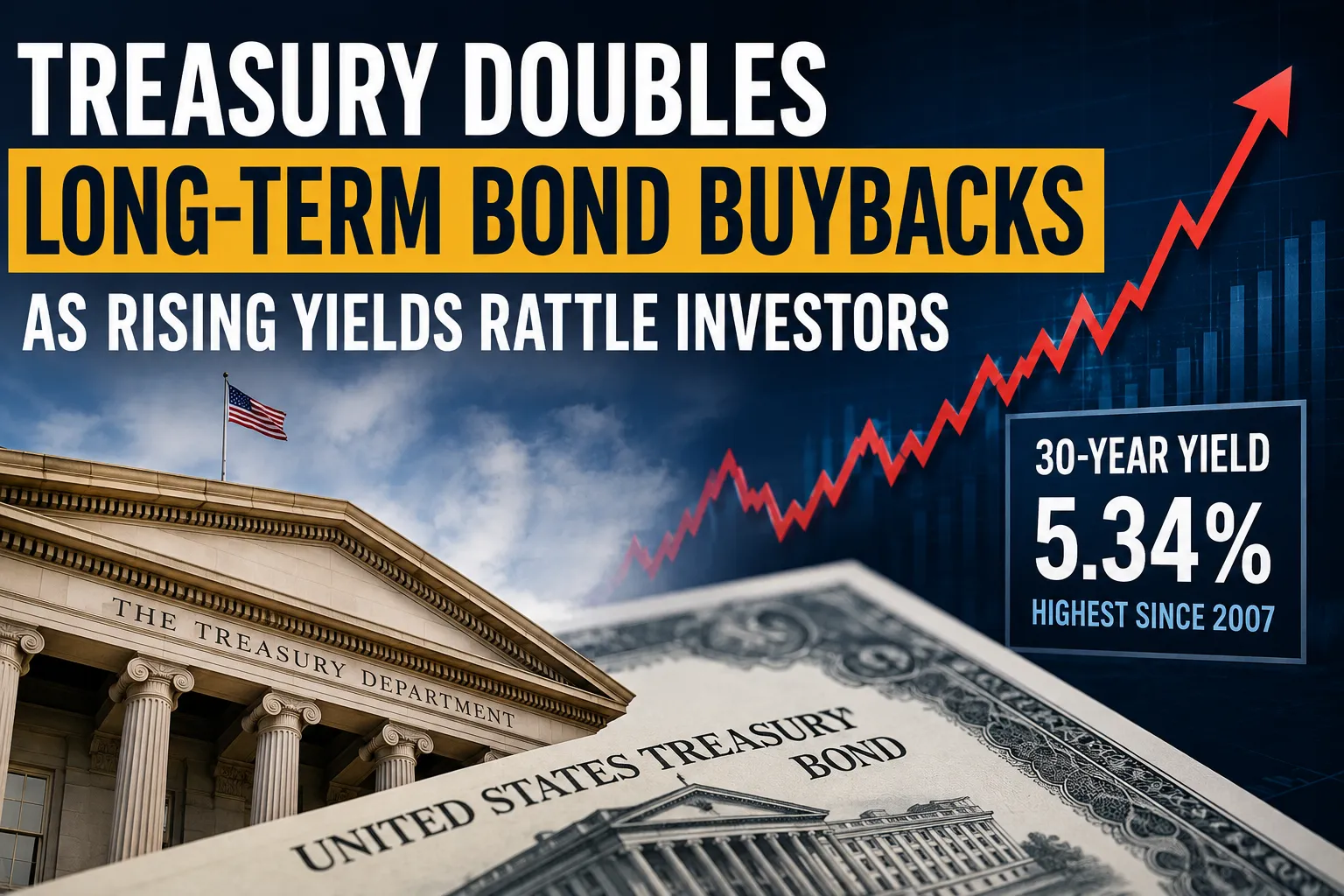
The move comes after a sharp rise in long-term Treasury yields, including a jump in the 30-year yield to around 5.34%, its highest level since 2007, before yields retreated following the Treasury announcement.
For investors, the development highlights a larger question facing markets: how much pressure can long-term borrowing costs absorb when government debt issuance, inflation risks and geopolitical uncertainty are all competing for investors’ capital?
Why Treasury Yields Have Been Rising
Treasury yields reflect a combination of expectations about inflation, economic growth, Federal Reserve policy, government borrowing and the supply and demand for bonds.
Recent market conditions have been particularly challenging for longer-maturity securities.
The Treasury Borrowing Advisory Committee reported in August that the 10-year Treasury yield had risen to roughly 4.6%, while the two-year yield was around 4.2%. The committee also noted that markets had shifted from expecting interest-rate cuts toward assigning substantial probability to future rate increases.
Higher oil prices and geopolitical uncertainty have contributed to concerns about inflation. At the same time, investors have been watching the U.S. government’s substantial financing needs.
Long-term bonds are particularly sensitive to these concerns because investors must commit their money for many years. If inflation expectations rise or investors demand a larger premium for holding long-term debt, yields can climb.
That creates a difficult environment for both bondholders and borrowers.
What Treasury Bond Buybacks Actually Do
A Treasury buyback occurs when the U.S. government purchases previously issued Treasury securities from investors before those securities mature.
The Treasury’s buyback program was introduced in 2024 primarily to improve liquidity in older, less actively traded Treasury securities. These are sometimes called off-the-run securities because they are no longer the newest benchmark issues.
The program is different from Federal Reserve quantitative easing.
The Federal Reserve can purchase Treasury securities as part of monetary policy and expand or contract its balance sheet. Treasury buybacks, by contrast, are part of the government’s debt-management operations.
The Treasury has described liquidity-support buybacks as a way to provide investors with a regular and predictable opportunity to sell less-liquid Treasury securities.
The Federal Reserve has also described Treasury’s program as being designed to support market liquidity rather than as a substitute for large-scale central-bank asset purchases.
Why the Long End of the Bond Market Matters
The 10-year, 20-year and 30-year Treasury markets play an important role in the broader financial system.
Long-term Treasury yields influence the pricing of numerous other assets and forms of borrowing, including:
- Mortgage rates
- Corporate bonds
- Municipal debt
- Long-duration stocks
- Infrastructure financing
- Some consumer borrowing costs
- Pension and insurance portfolios
When long-term Treasury yields rise substantially, borrowing costs across the economy can rise as well.
That is one reason investors are paying close attention to the Treasury’s decision to increase the size of its long-end buybacks.
For a broader understanding of how bonds interact with stocks and other financial assets, see the complete guide to financial markets and how they work.
Treasury Is Doubling the Buyback Size
The Treasury’s latest decision increases the maximum purchase size for certain long-term liquidity-support operations from $2 billion to at least $4 billion per operation.
The change applies to two maturity segments:
- 10 to 20 years
- 20 to 30 years
It takes effect September 9 and currently runs through November 4, when Treasury is expected to provide further guidance as part of its next quarterly refunding process.
Treasury said the increase reflects strong participation from market participants and the consistently high quality of offers it receives in longer-dated buyback operations.
That distinction matters.
The official rationale is primarily liquidity support, rather than an explicit commitment to maintain a particular yield level.
Still, the timing makes the policy significant for investors.
The Market Reaction Was Immediate
Financial markets reacted strongly to the announcement.
The 30-year Treasury yield fell sharply after reaching its recent high, while the 10-year yield also declined. Reuters reported that the 30-year yield dropped from roughly 5.34% to about 5.18% following the announcement.
Stocks and other risk assets also benefited from the improvement in bond-market sentiment.
That reaction illustrates how closely connected Treasury yields are to equity valuations.
When long-term bond yields rise, stocks—particularly companies whose valuations depend heavily on future earnings—can become less attractive relative to bonds.
When yields fall, some of that pressure can ease.
Why Rising Bond Yields Concern Stock Investors
Stocks and bonds compete for investors’ capital.
Suppose a long-term government bond offers a substantially higher yield than it did previously. Investors may demand a higher expected return from stocks to justify taking on additional risk.
This can put pressure on stock valuations.
The effect can be particularly noticeable for:
- Growth stocks
- Technology companies
- Highly valued companies
- Real estate investment trusts
- Utilities
- Other businesses sensitive to financing costs
Higher interest rates can also increase companies’ borrowing expenses, potentially reducing future profits.
That does not mean rising Treasury yields automatically cause stocks to fall. Economic growth, corporate earnings and investor expectations remain important.
For a more detailed look at this relationship, see how rising Treasury yields put pressure on stock valuations.
But the long-term Treasury yield is one of the most closely watched benchmarks in global financial markets.
What the Buybacks Cannot Solve
The Treasury’s move can improve liquidity and potentially reduce some pressure in the bond market, but it does not eliminate the underlying reasons investors may demand higher yields.
The United States still faces significant long-term borrowing requirements.
Treasury’s August refunding statement shows that the government continues to finance substantial amounts of debt through a combination of bills, notes, bonds, Treasury Inflation-Protected Securities and other instruments. For the August-to-October quarter, Treasury planned to offer $125 billion in securities in its August refunding operation, including $42 billion of 10-year notes and $25 billion of 30-year bonds.
Buybacks do not erase the government’s overall debt burden.
Instead, they alter the composition and liquidity of outstanding securities.
That distinction is critical when evaluating what the policy means for investors.
Could Buybacks Keep Long-Term Yields Lower?
The answer is more complicated than simply saying yes or no.
Treasury purchases increase demand for the securities being bought. If investors know that Treasury is prepared to purchase certain securities, the additional demand can potentially improve liquidity and market functioning.
But the Treasury market is enormous.
A few billion dollars of additional buying is relatively small compared with the overall amount of outstanding U.S. government debt. The latest reports put the Treasury market at tens of trillions of dollars.
That means buybacks alone are unlikely to permanently determine where long-term yields settle.
Inflation expectations, economic growth, Federal Reserve policy, government borrowing needs and global demand for U.S. debt remain much larger forces.
The Federal Reserve Still Matters
The Treasury and Federal Reserve have different responsibilities, and investors should not confuse the two.
The Federal Reserve controls monetary policy and the federal funds rate. Treasury manages the government’s borrowing and debt issuance.
That separation is important because long-term Treasury yields are not controlled directly by the Federal Reserve.
Even if the central bank lowers short-term interest rates, long-term yields can remain elevated if investors expect inflation, stronger economic growth, greater government borrowing or higher term premiums.
The current environment demonstrates that distinction.
The Treasury Borrowing Advisory Committee has highlighted the significant repricing in interest-rate markets as investors reassessed the outlook for monetary policy.
What Higher Yields Mean for Bond Investors
For existing bondholders, rising yields generally mean falling prices.
Bond prices and yields move in opposite directions.
When market yields increase, older bonds with lower coupon rates become less attractive. Their market prices therefore tend to fall until their effective yields become competitive with newly issued securities.
This creates both risks and opportunities.
Investors holding long-duration bonds can experience substantial price volatility when yields move quickly.
On the other hand, investors purchasing bonds after yields have risen may receive higher income than they would have received when rates were lower.
For investors who intend to hold individual Treasury securities to maturity, interim price movements may matter less, assuming the issuer makes the required payments and the investor does not need to sell early.
For additional context, investors can also explore the complete guide to bond markets.
Long-Term Bonds Carry More Duration Risk
The Treasury’s focus on the long end of the curve also highlights duration risk.
Duration measures how sensitive a bond’s price is to changes in interest rates.
Generally, longer-duration bonds experience larger price movements when yields change.
A 30-year Treasury can therefore experience significantly more price volatility than a short-term Treasury bill when market interest rates move.
This is especially relevant for investors who use bond funds rather than holding individual bonds to maturity.
A long-duration bond fund does not have a fixed maturity date for the portfolio as a whole. Managers continually buy and sell securities to maintain the fund’s investment strategy.
As a result, investors can remain exposed to changes in interest rates for an extended period.
What Investors Should Watch Next
The Treasury’s buyback expansion gives investors several indicators to monitor.
Long-Term Treasury Yields
The 10-year and 30-year yields remain central benchmarks.
If yields continue climbing despite increased Treasury buying, it could suggest that broader market forces are overwhelming the liquidity-support measures.
Treasury Auctions
Demand at Treasury auctions can provide clues about investor appetite for U.S. government debt.
Weak auctions can increase concerns about how easily the government can issue new debt without offering higher yields.
Inflation Expectations
Persistent inflation would make it more difficult for long-term yields to fall sustainably.
Investors will therefore continue watching inflation data and expectations closely.
Federal Reserve Policy
Changes in expectations for Federal Reserve interest rates can affect the entire Treasury yield curve.
If investors begin expecting higher policy rates for longer, short- and long-term yields can both come under pressure.
Government Borrowing Needs
Ultimately, Treasury’s financing requirements remain a major part of the equation.
If borrowing needs increase substantially, investors may demand greater compensation to absorb additional debt supply.
Why This Matters Beyond Bonds
The Treasury market is not isolated from the rest of the economy.
Higher long-term yields can influence mortgage rates, corporate financing, equity valuations and government interest expenses.
Lower yields can have the opposite effect by easing financial conditions.
That makes the current bond-market developments relevant even to people who do not own Treasury securities.
For investors, the bigger lesson is that interest rates remain a major driver of asset prices.
A portfolio that performed well when borrowing costs were extremely low can behave very differently in an environment where long-term government bonds offer substantially higher yields.
A More Complicated Bond Market Environment
The Treasury’s decision to increase long-term buybacks represents an important tactical response to unusual pressure in the bond market.
It demonstrates that Treasury officials are prepared to adjust the mechanics of debt management when liquidity conditions and investor demand change.
But investors should be careful not to interpret the move as a permanent solution to rising yields.
The fundamental forces behind long-term interest rates remain powerful. Inflation, economic growth, fiscal deficits, debt issuance and investor demand will ultimately determine whether today’s elevated yields persist.
For investors, that means the Treasury announcement is best viewed as one important development within a much larger interest-rate story.
The immediate market reaction showed that investors welcomed the additional liquidity support. Whether the effect lasts will depend on what happens next in the economy and in the enormous market for U.S. government debt.