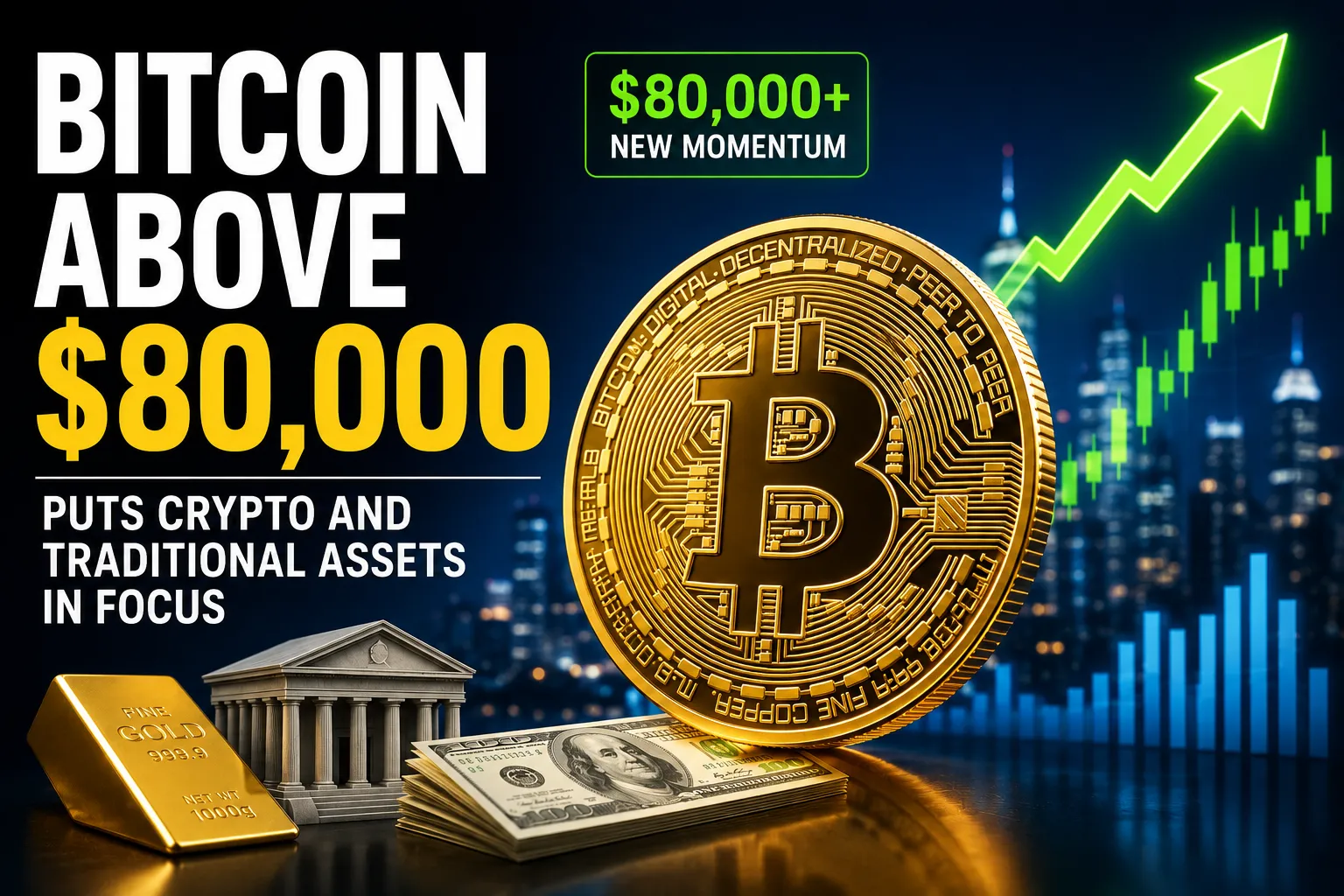
Bitcoin Above $80,000 Puts Crypto and Traditional Assets in Focus
Bitcoin has once again pushed above the psychologically important $80,000 level, putting cryptocurrency back at the center of the investment conversation and raising broader questions about where investors should look for returns as markets navigate currency, debt and interest-rate uncertainty.
The move is particularly notable because Bitcoin had spent much of the summer below that threshold. On August 25, 2026, the cryptocurrency briefly climbed above $81,000, reaching its highest level since May before giving back some of the gains. Bitcoin was up roughly 28% for August at the time, putting it on track for its strongest monthly performance since November 2024.
The rally has also extended beyond Bitcoin. Gold has been rising alongside the cryptocurrency, while crypto-related stocks and other digital assets have attracted renewed investor attention. The simultaneous moves are highlighting an increasingly important question: Are investors simply buying a volatile digital asset, or are Bitcoin and other alternative assets becoming part of a broader response to concerns about traditional currencies, government debt and financial-market liquidity?
For a broader explanation of how stocks, bonds, commodities and other markets interact, see the complete guide to financial markets and how they work.
Why Bitcoin Has Reclaimed $80,000
Several forces have come together behind Bitcoin’s latest rebound.
One of the most important has been a changing macroeconomic environment.
The U.S. Treasury recently announced plans to increase its purchases of longer-term government debt. The move was intended to improve liquidity and support the bond market, but investors also interpreted it as potentially reducing pressure on longer-term yields and weakening the U.S. dollar.
That helped create a more favorable environment for assets that investors often consider alternatives to traditional fiat currency.
Concerns about dollar weakness and currency debasement helped fuel demand for Bitcoin and gold.
Bitcoin’s rally has also been supported by renewed institutional interest and inflows into spot Bitcoin exchange-traded funds.
Bitcoin and Gold Are Moving Into the Same Conversation
For years, Bitcoin has been marketed by some investors as “digital gold,” although the two assets behave very differently.
Gold has a much longer history as a store of value and is widely held by central banks, governments, institutions and individuals. Bitcoin, by contrast, remains a relatively young and substantially more volatile asset.
Yet the two can sometimes attract investors for similar macroeconomic reasons.
When investors become concerned about:
- Currency depreciation
- Inflation
- Government debt
- Monetary policy
- Financial instability
- Geopolitical uncertainty
they may look for assets outside conventional cash and government bonds.
Recent market activity illustrates this dynamic. Gold reached a three-month high around the same period Bitcoin moved above $80,000, with both benefiting from concerns about the dollar and the broader economic environment.
That does not mean Bitcoin and gold are interchangeable investments. Their risk profiles remain dramatically different.
For a broader look at how investors evaluate precious metals alongside other financial assets, see Gold Nears $4,400: Why Investors Are Turning to Gold Again in 2026.
The Bitcoin Rally Has Been Extremely Fast
The speed of Bitcoin’s recent recovery is another reason investors are paying attention.
Bitcoin had fallen below $60,000 earlier in the year before recovering sharply. By August 25, the cryptocurrency had risen above $80,000 after gaining roughly 25% over seven days.
Rapid moves can attract additional buyers because investors fear missing out on further gains.
But the same momentum can work in reverse.
A market that rises quickly can also experience sharp pullbacks when traders take profits, leveraged positions are liquidated or macroeconomic expectations change.
That makes the $80,000 level important psychologically, but crossing it does not automatically establish a durable new floor.
Investors looking more broadly at the mechanics behind sharp price movements can also learn more from this guide to how stock market volatility works and what causes market volatility.
Bitcoin ETFs Have Changed the Investment Landscape
One of the biggest developments in cryptocurrency investing over the past several years has been the emergence of spot Bitcoin ETFs.
These products give investors exposure to Bitcoin through conventional investment accounts rather than requiring them to purchase and directly store cryptocurrency themselves.
The development has made it easier for institutional and traditional investors to participate in the Bitcoin market.
Recent ETF activity has again become an important part of the rally. Bitcoin ETF inflows reached about $1.92 billion during the week before the latest move, describing it as the strongest weekly performance for ETF inflows in 2026 at that point.
This matters because sustained institutional demand can potentially provide a broader base of buyers than the market had during earlier cryptocurrency cycles.
Traditional Investors Are Watching Crypto Differently
The growing accessibility of Bitcoin has changed how professional investors can think about cryptocurrency.
Instead of setting up cryptocurrency wallets and dealing directly with digital-asset exchanges, investors can potentially gain exposure through regulated investment products, depending on their jurisdiction and the products available to them.
That does not remove Bitcoin’s volatility.
It does, however, make the asset easier to incorporate into portfolios that already contain stocks, bonds, commodities and other investments.
The result is a gradual blurring of the line between “crypto investing” and mainstream portfolio management.
Crypto-Related Stocks Are Benefiting Too
Bitcoin’s rally has not been limited to the cryptocurrency itself.
Companies with significant exposure to the digital-asset ecosystem have also benefited from renewed enthusiasm.
Coinbase, for example, tends to be influenced by cryptocurrency trading activity and market sentiment. Companies that hold Bitcoin on their balance sheets can also see their stock prices move with the value of their cryptocurrency holdings.
Coinbase and Strategy were among the companies benefiting from the latest crypto rally, while other digital assets such as Ethereum and Solana also posted significant gains.
This creates another way for investors to participate in a cryptocurrency rally—but it also introduces additional company-specific risks.
Buying a crypto-related stock is not the same thing as owning Bitcoin.
Bitcoin’s Correlation With Traditional Assets Can Change
One of the more interesting questions for portfolio managers is how Bitcoin behaves relative to stocks, bonds and commodities.
Bitcoin has sometimes traded alongside riskier technology stocks, suggesting that investors may treat it as a risk asset rather than a traditional safe haven.
At other times, it has rallied when investors were concerned about currencies or government debt.
That means Bitcoin’s role in a portfolio cannot necessarily be defined by one permanent correlation.
Market conditions matter.
Interest rates, liquidity, investor sentiment, regulation and cryptocurrency-specific developments can all influence the relationship between Bitcoin and traditional assets.
The Dollar Is Part of the Story
Currency movements are particularly important when discussing Bitcoin’s dollar price.
Bitcoin is generally quoted in U.S. dollars, so changes in the value of the dollar can influence how investors perceive its price.
A weaker dollar can make dollar-denominated commodities and alternative assets more attractive to some investors.
Recent reports linked Bitcoin’s rise to renewed concerns about dollar debasement following the Treasury’s bond-buyback plans.
The argument is not that every dollar of government spending automatically sends Bitcoin higher.
Rather, investors are assessing whether fiscal and monetary policies could eventually reduce the purchasing power of traditional currencies.
That debate is increasingly relevant to both cryptocurrency and gold markets.
Government Debt Is Becoming an Investment Theme
Large government deficits and rising debt levels have become increasingly important considerations for investors.
When debt grows substantially, markets can become more sensitive to interest rates and the cost of servicing that debt.
If investors begin demanding higher yields on government bonds, borrowing costs can increase further.
That can influence everything from mortgage rates and corporate financing to stock valuations.
Investors interested in understanding the relationship between government bonds, yields and other financial markets can explore the complete guide to bond markets.
Bitcoin’s recent rally has partly been interpreted through this lens. Some investors see scarce digital assets as a potential hedge against long-term currency and fiscal risks.
But that thesis remains debated.
Bitcoin’s price history also demonstrates that it can experience enormous declines, making it fundamentally different from conventional government bonds.
The Federal Reserve Still Matters
Bitcoin does not exist independently of the global financial system.
Federal Reserve policy can influence liquidity, interest rates, the dollar and investor appetite for risk.
Lower interest rates can make speculative and growth-oriented assets more attractive because investors have fewer incentives to hold cash or low-risk fixed-income assets.
Higher rates can have the opposite effect.
For Bitcoin, therefore, investors will continue watching signals from the Federal Reserve alongside developments in the cryptocurrency market itself.
The sustainability of the latest move above $80,000 could depend partly on whether broader financial conditions remain supportive.
Regulation Could Become Another Catalyst
Regulatory policy is another major factor influencing cryptocurrency markets.
Investors have increasingly focused on efforts to establish clearer rules for digital assets in the United States.
The possibility of additional regulatory clarity can reduce uncertainty for financial institutions, exchanges, asset managers and companies considering cryptocurrency-related products.
Recent market reports have highlighted optimism around the proposed Clarity Act and other regulatory developments as factors supporting the latest rally.
For long-term investors, regulation may be just as important as short-term price movements.
Clearer rules could potentially encourage more institutional participation, while unfavorable regulations could have the opposite effect.
Why $80,000 Is More Than Just a Number
Round numbers often become important psychological levels in financial markets.
Bitcoin crossing $80,000 can influence investor sentiment because it provides a simple benchmark for measuring the strength of the rebound.
However, technical analysts are also watching the area above $80,000 closely.
Analysts identified roughly $80,000 to $82,000 as an important resistance zone after Bitcoin’s latest surge.
A sustained move above that area could encourage momentum investors.
Failure to hold it could instead lead to profit-taking and another period of consolidation.
Neither outcome is guaranteed.
The Risks Have Not Disappeared
A strong rally can make an asset appear safer than it actually is.
Bitcoin remains capable of substantial price swings, sometimes over very short periods.
Investors face risks including:
- Extreme volatility
- Regulatory changes
- Cybersecurity threats
- Exchange and custody risks
- Liquidity changes
- Leverage-driven liquidations
- Changes in investor sentiment
- Competition from other digital assets
- Macroeconomic shocks
The latest rally does not eliminate these risks.
In fact, rapidly rising prices can sometimes increase them by encouraging investors to use leverage or make decisions based primarily on recent performance.
Traditional Assets Still Have an Important Role
Bitcoin’s rise does not make stocks, bonds, cash or other conventional investments obsolete.
Each asset class serves different purposes.
Stocks can provide exposure to corporate earnings and economic growth. Bonds can provide income and diversification. Cash provides liquidity and stability. Real estate can provide exposure to property and rental income.
Bitcoin provides exposure to a fundamentally different type of asset.
For investors building long-term portfolios, the relevant question is therefore not necessarily whether Bitcoin will replace traditional assets.
It is whether cryptocurrency has a role within a broader investment strategy that matches the investor’s risk tolerance, objectives and time horizon.
Diversification Requires More Than Owning Many Assets
It is possible to own several investments and still have a poorly diversified portfolio.
For example, a portfolio containing Bitcoin, cryptocurrency-related stocks and companies heavily dependent on digital-asset activity could appear diversified on paper while remaining highly exposed to the same underlying risk.
True diversification depends partly on how investments behave relative to one another.
This is why investors should consider the economic drivers behind each asset rather than simply counting the number of holdings.
Investors Should Be Careful With Leverage
Leverage can magnify both gains and losses.
During rapid Bitcoin rallies, leveraged traders may increase their exposure because they expect prices to continue climbing.
If the market moves against them, forced liquidations can accelerate the decline.
The latest rally itself demonstrated how powerful this mechanism can be. Reports indicated that billions of dollars in bearish crypto positions were liquidated as Bitcoin surged, helping amplify the move higher.
Long-term investors do not need leverage to participate in Bitcoin’s potential upside.
For many, avoiding unnecessary leverage can be one of the simplest ways to reduce the risk of a forced sale during a market downturn.
What Investors Should Watch Next
The $80,000 milestone is likely to remain a reference point, but investors have several other indicators to monitor.
Federal Reserve Policy
Interest-rate expectations can influence liquidity, the dollar and demand for risk assets.
Bitcoin ETF Flows
Continued inflows could indicate sustained institutional demand, while large outflows could signal changing sentiment.
U.S. Treasury Policy
Further actions involving government debt and bond-market liquidity could influence expectations for inflation, interest rates and the dollar.
Cryptocurrency Regulation
Progress toward clearer rules could affect institutional participation and market confidence.
Bitcoin’s Ability to Hold Above $80,000
A brief move above a psychological level is different from establishing sustained support.
Gold and Other Alternative Assets
If Bitcoin and gold continue rising together, investors may increasingly interpret the moves as part of a broader demand for alternative stores of value.
The Bigger Investment Question
Bitcoin’s return above $80,000 is important not simply because of the number itself, but because of what is happening around it.
The cryptocurrency is benefiting from renewed institutional interest, strong ETF flows, regulatory optimism and a macroeconomic environment in which investors are increasingly focused on government debt, currency values and liquidity.
At the same time, gold is also attracting demand, while traditional financial markets remain sensitive to interest rates and fiscal policy.
That combination makes the latest Bitcoin rally more than another cryptocurrency price spike. It is also a reminder that investors increasingly have to consider how digital assets, commodities and traditional financial markets interact.
Bitcoin may continue higher if institutional demand and favorable macroeconomic conditions persist. It could also retreat sharply if those conditions change.
For investors, the most important lesson is not that $80,000 represents a guaranteed floor or that Bitcoin has become a substitute for every traditional asset. It is that cryptocurrency has become too significant for many investors to analyze in isolation.
The next phase of the market will depend on whether Bitcoin can turn its latest burst of momentum into sustained demand—and whether the economic forces pushing investors toward alternative assets remain in place.