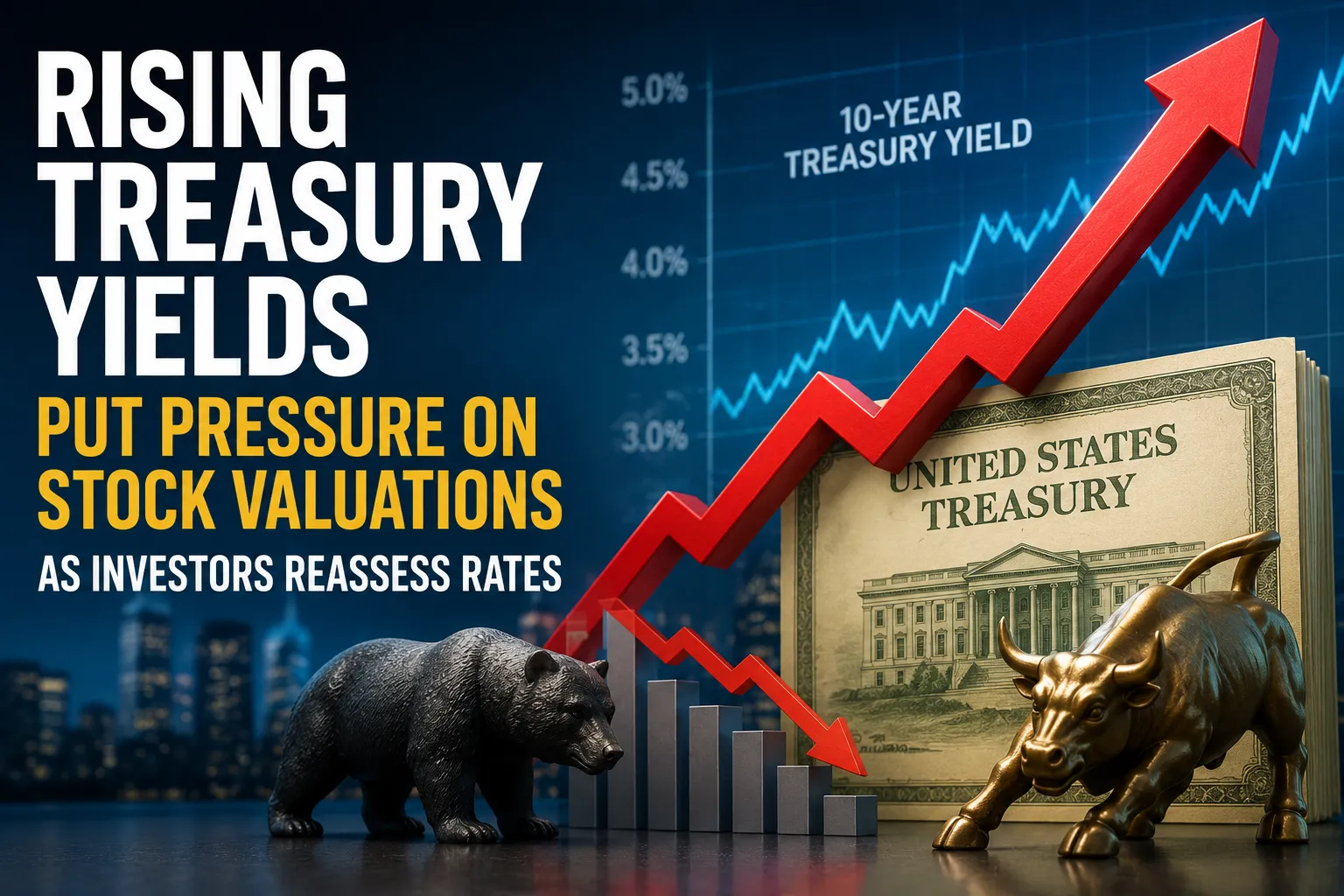
Rising Treasury Yields Put Pressure on Stock Valuations as Investors Reassess Rates
Rising U.S. Treasury yields are giving investors another reason to reassess stock valuations as financial markets weigh inflation, government borrowing, economic growth and the future path of interest rates.
The move is particularly important because Treasury yields influence the return investors demand from a wide range of assets. When government bond yields rise, stocks have to compete with a more attractive relatively low-risk alternative. At the same time, higher rates can increase borrowing costs for businesses and households and reduce the present value investors place on future corporate earnings.
The shift does not automatically mean a stock-market downturn is coming. Equity markets have continued to show resilience, supported by strong corporate earnings and enthusiasm around technology and artificial intelligence. But the balance between earnings growth and higher interest rates is becoming increasingly important for investors.
## Why Treasury Yields Matter to Stock Investors
The U.S. Treasury market is closely watched because Treasury securities are generally treated as a benchmark for relatively low-risk returns.
The 10-year Treasury yield, in particular, plays an important role in financial markets. It influences borrowing costs and is widely used as a reference point in valuation models.
When the 10-year yield rises, the return available from government bonds becomes more competitive with stocks.
Investors may therefore ask whether the additional risk of owning equities is sufficiently compensated by expected returns.
This relationship becomes especially important when stock valuations are already elevated.
For broader context, the relationship between Treasury yields, bonds and other asset classes is part of the wider complete guide to bond markets.
## Higher Yields Can Change How Stocks Are Valued
Stock valuation is ultimately tied to expectations about future cash flows.
Investors generally place less value on money expected many years from now when interest rates are higher. As the discount rate increases, the present value of future earnings declines.
This is particularly relevant for companies whose valuations depend heavily on profits expected far into the future.
High-growth technology companies are therefore often more sensitive to changes in long-term interest rates than businesses with more immediate and predictable cash flows.
That does not mean growth stocks automatically fall whenever Treasury yields increase. Strong earnings growth can offset some of the pressure.
But higher yields can make investors less willing to pay extremely high multiples for anticipated future growth.
## The Yield Move Comes Despite Strong Equity Performance
The current market environment illustrates the tension between rates and earnings.
U.S. stocks have remained relatively strong, with the S&P 500 approaching record levels and technology shares leading the market in recent sessions. On August 27, the S&P 500 gained 0.7%, while the Nasdaq Composite rose 1.6%, helped by strong technology-sector performance and upbeat earnings expectations.
At the same time, Treasury yields have continued to attract attention.
The 10-year Treasury yield recently moved around the mid-4% range, while the 30-year yield has remained above 5%. The 30-year Treasury yield reached 5.27% at the end of July, a level not seen since 2007.
The result is a market in which strong corporate earnings are competing against a less favorable interest-rate backdrop.
## Inflation Remains a Key Driver
One reason investors are watching yields closely is inflation.
If inflation remains above the Federal Reserve’s preferred pace, policymakers may have less room to reduce interest rates quickly.
Higher inflation can also push investors to demand greater yields on longer-term bonds because they need compensation for the possibility that future purchasing power will be eroded.
Recent market commentary has pointed to elevated energy prices and geopolitical risks as factors keeping inflation concerns alive.
For investors, the important question is whether inflation is temporary or persistent.
If inflation pressures fade, long-term yields could eventually ease. If inflation proves more stubborn, higher yields may remain a feature of the investment environment for longer.
## Investors Are Watching the Federal Reserve
Monetary policy remains central to the outlook.
Markets are closely watching Federal Reserve Chair Kevin Warsh for signals about how policymakers intend to balance inflation, economic growth and interest rates.
The Federal Reserve’s annual Jackson Hole gathering has become a major event for financial markets, particularly when investors are uncertain about the future direction of monetary policy.
Current market expectations include the possibility of another rate move in September, making upcoming communications from policymakers particularly important.
Any indication that rates may remain higher for longer could put additional pressure on equity valuations.
Conversely, clearer evidence that inflation is easing could help bring long-term yields down and provide support for stocks.
## Growth Stocks Face a Bigger Valuation Challenge
Not all stocks respond equally to higher yields.
Companies whose valuations depend heavily on earnings many years into the future can be particularly sensitive to changes in discount rates.
This is one reason technology and other high-growth shares frequently attract attention when bond yields rise.
The issue is not that technology businesses suddenly become less profitable.
Instead, the valuation investors are willing to assign to those profits can change.
A company expected to generate substantial earnings a decade from now may appear less valuable when those future earnings are discounted at a higher rate.
## Strong Earnings Can Offset Some Rate Pressure
Higher yields are not necessarily enough to derail equities when corporate earnings are growing rapidly.
That has been one of the defining characteristics of the current market.
LPL Financial recently described the environment as a tug-of-war between strong earnings and higher rates, noting that second-quarter S&P 500 earnings growth was tracking above 30% and analyst estimates were continuing to rise.
This creates an important distinction for investors.
A higher interest-rate environment is not automatically bearish if companies can grow profits quickly enough to justify their valuations.
The greater concern arises when yields increase while earnings expectations weaken.
Investors can learn more about this relationship through how corporate earnings affect stock prices and market valuations.
## Borrowing Costs Can Affect Corporate Profits
The impact of higher Treasury yields extends beyond valuation models.
Higher market interest rates can raise the cost of borrowing for companies.
Businesses refinancing debt may face higher interest expenses, while companies considering major investments may have to reassess whether new projects generate sufficient returns.
For highly leveraged businesses, the impact can be particularly significant.
Higher interest expenses can reduce net income and cash available for investment, dividends, share buybacks or acquisitions.
That creates another channel through which rising yields can eventually affect stock prices.
## Consumers Feel the Effects Too
The bond market also influences household finances.
Treasury yields help shape borrowing costs throughout the economy, affecting areas such as mortgages, corporate loans and other forms of credit.
When financing becomes more expensive, consumers may reduce spending on large purchases.
Businesses can also become more cautious about expansion.
If higher rates eventually slow economic activity, investors may begin lowering their expectations for corporate revenue and earnings.
That would create a second source of pressure on stocks beyond valuation changes.
## Bonds Are Becoming More Competitive
One of the most important changes for investors is the relative attractiveness of bonds.
When Treasury yields were extremely low, investors seeking income had fewer attractive options. Stocks, corporate bonds and other riskier assets could appear more compelling because government debt offered relatively little income.
Higher Treasury yields change that calculation.
A government bond offering a substantially higher yield can become more appealing to investors who prioritize capital preservation and income.
This can reduce the need to take additional equity risk to achieve a reasonable return.
It does not mean investors will abandon stocks, but it can influence how much they are willing to pay.
## Higher Yields Do Not Affect Every Sector Equally
The relationship between interest rates and equities varies across industries.
Financial companies can sometimes benefit from higher rates, although the impact depends on factors such as deposit costs, lending demand, credit quality and the shape of the yield curve.
Defensive sectors may also attract greater interest when investors become concerned about economic uncertainty.
Meanwhile, highly valued growth companies can face greater pressure if their future earnings are heavily discounted.
The result is often greater dispersion between sectors rather than a uniform market reaction.
## The Yield Curve Deserves Attention
Investors should also look beyond the 10-year Treasury.
The entire yield curve provides information about how markets view interest rates, inflation and economic conditions.
Movements in short-term yields are closely connected to expectations for central-bank policy, while longer-term yields reflect a broader combination of inflation expectations, economic growth, government borrowing and investor demand for bonds.
When long-term yields rise independently of short-term policy rates, investors may interpret the move differently than when the entire curve shifts higher.
Understanding that distinction can provide more context than focusing on a single Treasury yield.
## Government Borrowing Is Part of the Equation
Fiscal policy is another factor influencing bond markets.
Large government deficits require substantial borrowing, increasing the supply of government debt that investors must absorb.
Investors may demand higher yields to purchase longer-term bonds, particularly when they expect heavy borrowing to continue.
Recent market commentary has highlighted concerns about government debt and the durability of higher long-term borrowing costs.
This means the long-term interest-rate outlook cannot be determined by central-bank policy alone.
Markets are also considering fiscal policy and the supply of Treasury securities.
## AI Investment Adds Another Layer
The rapid expansion of artificial-intelligence infrastructure is creating another connection between technology stocks and bond markets.
Large-scale data centers, computing infrastructure and related projects require significant capital investment.
Some of that investment can be financed through debt, potentially adding to demand for corporate credit and influencing broader financial conditions.
At the same time, investors continue to assign substantial valuations to companies expected to benefit from AI spending.
That creates a delicate balance: AI-driven earnings growth can support stocks, but the capital required to sustain the boom can also contribute to higher financing costs.
Recent market analysis has specifically highlighted the relationship between AI-related investment, borrowing and bond yields.
## What Investors Should Watch Next
The next phase of the market may depend less on the absolute level of Treasury yields and more on why yields are rising.
If yields increase because economic growth is strong and corporate earnings are accelerating, stocks may be able to absorb the pressure.
If yields rise because inflation is unexpectedly persistent or fiscal concerns are worsening, the consequences could be more challenging.
Investors should therefore pay attention to:
- 10-year and 30-year Treasury yields
- Inflation data
- Federal Reserve policy signals
- Employment and economic-growth indicators
- Corporate earnings forecasts
- Government borrowing expectations
- Credit-market conditions
- Equity valuation multiples
- Energy prices and geopolitical developments
The interaction between these factors is likely to determine whether higher yields remain a manageable headwind or become a more serious threat to equity valuations.
## A More Selective Market May Be Emerging
The current environment does not necessarily point to an immediate stock-market collapse.
Instead, it may signal a market in which investors become more selective about the prices they are willing to pay.
Companies with strong balance sheets, reliable cash flow and sustainable earnings growth may be better positioned to withstand higher discount rates than companies whose valuations depend primarily on distant future profits.
That distinction can become increasingly important if Treasury yields remain elevated.
Strong businesses can continue to perform well in a high-rate environment, but investors may demand stronger evidence that growth expectations can actually be delivered.
## Rates Are Becoming Part of the Stock-Picking Equation Again
For much of the recent market rally, earnings growth and enthusiasm around technology and artificial intelligence have been powerful drivers of investor sentiment.
Rising Treasury yields are forcing markets to consider another question: How much should investors pay for those earnings when the return available from government bonds is increasing?
That question does not have a simple answer.
If corporate profits continue to grow rapidly, equities can remain attractive despite higher yields. But if inflation stays elevated, long-term borrowing costs remain high and earnings expectations begin to weaken, expensive stocks could face greater pressure.
For investors, the lesson is not simply to fear rising yields. It is to recognize that interest rates, bond markets and stock valuations are closely connected.
This also helps explain why a sharp change in rates can produce sudden moves across equities. Investors assessing that risk should understand how stock market volatility works and what causes market volatility.
As the market heads toward September, the direction of Treasury yields—and the economic and policy forces behind them—could become one of the most important signals for determining whether strong equity valuations can continue to hold.
The broader relationship between interest rates, equities, bonds and other asset classes is also part of the complete guide to financial markets and how they work.