Target Earnings Could Show How Inflation Is Changing What Americans Buy
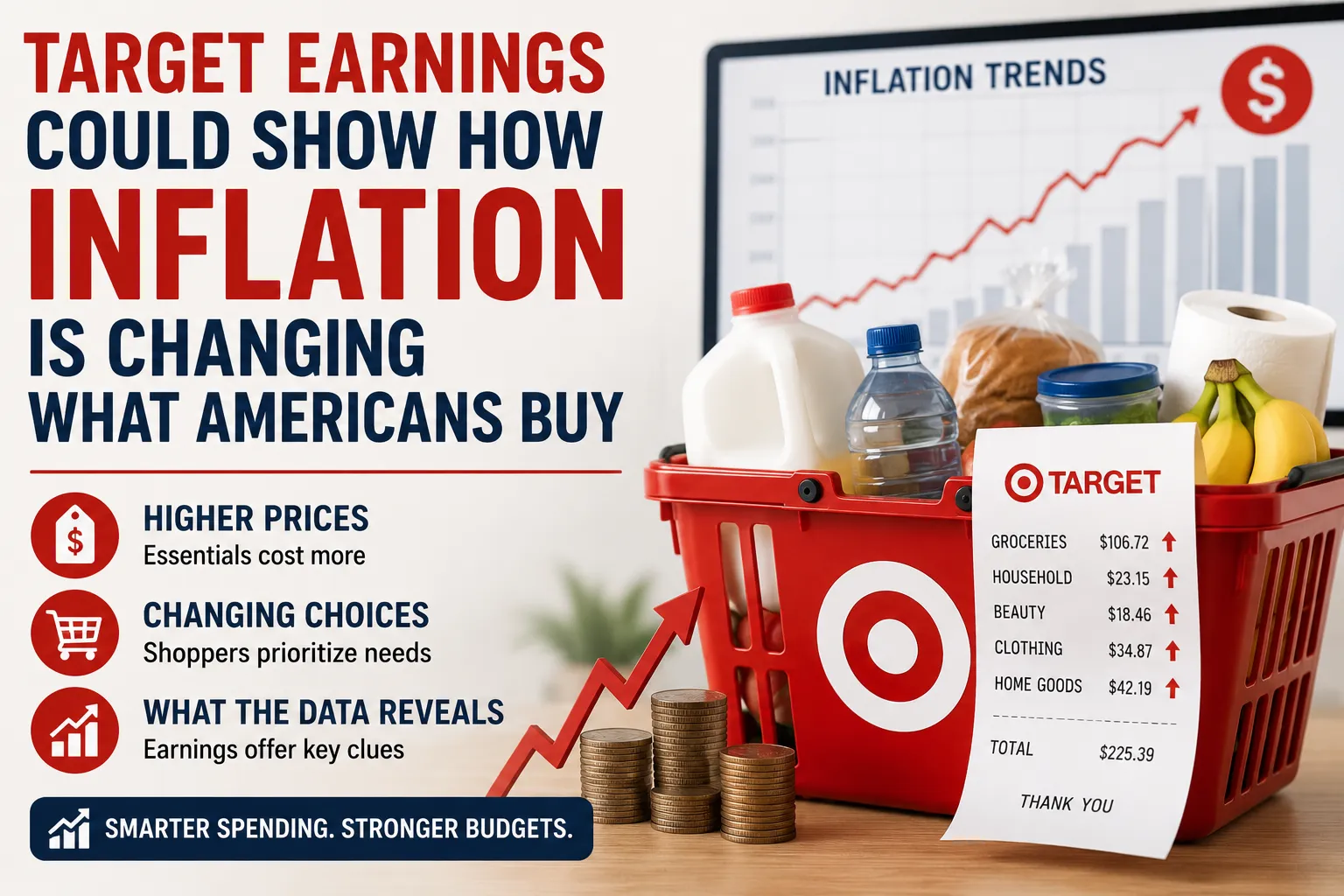
For households trying to stretch their budgets, inflation is not simply a number reported in an economic release. It can show up in the shopping cart, the household budget, and the decisions consumers make about what they can afford to buy.
That makes retailer earnings reports an important window into household finances. Target is scheduled to report its second-quarter 2026 results on Wednesday, August 19, giving investors and consumers another opportunity to see how Americans are responding to prices, changing priorities, and uncertainty about the economy.
The report arrives after a period of mixed signals. U.S. retail sales fell 0.6% from June to July, while recent inflation data showed some moderation. Analysts are therefore watching major retailers closely for evidence of whether consumers are still spending confidently or becoming more selective.
Why Target’s Earnings Matter to Household Budgets
Target occupies an interesting position in the U.S. retail market because its stores sell a broad range of products, from groceries and household essentials to clothing, beauty products and discretionary merchandise.
That makes its sales performance useful for understanding more than just the health of one company.
If shoppers are buying necessities while cutting back on clothing, home goods or other discretionary purchases, Target’s results could provide a real-world illustration of how households are adapting to higher living costs.
On the other hand, stronger discretionary spending could suggest that consumers still have room in their budgets despite persistent concerns about inflation.
Target’s previous quarterly results offered some encouraging signs. In its first quarter, the company reported a 6.7% increase in net sales and a 5.6% increase in comparable sales, with growth across its major merchandising categories.
The second-quarter report will show whether that momentum continued.
Inflation Does Not Have to Rise to Pressure Household Budgets
One of the most important distinctions for consumers is the difference between inflation and prices.
Inflation measures how quickly prices are changing. When inflation slows, prices do not necessarily return to where they were several years ago.
Instead, prices can continue rising at a slower rate.
For example, if a household previously paid $100 for a basket of everyday products and prices subsequently rose 5%, slowing inflation does not automatically bring that basket back to $100.
The new price level can remain higher even after inflation moderates.
That is one reason households may continue feeling financial pressure even when economic reports describe inflation as cooling.
Recent reporting indicates that July inflation showed some moderation, while other household costs remained elevated.
What Target Could Reveal About Consumer Behavior
Investors will likely examine several areas of Target’s results for clues about household spending.
1. Comparable Sales
Comparable sales measure sales at established locations and are useful for determining whether existing stores are attracting more spending.
Strong comparable sales could indicate that shoppers are maintaining spending levels.
Weak results could suggest consumers are becoming more cautious.
2. Store Traffic
Traffic can reveal whether shoppers are visiting stores more or less frequently.
A retailer can sometimes increase revenue through higher prices even when customers buy fewer items. Traffic and transaction data can provide additional context.
3. Average Transaction Size
Another important question is whether customers are spending more during each shopping trip.
If transaction sizes increase primarily because prices are higher, that does not necessarily mean consumers are buying more products.
4. Product Categories
The mix of products consumers purchase can be especially revealing.
Households under pressure may prioritize:
- Groceries
- Cleaning supplies
- Personal-care products
- Household necessities
- Discounted merchandise
They may be more cautious about:
- Clothing
- Electronics
- Furniture
- Home décor
- Other discretionary purchases
A shift between these categories can tell a more useful story than total sales alone.
Consumers May Be Redefining Value
Inflation can change what shoppers consider a good deal.
Consumers may not simply look for the lowest sticker price. They can also consider durability, convenience, quality, delivery costs, loyalty rewards and how frequently they expect to use a product.
Recent retail analysis suggests that consumers are increasingly thinking about “value” in broader terms as household budgets remain under pressure.
For a retailer such as Target, that creates a difficult balancing act.
Lower prices can attract budget-conscious shoppers, but retailers must also protect margins and manage their own costs.
The Difference Between Essentials and Discretionary Spending
One of the clearest signs of household financial pressure is a shift in spending priorities.
When budgets become tighter, consumers typically cannot eliminate essential expenses such as food, cleaning products and basic household supplies.
Instead, they have greater flexibility with discretionary purchases.
A family might postpone:
- Replacing furniture
- Buying new clothing
- Upgrading electronics
- Redecorating a room
- Purchasing nonessential household products
This behavior can create very different outcomes across retail categories.
A retailer may therefore report reasonable overall sales while still experiencing weakness in certain discretionary categories.
Why Retail Earnings Matter Beyond Wall Street
Corporate earnings reports are often presented as investment stories, but they can also provide useful information about everyday economic conditions.
Government statistics offer broad measures of consumer spending and inflation.
Retailers provide a different perspective: what people are actually buying.
That makes earnings from companies such as Target, Walmart and other major retailers valuable pieces of the broader consumer puzzle.
This week’s retail results are receiving particular attention because they arrive after July retail sales weakened and amid ongoing questions about the strength of American consumers.
For investors looking at the broader relationship between company profits and market prices, how corporate earnings affect stock prices and market valuations provides useful context.
Americans Are Facing More Than One Budget Pressure
Inflation is only one factor affecting household spending.
Consumers also have to contend with:
- Housing costs
- Insurance premiums
- Healthcare expenses
- Transportation costs
- Food prices
- Energy bills
- Interest rates
- Employment uncertainty
- Debt payments
Even if one category becomes cheaper, households may not feel significantly better off if another major expense increases.
This is why retail spending can sometimes remain resilient even when consumers say they are financially stressed.
People still need to spend money.
The question is where that money goes.
What Falling Retail Sales Could Mean
Recent data showed U.S. retail sales falling 0.6% from June to July. Analysts have noted that the result needs to be interpreted carefully because the timing of major promotional events, including Amazon’s Prime Day, affected comparisons.
Still, a broader slowdown would matter.
If Target and other retailers report weaker traffic or softer discretionary sales, economists could interpret that as evidence that consumers are becoming more cautious.
That could have wider implications for:
- Economic growth
- Corporate earnings
- Employment
- Consumer confidence
- Federal Reserve policy
Consumer spending is a major component of the U.S. economy, so persistent weakness could eventually extend beyond the retail sector.
What Strong Target Sales Would Tell Us
A stronger-than-expected report could provide a different message.
If Target sees healthy traffic, sales and discretionary demand, it could suggest that consumers are still willing and able to spend despite higher prices.
That would not necessarily mean inflation is no longer a concern.
Instead, it could indicate that households have adapted to the higher price environment or that employment and income conditions are supporting spending.
Target’s first-quarter results showed growth across all six of its core merchandising categories, providing a relatively strong starting point for the year.
The key question is whether that broad strength continued into the second quarter.
The New Target Leadership Adds Another Dimension
Target is also undergoing a broader business transition under CEO Michael Fiddelke, who took the top job in 2026.
The company has emphasized improvements in merchandising, the guest experience, technology and other parts of its strategy.
That means investors will not only be asking how consumers are behaving.
They will also be asking whether Target’s business changes are helping the company capture consumer spending in a challenging environment.
The distinction matters because weak sales could reflect broader consumer weakness, company-specific issues, or a combination of both.
What Budget-Conscious Consumers Should Watch
The earnings report itself will be aimed primarily at investors, but consumers can pay attention to several themes.
Are shoppers buying fewer products?
If consumers are purchasing smaller quantities or postponing discretionary purchases, it could indicate greater pressure on household budgets.
Are shoppers trading down?
A shift toward cheaper products or private-label alternatives could show that consumers are looking for ways to reduce spending without abandoning purchases entirely.
Are promotions becoming more important?
If discounts and promotions are playing a larger role in sales, retailers may be working harder to convince consumers to spend.
Are essential categories holding up?
Strong demand for necessities alongside weaker discretionary categories could be evidence that households are prioritizing their budgets.
Are prices still rising?
Retailers’ comments about supplier costs, pricing and consumer sensitivity can offer clues about where household prices may be heading.
How Families Can Respond to Persistent Higher Prices
Consumers do not need to wait for an earnings report to make their budgets more resilient.
A few practical strategies can help.
Track spending by category
Instead of looking only at total monthly spending, divide expenses into essentials, discretionary purchases and financial obligations.
This makes it easier to see where costs are increasing.
Compare unit prices
A larger package is not always cheaper per unit.
Comparing the price per ounce, kilogram, liter or individual item can provide a better measure of value.
Distinguish wants from needs
A higher-cost environment makes it particularly useful to identify purchases that can be postponed.
Use promotions strategically
Discounts can help when they apply to products you already planned to buy.
Buying something solely because it is discounted can still increase spending.
Review recurring expenses
Subscriptions, memberships, insurance and other recurring charges can quietly consume a significant portion of a household budget.
Reviewing them periodically can reveal opportunities to reduce expenses.
Why One Earnings Report Cannot Tell the Whole Story
Target’s results will be informative, but they should not be treated as a complete measure of the American consumer.
Target serves a particular customer base and operates in specific product categories.
Other retailers may see different trends.
For example, a warehouse club, discount retailer, luxury retailer and home-improvement chain can each attract different shoppers and respond differently to economic conditions.
That is why analysts are watching several retailers this week rather than relying on one company’s results. Major retailers including Home Depot, Target, Lowe’s and Walmart are reporting around the same period, creating a broader picture of consumer demand.
The broader market implications can also be understood through the complete guide to financial markets and how they work.
The Bigger Question for Household Finances
Target’s August 19 earnings report comes at an interesting moment for the U.S. economy.
Inflation has shown signs of moderation, but prices remain higher than they were before the recent inflation surge. At the same time, retail spending has shown signs of slowing, creating questions about whether consumers are beginning to adjust their behavior.
For families, the most meaningful signal may not be whether Americans stop spending altogether.
It may be whether they change what they spend money on.
A shift from discretionary purchases toward essentials, cheaper alternatives, promotions and smaller shopping trips could indicate that inflation is having a lasting effect on household decision-making.
What Target’s Results Could Mean for Everyday Budgets
When Target reports its second-quarter results on Wednesday, the headline numbers will attract attention from investors. But the details could be just as important for anyone managing a household budget.
Sales trends, customer traffic, product categories, pricing and management commentary could help reveal whether American consumers are still spending freely or quietly changing their habits to cope with a higher cost of living.
For households, that distinction matters.
A period of slower inflation does not necessarily mean life has become cheaper. It can simply mean that prices are rising more slowly. If consumers continue adjusting what they buy, where they shop and how much they spend, those changes could become one of the clearest signs of how Americans are adapting to the new cost of living.