Retail Sales Friday Could Move Stocks: Are Consumers Still Spending?
Wall Street is heading into Friday with another important question for the U.S. economy: are American consumers still spending strongly enough to keep economic growth moving?
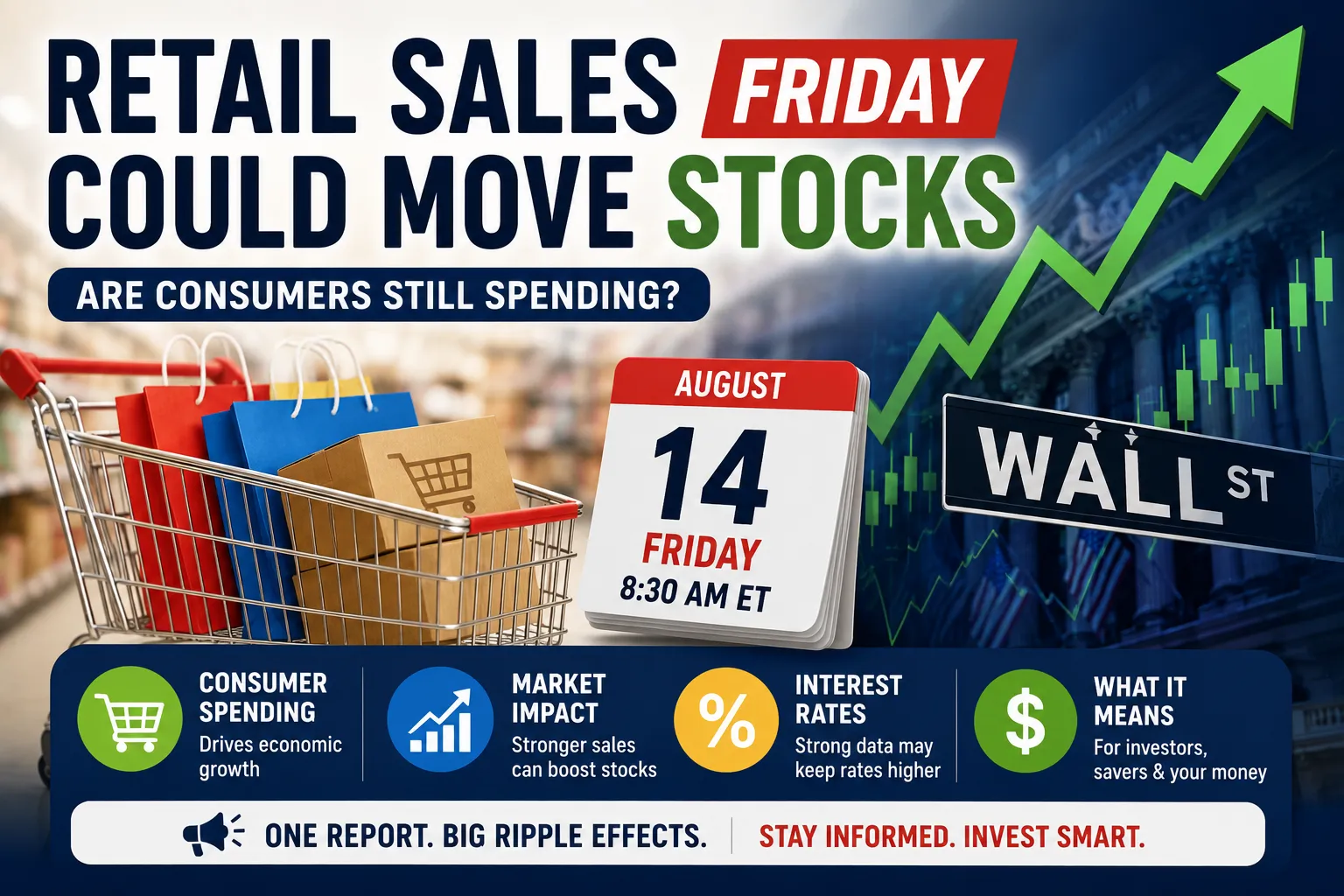
The U.S. Census Bureau is scheduled to release its July 2026 advance retail sales report on Friday, August 14, at 8:30 a.m. Eastern Time. The report will provide an early look at how much consumers spent at retailers and food-service establishments during July.
The timing makes the report particularly important for investors.
Markets have already been watching inflation closely this week, while the Federal Reserve continues to balance elevated inflation against signs that parts of the economy may be losing momentum. The Fed kept its federal funds target range at 3.50% to 3.75% at its July meeting, with three officials preferring a quarter-point increase.
Retail sales could help answer a crucial question: Is the American consumer still strong, or is higher prices and a softer labor market beginning to weigh on spending?
When Is the July Retail Sales Report Released?
The Census Bureau is scheduled to publish the July advance retail and food-services sales report at 8:30 a.m. ET on Friday, August 14.
The report is an early economic indicator because it provides a relatively timely snapshot of consumer spending.
It covers sales at businesses primarily engaged in retail trade as well as food-service establishments and drinking places. The Census Bureau describes the data as an early indication of sales activity among retail and food-service companies.
For investors, the release can offer an important real-time signal about household demand.
For broader context on how consumer spending fits into the wider economic picture, see the complete guide to economic indicators.
Why Retail Sales Matter to Investors
Consumer spending is one of the most important components of the U.S. economy.
When households continue buying goods and services, businesses can generate revenue, maintain inventories and invest in expansion.
Strong consumer demand can support:
- Retail companies
- Restaurants
- Travel businesses
- Consumer brands
- Payment companies
- Banks
- Transportation companies
- Manufacturers
- E-commerce businesses
But strong spending can have a second side.
If demand remains extremely strong while the economy faces supply constraints, businesses may have more ability to raise prices. That can complicate the Federal Reserve’s fight against inflation.
This creates an important tension for investors.
Strong spending can be good for corporate earnings but potentially bad for interest-rate expectations if it contributes to persistent inflation.
What Happened in June?
The June retail sales report showed a relatively modest increase.
According to the Census Bureau, advance retail and food-service sales rose 0.2% from May to $768.6 billion in June. Sales were 6.7% higher than June 2025.
The May-to-June increase was also weaker than the revised 1.0% increase recorded from April to May.
That suggests the consumer remained active, but the pace of spending was not uniformly accelerating.
The details matter even more than the headline.
Was June Spending Really Weak?
Not necessarily.
Headline retail sales are measured in nominal dollars and are not adjusted for price changes.
That means a sales increase can reflect a combination of:
- More goods being purchased
- Higher prices
- Changes in the mix of products purchased
- Seasonal factors
Likewise, a decline in nominal sales does not necessarily mean consumers dramatically reduced the quantity of goods they bought.
Investors therefore need to interpret retail sales alongside inflation data and other measures of consumer activity.
The Consumer Has Shown Signs of Resilience
There are reasons not to assume consumers are suddenly pulling back.
The Federal Reserve’s July Monetary Policy Report described economic activity as expanding at a solid pace, while noting that household consumption had increased only modestly in the first five months of 2026.
That combination paints a mixed picture.
Consumers are still supporting economic activity, but spending growth is not necessarily running at an exceptionally strong pace.
The July retail report will provide another piece of evidence.
Why Friday’s Report Could Move Stocks
Stock prices reflect expectations about future corporate earnings and economic conditions.
If retail sales are substantially stronger than expected, investors could interpret that as evidence that consumers remain resilient.
That could support companies exposed to consumer demand.
But there is a catch.
A strong spending report could also make investors worry that the economy remains sufficiently strong to keep inflation elevated.
That could lead markets to price a more cautious Federal Reserve.
Higher expected interest rates can put pressure on stock valuations, particularly companies whose valuations depend heavily on earnings expected far in the future.
What If Retail Sales Are Weaker?
A weak report could create an entirely different market reaction.
If consumers are spending less than expected, investors may interpret that as evidence that higher prices, borrowing costs or weaker employment conditions are beginning to affect households.
That could raise concerns about:
- Corporate revenue
- Retail earnings
- Economic growth
- Consumer confidence
- Employment
- Credit conditions
However, weaker spending could also make it easier for the Federal Reserve to consider less restrictive monetary policy if inflation is simultaneously cooling.
That creates another market paradox:
Bad economic news can sometimes be good news for stocks if it reduces expectations for higher interest rates.
But if the economic deterioration is severe enough, bad news can simply be bad news.
The “Good News Is Bad News” Problem
Investors have spent years dealing with the relationship between economic data and Federal Reserve policy.
Normally, stronger economic growth is positive.
But when inflation is elevated, exceptionally strong data can cause markets to worry about interest rates.
This creates a three-way relationship:
Strong spending → stronger economic growth → potentially higher inflation and rates
while:
Weak spending → weaker growth → potentially lower rates
But an even weaker economy can eventually mean:
Weak spending → falling earnings → greater recession risk
That’s why investors cannot interpret retail sales in isolation.
What the Fed Is Watching
The Federal Reserve’s mandate includes maximum employment and price stability.
Its longer-run inflation target is 2% as measured by the annual change in the personal consumption expenditures price index.
The Fed said in July that inflation remained elevated relative to that goal.
It also said economic activity was expanding at a solid pace and that unemployment had changed little.
That leaves policymakers watching both sides of the economy.
A strong retail sales report could suggest demand remains resilient.
A weak report could provide evidence that tighter financial conditions are having more impact.
Retail Sales and Inflation Need to Be Read Together
Retail sales alone cannot tell investors whether consumers are becoming financially healthier or simply paying more.
For example, suppose retail sales rise 0.5%.
That sounds positive.
But if prices increased substantially during the same period, the real increase in the amount of goods and services purchased could be much smaller.
This is why investors should consider retail sales alongside:
- CPI
- PPI
- Personal consumption expenditures
- Wage growth
- Consumer confidence
- Employment
- Credit growth
The combination provides a much clearer picture of household demand.
The relationship between inflation and household purchasing power is also explored in How Inflation Affects Everyday Finances.
What Happened to Inflation This Week?
The retail sales report arrives after a week dominated by inflation data.
Reuters reported that economists expected July consumer prices to rise moderately, with headline CPI forecast at 3.4% year over year and core CPI at 2.5%.
That inflation backdrop matters because investors will be asking whether consumers are still spending despite elevated prices.
If spending remains strong while inflation stays above the Fed’s target, the central bank could face a difficult policy trade-off.
Retailers Will Be Closely Watched
Not every company benefits equally from strong consumer spending.
Investors will pay attention to categories such as:
- General merchandise
- Clothing
- Electronics
- Furniture
- Motor vehicles
- Grocery stores
- Restaurants
- Online retail
- Building materials
- Gasoline stations
The composition of sales can tell investors where consumers are directing their money.
For example, strong spending on necessities but weak discretionary purchases could suggest households are becoming more cautious.
Essentials vs. Discretionary Spending
One of the most useful distinctions is between essential and discretionary purchases.
Essential spending
This can include:
- Groceries
- Household necessities
- Basic personal-care products
- Certain healthcare-related purchases
Discretionary spending
This can include:
- Electronics
- Furniture
- Clothing
- Entertainment
- Restaurants
- Luxury goods
- Recreational products
If consumers continue buying necessities but cut back on discretionary purchases, that could indicate increasing pressure on household budgets.
Online Shopping Could Offer Another Clue
E-commerce has become an increasingly important part of retail.
The Census Bureau’s retail data includes sales from nonstore retailers, providing investors with information about online and other nontraditional retail activity.
Strong online sales can indicate that consumers remain willing to spend, although promotions and shifts in purchasing patterns can influence monthly numbers.
Investors should therefore examine the broader trend rather than interpreting one month’s online sales in isolation.
Why Gasoline Sales Can Distort the Picture
Gasoline sales are included in retail sales, meaning changes in fuel prices can influence the headline figure.
When gasoline prices fall, dollar sales at gas stations can decline even if Americans continue driving similar distances.
Conversely, higher fuel prices can increase nominal sales without necessarily representing stronger underlying consumer demand.
This is another reason investors often look at measures that remove volatile categories when trying to assess the underlying trend.
What Is the Control Group?
Investors may also hear analysts discuss the retail sales control group.
It is a narrower measure designed to provide a useful signal for estimating consumer spending in the national accounts.
The measure excludes certain volatile categories.
Because it is used in economic analysis of consumption and GDP, a surprise in the control group can attract considerable market attention.
The headline number remains important, but the underlying measures can sometimes tell a more useful story about momentum.
Scenario 1: Retail Sales Beat Expectations
Suppose July retail sales come in significantly above expectations.
That could suggest consumers remained resilient despite elevated prices and financial pressures.
Potential market effects could include:
- Higher Treasury yields
- Increased expectations for restrictive Fed policy
- Strength in consumer-related stocks
- Pressure on rate-sensitive growth stocks
- Greater confidence in near-term economic growth
The exact reaction would depend on the size of the surprise and what other economic data are saying.
Scenario 2: Retail Sales Match Expectations
A report close to expectations may produce a relatively muted market reaction.
Investors may already have priced the result into stocks, bonds and currencies.
In that case, attention could shift toward:
- The category breakdown
- Revisions
- Control-group sales
- Inflation
- Labor-market data
- Corporate earnings
Sometimes the absence of a major surprise is itself useful information.
Scenario 3: Retail Sales Miss Expectations
A substantial decline or disappointing increase could raise questions about consumer resilience.
That could initially pressure shares of consumer-facing businesses.
But if investors believe weaker demand will encourage the Fed to adopt a more accommodative stance, Treasury yields could decline and some rate-sensitive stocks could benefit.
Again, context matters.
A mild slowdown may be welcomed if it helps cool inflation.
A sharp deterioration could instead raise recession concerns.
The Labor Market Is Part of the Story
Consumers need income to maintain spending.
That’s why investors will also compare retail sales with labor-market conditions.
The Fed’s July assessment said job gains had kept pace with the workforce and unemployment had changed little, although uncertainty remained elevated.
If employment remains relatively stable, consumers may have more capacity to absorb higher prices.
If job growth weakens materially, spending could eventually follow.
The connection between employment conditions and markets is examined further in How Employment Data Influences Financial Markets.
Consumer Confidence Doesn’t Always Equal Consumer Spending
Surveys of consumer sentiment can be useful, but people do not always behave exactly as they say they will.
Consumers may report concerns about the economy while continuing to spend.
Conversely, confidence can remain relatively strong until households suddenly become more cautious.
Actual retail sales therefore provide an important behavioral measure.
The strongest analysis combines sentiment surveys with actual spending, income and employment data.
Credit Could Become Increasingly Important
When households face higher prices or limited income growth, some may rely more heavily on credit.
That can temporarily support spending.
But increasing reliance on borrowing can create problems if debt-service costs rise or household finances weaken.
Investors should therefore watch consumer credit alongside retail sales.
Strong sales accompanied by rapidly deteriorating household credit quality could represent a very different economic picture from strong sales supported by healthy income growth.
What Retail Sales Could Mean for Different Stocks
| Retail sales outcome | Potential market interpretation | Possible beneficiaries | Potential pressure |
|---|---|---|---|
| Strong beat | Consumer resilience, possible rate pressure | Consumer companies, financials | Rate-sensitive growth stocks |
| Moderate beat | Healthy demand | Retail, restaurants, consumer brands | Limited |
| In line | Little change to outlook | Depends on details | Depends on details |
| Moderate miss | Consumer slowing | Rate-sensitive stocks if yields fall | Consumer discretionary |
| Major miss | Growth concerns | Defensive sectors | Consumer and economically sensitive stocks |
These are general scenarios rather than predictions.
Individual companies can move for completely different reasons.
Why Technology Stocks Could React
Technology and growth stocks can be particularly sensitive to changes in interest-rate expectations.
When bond yields rise, the present value of future earnings can become less attractive, all else equal.
That’s one reason a strong economic report can sometimes produce a counterintuitive reaction in high-growth stocks.
The broader market environment also matters.
Reuters recently noted that U.S. stocks had been lifted by a technology-led rally, while inflation and Federal Reserve expectations remained important risks for markets.
A retail-sales surprise could therefore add another layer of volatility to an already data-sensitive market.
What Investors Should Watch at 8:30 a.m.
When the report arrives Friday morning, investors should look beyond the headline percentage.
Pay attention to:
Total Retail Sales
The broad measure of consumer spending at retailers and food-service establishments.
Month-to-Month Change
Shows the latest pace of spending.
Year-over-Year Change
Provides longer-term context.
Control Group
Can offer clues about underlying consumer demand and economic growth.
Gasoline Sales
Useful for understanding how fuel prices affected the headline.
Motor Vehicles
A large and potentially volatile category.
Restaurants
Can provide a useful signal about discretionary spending.
Nonstore Retailers
Provides insight into online and other nontraditional retail activity.
Revisions
Previous months can be revised, changing the interpretation of the trend.
Why Revisions Matter
Economic data is not necessarily final when first released.
The Census Bureau’s advance retail sales figures are estimates and can be revised as additional information becomes available.
This means investors should avoid treating one month’s initial number as an immutable fact.
A seemingly weak report can become less concerning after an upward revision to the previous month.
Likewise, an initially strong result can look less impressive if earlier data are revised lower.
The trend is generally more important than a single data point.
Should Investors Change Their Portfolios Before Friday?
Trying to trade every economic release can be risky.
Retail sales can surprise in either direction, and the market reaction can also differ from what seems intuitive.
For long-term investors, the more useful approach may be to focus on:
- Investment time horizon
- Diversification
- Valuations
- Corporate earnings
- Cash-flow quality
- Balance-sheet strength
- Risk tolerance
A single retail report is unlikely to change the long-term prospects of a well-run company.
But a sustained shift in consumer demand can.
What a Strong Consumer Could Mean for the Economy
If retail sales continue to show healthy growth, it would support the idea that household demand remains an important source of economic momentum.
That could help businesses maintain revenue and employment.
It could also reduce concerns about an immediate slowdown.
However, if inflation remains elevated, strong demand could make the Federal Reserve’s job more difficult.
The ideal scenario for markets is often not explosive consumer spending.
It is steady spending accompanied by cooling inflation and stable employment.
What a Weak Consumer Could Mean
A weakening consumer can be an early warning sign.
Consumers may reduce spending when:
- Prices rise faster than income.
- Job security deteriorates.
- Borrowing costs increase.
- Household debt becomes burdensome.
- Savings decline.
- Confidence falls.
If weakness becomes broad and persistent, businesses can respond by reducing inventories, investment and hiring.
That can create a negative feedback loop.
The Bigger Investment Question
Friday’s retail sales report is ultimately about more than shopping.
It is about the resilience of the U.S. economy.
Investors are trying to determine whether the economy is moving toward:
Stable growth + moderating inflation
or
Persistent inflation + restrictive monetary policy
or
Weakening demand + slowing growth
Each scenario can produce very different outcomes for stocks and bonds.
The data point itself is only the beginning of the analysis.
What Friday’s Retail Sales Report Could Tell Investors
The July retail sales report arrives at a particularly important moment for financial markets.
The Census Bureau will publish the data at 8:30 a.m. ET on Friday, August 14, giving investors a fresh look at consumer demand. June showed retail and food-service sales rising 0.2% from May, while the Federal Reserve continues to describe economic activity as solid but inflation as elevated relative to its 2% goal.
The biggest question is not simply whether consumers spent more.
It is how strong that spending was, where the money went, and what it says about the balance between economic growth and inflation.
A strong report could reinforce confidence in the consumer while simultaneously pushing interest-rate expectations higher. A weak report could raise concerns about corporate earnings while potentially supporting hopes for easier monetary policy.
For long-term investors, that means Friday’s number should be treated as one piece of a much larger puzzle—not a standalone buy or sell signal.
The most important trend to watch is whether American households can continue spending at a sustainable pace without inflation remaining high enough to force the Federal Reserve to keep financial conditions restrictive.