How Volatility Differs Across Asset Classes
Financial markets rarely move in a perfectly straight line. Prices rise and fall as investors respond to economic data, interest rates, company results, geopolitical developments, market sentiment, and changes in supply and demand.
However, not all assets experience these movements in the same way.
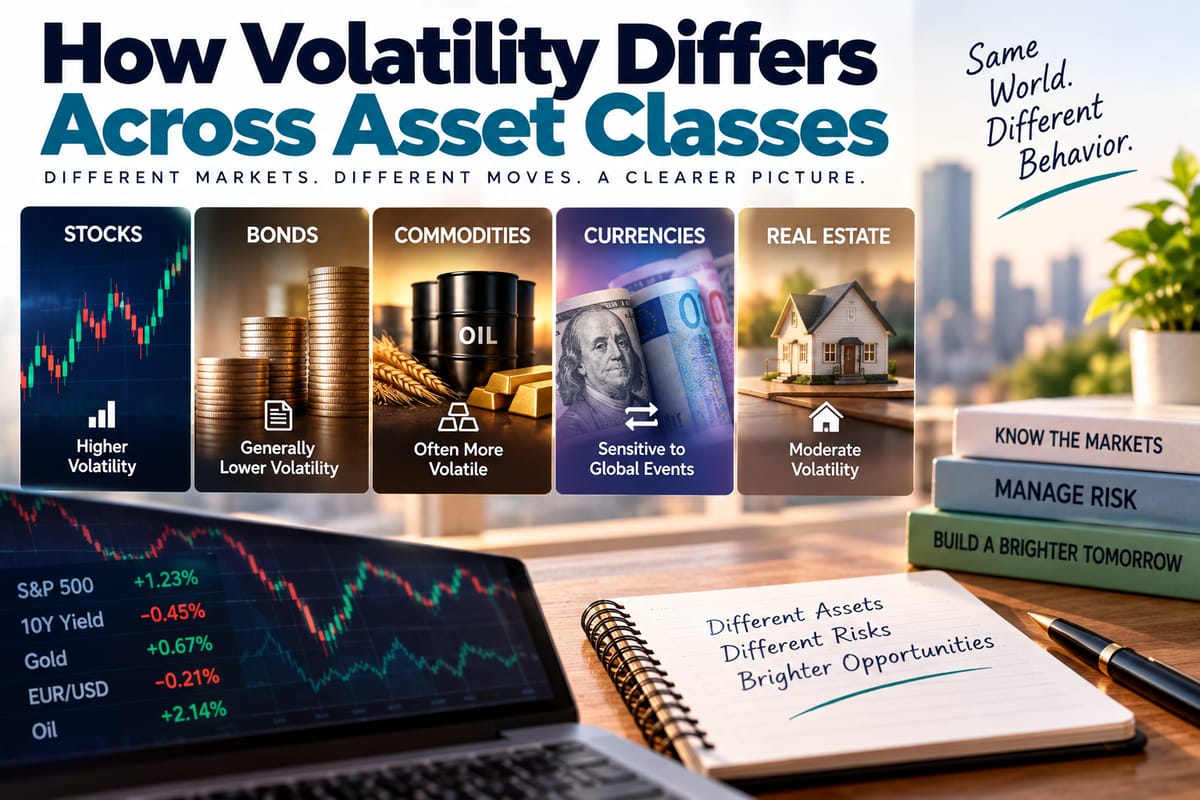
Stocks can experience sharp daily price changes, bonds often respond closely to interest rates and credit conditions, commodities can react quickly to changes in supply and demand, and currencies can move as expectations about economies and monetary policy change.
Understanding how volatility differs across asset classes can help explain why different investments behave differently during periods of uncertainty.
What Is Financial Volatility?
Volatility describes the degree to which an asset’s price changes over a particular period.
An asset with relatively small and frequent price movements may be considered less volatile than one that regularly experiences large price swings.
Volatility does not tell investors whether an asset will rise or fall. It describes the magnitude and frequency of price movements.
It can also change over time. An asset that normally experiences relatively modest movements may become much more volatile when markets face an unexpected event.
The broader structure of financial markets is explained in the Complete Guide to Financial Markets and How They Work.
Why Different Assets Have Different Volatility
Asset classes have different characteristics, participants, pricing mechanisms, and sources of risk.
Some of the factors that influence volatility include:
- Interest rates
- Economic growth
- Inflation
- Supply and demand
- Market liquidity
- Investor sentiment
- Leverage
- Credit risk
- Currency movements
- Geopolitical developments
Because these factors affect assets differently, volatility can vary significantly between markets.
Stock Market Volatility
Stocks represent ownership interests in companies, so their prices are influenced by expectations about future corporate performance.
Investors consider factors such as revenue, profits, costs, competition, economic conditions, interest rates, and future growth prospects.
Stock prices can therefore move sharply when new information changes expectations.
A company reporting unexpectedly strong earnings may see its shares rise, while disappointing results can trigger a decline.
At the broader market level, economic data and changes in investor sentiment can cause many stocks to move simultaneously.
The mechanics of these movements are explored in How Stock Market Volatility Works and What Causes Market Volatility.
Why Individual Stocks Can Be Especially Volatile
Individual companies can experience much larger price movements than broad stock indexes.
A diversified index contains many companies, so a major decline in one stock may have only a limited effect on the overall index.
An individual company, however, may experience a substantial price change following a major announcement.
Examples include:
- Earnings surprises
- Management changes
- Product launches
- Regulatory decisions
- Lawsuits
- Acquisitions
- Profit warnings
- Major changes in business conditions
The smaller the company or the more uncertain its future earnings, the greater the potential for significant price movements in some circumstances.
Bond Market Volatility
Bonds are debt instruments, and their prices are strongly influenced by interest rates.
When market interest rates rise, the prices of many existing bonds tend to fall because newly issued bonds may offer more attractive yields.
When interest rates decline, existing bonds with higher coupon payments can become more valuable.
This relationship means bond prices can become volatile when expectations about monetary policy or inflation change rapidly.
The structure and operation of this market are explained in the Complete Guide to Bond Markets.
Bond Volatility Depends on Maturity
Not all bonds respond equally to changes in interest rates.
Longer-maturity bonds generally have greater sensitivity to interest-rate movements than shorter-maturity bonds.
This means a significant change in interest-rate expectations can produce a relatively large price movement in longer-term bonds.
Short-term bonds may be less sensitive to the same change because their cash flows are closer to maturity.
Duration is one of the concepts investors use to assess this interest-rate sensitivity.
Credit Risk Can Increase Bond Volatility
Interest rates are not the only source of bond-market volatility.
Corporate and other non-government bonds also carry credit risk. If investors become concerned that an issuer may have difficulty meeting its financial obligations, the bond’s price can decline and its yield can rise.
Changes in credit spreads can therefore contribute to volatility.
During periods of economic stress, concerns about corporate defaults or deteriorating financial conditions can cause credit markets to move sharply.
Government Bonds Can Behave Differently
Government bonds are often influenced strongly by expectations about inflation, economic growth, and monetary policy.
Investors may view certain government debt markets as relatively defensive during periods of uncertainty, but this does not mean their prices are always stable.
Rapid changes in inflation expectations or interest-rate forecasts can produce significant movements in government bond yields and prices.
The behavior depends on the country, maturity, monetary policy environment, and broader market conditions.
Commodity Market Volatility
Commodities can have particularly distinctive volatility patterns because prices are influenced heavily by physical supply and demand.
Major commodity categories include:
- Oil
- Natural gas
- Gold
- Silver
- Agricultural products
- Industrial metals
Supply disruptions, weather events, geopolitical developments, changes in production, inventory levels, and shifts in global demand can all affect prices.
Because physical supply can sometimes change more slowly than demand, relatively small changes in available supply can produce significant price movements.
Energy Commodities Can Move Quickly
Oil and natural gas can experience sharp price changes when markets anticipate disruptions or changes in supply.
Production decisions, transportation problems, geopolitical developments, weather, inventories, and changes in economic activity can all influence prices.
Energy prices can also affect other markets because fuel is an important input into transportation and production.
This creates potential connections between commodity volatility, inflation, corporate costs, and consumer prices.
Agricultural Commodities Have Their Own Risks
Agricultural commodities can be strongly influenced by weather and growing conditions.
Droughts, floods, extreme temperatures, pests, and other environmental conditions can affect crop production.
Because agricultural production follows seasonal cycles, supply cannot always be increased immediately when demand rises.
This can create periods of substantial price volatility.
Gold and Precious Metals
Precious metals can behave differently from many industrial commodities.
Gold is influenced by factors including interest rates, inflation expectations, currency movements, investor demand, and perceptions of financial risk.
Changes in real interest rates can be particularly relevant because they can influence the attractiveness of holding an asset that does not generate conventional interest income.
Gold can therefore respond differently from oil or agricultural commodities even when all are classified as commodities.
Currency Market Volatility
Foreign exchange markets involve the relative value of one currency against another.
Currency prices can change as investors reassess:
- Interest-rate expectations
- Economic growth
- Inflation
- Central bank policy
- Trade conditions
- Political and geopolitical risks
- Capital flows
Because currencies are traded in pairs, a movement in one currency’s value is simultaneously a movement in another currency’s relative value.
Major currency pairs can have substantial trading volume, while some less-traded currencies may experience larger price movements during periods of stress.
Why Liquidity Matters
Liquidity refers broadly to how easily an asset can be bought or sold without causing a substantial change in its price.
Highly liquid markets generally have many buyers and sellers, which can make it easier to execute transactions.
Less liquid markets may have fewer participants or wider differences between buying and selling prices.
During periods of stress, liquidity can deteriorate even in markets that are normally highly active.
The relationship between liquidity and market conditions is explored in How Market Liquidity Affects Financial Stability.
Liquidity Can Amplify Price Movements
When many investors want to sell an asset at the same time, prices can move rapidly if there are not enough buyers willing to absorb the selling pressure.
The same principle applies when demand suddenly increases.
This means volatility is not determined solely by how much investors want to buy or sell. It also depends on the ability of the market to accommodate those transactions.
Liquidity can therefore help explain why similar news can produce very different price movements in different markets.
Volatility Can Increase Across Multiple Asset Classes
During major periods of uncertainty, volatility can rise across several markets simultaneously.
For example, a significant economic shock could affect:
- Stocks through changing earnings expectations
- Bonds through changing interest-rate expectations
- Commodities through changes in demand
- Currencies through changes in capital flows
- Credit markets through concerns about defaults
Although each asset class responds through different mechanisms, the underlying economic shock can connect them.
Correlations Can Change During Market Stress
The relationship between asset classes is not fixed.
Assets that usually move independently can become more closely correlated during periods of market stress.
For example, investors may sell multiple types of assets to raise cash or reduce risk. Alternatively, a major change in interest-rate expectations may cause several asset classes to respond simultaneously.
This means diversification can behave differently under different market conditions.
Volatility and Investment Time Horizons
The importance of short-term price movements depends partly on an investor’s time horizon.
Someone trading over very short periods may be highly exposed to daily price fluctuations.
A long-term investor may experience substantial short-term volatility while focusing more heavily on longer-term fundamentals.
This does not eliminate risk. It simply changes how price movements are viewed within the context of an investment strategy.
Volatility Is Not the Same as Risk
Volatility is often used as a measure of investment risk, but the two concepts are not identical.
A volatile asset can experience large price movements in either direction.
Risk can include many other factors, such as:
- Permanent loss of capital
- Credit default
- Inflation
- Liquidity constraints
- Currency risk
- Interest-rate risk
- Operational problems
- Counterparty risk
Volatility provides useful information about price behavior, but it does not capture every possible form of financial risk.
How Investors Compare Volatility
Investors can use several measures to examine price variability.
Historical volatility looks at how much an asset’s price has moved in the past.
Implied volatility, commonly associated with options markets, reflects expectations embedded in option prices about future price movements.
Standard deviation is another statistical measure commonly used to describe the dispersion of returns.
These measures provide different types of information and should be interpreted within the context of the asset being analyzed.
Volatility Can Create Both Opportunities and Challenges
Price fluctuations can create opportunities for investors who are prepared to accept uncertainty, but they can also produce substantial losses.
Higher volatility means outcomes can become less predictable over short periods.
Investors therefore need to consider their objectives, time horizons, financial circumstances, and tolerance for losses when evaluating assets with different volatility characteristics.
The same level of volatility may have very different implications for different investors.
Why Asset-Class Diversification Matters
Different asset classes respond to different economic forces.
Stocks may be strongly influenced by corporate earnings and growth expectations. Bonds can be particularly sensitive to interest rates and credit conditions. Commodities can respond to physical supply and demand. Currencies can react to relative economic and monetary conditions.
Holding assets with different characteristics can change how a portfolio responds to market developments.
However, diversification does not eliminate losses or guarantee that assets will move independently during periods of severe market stress.
Understanding the Source of the Movement
When an asset becomes volatile, the size of the price movement is only part of the story.
Investors may also ask why the movement occurred.
Was there a change in interest-rate expectations? Did economic data surprise markets? Was there a supply disruption? Did a company’s earnings outlook change? Did liquidity deteriorate?
Understanding the underlying cause can provide more useful context than simply observing that an asset moved sharply.
Different Markets, Different Volatility Patterns
Volatility varies across asset classes because each market has its own economic drivers, participants, liquidity conditions, and pricing mechanisms.
Stocks can respond quickly to changes in corporate and economic expectations. Bonds can be particularly sensitive to interest rates and credit conditions. Commodities can react sharply to changes in physical supply and demand, while currencies reflect changing relationships between economies and financial systems.
These differences mean that volatility should always be considered in context. Looking at how an asset moves, why it moves, and how its market functions can provide a clearer understanding of the risks and opportunities associated with price fluctuations.