Difference Between Economic Growth and Economic Development
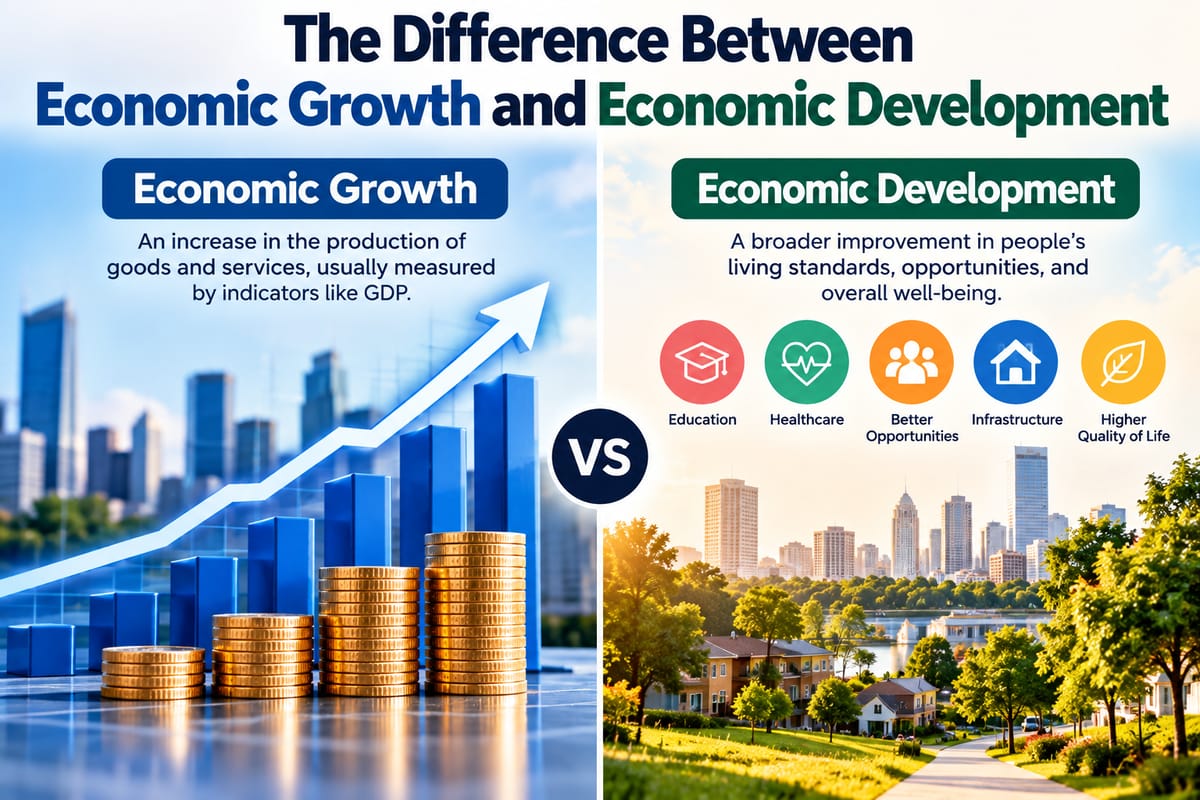
Economic growth and economic development are often used interchangeably, but they describe different aspects of how an economy changes over time. Economic growth generally refers to an increase in the production of goods and services, while economic development is a broader concept that includes improvements in living standards, economic opportunities, health, education, infrastructure, and overall quality of life.
The distinction matters because an economy can become larger without every household necessarily experiencing a comparable improvement in well-being. Looking at both concepts provides a more complete understanding of economic progress and the conditions that shape people’s lives.
What Is Economic Growth?
Economic growth refers to an increase in the amount of goods and services an economy produces over a period of time.
One of the most commonly used measures of economic growth is gross domestic product, or GDP. GDP measures the market value of final goods and services produced within an economy during a specified period.
The relationship between GDP and economic activity is explained in How GDP Measures Economic Activity and Economic Growth.
When inflation is taken into account, economists generally focus on real GDP when examining whether the economy is producing more goods and services over time.
Economic growth can result from several factors, including:
- A larger workforce
- Increased investment
- Higher productivity
- Technological improvements
- Greater business activity
- Improved infrastructure
- Increased capital formation
- More efficient use of resources
Growth can occur over relatively short periods, but sustained long-term growth usually depends on improvements in an economy’s productive capacity.
What Is Economic Development?
Economic development is broader than economic growth.
It considers whether people are experiencing improvements in their overall economic and social well-being rather than focusing primarily on the size of economic output.
Development can involve improvements in:
- Education
- Healthcare
- Housing
- Employment opportunities
- Income security
- Infrastructure
- Access to essential services
- Productivity
- Living standards
- Economic participation
A country can therefore experience economic growth while still facing significant challenges involving poverty, inequality, education, healthcare, or access to basic services.
Economic development attempts to capture some of these broader changes.
Economic Growth Measures Output
Economic growth is primarily concerned with how much an economy produces.
GDP is particularly useful for this purpose because it provides a standardized way to measure economic activity.
For example, if real GDP rises from one year to the next, the economy has generally produced more goods and services in real terms.
Economists can also examine GDP per capita, which divides economic output by population. This can provide additional context because a growing population can increase total GDP without producing an equivalent increase in output per person.
However, GDP and GDP per capita do not capture every aspect of people’s well-being.
They do not fully describe factors such as environmental quality, unpaid household work, health outcomes, or how income and economic opportunities are distributed.
Economic Development Looks at Living Standards
Economic development asks a broader question: Are people’s lives improving?
Higher incomes can contribute to better living standards, but development may also depend on whether people have access to quality education, healthcare, reliable infrastructure, safe housing, productive employment, and other essential resources.
For example, an economy might experience strong GDP growth because of increased production in a particular industry. If that growth generates employment, raises household incomes, improves public services, and expands economic opportunities, it may contribute to broader development.
If the benefits are narrowly concentrated while other living conditions remain unchanged, the relationship between growth and development may be less direct.
The Role of Productivity
Productivity is an important connection between economic growth and economic development.
When workers and businesses can produce more output using the same or fewer resources, productivity increases. Higher productivity can support economic growth by expanding an economy’s productive capacity.
It can also influence living standards by supporting higher wages, better products, greater investment, and improved economic opportunities.
The relationship is explored in What Drives Economic Growth and How Productivity Affects Living Standards.
Productivity can improve through:
- Better technology
- Worker education and training
- Improved infrastructure
- More efficient production methods
- Business investment
- Research and innovation
- Better management practices
Long-term improvements in productivity are particularly important because simply adding more workers or resources has limits.
Key Differences Between Growth and Development
Although the two concepts are closely related, they focus on different outcomes.
| Economic Growth | Economic Development |
|---|---|
| Focuses primarily on economic output | Focuses on broader human and economic well-being |
| Often measured using GDP or real GDP | Uses a wider range of social and economic indicators |
| Emphasizes production and income | Emphasizes living standards and opportunities |
| Can occur over shorter periods | Generally reflects longer-term structural change |
| Focuses on the size of the economy | Considers the quality and distribution of economic progress |
| Productivity and investment are major drivers | Education, health, infrastructure, institutions, and opportunity also matter |
Neither concept completely replaces the other. Growth provides important economic capacity, while development considers how that capacity affects society.
How Economic Indicators Help Measure Progress
No single statistic can describe an entire economy.
Economists therefore use many indicators to examine different aspects of economic performance. These can include GDP growth, unemployment, inflation, productivity, household income, investment, consumer spending, and trade.
The Complete Guide to Economic Indicators provides broader context on the measurements used to understand economic conditions.
Development may require an even wider collection of indicators, including measures related to education, healthcare, poverty, life expectancy, infrastructure, and access to essential services.
Looking at several indicators together can provide a more useful picture than relying on a single number.
Can Economic Growth Happen Without Economic Development?
Yes. Economic growth does not automatically guarantee broad-based economic development.
Imagine an economy where production increases rapidly because a single natural-resource industry expands. GDP may rise significantly, but the broader effects could depend on factors such as employment, wages, government investment, environmental impacts, and how the resulting income is distributed.
Similarly, an economy can experience growth while certain communities continue to have limited access to healthcare, education, transportation, or financial opportunities.
This does not mean growth has no connection to development. Economic growth can provide governments, businesses, and households with additional resources that can support improvements in living standards.
The outcome depends partly on how those resources are used and distributed.
Can Development Occur Without Strong Economic Growth?
Development and growth are closely connected, so prolonged economic stagnation can make development more difficult.
However, improvements in areas such as education, healthcare, infrastructure, public administration, and access to essential services can occur even when GDP growth is modest.
For example, improvements in educational outcomes can increase human capital and eventually contribute to higher productivity.
Better infrastructure can reduce transportation costs and improve access to markets.
Improved healthcare can support a healthier workforce and reduce economic losses associated with preventable illness.
These improvements can therefore contribute to future economic growth while also representing development in their own right.
The Importance of Human Capital
Human capital refers broadly to the knowledge, skills, education, experience, and capabilities that people contribute to an economy.
It is an important part of both growth and development.
An educated and skilled workforce can help businesses adopt new technologies, develop new products, improve production processes, and increase productivity.
At the same time, greater access to education can improve individual economic opportunities.
This demonstrates why development cannot be understood purely through production statistics. People are both participants in the economy and beneficiaries of economic progress.
Infrastructure Connects Growth and Development
Infrastructure provides another important connection between the two concepts.
Roads, ports, electricity networks, telecommunications systems, water systems, and other forms of infrastructure can make economic activity more efficient.
Businesses can transport goods more easily, communicate with customers, access electricity, and reach new markets.
Infrastructure can also directly affect quality of life by improving access to healthcare, education, transportation, sanitation, and other services.
Investment in infrastructure can therefore support economic growth while also contributing to economic development.
How Technology Affects Both
Technology can influence economic growth by allowing businesses and workers to produce goods and services more efficiently.
Automation, digital services, advanced manufacturing, telecommunications, and other innovations can increase productivity and create new industries.
Technology can also contribute to development by expanding access to information, financial services, education, healthcare, and communication.
However, technological progress can also create challenges. Workers may need new skills as industries change, and unequal access to technology can create differences in economic opportunity.
The effect of technology therefore depends not only on whether it is adopted but also on how people, businesses, and institutions adapt to it.
The Role of Employment
Employment is another important link between growth and development.
An expanding economy can create new jobs, but the quality of employment also matters.
People may benefit from economic progress through stable employment, higher wages, safer working conditions, opportunities for advancement, and access to productive work.
A country with high economic output but widespread unemployment or underemployment may face development challenges despite having a large economy.
Employment statistics should therefore be considered alongside production and income measures.
Inequality Can Affect the Relationship
Economic growth does not necessarily benefit every household equally.
Income distribution, access to education, geographic differences, employment opportunities, and other structural factors can influence how economic gains are experienced.
Two countries could record similar GDP growth rates while experiencing very different changes in household living standards.
This is one reason economic development is a broader concept than economic growth.
Development considers not only whether economic resources are increasing but also whether people have meaningful opportunities to improve their lives.
Economic Growth and Business Cycles
Economic growth is not always a smooth upward path.
Economies move through periods of expansion and contraction as consumer spending, investment, employment, production, financial conditions, and other factors change.
These fluctuations are commonly discussed through the concept of business cycles.
How Business Cycles Affect Economies and Financial Markets provides additional context on how changing economic conditions can influence businesses and financial markets.
Short-term economic fluctuations should not necessarily be confused with long-term development.
A recession can temporarily reduce output and employment without permanently reversing decades of improvements in education, infrastructure, technology, or living standards.
Likewise, one year of strong economic growth does not automatically represent a major transformation in economic development.
Why Long-Term Trends Matter
Economic growth is often discussed in terms of quarterly or annual changes, but economic development typically requires a longer perspective.
Building schools, improving healthcare systems, expanding infrastructure, developing skilled workers, increasing productivity, and strengthening institutions can take many years.
Long-term trends can therefore provide important context when evaluating whether an economy is becoming more productive and whether living conditions are improving.
This is particularly important when comparing economies at different stages of development.
Growth and Development Can Reinforce Each Other
Although economic growth and development are distinct concepts, they can support each other.
Higher productivity can increase economic output and incomes. Greater incomes and government revenues can provide resources for investment in education, healthcare, and infrastructure.
Better education and healthcare can improve human capital and workforce productivity. Better infrastructure can reduce costs and support business activity.
The relationship can therefore become a cycle in which improvements in productive capacity and living standards reinforce one another.
However, the relationship is not automatic. Economic policies, institutions, investment decisions, resource allocation, and social conditions all influence how growth translates into broader development.
A Broader Way to Understand Economic Progress
The difference between economic growth and economic development ultimately comes down to what is being measured.
Economic growth focuses primarily on the expansion of economic output. Economic development looks more broadly at improvements in people’s economic and social conditions.
GDP and other economic indicators remain essential for understanding how an economy is performing, but they represent only part of the overall picture.
To understand economic progress more fully, it is useful to consider production alongside productivity, employment, income, education, healthcare, infrastructure, opportunity, and living standards.
An economy can become larger without automatically becoming more developed. Sustainable progress generally involves both the capacity to produce more and the ability to translate economic resources into meaningful improvements in people’s lives.