How Financial News Influences Market Sentiment
Financial markets respond not only to economic data and corporate performance but also to how investors interpret new information. Financial news plays an important role in that process by bringing information about companies, economies, interest rates, government decisions, geopolitical developments, and other events to the attention of market participants.
A single news report can sometimes trigger a significant change in investor expectations. At other times, an apparently important story may have little lasting effect because markets had already anticipated the information.
The relationship between financial news and market sentiment is therefore more complicated than simply assuming that positive news pushes prices higher and negative news pushes them lower.
What Is Market Sentiment?
Market sentiment refers broadly to the collective attitude and expectations of investors toward financial markets or particular assets.
When sentiment is optimistic, investors may have greater confidence in future economic growth, corporate earnings, or asset prices. This can contribute to stronger demand for certain investments.
When sentiment becomes pessimistic, investors may become more concerned about economic conditions, corporate performance, interest rates, or other risks.
Sentiment can influence buying and selling decisions, but it does not operate independently of fundamental information.
Why Financial News Matters
Financial news helps investors process information that may affect the future value or risk of an asset.
News can provide information about:
- Corporate earnings
- Economic growth
- Inflation
- Employment
- Interest rates
- Monetary policy
- Government decisions
- Commodity prices
- Mergers and acquisitions
- Supply disruptions
- Geopolitical developments
- Industry trends
Investors then interpret this information in relation to what was previously expected.
That last point is particularly important. Markets generally respond to the difference between what investors expected and what actually happened.
Markets React to Surprises
Suppose investors expect a company to report strong quarterly earnings. If the company delivers results that are broadly in line with expectations, the stock may experience a relatively limited reaction.
If earnings significantly exceed expectations, investors may reassess the company’s future prospects.
The opposite can happen when results disappoint.
This principle applies to economic news as well. A stronger-than-expected employment report, lower-than-expected inflation reading, or unexpected interest-rate decision can have a larger market impact than information that was already widely anticipated.
Positive News Does Not Always Mean Higher Prices
It may seem logical that good news should cause an asset’s price to rise.
However, markets can behave differently depending on expectations.
Imagine a company reports record profits, but investors had expected an even larger increase. The headline may sound positive, yet the stock could decline if the results are viewed as disappointing relative to expectations.
This is why financial news needs to be interpreted within the broader context of market expectations.
Corporate Earnings Can Shift Sentiment
Corporate earnings are among the most closely watched forms of financial news.
Investors examine revenue, profits, margins, guidance, cash flow, and other information to assess how a company is performing and what its future may look like.
The relationship between earnings information and market prices is explored in how corporate earnings affect stock prices and market valuations.
Strong earnings can increase confidence when they indicate improving business conditions. Weak results can raise concerns about slowing demand, rising costs, or weaker future profitability.
However, the market reaction depends on expectations and valuation as well as the headline earnings figure.
Economic News Can Affect Entire Markets
Some financial news concerns individual companies, while other reports have implications for the broader economy.
Investors regularly watch information about:
- Inflation
- Gross domestic product
- Employment
- Consumer spending
- Manufacturing
- Housing
- Business investment
- Interest rates
- Consumer confidence
A significant economic report can influence expectations about future growth and monetary policy.
For example, evidence of persistent inflation could lead investors to reconsider the likely path of interest rates. That change in expectations can affect stocks, bonds, currencies, and other financial assets.
Monetary Policy Is Closely Watched
Central bank decisions can have substantial effects on financial markets because interest rates influence borrowing costs, investment decisions, bond yields, and asset valuations.
Financial news about central bank meetings, policy statements, and officials’ comments can therefore attract considerable attention.
Understanding how monetary policy affects financial markets helps explain why even relatively small changes in interest-rate expectations can influence investor behavior.
Markets may respond not only to an actual policy decision but also to signals about what policymakers might do in the future.
Headlines Can Change Expectations Quickly
Financial markets operate continuously during trading hours, while news can arrive at any moment.
A company announcement, economic report, policy statement, or unexpected event can cause investors to rapidly reassess their expectations.
This can produce sudden changes in:
- Stock prices
- Bond yields
- Currency values
- Commodity prices
- Trading volume
- Market volatility
The speed of these reactions is one reason financial markets can sometimes appear highly sensitive to news.
Social Media Can Accelerate Information
Financial information can now spread rapidly through digital platforms.
A news report may be shared across social media, investor forums, financial websites, and messaging platforms within minutes.
This can increase the speed at which investors become aware of an event.
However, rapid information sharing also creates challenges. Headlines can be taken out of context, preliminary information can spread before it is verified, and commentary can become mixed with factual reporting.
Investors therefore need to distinguish between confirmed information and speculation.
The Difference Between News and Interpretation
A financial news report may describe an event, while commentators and investors interpret what the event could mean.
For example:
Fact: A central bank raised its policy interest rate.
Interpretation: Investors may conclude that borrowing costs will remain elevated for longer.
Market reaction: Asset prices may change as investors adjust their expectations.
Keeping these stages separate can make it easier to understand why markets sometimes move in unexpected directions.
Fear and Uncertainty Can Increase Volatility
Uncertainty can play an important role in market sentiment.
When investors have difficulty assessing the potential consequences of an event, they may reduce risk exposure, increase hedging activity, or delay investment decisions.
This can contribute to greater market volatility.
The relationship between uncertainty, investor behavior, and price movements is explored in how stock market volatility works and what causes market volatility.
Volatility does not necessarily mean that markets are moving in one direction. It refers more broadly to the size and frequency of price changes.
News Can Affect Different Assets in Different Ways
The same news event can have different effects across financial markets.
For example, higher inflation could lead investors to reconsider interest-rate expectations. That may affect stocks, bonds, currencies, and commodities in different ways.
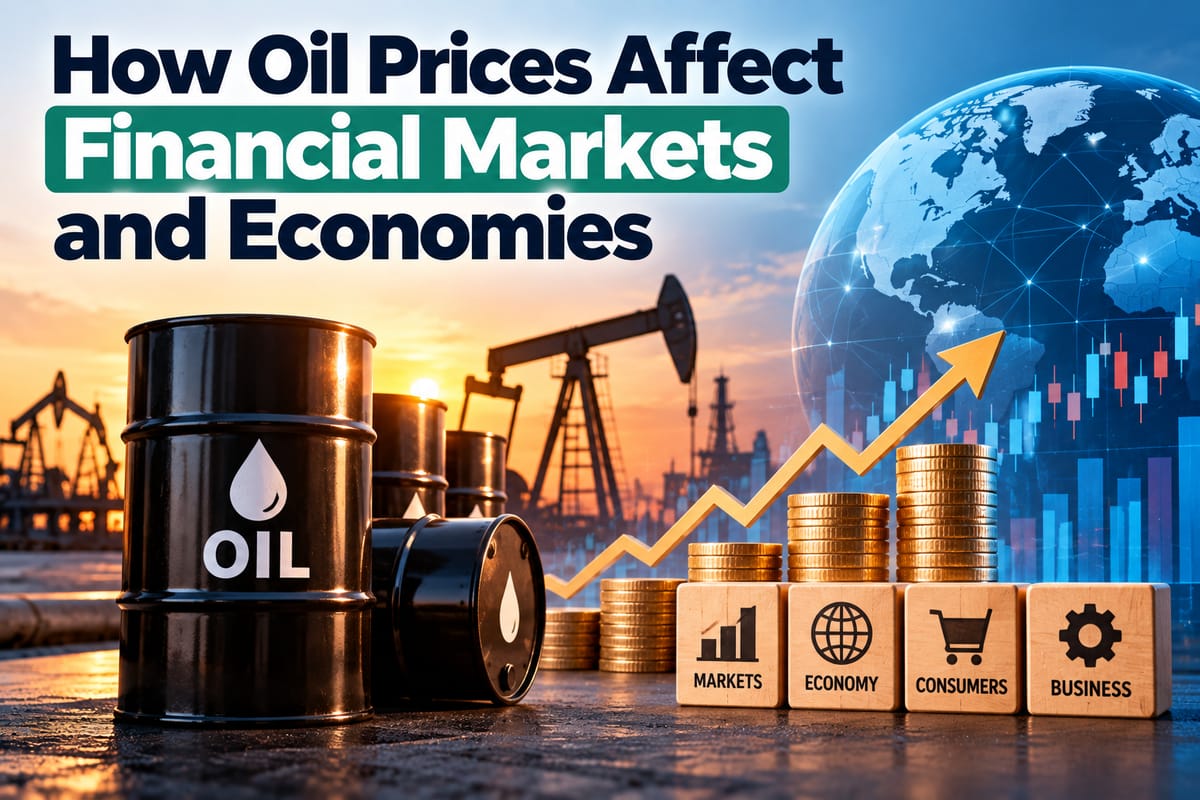
Similarly, a rise in oil prices could benefit some energy producers while increasing costs for companies that rely heavily on fuel.
Market sentiment is therefore not always uniform.
Investors may become optimistic about one sector while becoming more cautious about another.
The Importance of Market Cycles
Financial news also interacts with the broader stage of the market cycle.
During periods of strong economic expansion, investors may interpret certain developments differently than they would during a slowdown.
A rise in corporate investment could be viewed as a sign of confidence during one period, while the same increase might raise concerns about excessive spending during another.
The broader framework of how economic and financial market cycles work helps explain why the same type of news can produce different reactions at different points in the economic and financial cycle.
Expectations Can Be More Important Than Headlines
One of the most important principles in understanding financial news is that markets tend to look forward.
Investors are constantly asking what new information means for future earnings, economic growth, interest rates, inflation, and risk.
As a result, a news story may have a strong market impact when it changes expectations.
If an event was already widely anticipated, however, much of its potential impact may already be reflected in asset prices.
This is sometimes described as information being “priced in.”
Why Analysts Can Interpret the Same News Differently
Investors do not always agree about what a particular development means.
One analyst might see strong economic growth as evidence that corporate profits will increase.
Another might focus on the possibility that stronger growth could keep inflation elevated and lead to tighter monetary policy.
Both may be looking at the same information but reaching different interpretations.
These differing expectations are part of what creates a functioning market, where buyers and sellers have different views about future value and risk.
News Can Create Short-Term Reactions
Some market reactions to news are relatively short-lived.
Investors may initially respond strongly to a headline and then reassess the information after examining the details.
For example, a company might announce a major development that initially attracts enthusiasm. Once investors examine the financial implications more closely, the initial reaction may weaken.
This is one reason headline-driven market movements can sometimes reverse.
Not Every Story Has a Lasting Effect
Financial markets receive an enormous amount of information.
Only some news materially changes long-term expectations.
A short-lived market reaction can occur when investors determine that an event has limited implications for future earnings, economic growth, interest rates, or other fundamental factors.
More significant developments can have longer-lasting effects when they change expectations about future conditions.
The Role of Financial Journalism
Financial journalism helps organize and communicate complicated information.
Good reporting can provide context around economic releases, corporate announcements, policy decisions, and market movements.
It can also explain why a particular development may matter without assuming that every price movement has a single cause.
Readers benefit when reporting clearly distinguishes verified facts, expert analysis, market reactions, and forecasts.
Investors Need More Than Headlines
A headline can attract attention, but it rarely provides enough information to understand an entire market development.
Investors evaluating financial news may want to consider:
- What actually happened?
- Was the event expected?
- How significant is it?
- Which assets or industries could be affected?
- What assumptions are changing?
- Is the information confirmed?
- Could the market reaction be temporary?
- What other factors are influencing prices?
This approach can reduce the risk of making decisions based solely on emotional reactions to individual headlines.
Information Overload Can Influence Sentiment
The constant flow of financial information can itself affect how investors perceive markets.
A continuous stream of alarming headlines may create an impression of unusually high risk even when individual developments have limited long-term significance.
Likewise, a steady flow of optimistic stories can contribute to excessive confidence.
This is one reason maintaining a broader perspective can be useful when interpreting daily financial news.
Financial News and Long-Term Decision-Making
Financial news can provide valuable information, but short-term headlines should be distinguished from long-term investment objectives.
An investor focused on long-term financial goals may not need to respond to every daily market movement.
Instead, financial news can be used to understand changing economic conditions, corporate developments, risks, and opportunities while maintaining a consistent decision-making framework.
The appropriate response to news depends on the individual’s objectives, time horizon, risk tolerance, and circumstances.
A Constant Feedback Loop
Financial news and market sentiment influence each other in an ongoing feedback loop.
News provides information. Investors interpret that information. Their buying and selling decisions influence prices. Those price movements then become news themselves, generating further analysis and commentary.
This process can amplify market movements, particularly when investors are uncertain or highly focused on a particular theme.
Understanding this feedback loop helps explain why financial markets can sometimes move rapidly even when the underlying economic conditions have not changed dramatically.
Reading Financial News With Context
Financial news can influence market sentiment because it changes what investors know, what they expect, and how they assess risk.
Corporate earnings can alter expectations about company profitability. Economic reports can change views about growth and inflation. Monetary policy decisions can affect interest-rate expectations. Unexpected events can increase uncertainty and volatility.
But the relationship is rarely as simple as positive news equals rising prices or negative news equals falling prices.
Markets constantly compare new information with existing expectations. The most meaningful market reactions often occur when news changes the outlook for future earnings, economic conditions, policy, or risk.
For readers and investors, understanding that distinction can make financial news easier to interpret and help separate an important change in expectations from a headline that may have only a temporary effect.