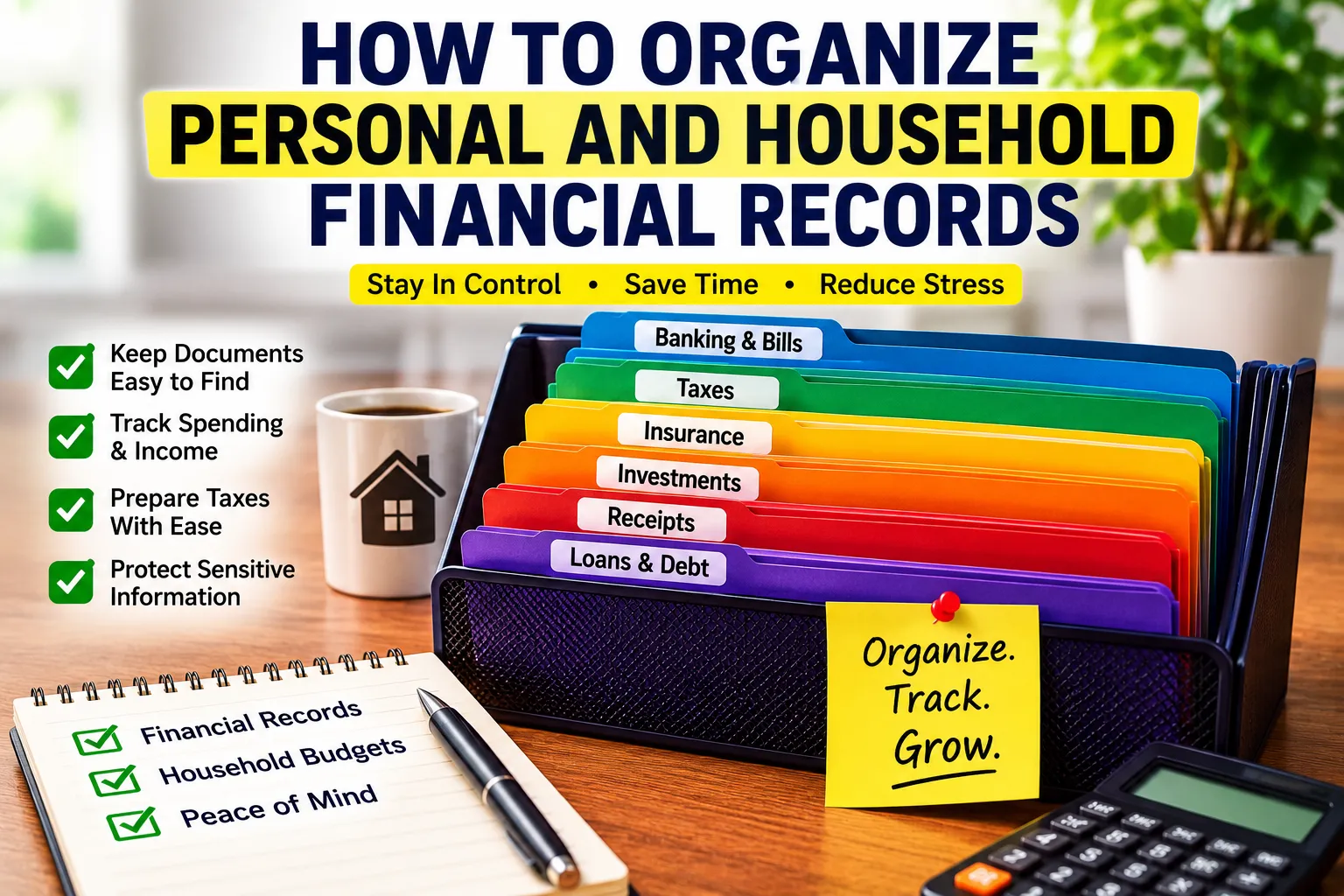
How to Organize Personal and Household Financial Records
Financial records can accumulate quickly. Bank statements, bills, insurance documents, tax records, receipts, investment statements and loan paperwork can easily end up scattered across email accounts, filing cabinets, phone storage and multiple online platforms.
When important information is difficult to find, ordinary financial tasks can become unnecessarily stressful. Paying bills, preparing taxes, reviewing spending, applying for a loan or checking an insurance policy can take much longer when records are disorganized.
A simple financial record-keeping system can make household finances easier to manage. The goal is not to keep every piece of paper forever. It is to create a practical system that makes important information easy to find, protects sensitive documents and helps the household understand where its money is going.
For a broader framework covering the different tools and systems used to manage household finances, see this complete money management system.
Why Financial Records Matter
Financial records provide a history of what has happened with your money.
They can help you:
- Track income and expenses
- Confirm that bills have been paid
- Monitor bank and credit accounts
- Prepare tax returns
- Review insurance coverage
- Manage loans and debts
- Document major purchases
- Track investments
- Resolve billing disputes
- Apply for financial products
- Plan household spending
Good records can also make it easier to identify mistakes.
A duplicate charge, unfamiliar transaction or unexpected fee is much easier to investigate when statements and receipts are organized.
Start With a Financial Inventory
Before creating folders or buying storage equipment, make a list of the financial accounts and documents your household currently has.
This might include:
- Checking accounts
- Savings accounts
- Credit cards
- Mortgages
- Personal loans
- Student loans
- Insurance policies
- Investment accounts
- Retirement accounts
- Utility accounts
- Tax records
- Property documents
- Vehicle documents
- Major purchase receipts
- Employment and income records
The inventory provides a starting point for organizing everything else.
It can also reveal accounts or subscriptions that you have forgotten about.
Separate Records Into Categories
One of the easiest ways to organize financial documents is to create broad categories.
A household might use categories such as:
- Income
- Banking
- Bills and household expenses
- Debt
- Taxes
- Insurance
- Investments and retirement
- Property and vehicles
- Important legal and financial documents
- Receipts and warranties
The categories do not need to be identical for every household.
The best system is one that makes sense to the people who actually need to use it.
Create a Digital Filing System
Many financial documents are now delivered electronically, making digital organization particularly important.
A simple folder structure could look like this:
Household Finances
│
├── Income
├── Banking
├── Bills
├── Credit Cards
├── Loans
├── Insurance
├── Taxes
├── Investments
├── Property
├── Vehicles
└── Receipts & Warranties
Within each folder, documents can be organized by year, account or document type.
For example:
Taxes
├── 2024
├── 2025
└── 2026
This approach makes it easier to locate records without creating hundreds of individual folders.
Use Consistent File Names
A logical file-naming system can save considerable time.
Instead of keeping a document with a generic name such as:
statement.pdf
rename it using information that identifies what it contains.
For example:
2026-08-Bank-Statement.pdf
or:
2026-08-Electricity-Bill.pdf
For important documents, you might include the account or institution:
2026-08-BankName-Savings-Statement.pdf
The exact naming convention is less important than using it consistently.
Organize Records by Year
Year-based organization works particularly well for documents that accumulate over time.
Tax records, bank statements, investment statements and income documents can be grouped by year.
For example:
Financial Records
├── 2024
├── 2025
└── 2026
However, documents that remain relevant for several years, such as insurance policies or loan agreements, may be easier to organize by category rather than placing them in a single annual folder.
Keep Current Documents Separate
Active financial records should be easy to access.
For example, current insurance policies, active loan agreements and current household bills should not be buried among years of archived documents.
A simple structure could include:
- Current
- Archive
- To Review
The “To Review” folder can temporarily hold documents that need attention.
Once reviewed, they can be moved to the appropriate permanent location.
Create a Physical Filing System
Paper records still matter even in a largely digital household.
Some documents may arrive physically, while others may be worth keeping in their original form.
A small filing cabinet, document box or set of labeled folders can be enough.
Useful categories might include:
- Tax documents
- Insurance
- Property
- Vehicles
- Loans
- Legal documents
- Warranties
- Important receipts
Avoid creating too many categories. If a filing system becomes complicated, people are less likely to maintain it.
Keep Important Original Documents Secure
Some documents deserve special treatment.
Depending on your circumstances and jurisdiction, these might include:
- Property deeds
- Certain legal documents
- Certificates
- Loan agreements
- Insurance documents
- Estate-planning documents
- Important identification records
Important originals should be stored somewhere secure and protected from foreseeable risks such as theft, fire or water damage.
Digital copies can provide a useful backup, but they do not necessarily replace originals where an original document is legally or practically required.
Protect Digital Financial Records
Financial documents contain sensitive information.
A digital filing system should therefore be protected with strong security practices.
Use:
- Strong, unique passwords
- Multi-factor authentication where available
- Updated operating systems and security software
- Secure cloud storage or reliable backups
- Screen locks on computers and phones
- Encryption where appropriate
Avoid storing sensitive financial documents in unsecured locations or sharing them through channels that do not provide appropriate protection.
Back Up Important Documents
A single copy is not enough for critical financial information.
Computer failures, accidental deletion, theft or ransomware can make files inaccessible.
A practical backup strategy can involve maintaining copies in more than one location.
For example, important documents could be stored:
- On the primary computer
- In a reputable cloud-storage service
- On a separate backup device
The exact setup depends on your needs and technical ability.
The important principle is redundancy.
Be Careful With Cloud Storage
Cloud storage can make documents accessible from multiple devices, but convenience should be balanced with security.
Choose reputable services and enable available security protections, particularly multi-factor authentication.
Avoid creating shared links to sensitive financial documents unless you specifically need to share them and understand who can access them.
Financial records should be treated as confidential information.
Keep a Household Financial Dashboard
A document or spreadsheet containing a high-level financial overview can make household management easier.
It might include:
| Category | Information |
|---|---|
| Bank accounts | Institution and account type |
| Credit cards | Issuer and payment information |
| Loans | Balance, rate and payment |
| Insurance | Provider and policy details |
| Investments | Institution and account type |
| Utilities | Provider and account information |
| Subscriptions | Service and billing frequency |
For security reasons, avoid creating a document that unnecessarily contains full passwords, PINs or other authentication credentials.
The dashboard should help you locate accounts, not become a master key to your finances.
Create a Bill-Payment System
Financial organization becomes much easier when recurring bills are tracked consistently.
A household bill tracker might include:
| Bill | Due Date | Frequency | Payment Method | Status |
|---|---|---|---|---|
| Electricity | 15th | Monthly | Bank | Paid |
| Internet | 20th | Monthly | Card | Paid |
| Insurance | 1st | Monthly | Bank | Upcoming |
| Rent/Mortgage | 5th | Monthly | Bank | Paid |
The purpose is not to create unnecessary paperwork.
It is to make upcoming obligations visible and reduce the chance of missed payments.
Review Bank Statements Regularly
Organizing financial records is more useful when you actually review them.
Checking statements regularly can help identify:
- Unauthorized transactions
- Duplicate charges
- Unexpected fees
- Forgotten subscriptions
- Incorrect payments
- Unusual spending patterns
The sooner an error is identified, the easier it may be to investigate.
Regular transaction reviews can also support efforts to reduce unnecessary household spending by making recurring or overlooked expenses easier to identify.
Keep Receipts for Major Purchases
Not every grocery receipt needs to be preserved indefinitely.
However, receipts for expensive purchases can be useful for:
- Returns
- Warranty claims
- Insurance claims
- Tax documentation where applicable
- Proof of ownership
- Repair records
Consider keeping receipts for significant purchases in a dedicated digital or physical folder.
For digital copies, include the purchase date and item in the filename.
Track Warranties and Maintenance Records
Large household purchases can come with warranties, service agreements and maintenance requirements.
Instead of storing those documents randomly, create a Property & Warranties folder.
For example:
Property & Warranties
├── Refrigerator
├── Washing Machine
├── Television
├── HVAC
└── Other Appliances
You can include purchase receipts, warranty documents, manuals and significant repair records.
This can be especially helpful when selling a property or making an insurance claim.
Organize Tax Documents Early
Tax season becomes considerably easier when financial records are collected throughout the year rather than at the last minute.
Depending on your location and circumstances, relevant records may include:
- Employment income documents
- Business income records
- Bank interest statements
- Investment records
- Property-related documents
- Charitable donation records
- Deductible expense documentation
- Previous tax returns
Tax requirements vary by jurisdiction, so households should follow the retention and documentation rules applicable to them.
Keep Investment Records Organized
Investment accounts can generate numerous documents.
These may include:
- Account statements
- Transaction confirmations
- Dividend information
- Interest statements
- Tax documents
- Retirement account records
- Investment purchase information
Keeping investment records organized can make it easier to monitor portfolio performance and provide information needed for tax reporting.
Separate Personal and Business Records
If someone in the household operates a business, freelance activity or side business, keeping business and personal records separate can make financial management significantly easier.
Use separate folders and, where appropriate, separate financial accounts.
For example:
Personal Finances
└── Household Records
Business Finances
├── Income
├── Expenses
├── Taxes
├── Invoices
└── Banking
Mixing business and personal transactions can make accounting and tax reporting unnecessarily complicated.
Do Not Keep Everything Forever
Organization is not simply about accumulating documents.
Keeping every receipt, statement and bill indefinitely can create clutter and make important records harder to find.
Retention requirements vary considerably depending on the document, jurisdiction and individual circumstances.
Tax authorities, financial institutions, insurers and legal professionals may have different requirements.
For records with legal, tax or property significance, check the applicable retention rules before destroying them.
Securely Dispose of Sensitive Documents
When documents no longer need to be kept, disposal matters.
Financial documents can contain information such as:
- Account numbers
- Addresses
- Income information
- Transaction details
- Identification information
Paper records containing sensitive information should generally be securely destroyed rather than simply thrown into an open trash bin.
Digital files should also be removed appropriately when they are no longer required, including from temporary folders or easily accessible cloud locations.
Create an “Important Information” File
A household can benefit from having one secure place that identifies where important financial information can be found.
It might contain:
- Names of financial institutions
- Insurance providers
- Mortgage or loan information
- Important account contacts
- Location of key documents
- Information about recurring financial obligations
Avoid placing passwords or highly sensitive authentication information in an unsecured document.
The purpose is to help an authorized household member understand the financial structure of the household if the primary person who manages it becomes unavailable.
Make the System Easy for the Whole Household
A financial filing system should not depend entirely on one person’s memory.
If one household member normally handles the finances, another trusted adult should at least understand:
- Where important documents are stored
- Which bills are recurring
- Which financial institutions are used
- Where insurance information can be found
- How to access important records appropriately
This can make the household more resilient when circumstances change unexpectedly.
Review Your Records Every Month
Financial organization works best when it becomes a routine.
A monthly review can be relatively short.
Check:
- Bank and credit-card statements.
- Upcoming bills.
- Recent receipts.
- New financial documents.
- Insurance or subscription changes.
- Important account notifications.
- Files waiting in the “To Review” folder.
Moving documents into their proper location immediately prevents a large backlog from developing.
Do a Deeper Financial Cleanup Once a Year
A monthly review handles everyday organization, while an annual cleanup can address the bigger picture.
Once a year, consider:
- Archiving older documents
- Reviewing financial accounts
- Checking insurance policies
- Reviewing subscriptions
- Updating the household financial inventory
- Confirming backup systems work
- Destroying records that no longer need to be retained
- Reviewing beneficiaries and important financial information where appropriate
The annual review is also an opportunity to simplify.
If a folder or process is consistently difficult to use, redesign it.
Use Automation Where It Helps
Technology can reduce the amount of manual work involved in financial organization.
Depending on the services available to you, automation can help with:
- Recurring bill payments
- Electronic statements
- Transaction notifications
- Automatic savings
- Cloud backups
- Expense categorization
Automation should not mean ignoring accounts.
Even automated systems need periodic review to make sure payments are correct and accounts remain secure.
Avoid Relying Entirely on Email
Email can be useful for receiving financial documents, but it should not become the household’s only filing system.
Important documents can become difficult to locate among thousands of messages.
Download and organize important records in your designated financial storage system.
This also reduces the risk of losing access to a document if an email account is compromised, closed or otherwise unavailable.
A Simple Financial Filing Routine
A practical routine does not need to take hours.
Weekly
- File new receipts and documents.
- Review unusual transactions.
- Check upcoming bills.
Monthly
- Review bank and credit-card statements.
- Update financial records.
- Move documents from “To Review” into permanent folders.
Quarterly
- Review subscriptions and recurring expenses.
- Check account balances and debts.
- Confirm important records are backed up.
Annually
- Archive old records.
- Review insurance.
- Check important household information.
- Review document-retention needs.
- Clean up unnecessary digital and paper files.
The exact schedule can be adjusted to fit the household.
Common Financial Organization Mistakes
Even well-intentioned households can make record-keeping unnecessarily complicated.
Keeping Everything in One Folder
A single folder called “Finances” eventually becomes difficult to search.
Creating Too Many Folders
An overly complicated filing system can be just as frustrating as no system at all.
Keeping Only Paper Copies
Physical records can be lost or damaged.
Keeping Only Digital Copies
Important originals may sometimes need to be retained.
Ignoring Security
Financial records should not be stored without appropriate passwords and access controls.
Never Reviewing Statements
Organizing documents is less useful if transactions are never checked.
Mixing Personal and Business Records
This can complicate accounting, budgeting and tax documentation.
The Best System Is the One You Will Maintain
There is no single perfect way to organize household financial records.
One person may prefer a detailed spreadsheet, while another may prefer clearly labeled folders and a simple bill calendar.
The important characteristics are consistency, accessibility and security.
A good system should answer three questions quickly:
What do we have?
Where is the documentation?
What needs attention?
If you can answer those questions without searching through piles of paperwork or hundreds of emails, your financial records are probably organized well enough to serve their purpose.
Turning Financial Clutter Into Financial Clarity
Organizing personal and household financial records is not about creating more administrative work. It is about reducing the amount of time and stress required to manage money.
A simple combination of digital folders, secure physical storage, regular reviews, reliable backups and consistent naming can transform a collection of scattered documents into a useful household financial system.
The real benefit goes beyond knowing where a bank statement is. Organized records make it easier to monitor spending, prepare taxes, manage bills, protect important information and make better financial decisions.
A few minutes spent filing a document today can save considerably more time when that information is needed months or years later.