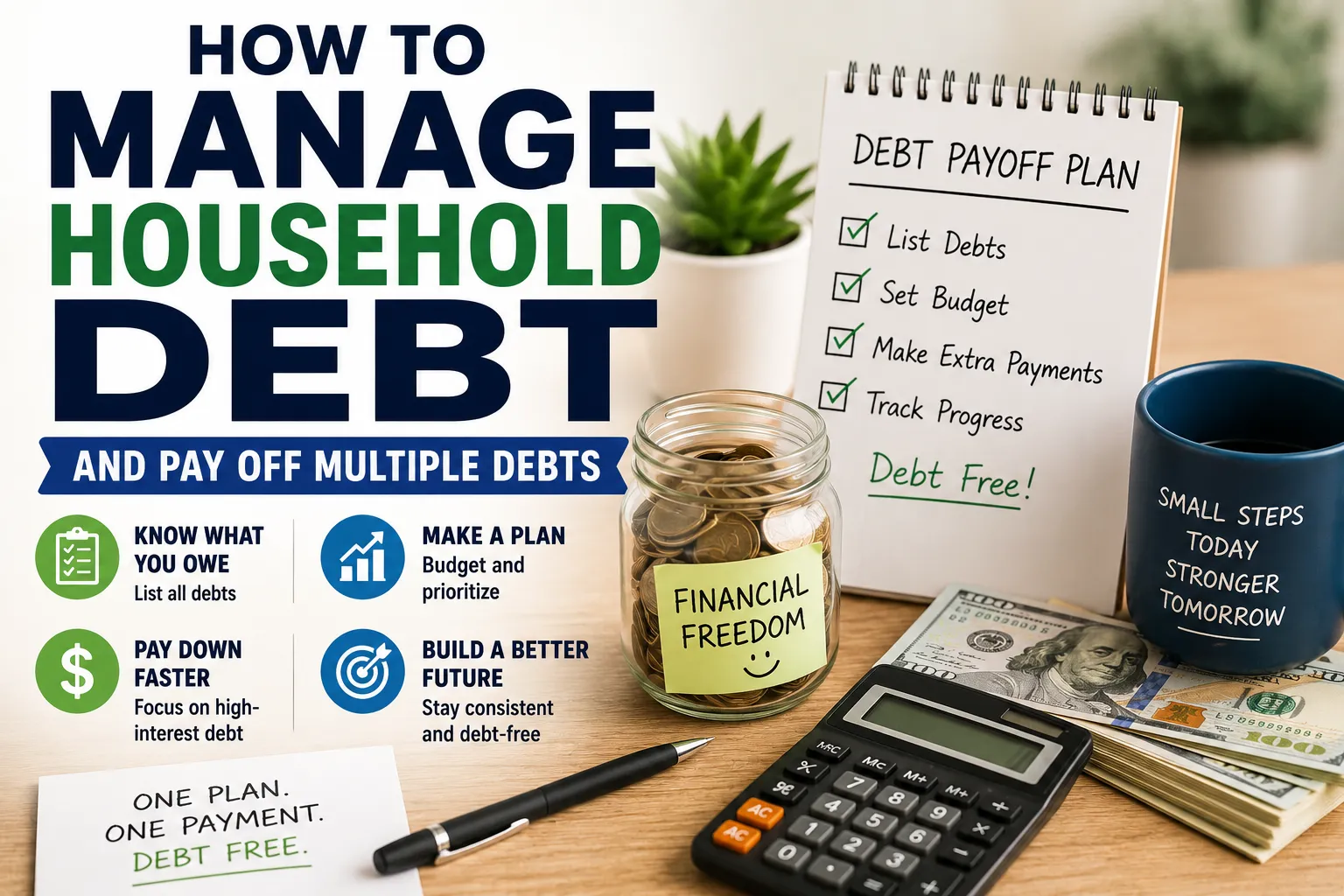
How to Manage Household Debt and Pay Off Multiple Debts
Managing household debt can feel overwhelming, particularly when several balances are due at different times, carry different interest rates and have their own minimum payments.
A credit card balance, personal loan, car payment and other debts can quickly turn into a complicated monthly puzzle. When payments consume a large share of household income, it can become difficult to save, handle emergencies or make progress toward other financial goals.
The good news is that multiple debts do not have to be tackled all at once. A clear system can help a household understand what it owes, prioritize the most expensive balances and gradually reduce the amount of money going toward debt.
The key is to replace scattered payments with a deliberate plan.
For a broader overview of credit cards, credit scores, loans, debt repayment and other borrowing tools, see the Complete Guide to Credit Tools.
Start by Listing Every Debt
Before deciding how to repay debt, establish exactly what you owe.
Create a list containing:
- Name of the lender
- Current balance
- Interest rate
- Minimum monthly payment
- Payment due date
- Type of debt
- Any fees or penalties
- Whether the interest rate is fixed or variable
For example:
| Debt | Balance | Interest Rate | Minimum Payment |
|---|---|---|---|
| Credit card A | $2,500 | 24% | $75 |
| Credit card B | $1,200 | 19% | $40 |
| Personal loan | $6,000 | 11% | $180 |
| Car loan | $10,000 | 7% | $250 |
The exact numbers will vary from household to household, but the exercise serves an important purpose.
Debt becomes easier to manage when it is visible.
Calculate the Total Debt
Once everything is listed, add the balances together.
This number may initially be uncomfortable, but knowing the total provides a starting point.
It can also reveal something that individual statements may hide: several relatively small debts can add up to a substantial financial obligation.
Calculate both:
Total outstanding debt
and
Total required monthly payments.
The second figure is particularly important for household cash flow.
Separate Necessary Debt From Expensive Debt
Not all debt has the same financial impact.
A relatively low-interest loan may be manageable within a household budget, while a high-interest credit card balance can grow quickly if only minimum payments are made.
Pay particular attention to debts with:
- High interest rates
- Variable interest rates
- Expensive fees
- Penalties
- Large minimum payments
This does not necessarily mean ignoring other debts. It means understanding which balances are costing the household the most.
Create a Debt Repayment Budget
Debt repayment needs to fit within the household’s actual cash flow.
Start with monthly take-home income and subtract essential expenses such as:
- Housing
- Utilities
- Food
- Transportation
- Insurance
- Essential healthcare
- Minimum debt payments
The amount remaining provides a clearer picture of how much can realistically be directed toward additional debt payments.
Avoid creating a repayment target that looks impressive on paper but leaves the household unable to cover basic expenses.
Keep Making Minimum Payments
When paying off multiple debts, continue making at least the required minimum payment on every account unless a lender has explicitly agreed to a different arrangement.
Missing payments can lead to:
- Late fees
- Additional interest
- Account restrictions
- Credit-report consequences
- Collection activity
The goal is to concentrate extra money on one priority debt while keeping the other accounts current.
Choose a Debt Repayment Strategy
Two widely used approaches are the debt avalanche and the debt snowball.
Both can work. The better choice is often the one a household can follow consistently.
The Debt Avalanche Method
With the debt avalanche, you prioritize the debt with the highest interest rate.
You continue paying the minimum on all other debts while directing extra money toward the highest-rate balance.
Once that debt is eliminated, you move the money that had been going toward it to the next-highest-rate debt.
Why the Avalanche Method Can Save Money
High-interest debt is expensive.
Suppose one credit card charges 25% interest while another charges 12%.
Paying down the 25% balance first can reduce the amount of interest accumulating over time.
The avalanche method is therefore particularly attractive for households focused on minimizing total interest costs.
The Debt Snowball Method
The debt snowball takes a different approach.
Instead of prioritizing interest rates, you start with the smallest balance.
Once that debt is eliminated, you move to the next-smallest balance.
Why the Snowball Can Be Motivating
Paying off a debt completely creates a visible milestone.
For someone managing five different accounts, eliminating one balance can make the overall situation feel less complicated.
That psychological benefit can matter.
A mathematically efficient plan is not useful if it is abandoned after a few months.
Which Strategy Should You Choose?
Consider the trade-off.
Avalanche:
- Usually minimizes interest costs
- Targets expensive debt first
- May take longer to produce the first complete payoff
Snowball:
- Produces quick victories
- Simplifies the number of accounts faster
- May result in more interest paid than the avalanche method
Neither approach requires perfection.
The most important factor is consistently directing extra money toward the selected priority debt.
Consider a Hybrid Approach
Some households may benefit from combining the two methods.
For example, a very small balance could be eliminated quickly if doing so would free a meaningful monthly payment. After that, the household could switch to targeting the highest-interest balance.
The important thing is to understand why the strategy is being used rather than switching randomly between debts.
Debt repayment tools can also make it easier to compare payoff strategies, organize balances and estimate how different payment amounts could affect the timeline. See How Debt Repayment Tools Help Plan Debt Payoff for more on using these tools.
Stop Adding New High-Cost Debt
Paying down debt becomes much harder if new balances are continually being added.
Before aggressively paying off existing debt, identify the spending patterns that are causing balances to grow.
These might include:
- Overspending on discretionary purchases
- Using credit cards for recurring expenses that exceed income
- Large unexpected bills
- Lifestyle expenses
- Subscription costs
- Frequent impulse purchases
The goal is not necessarily to eliminate every enjoyable expense.
It is to prevent new borrowing from undermining repayment progress.
Build a Small Emergency Fund
It can seem counterintuitive to save money while carrying debt.
However, having no emergency savings can force a household to borrow again when something goes wrong.
A broken appliance, urgent repair or unexpected bill can easily end up on a credit card if there is no cash available.
A small emergency reserve can provide a buffer while the household works on expensive debt.
Once high-interest debt is under control, the household can work toward building a larger emergency fund.
Avoid Emptying All Your Savings to Pay Debt
Using available savings to eliminate debt can sometimes make sense, particularly when the debt carries a very high interest rate.
But putting every available dollar toward debt can leave a household vulnerable.
Imagine paying off a credit card completely and then having a major car repair two weeks later.
Without savings, the household might immediately need to borrow again.
A balanced approach can be more sustainable.
Look for Ways to Increase Monthly Cash Flow
Debt repayment becomes easier when more money is available each month.
Consider whether income can temporarily increase through:
- Overtime
- Freelance work
- Selling unused items
- Seasonal work
- Consulting
- A temporary second job
- Monetizing an existing skill
The goal does not have to be permanent additional work.
Even a temporary increase in income can accelerate repayment.
Use Windfalls Strategically
Unexpected money can provide an opportunity to make significant progress.
Potential windfalls include:
- Bonuses
- Tax refunds
- Gifts
- Inheritances
- Proceeds from selling assets
- Temporary increases in income
Instead of automatically spending the entire amount, consider directing a portion toward high-interest debt.
A large one-time payment can reduce future interest and shorten the repayment timeline.
Review Household Subscriptions
Small recurring expenses can quietly consume money that could otherwise go toward debt.
Review:
- Streaming services
- Apps
- Memberships
- Cloud storage
- Fitness subscriptions
- Software
- Delivery memberships
- Other recurring charges
You do not necessarily need to cancel everything.
Removing services that provide little value can create additional monthly cash flow without significantly changing your lifestyle.
Reduce Food and Convenience Costs Carefully
Food is an important household expense, but cutting it too aggressively can make a budget difficult to maintain.
Instead, look for sustainable changes such as:
- Planning meals
- Cooking at home more often
- Reducing food waste
- Comparing grocery prices
- Limiting unnecessary delivery fees
- Preparing lunches in advance
A sustainable reduction is usually more valuable than an extreme short-term restriction.
Consider Debt Consolidation Carefully
Debt consolidation combines multiple debts into one new loan or account.
Potential advantages include:
- One monthly payment
- Simplified debt management
- Potentially lower interest
- A defined repayment schedule
But consolidation does not automatically make debt cheaper.
Compare:
- New interest rate
- Fees
- Loan term
- Total repayment amount
- Monthly payment
- Whether the rate can change
A lower monthly payment can sometimes result from extending the repayment period, which may increase the total interest paid.
Before consolidating, it can help to understand the broader mechanics and costs of personal borrowing. The Complete Guide to Loan Calculators can also be useful when comparing repayment amounts and loan scenarios.
Be Careful With Balance Transfers
Some credit cards offer promotional periods with low or zero interest on transferred balances.
This can potentially reduce interest costs, but the details matter.
Look for:
- Balance-transfer fees
- Length of promotional period
- Interest rate after the promotion
- Eligibility requirements
- Minimum payment requirements
A balance transfer can be useful when it is part of a defined repayment plan.
It becomes less useful if it simply creates another opportunity to accumulate debt.
Don’t Confuse a Lower Payment With a Lower Cost
This distinction is critical.
Imagine a lender offers to reduce a monthly payment by extending the loan from three years to six years.
The monthly budget may look better.
But if interest continues accumulating for twice as long, the total cost could increase.
Whenever evaluating a refinancing or consolidation offer, ask:
How much will I pay in total from today until the debt is completely gone?
Communicate With Lenders Before Missing Payments
If a household is struggling to make required payments, contacting the lender early may be better than waiting until an account becomes seriously delinquent.
Depending on the situation and lender, possible options may include:
- Modified payment arrangements
- Temporary hardship programs
- Adjusted due dates
- Interest concessions
- Restructuring
The options vary significantly by lender and jurisdiction.
Any agreement should be understood clearly before accepting it.
Be Wary of Debt Relief Promises
Debt problems can make people vulnerable to companies promising fast solutions.
Be cautious about organizations that:
- Guarantee that all debt will disappear
- Demand large upfront fees
- Tell you to stop communicating with creditors without explaining the consequences
- Promise to repair your credit instantly
- Make unrealistic claims about reducing debt
Before entering a debt-relief program, understand exactly what the service costs, what it does and what risks it creates.
Automate Your Payments
Automation can remove a major source of financial stress.
Set up automatic payments for minimum amounts where practical, then make additional payments toward the priority debt.
Automation can help prevent:
- Missed due dates
- Late fees
- Forgetting payments
- Accidental overspending of money intended for debt
It is still important to monitor accounts and confirm that payments are being processed correctly.
Align Due Dates With Your Cash Flow
If several bills are due around the same time, managing cash flow can become difficult.
Some lenders may allow customers to change payment dates.
Where available, aligning major payments with income dates can make monthly budgeting easier.
This does not reduce the amount owed, but it can make the repayment process more manageable.
Track Your Progress Visually
Debt repayment can take months or years.
A progress tracker can make improvement easier to see.
You could track:
- Total debt
- Number of accounts
- Interest paid
- Principal paid
- Monthly debt payments
- Remaining balances
For example:
Starting debt: $25,000
Current debt: $18,500
Debt eliminated: $6,500
Seeing the number decline can reinforce the habit of continuing.
Calculate Your Debt-to-Income Ratio
A useful financial metric is the debt-to-income ratio.
A simplified version is:
Monthly debt payments ÷ gross monthly income × 100
For example, if monthly debt payments are $800 and gross monthly income is $4,000:
$800 ÷ $4,000 × 100 = 20%
Different lenders use different definitions and thresholds, so this calculation should not be treated as a universal measure of financial health.
Still, tracking the ratio can help households understand how much of their income is committed to debt payments.
Avoid Lifestyle Inflation During Debt Repayment
Income increases can make debt repayment substantially faster.
But if every raise immediately produces higher spending, the additional income may disappear.
When income increases, consider directing at least part of the additional money toward:
- Debt repayment
- Emergency savings
- Retirement
- Other financial goals
This allows financial progress to accelerate as earnings improve.
Use the Money From Paid-Off Debts
One of the most powerful parts of the debt avalanche or snowball method happens after a debt is eliminated.
Suppose you were paying:
- $75 minimum on Credit Card A
- $100 extra toward it
Once that balance reaches zero, you now have $175 available each month.
Do not allow that money to disappear into ordinary spending.
Redirect it toward the next debt.
This is how the repayment process can accelerate.
Don’t Forget About Taxes and Essential Bills
Debt repayment should not come at the expense of critical financial obligations.
Keep up with:
- Housing payments
- Utility bills
- Insurance
- Taxes
- Essential transportation
- Necessary healthcare
A household should avoid using aggressive debt repayment as an excuse to neglect expenses that could create even more serious financial problems.
Make Debt a Household Conversation
When multiple people share household finances, debt management works better when everyone understands the plan.
Discuss:
- Total debt
- Monthly payments
- Spending limits
- Financial priorities
- Upcoming large expenses
- Progress toward repayment
The conversation should focus on solving the problem rather than assigning blame.
Debt is a financial challenge, not a measure of someone’s personal worth.
Give Every Extra Dollar a Job
Once essential expenses and minimum payments are covered, decide in advance where additional money should go.
For example:
Extra monthly money: $400
- $300 → priority debt
- $50 → emergency savings
- $50 → flexible spending
The exact allocation depends on the household’s circumstances.
The principle is to make the decision before the money disappears into unplanned spending.
Know When to Prioritize Savings Instead
There are situations where increasing savings may be more important than making aggressive additional debt payments.
For example, if a household has:
- No emergency savings
- Highly unstable income
- Significant upcoming expenses
- An imminent financial obligation
Maintaining some liquidity can reduce the risk of needing to borrow again.
Personal finance rarely has a single rule that works for every household.
Understand the Cost of Minimum Payments
Minimum payments can make debt appear manageable because the required amount may be relatively small.
But paying only the minimum can extend repayment for years, particularly on high-interest revolving debt.
A statement showing a low minimum payment does not mean the debt is inexpensive.
Look at the interest rate and projected repayment cost to understand the true burden.
Protect Yourself From New Financial Emergencies
As debt declines, use the extra financial capacity to make the household more resilient.
That can mean:
- Building emergency savings
- Maintaining adequate insurance
- Establishing sinking funds for predictable expenses
- Saving for vehicle repairs
- Planning for annual bills
- Building retirement savings
The objective is not simply to reach a zero balance.
It is to create a financial system that makes returning to expensive debt less likely.
A Simple Multiple-Debt Payoff Plan
A household starting today could use the following process:
Step 1: List everything owed
Write down every balance, rate and minimum payment.
Step 2: Protect the essentials
Prioritize housing, utilities, food, insurance and other necessary expenses.
Step 3: Stop adding unnecessary debt
Identify spending that is causing balances to grow.
Step 4: Build a basic emergency buffer
Keep enough cash available to handle smaller unexpected expenses.
Step 5: Choose a repayment strategy
Use either the avalanche, snowball or a carefully designed hybrid.
Step 6: Automate minimum payments
Reduce the risk of missed payments.
Step 7: Direct extra money toward one debt
Concentrate your additional repayment rather than spreading small extra payments across every balance.
Step 8: Roll the payment forward
When one debt disappears, send that payment toward the next debt.
Step 9: Reassess periodically
Review interest rates, income, expenses and progress.
Step 10: Redirect freed-up cash after becoming debt-free
Build savings and investments rather than allowing old debt payments to become lifestyle spending.
The Goal Is More Than a Zero Balance
Paying off multiple debts is ultimately about creating financial breathing room.
When fewer monthly payments are required, more of a household’s income becomes available for saving, investing, education, home improvements, family priorities and other goals.
The process may take time, particularly when balances are large or interest rates are high. But every payment that reduces principal changes the equation.
Turn Debt Repayment Into a Financial System
Managing household debt successfully is less about finding one magical strategy and more about building a repeatable system.
Know exactly what you owe. Protect essential expenses. Keep minimum payments current. Prioritize expensive debt. Avoid adding new balances. Use extra income and windfalls strategically. Then redirect every payment from a debt that has been eliminated toward the next one.
The biggest shift happens when debt repayment stops being something the household simply reacts to each month and becomes a deliberate financial priority.
The objective is not merely to pay off today’s debts. It is to build a household financial system that makes tomorrow’s income work harder, creates room for savings and reduces the need to borrow again.