How to Manage Household Bills and Monthly Expenses
Managing household bills and monthly expenses can feel overwhelming when payments arrive at different times, prices change and unexpected costs appear without warning. Without a clear system, even a household with a reasonable income can struggle to understand where its money is going.
The good news is that household budgeting does not have to be complicated.
A practical system starts with knowing what comes in, understanding what goes out, organizing bills by priority and creating enough flexibility for irregular expenses. Once those basics are in place, managing monthly finances becomes less about constantly worrying about money and more about following a routine.
For households that want to put these practices into a broader financial framework, building a family budget provides a useful foundation for organizing income, expenses, savings and financial priorities.
Start With a Clear Picture of Household Income
Before deciding how much to spend, determine how much money the household actually receives.
This may include:
- Salaries and wages
- Self-employment income
- Business income
- Pension payments
- Government benefits
- Investment income
- Rental income
- Other regular sources
Use the amount that is realistically available for household spending rather than relying on an optimistic estimate.
For variable income, such as freelance or business earnings, looking at several previous months can provide a more useful baseline.
Knowing the household’s dependable income makes it easier to determine how much can safely be committed to recurring expenses.
Separate Fixed and Variable Expenses
One of the simplest ways to understand a household budget is to divide expenses into categories.
Fixed expenses generally remain relatively stable from month to month.
Examples include:
- Rent or mortgage payments
- Insurance premiums
- Loan payments
- School fees
- Subscription contracts
- Certain utility charges
Variable expenses can change considerably.
These may include:
- Groceries
- Electricity
- Water
- Transportation
- Fuel
- Entertainment
- Clothing
- Household supplies
This distinction makes it easier to identify which costs are difficult to change and which ones offer greater flexibility.
Housing deserves particular attention because the true cost can extend well beyond rent or the mortgage payment. Property taxes, insurance, maintenance, utilities and repairs can all affect what a household actually spends on keeping a home. Understanding how housing costs affect family finances can therefore help put the monthly housing payment into its proper context.
List Every Regular Household Bill
Small bills can be easy to overlook when they are paid separately.
Create one complete list of recurring household expenses.
Include everything from major housing payments to smaller subscriptions and service charges.
A useful list might contain:
| Expense | Typical Amount | Due Date | Payment Method |
|---|---|---|---|
| Housing | — | — | — |
| Electricity | — | — | — |
| Water | — | — | — |
| Internet | — | — | — |
| Insurance | — | — | — |
| Transportation | — | — | — |
| School or childcare | — | — | — |
| Subscriptions | — | — | — |
The purpose is not to create a perfect spreadsheet.
It is to make sure there are no forgotten obligations.
Organize Bills by Due Date
Knowing how much you owe is only part of the problem.
You also need to know when the money is required.
A household can have enough income to cover its monthly expenses and still experience cash-flow problems if several large bills arrive before the next paycheck.
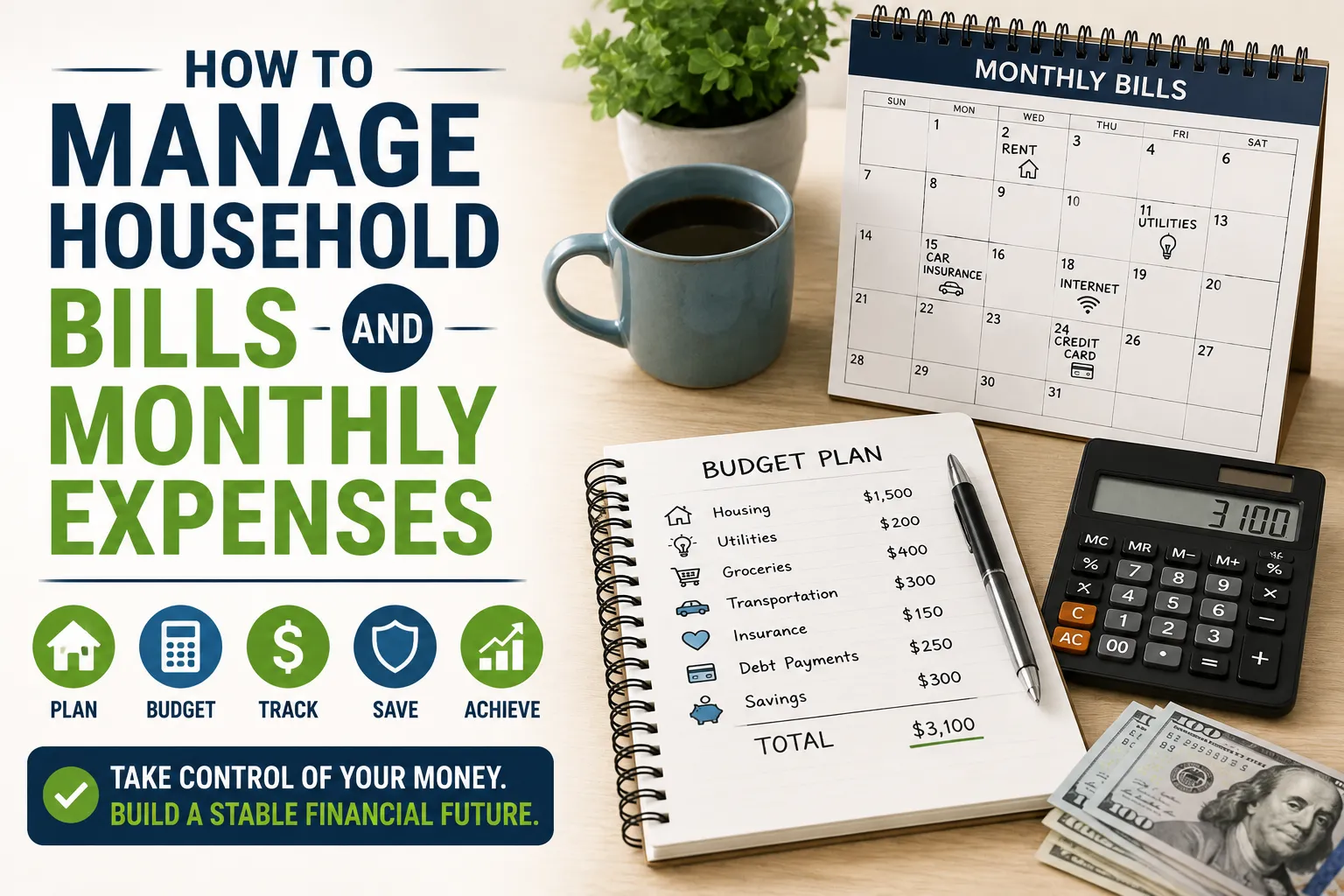
A simple bill calendar can help.
Record each bill’s:
- Amount
- Due date
- Account used for payment
- Whether the amount is fixed or variable
Review the calendar at the beginning of each month.
Prioritize Essential Expenses
Not all expenses have the same importance.
A useful hierarchy begins with necessities such as:
- Housing
- Utilities
- Food
- Transportation needed for work or essential activities
- Insurance
- Minimum debt payments
- Other important obligations
Discretionary spending comes afterward.
This does not mean entertainment, dining out or hobbies are unimportant. It simply recognizes that some expenses have more serious consequences when they are missed.
Create a Monthly Spending Plan
Once income and expenses are known, create a plan for the month.
Start with essential bills.
Then account for variable necessities such as groceries and transportation.
Next, allocate money toward financial priorities such as:
- Emergency savings
- Retirement
- Debt repayment
- Short-term goals
- Planned large purchases
Whatever remains can be assigned to discretionary spending.
The exact percentages will vary from household to household. A useful budget is one that reflects actual circumstances rather than forcing every family into an arbitrary formula.
Give Every Dollar a Purpose
A household budget works best when money has a job before it is spent.
For example, income might be divided among:
- Housing
- Utilities
- Food
- Transportation
- Insurance
- Debt
- Savings
- Personal spending
- Entertainment
- Long-term goals
This approach reduces the likelihood of spending heavily early in the month and discovering later that money is needed for an upcoming bill.
Track Spending During the Month
A budget is only useful if actual spending is compared with the plan.
Tracking does not require recording every purchase manually.
Depending on personal preference, households can use:
- Banking apps
- Expense-tracking applications
- Spreadsheets
- Budgeting software
- A simple notebook
The important thing is consistency.
Reviewing spending regularly can reveal patterns that are easy to miss when looking only at the bank balance.
Don’t Confuse a Bank Balance With Available Money
Seeing money in a checking account does not necessarily mean all of it is available to spend.
Some of that balance may already be needed for:
- An upcoming rent or mortgage payment
- Utility bills
- Credit card payments
- Insurance
- School expenses
- Savings goals
- Annual expenses
A bill calendar and spending plan provide a more accurate picture of what is genuinely available.
Plan for Variable Utility Bills
Utility costs can fluctuate with weather, usage and changing rates.
Electricity, gas and water bills may be higher in some months than others.
Instead of assuming that last month’s bill will repeat, examine previous bills and estimate a reasonable monthly average.
If possible, keep some money available for months when usage rises unexpectedly.
This can prevent a higher-than-usual utility bill from disrupting the rest of the household budget.
Budget for Groceries Realistically
Food is one of the expenses households often underestimate.
A grocery budget should account for the actual household size, dietary needs and local prices.
One useful approach is to review several months of grocery spending and calculate an average.
Then look for areas where spending can be reduced without creating unnecessary inconvenience.
Potential strategies include:
- Planning meals before shopping
- Comparing prices
- Buying frequently used staples in appropriate quantities
- Reducing food waste
- Using ingredients across multiple meals
- Limiting impulse purchases
The objective is not necessarily to spend as little as possible.
It is to make food spending predictable and intentional.
Distinguish Needs From Wants
The distinction between needs and wants can help when money is tight.
Housing, basic food, essential transportation and utilities are generally needs.
Upgrading a phone, ordering takeout or subscribing to another streaming service may be wants.
The distinction is not always absolute.
For example, internet access may be essential for one household and less important for another.
The purpose of the exercise is to identify expenses that can be adjusted when necessary.
Review Subscriptions Regularly
Recurring subscriptions can quietly consume a significant amount of money.
Entertainment services, software, memberships, cloud storage and other subscriptions may each seem inexpensive individually.
Together, they can become a meaningful monthly expense.
Review subscriptions periodically and ask:
- Do we still use this?
- Is there a cheaper plan?
- Are multiple services providing similar benefits?
- Is the subscription still worth the cost?
Canceling unused services can create recurring savings without affecting essential household needs.
Be Careful With Buy-Now, Pay-Later Spending
Installment payment services can make purchases appear more affordable because the cost is divided into smaller payments.
However, multiple installment plans can create a complicated collection of future obligations.
Before using one, consider the total purchase price and whether the payment fits comfortably within the household budget.
A low monthly payment does not necessarily mean an affordable purchase.
Manage Credit Card Bills Deliberately
Credit cards can be useful financial tools, but carrying balances can make monthly expenses more expensive because of interest charges.
If possible, understand:
- Current balance
- Minimum payment
- Interest rate
- Payment due date
- Available credit
- Any annual or other fees
Making only minimum payments can cause debt to remain outstanding for a long time, depending on the interest rate and balance.
Households carrying expensive revolving debt may want to make debt reduction a priority alongside other financial goals.
Build an Emergency Fund
A household budget should account for expenses that cannot be predicted precisely.
Emergency savings can provide a financial buffer for events such as:
- Major repairs
- Unexpected travel
- Temporary income disruption
- Essential medical or family expenses
- Vehicle problems
- Urgent household replacements
The appropriate emergency fund depends on the household’s circumstances.
Even a modest reserve can reduce the need to rely immediately on credit when something goes wrong.
Create Sinking Funds for Predictable Expenses
Not every large expense is technically an emergency.
Annual insurance payments, school expenses, holidays, property taxes, vehicle maintenance and major household purchases may be predictable even if they do not occur every month.
A sinking fund allows households to save gradually for these expenses.
For example, if an annual expense is expected to cost $1,200, setting aside approximately $100 per month would build the money gradually.
The exact amount should reflect the actual expected cost and timing.
This approach is especially useful for families because many significant expenses arrive irregularly rather than as predictable monthly bills.
Account for Annual Expenses
Monthly budgets can fail because people focus exclusively on monthly bills.
Some expenses arrive once or twice a year.
Examples include:
- Insurance renewals
- School-related costs
- Property taxes
- Vehicle registration
- Professional fees
- Holiday spending
- Home maintenance
- Annual memberships
Create a list of these expenses and divide their estimated annual cost across the months available to save.
This turns irregular expenses into predictable budget items.
Families dealing with several non-monthly costs can also benefit from understanding how families can budget for irregular expenses.
Keep a Household Maintenance Fund
Homeowners in particular should expect maintenance expenses.
Roofs, plumbing, appliances, electrical systems, air conditioning and other household components eventually require attention.
Waiting until something breaks can create larger financial problems.
A dedicated maintenance fund can help cover routine repairs without forcing the household to divert money from essential monthly expenses.
Plan for Transportation Costs
Transportation expenses extend beyond fuel.
A realistic budget may need to include:
- Vehicle payments
- Fuel
- Insurance
- Maintenance
- Repairs
- Registration
- Parking
- Public transportation
- Tires
Some costs occur irregularly, so averaging them over the year can provide a more accurate estimate of the true monthly transportation expense.
Don’t Forget Small Everyday Purchases
Small purchases can have a surprisingly large cumulative effect.
Coffee, snacks, delivery fees, convenience-store purchases and small online orders may not appear significant individually.
The problem is not necessarily any single purchase.
It is the repeated pattern.
Tracking spending for a month can reveal whether these small transactions are consuming more money than expected.
Use Automatic Payments Carefully
Automatic bill payments can reduce the risk of forgetting due dates.
They can be particularly useful for predictable recurring expenses.
However, automation should not replace monitoring.
Before a payment is scheduled, make sure the account has enough money available.
It is also worth reviewing automatic payments periodically to ensure that canceled services or changed bills are not being overlooked.
Keep Bill Money Separate When Helpful
Some households find it easier to separate money intended for bills from money available for everyday spending.
This can be done through separate bank accounts or designated budgeting categories, depending on the available banking options.
The objective is to make essential money less tempting to spend.
This system can be especially helpful when income arrives at different times throughout the month.
Build a Buffer Into the Budget
A budget that allocates every cent to a specific expense can be difficult to maintain.
Unexpected costs happen.
A small monthly buffer provides flexibility when a utility bill is higher than expected, a household item needs replacing or another minor expense appears.
Without a buffer, these relatively small surprises can cause the entire monthly plan to fall apart.
Adjust the Budget When Income Changes
A household budget should change when circumstances change.
Income may increase or decrease.
Housing costs may change.
A child may begin school.
A vehicle may be paid off.
Insurance premiums may rise.
A new debt may be taken on.
Review the budget whenever there is a major financial change instead of continuing to use outdated numbers.
Use Windfalls Carefully
Occasional financial windfalls can include:
- Bonuses
- Tax refunds
- Gifts
- Business profits
- Inheritance
- Other unexpected income
It can be tempting to immediately increase spending.
A more deliberate approach might divide the money among several priorities, such as:
- Building emergency savings
- Paying down expensive debt
- Funding upcoming expenses
- Investing
- Spending a portion on something enjoyable
There is no requirement to save every unexpected dollar.
The important point is to make a conscious decision rather than allowing the money to disappear through unplanned spending.
Have a Monthly Money Meeting
For households managing finances together, communication can be just as important as budgeting tools.
A short monthly meeting can cover:
- Upcoming bills
- Current account balances
- Large expected expenses
- Savings progress
- Debt payments
- Changes in income
- Planned purchases
This helps prevent one person from carrying all the financial knowledge and reduces the chance of unexpected surprises.
Teach Children About Household Money
Children can gradually learn how household finances work.
Age-appropriate discussions can cover concepts such as:
- Needs and wants
- Saving
- Spending
- Comparing prices
- Delaying purchases
- Planning for goals
Teaching these ideas early can help establish practical money habits that extend into adulthood.
Parents who want to develop this part of their household financial system can also explore how to teach children about money.
Look for Recurring Expenses Before Cutting Essentials
When a budget is under pressure, start by examining flexible or discretionary expenses.
Potential areas include:
- Unused subscriptions
- Frequent takeout
- Impulse shopping
- Entertainment
- Premium services
- Unnecessary fees
Cutting essential expenses may sometimes be unavoidable, but households should first identify reductions that have less impact on basic living needs.
Negotiate or Shop Around When Appropriate
Some recurring expenses may be reduced by comparing alternatives.
Depending on the service and local market, households may be able to reduce costs by reviewing:
- Insurance
- Internet plans
- Mobile phone services
- Banking fees
- Utilities
- Transportation options
However, the cheapest option is not always the best value.
Consider reliability, coverage, service quality and other important features alongside price.
Avoid Lifestyle Inflation
When income rises, spending often rises with it.
This is known as lifestyle inflation.
A higher income can certainly justify some improvements in quality of life.
But automatically increasing every category of spending can prevent the household from building wealth despite earning more.
Consider directing part of an income increase toward savings, debt reduction or other financial goals before expanding recurring expenses.
Plan Ahead for Major Purchases
Large purchases can disrupt an otherwise stable household budget when they are financed or paid for without adequate preparation.
Examples might include:
- A vehicle
- Major appliances
- Furniture
- Home improvements
- Electronics
- Family travel
- Other expensive necessities
When a major purchase is foreseeable, saving for it in advance can reduce the need to rely on high-cost borrowing or drain emergency savings.
Families can also benefit from learning how to plan financially for major purchases before committing a large amount of household cash.
Prepare for Education Costs
Education can represent another significant household expense.
Depending on the family and education system, costs may include:
- Tuition
- School supplies
- Transportation
- Books
- Technology
- Activities
- Childcare
- Other school-related expenses
These costs should be considered alongside ordinary monthly bills rather than treated as completely separate from the household budget.
Planning early can give families more time to save and adjust spending.
Families with long-term education goals can explore how families can plan and save for education costs.
Review the Budget Every Month
A budget should be treated as a living system rather than a document created once and forgotten.
At the end of each month, compare:
Planned spending vs. actual spending
Ask:
- Which categories were higher than expected?
- Which were lower?
- Were any bills forgotten?
- Did an unusual expense occur?
- Is the income estimate still accurate?
- Does next month’s budget need adjustment?
These reviews help make the next month’s plan more realistic.
Focus on Cash Flow, Not Just Total Spending
Two households can have identical annual expenses but experience very different financial pressure.
The timing of income and expenses matters.
If most major bills are due at the beginning of the month while income arrives later, cash flow can become difficult even when the annual numbers look manageable.
Tracking when money enters and leaves the household can therefore be just as important as calculating the total amount spent.
Use a Simple System You Will Actually Maintain
The most sophisticated budgeting system is not necessarily the most effective.
A household may use an advanced budgeting application, a detailed spreadsheet or nothing more than a calendar and notebook.
What matters is whether the system is:
- Easy to understand
- Updated regularly
- Accurate enough for decision-making
- Shared with the people who need to use it
- Sustainable over time
A simple system that is consistently maintained is usually more useful than a complicated system that gets abandoned after a few weeks.
A Practical Monthly Routine
A simple household money routine might look like this:
At the Beginning of the Month
- Confirm expected income
- Review upcoming bills
- Allocate money for essentials
- Set savings targets
- Review planned large expenses
During the Month
- Track major spending
- Monitor account balances
- Adjust variable categories when necessary
- Avoid spending money reserved for upcoming bills
At the End of the Month
- Compare planned and actual spending
- Review unusual expenses
- Move money toward savings or debt goals
- Prepare for upcoming annual or irregular expenses
- Update next month’s plan
This routine can take relatively little time once it becomes a habit.
What to Do When Expenses Exceed Income
If essential monthly expenses consistently exceed household income, the problem requires more than simply tracking spending.
First, identify the size of the gap.
Then examine whether the problem comes from:
- Housing costs
- Debt payments
- Transportation
- Food
- Utilities
- Discretionary spending
- Insufficient income
Some expenses can be reduced quickly, while others may require larger decisions.
If the imbalance is persistent, increasing income may need to become part of the strategy alongside reducing expenses.
Household Budgeting Is About Control, Not Perfection
A household budget does not need to predict every purchase perfectly.
Unexpected expenses are inevitable.
Prices change.
Plans change.
Income can fluctuate.
The purpose of budgeting is to create enough visibility and structure to make informed decisions when those changes occur.
A household that knows its essential expenses, tracks cash flow and maintains financial reserves is generally better positioned to handle surprises than one that relies entirely on its bank balance.
Turning Monthly Bills Into a Manageable System
Managing household bills becomes much easier when expenses are treated as a system rather than a collection of unrelated payments.
Start by identifying all sources of income and recurring expenses. Separate fixed costs from variable spending, organize bills by due date and prioritize essential obligations. Then build room for savings, irregular expenses and emergencies.
From there, regular reviews can reveal where money is being wasted, where costs can be reduced and where financial priorities need to change.
The goal is not to create a restrictive budget that makes everyday life difficult. It is to build a system that gives every major expense a place, keeps upcoming bills visible and leaves enough flexibility to handle the unexpected. When household finances become predictable and organized, monthly money management can shift from a source of stress into a routine that supports longer-term financial stability.