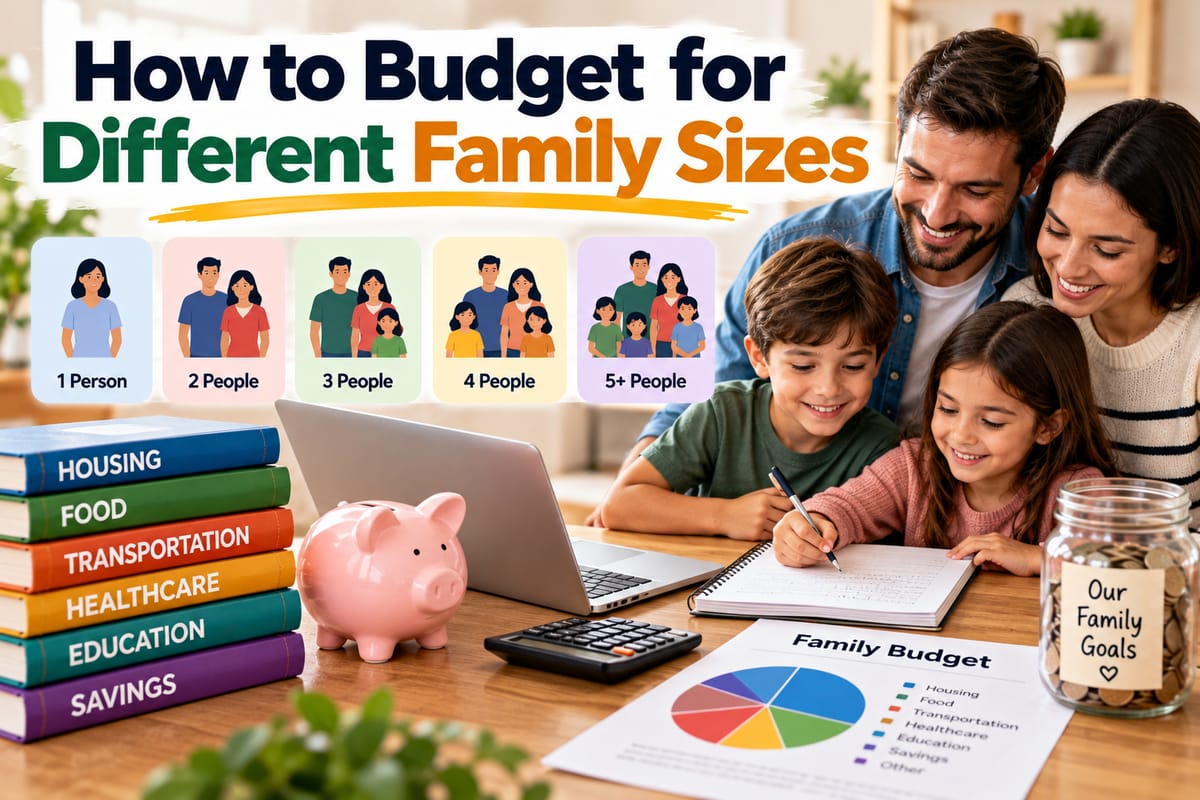
How to Budget for Different Family Sizes
Family budgets are rarely one-size-fits-all. A household with one adult and one child has different financial needs from a household with two adults and four children. Even families with the same number of people can have very different budgets because of differences in income, housing, transportation, childcare, education, health needs, and personal priorities.
The size of a family affects how much money is needed for everyday expenses, but it does not determine exactly how much a household should spend in each category. A practical family budget needs to reflect the household’s actual circumstances.
The goal is to create a spending plan that covers essential costs, supports financial goals, prepares for irregular expenses, and leaves enough flexibility for changes in family needs.
Why Family Size Affects a Household Budget
Some household expenses increase directly as the number of people increases.
For example, a larger family may spend more on:
- Groceries
- Clothing
- School supplies
- Transportation
- Healthcare
- Personal care
- Recreation
- Utilities
- Household supplies
Other expenses may remain relatively stable.
A family of five does not necessarily pay five times as much for internet service as a family of two. Similarly, housing costs do not always increase in direct proportion to the number of household members.
This means budgeting for family size requires looking at individual spending categories rather than simply multiplying a smaller household’s budget.
Start With Household Income
Before deciding how much a family should spend, determine how much money is actually available.
Income may come from:
- Salaries
- Wages
- Self-employment
- Business income
- Freelance work
- Bonuses
- Investment income
- Government benefits
- Child support
- Other regular sources
For households with irregular income, it can be useful to work from a conservative estimate rather than assuming the highest possible monthly income.
The budget should reflect money that is realistically available for household expenses.
Count the Number of People in the Household
The first step in adjusting a budget for family size is identifying who the budget needs to support.
Consider:
- Adults
- Children
- Teenagers
- Infants
- Dependents
- Older relatives
- Other household members
Age matters because different household members have different financial needs.
A baby may increase spending on diapers, feeding supplies, childcare, and healthcare. A teenager may have higher food, transportation, technology, clothing, and activity expenses.
Family Size Is Not the Only Variable
Two families with four members can have dramatically different financial situations.
For example, one household may have:
- Two working adults
- Two school-age children
- Low housing costs
- Public transportation
- Employer-provided health coverage
Another might have:
- One working adult
- Three dependents
- High housing costs
- Two vehicles
- Significant childcare expenses
Both households have different financial requirements.
A family budget should therefore use household size as a starting point rather than a complete financial formula.
Separate Fixed and Variable Expenses
One useful way to organize a family budget is to separate expenses into fixed and variable categories.
Fixed Expenses
These are expenses that tend to remain relatively stable from month to month.
Examples include:
- Rent or mortgage payments
- Insurance premiums
- Loan payments
- School fees
- Certain subscriptions
- Childcare arrangements
Variable Expenses
These can change more frequently.
Examples include:
- Groceries
- Electricity
- Transportation
- Clothing
- Entertainment
- Household supplies
- Personal spending
This distinction makes it easier to identify which costs are likely to increase when the family grows.
Housing Costs and Family Size
Housing is often one of the largest household expenses, and family size can influence housing needs.
A growing family may eventually need:
- An additional bedroom
- More living space
- A larger kitchen
- More storage
- A safer outdoor area
- Access to different schools or services
Moving to a larger home can increase rent or mortgage payments as well as other costs such as utilities, maintenance, property taxes, and insurance.
How Housing Costs Affect Family Finances explores the broader ways housing expenses can influence a household’s financial situation.
The important point is that a larger home should be evaluated based on the entire cost rather than the monthly housing payment alone.
Budgeting for a One-Person Household
A household with one person may have fewer variable expenses than a larger family, but that does not automatically make budgeting simple.
Single-person households often carry certain costs alone.
For example, one person may be responsible for:
- The entire housing payment
- Utilities
- Insurance
- Transportation
- Food
- Household maintenance
There are fewer people sharing these costs.
A single-person budget can therefore benefit from maintaining a strong emergency fund and carefully monitoring major fixed expenses.
Budgeting for a Couple
A two-adult household can potentially share many expenses.
These may include:
- Housing
- Utilities
- Transportation
- Internet
- Household supplies
- Insurance
However, couples may also have separate personal expenses and different financial priorities.
A shared budget can identify household obligations while leaving room for individual spending.
Important categories may include:
- Joint bills
- Individual spending
- Shared savings
- Retirement contributions
- Debt payments
- Insurance
- Long-term goals
Budgeting for a Couple With One Child
Adding a child changes the household budget in several ways.
New or increased expenses can include:
- Childcare
- Clothing
- Food
- Healthcare
- School supplies
- Toys
- Activities
- Transportation
Some costs may appear gradually rather than all at once.
For example, childcare may be a major expense during early childhood but decline when the child begins school.
A family budget should therefore account for changing expenses rather than assuming that current costs will remain unchanged.
Budgeting for Two Children
Two children can create economies of scale in some categories.
For example, younger children may share:
- Toys
- Books
- Certain household equipment
- Transportation
- Family entertainment
But other expenses can increase with each additional child.
Food, clothing, healthcare, education, activities, and transportation may all rise.
The age gap between children also matters.
Two children attending different schools may create different education and transportation costs than two children at the same school.
Budgeting for Larger Families
As the number of children increases, some expenses become more significant.
Food is one obvious example.
A larger household may also need to consider:
- Larger housing
- More transportation capacity
- Additional school costs
- More clothing
- Higher utility usage
- Larger healthcare expenses
- More household supplies
- Increased activity costs
At the same time, families can sometimes reduce the average cost per person through bulk purchases, shared resources, and careful planning.
Grocery Budgeting by Family Size
Food is one category where family size can have a direct effect.
A larger household generally consumes more food, but grocery spending does not have to increase in a perfectly linear way.
Families can control costs by:
- Planning meals
- Buying appropriate quantities
- Comparing prices
- Cooking at home
- Using leftovers
- Reducing food waste
- Buying staple foods in suitable quantities
- Adjusting portions
- Choosing seasonal options when practical
The objective is not simply to spend as little as possible.
The goal is to provide nutritious food within the household’s available resources.
Food Needs Change With Age
Children do not all eat the same amount.
A toddler, teenager, and adult can have significantly different food needs.
Teenagers may consume considerably more food than younger children, particularly during periods of growth or high physical activity.
This means a family with several teenagers may have a different grocery budget from a family with several young children even if the number of household members is identical.
Clothing Costs
Clothing is another category affected by family size and age.
Young children may outgrow clothes quickly.
Older children and teenagers may have changing preferences and different school or activity requirements.
Families can manage clothing expenses by:
- Planning purchases
- Reusing suitable items between siblings
- Buying durable basics
- Separating essential purchases from discretionary shopping
- Setting seasonal clothing budgets
Hand-me-downs can reduce costs when clothing remains in usable condition.
Education Expenses
Education costs can vary significantly depending on the family’s location, school choices, children’s ages, and educational needs.
Possible expenses include:
- School fees
- Uniforms
- Books
- Supplies
- Transportation
- Meals
- Technology
- Extracurricular activities
- Tuition or tutoring
Families with multiple children may experience periods when several education-related expenses occur simultaneously.
A monthly budget should account for these costs even when some are paid only once or twice a year.
Childcare Costs
Childcare can be one of the largest expenses for families with young children.
Costs can include:
- Daycare
- Babysitting
- After-school care
- Nannies
- Holiday programs
- Transportation to childcare
Childcare needs may change as children grow.
A family may therefore experience a significant reduction in this category when a child begins school.
Budgeting should anticipate these transitions rather than treating childcare as a permanent expense.
Transportation for Different Family Sizes
Transportation needs can change as families grow.
A couple with one child may be comfortable with a small vehicle, while a larger family may require more seating or storage.
Transportation expenses can include:
- Vehicle payments
- Fuel
- Insurance
- Maintenance
- Repairs
- Registration
- Public transportation
- School transportation
The cost of a larger vehicle should be evaluated alongside fuel consumption, insurance, maintenance, and financing.
Healthcare Costs
Healthcare expenses can become more complex as family size increases.
Families may need to budget for:
- Insurance
- Doctor visits
- Dental care
- Prescription medicines
- Vision care
- Preventive services
- Children’s healthcare
- Unexpected medical expenses
Not every healthcare expense can be predicted.
Maintaining a financial buffer can make unexpected costs easier to manage.
Household Supplies
Larger families often use household supplies more quickly.
These can include:
- Cleaning products
- Toilet paper
- Laundry detergent
- Personal care products
- Kitchen supplies
- Paper products
Tracking these expenses over several months can help families estimate a realistic average.
Buying larger quantities can sometimes reduce the cost per unit, but only when the household can use the products before they expire or become unnecessary.
Utilities and Family Size
Larger families may consume more electricity, water, and other utilities.
Factors can include:
- Number of people
- Time spent at home
- Laundry frequency
- Cooking habits
- Home size
- Climate
- Appliances
However, utility costs depend on many factors beyond family size.
Energy-efficient appliances, household habits, and the size and condition of the home can all influence the final bill.
Personal Spending
Every household member may need some personal spending money.
For adults, this might cover:
- Hobbies
- Entertainment
- Clothing
- Dining out
- Personal purchases
For children, age-appropriate spending may include:
- Snacks
- Small toys
- Games
- Activities
- Allowances
Including personal spending in the budget can make the plan more realistic.
A budget that leaves no room for discretionary spending may become difficult to maintain over time.
Savings Should Grow With Family Responsibilities
As family responsibilities increase, savings can become increasingly important.
Families may save for:
- Emergencies
- Education
- Major purchases
- Home repairs
- Vehicles
- Travel
- Retirement
- Other long-term goals
The appropriate savings amount depends on income, expenses, job stability, debt, insurance, and other circumstances.
How Families Can Set, Prioritize and Achieve Household Financial Goals provides a broader framework for identifying and organizing household financial objectives.
Emergency Savings for Larger Families
Larger families may have more potential expenses to manage when something goes wrong.
For example, a major vehicle repair or temporary loss of income can affect a household with several dependents.
Emergency savings can provide a financial buffer against unexpected costs.
Rather than choosing an arbitrary savings number, families can consider their essential monthly expenses and how much income protection they need.
Budgeting for Irregular Expenses
Not every expense arrives every month.
Families may face:
- Annual insurance payments
- School fees
- Holiday expenses
- Vehicle maintenance
- Property repairs
- Medical expenses
- Birthdays
- Back-to-school costs
- Seasonal clothing purchases
Ignoring these expenses can make a monthly budget look healthier than it really is.
How Families Can Budget for Irregular Expenses explains how households can plan for costs that do not occur evenly throughout the year.
Create Sinking Funds
A sinking fund is money set aside gradually for a known future expense.
For example, if a family expects to spend $600 on vehicle maintenance over the next year, it could set aside approximately $50 per month.
Other possible sinking funds include:
- School expenses
- Holidays
- Home repairs
- Insurance
- Birthdays
- Annual subscriptions
- Vehicle costs
The amounts should reflect the family’s actual expected expenses.
Use a Per-Person Estimate Carefully
Some families try to calculate a single monthly cost per person.
This can be useful as a rough planning tool, but it should not become the entire budget.
For example, housing may be largely independent of the number of children until the family needs a larger home.
Similarly, internet service may cost roughly the same whether two or six people use it.
A category-by-category approach is generally more useful.
Economies of Scale in Larger Families
Larger households can sometimes benefit from shared costs.
For example:
- One internet connection serves multiple people.
- One home can accommodate several family members.
- Family transportation can serve several people.
- Household appliances are shared.
- Some entertainment costs cover the entire family.
This means the average cost per person may fall in certain categories as household size increases.
When Larger Families Need More Space
Housing is an area where economies of scale can eventually disappear.
A family may need to move from a two-bedroom home to a three- or four-bedroom property.
That can increase:
- Rent or mortgage payments
- Utilities
- Maintenance
- Property taxes
- Insurance
- Furniture costs
- Transportation expenses
A larger home should therefore be treated as a broader financial decision rather than simply a housing upgrade.
Budgeting for Family Growth
Families expecting a new child can begin adjusting their budget before the household changes.
Potential new expenses may include:
- Medical care
- Childcare
- Baby equipment
- Clothing
- Food
- Transportation
- Insurance
- Housing
Some existing expenses may decrease or increase after the child arrives.
Preparing ahead of time can make the transition less financially disruptive.
Budgeting for Teenagers
Teenagers often have different financial needs from younger children.
Potential expenses include:
- Transportation
- School activities
- Technology
- Clothing
- Food
- Sports
- Entertainment
- Education
- Personal spending
Teenagers can also begin learning how household financial decisions work.
Including them in age-appropriate conversations can help them understand budgeting and financial responsibility.
Budgeting for Adult Children
Some families continue supporting adult children.
This may involve:
- Education
- Housing
- Transportation
- Healthcare
- Food
- Emergency support
These costs should be recognized openly rather than quietly absorbing them into unrelated budget categories.
If support is expected to continue for an extended period, families may want to establish clear expectations and a realistic financial plan.
Budgeting for Multigenerational Households
Some households include grandparents, parents, children, or other relatives.
These arrangements can change the budget considerably.
Shared expenses may include:
- Housing
- Food
- Healthcare
- Transportation
- Utilities
- Caregiving
- Education
Multigenerational households may benefit from clearly discussing financial responsibilities.
Who pays which bills? Who purchases groceries? Who contributes toward housing? Who handles unexpected expenses?
Clear expectations can reduce misunderstandings.
Creating Simple Financial Routines
A family budget becomes easier to maintain when household members have regular routines.
For example, a family might review finances:
- Weekly
- Every two weeks
- Monthly
- Before major purchases
A routine can include checking bills, reviewing spending, updating savings, and looking ahead at upcoming expenses.
How Families Can Create Simple Routines for Managing Bills, Spending and Savings provides additional ideas for making everyday household financial management more consistent.
Use Categories That Match Your Family
There is no requirement to use someone else’s exact budget categories.
A family with young children might need categories such as:
- Diapers
- Childcare
- Baby supplies
A family with teenagers might instead prioritize:
- Transportation
- School activities
- Technology
- Personal spending
A multigenerational household may need:
- Elder care
- Medical support
- Shared family expenses
The best categories are those that help the household understand where its money is going.
Adjust the Budget When Family Circumstances Change
A budget should not remain unchanged simply because it was created at the beginning of the year.
Review it when:
- A child is born
- A child starts school
- A child graduates
- Someone changes jobs
- Income changes
- Housing changes
- A vehicle is purchased
- Debt is paid off
- A major expense appears
These changes can affect several categories simultaneously.
What to Do When Income Does Not Grow With Family Size
Family expenses can increase even when income remains unchanged.
When this happens, households may need to reassess priorities.
Start by identifying:
- Essential expenses
- Financial obligations
- Important savings goals
- Discretionary spending
- Expenses that can be reduced or postponed
The objective is not necessarily to eliminate everything enjoyable.
Instead, the household can decide which expenses provide the most value within its available resources.
Avoid Using a Rigid Percentage Formula
Popular budgeting rules sometimes recommend assigning fixed percentages of income to housing, food, savings, entertainment, and other categories.
These frameworks can provide a starting point, but family circumstances vary significantly.
A household with expensive childcare may need a different allocation from a household with older children.
A family living in a high-cost housing market may spend more on housing.
A family with substantial medical expenses may need to devote more money to healthcare.
A useful budget should reflect reality rather than forcing every household into identical percentages.
Track Actual Spending
One of the best ways to improve a family budget is to compare planned spending with actual spending.
For several months, record expenses in categories such as:
- Housing
- Food
- Transportation
- Healthcare
- Education
- Childcare
- Household supplies
- Entertainment
- Debt
- Savings
After collecting the information, look for patterns.
You may discover that some expenses are consistently higher than expected while others are lower.
That information can help make the next budget more realistic.
Build Flexibility Into the Budget
Family life rarely follows a perfect financial schedule.
Children become sick. Vehicles break down. School expenses appear. Work situations change.
A useful budget therefore needs some flexibility.
A flexible budget might include:
- An emergency fund
- A miscellaneous category
- Sinking funds
- Discretionary spending
- Adjustable savings contributions
Flexibility makes it easier to absorb small changes without rebuilding the entire financial plan.
Don’t Treat Every Family Member as an Equal Expense
A household budget is not a mathematical exercise where every person receives an identical financial allocation.
Needs differ by:
- Age
- Health
- Education
- Employment
- Transportation requirements
- Personal circumstances
A young child may require childcare, while an older teenager may need transportation.
One adult may have commuting costs while another works from home.
The budget should account for these differences.
Use Family Size to Plan Ahead
Family size can help households anticipate future financial changes.
For example:
Growing Family
Expect potential increases in childcare, food, healthcare, clothing, and housing.
School-Age Children
Prepare for education, transportation, uniforms, supplies, and activities.
Teenagers
Plan for potentially higher food, transportation, technology, and personal spending.
Adult Children
Consider education, housing support, or other financial assistance if applicable.
Multigenerational Household
Plan for shared housing, food, healthcare, and caregiving expenses.
Planning ahead can make financial changes easier to absorb.
A Sample Budget Structure
A family might organize its monthly budget like this:
| Category | What to Include |
|---|---|
| Housing | Rent, mortgage, insurance, maintenance |
| Food | Groceries, household food |
| Utilities | Electricity, water, internet, communications |
| Transportation | Fuel, public transit, vehicle costs |
| Healthcare | Insurance, medicines, appointments |
| Education | Fees, supplies, activities |
| Childcare | Daycare, babysitting, after-school care |
| Debt | Loan and credit payments |
| Savings | Emergency fund and long-term goals |
| Household | Cleaning and personal supplies |
| Personal | Individual spending |
| Recreation | Entertainment and family activities |
| Irregular Expenses | Repairs, annual costs, seasonal expenses |
The categories can be changed according to the family’s circumstances.
How to Review a Family Budget
A monthly review does not need to take hours.
Ask:
- Did income match expectations?
- Which expenses were higher than planned?
- Which expenses were lower?
- Did any unexpected costs occur?
- Are savings progressing?
- Are bills being paid on time?
- Are family priorities still the same?
- What expenses are coming next month?
These questions can help keep the budget connected to real life.
Budgeting for Different Family Sizes Is About Adaptation
There is no single correct budget for a family of two, four, six, or eight people.
Family size provides useful information, but the real budget depends on the combination of people, needs, income, location, housing, transportation, lifestyle, and financial goals.
A growing family may need to spend more on food, childcare, education, transportation, and housing. At the same time, larger households can share many costs and may benefit from buying and planning more efficiently.
The most useful approach is to build the budget category by category, track actual spending, prepare for irregular expenses, and review the plan whenever family circumstances change.
A family budget works best when it reflects the household that actually exists—not an idealized household based on a generic formula. By regularly adjusting the plan to match changing needs and priorities, families can create a financial system that remains practical as their household grows and evolves.