How Tax Rates Affect Financial Decisions
Taxes are an unavoidable part of financial life, but their influence goes far beyond the amount shown on an annual tax bill. Tax rates can affect how people earn money, spend it, save for the future, invest, borrow, purchase property, and plan for retirement.
A financial decision that looks attractive before taxes may produce a very different result after taxes are considered. Likewise, two investments with similar returns can leave an individual with significantly different amounts of money after applicable taxes.
Understanding how tax rates interact with income, investments, deductions, and financial planning can help people make decisions based on their actual after-tax position rather than headline numbers.
What Is a Tax Rate?
A tax rate is the percentage used to calculate the tax owed on a particular amount of taxable income, transaction, or other taxable base.
The exact structure varies by country and type of tax. Individuals may encounter income tax rates, capital gains rates, consumption taxes, property-related taxes, payroll taxes, and other charges.
Tax systems can also use different rate structures. Some apply a single rate to a particular category of income, while others use multiple rates based on income levels or circumstances.
Because of these differences, understanding the tax rate that applies to a particular financial decision requires looking at the type of income and the rules governing it.
Why Tax Rates Matter in Personal Finance
Financial decisions are ultimately about allocating limited resources.
When taxes reduce the amount of money retained from income or an investment, they affect how much capital remains available for other purposes.
For example, taxes can influence whether someone chooses to:
- Spend or save additional income
- Invest in one asset rather than another
- Receive income now or defer it
- Sell an investment
- Contribute to a tax-advantaged account
- Purchase a business asset
- Pay down debt
- Increase retirement savings
- Make a large purchase
- Change the timing of a financial transaction
The tax consequences should not necessarily determine the decision on their own, but they can be an important part of the calculation.
Tax Rates and Take-Home Pay
One of the most direct effects of taxation is on the amount of income a person actually keeps.
An employee may receive a stated salary, but the amount available for spending and saving is generally lower after applicable taxes and other deductions.
This distinction between gross income and after-tax income is important when creating a household budget.
For example, a salary increase may look substantial when expressed as a percentage, but the increase in disposable income can be smaller after taxes.
That means financial planning should generally focus on the money available after relevant taxes rather than relying exclusively on gross earnings.
For a broader explanation of taxable income and the different concepts that affect tax calculations, see the Complete Guide to Income Taxes and Taxable Income.
Marginal Tax Rates Versus Effective Tax Rates
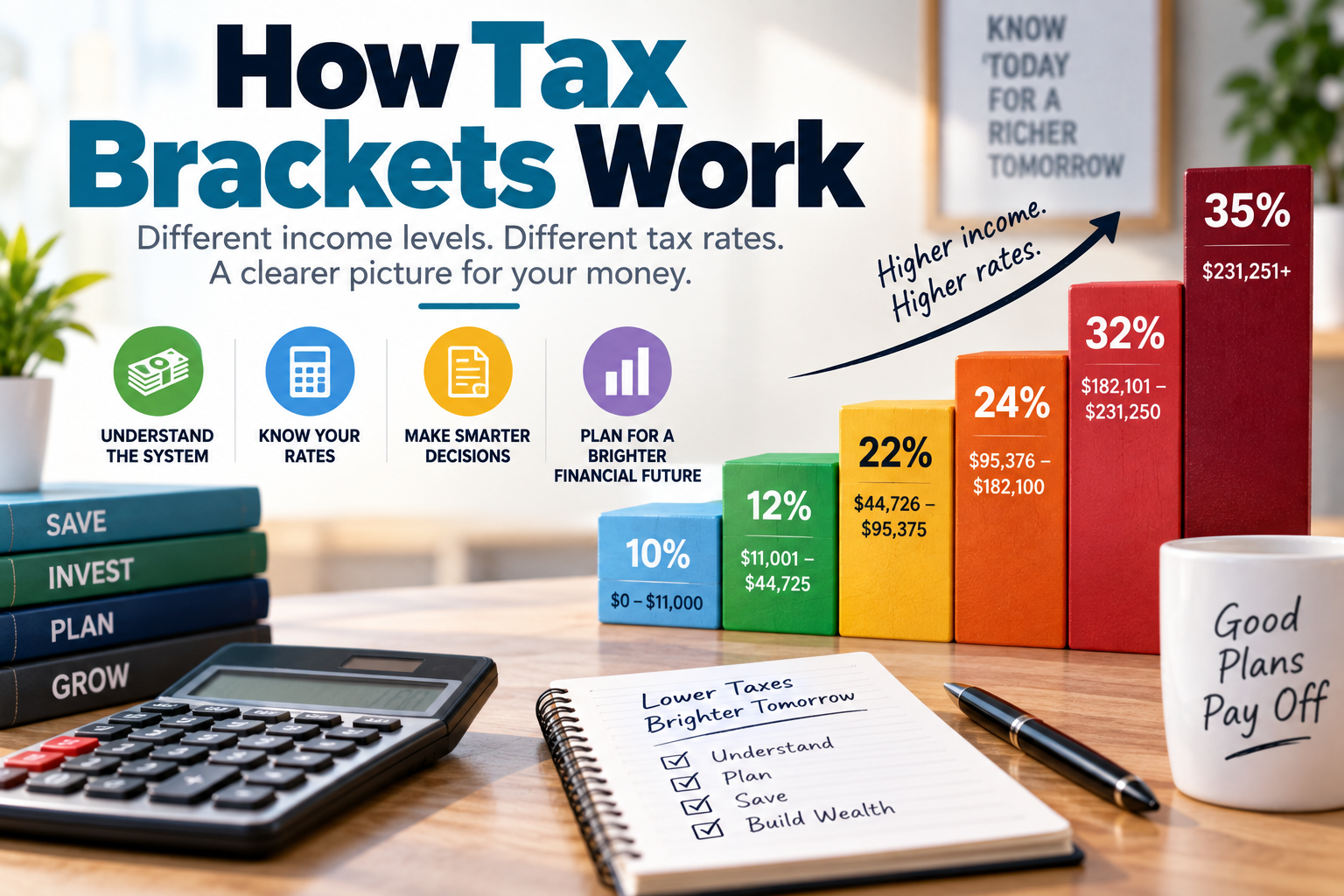
One of the most important concepts in tax planning is the difference between a marginal tax rate and an effective tax rate.
A marginal tax rate is the rate applied to the next portion of taxable income under a progressive tax system.
An effective tax rate represents the overall percentage of taxable income that is actually paid in tax after accounting for the applicable rate structure and relevant adjustments.
These figures can be quite different.
Someone moving into a higher marginal tax bracket does not necessarily pay that higher rate on every unit of income. Only the portion falling within the higher bracket is generally subject to that marginal rate in a progressive system.
Understanding this distinction can prevent people from making financial decisions based on the mistaken belief that earning additional income automatically causes all of their income to be taxed at a higher rate.
The guide to how tax brackets and marginal rates work provides a more detailed explanation of this concept.
Tax Rates Can Influence Saving Decisions
Taxes can affect the relative attractiveness of different ways to save.
For example, two savings or investment options may produce similar pre-tax returns but have different tax consequences. The option with the higher headline return may not necessarily produce the higher after-tax outcome.
When comparing savings strategies, individuals can consider:
- Expected return
- Applicable tax rate
- Tax timing
- Fees
- Liquidity
- Risk
- Inflation
- Investment horizon
This broader comparison can provide a more realistic picture of the potential outcome.
Tax Rates and Investment Decisions
Taxes can have a particularly significant influence on investment decisions.
Investment income may arise from interest, dividends, distributions, rental income, or gains from selling assets. Different types of investment income may be subject to different tax treatment depending on the jurisdiction and circumstances.
An investor therefore needs to distinguish between the pre-tax return and the after-tax return.
For example, an investment earning 8% before tax may leave substantially less than 8% available to the investor after applicable taxes.
This does not mean investors should always choose the investment with the lowest tax burden. Risk, diversification, liquidity, growth potential, and investment objectives remain important.
Tax is one part of the overall decision.
Capital Gains Can Affect When Investors Sell
Taxes can influence the timing of investment sales.
When an asset increases in value and is sold for more than its original tax basis, the resulting gain may be taxable under applicable capital gains rules.
An investor considering a sale may therefore compare the expected benefit of selling now with the potential tax consequences.
This can create situations in which investors consider holding an asset longer, selling only part of a position, or coordinating gains and losses with broader financial plans.
The rules surrounding capital gains vary considerably between jurisdictions and asset types, so investors should not assume that the treatment of one investment applies universally.
The guide to how investment income and capital gains are taxed explores these concepts in greater detail.
Tax Rates and Retirement Planning
Taxes can also affect retirement planning.
People saving for retirement often need to consider not only how much they contribute but also when contributions receive tax benefits and when withdrawals may become taxable.
The value of a retirement strategy can depend partly on the relationship between tax rates during a person’s working years and the rates that may apply later.
Other considerations include:
- Expected retirement income
- Contribution limits
- Tax treatment of withdrawals
- Investment growth
- Inflation
- Account rules
- Required distributions where applicable
- Changes in future tax policy
The goal is not simply to minimize taxes today. A sound retirement strategy considers the individual’s financial situation over many years.
Tax Rates Can Influence Investment Location
For people who use multiple types of investment accounts, tax treatment can influence where particular assets are held.
Some accounts may provide tax advantages or defer taxation under specific conditions. Other accounts may be fully taxable as income or gains occur.
This can lead investors to consider the tax characteristics of different investments alongside their expected returns.
However, tax efficiency should not become the sole objective. An investment strategy still needs to fit the investor’s risk tolerance, diversification requirements, time horizon, and financial goals.
Tax Deductions Can Change the Effective Cost of Decisions
Tax deductions can reduce taxable income or otherwise lower a person’s tax liability when the applicable rules allow them.
This can affect the effective cost of certain expenses or financial activities.
For example, where a legitimate deduction applies, the after-tax cost of an expense may be lower than its initial price.
However, deductions are generally subject to specific eligibility requirements. A person should not spend money solely to obtain a tax deduction when the underlying expense does not make financial sense.
A deduction can reduce the cost of a financially worthwhile decision, but it does not automatically turn an unnecessary expense into a good investment.
Tax Credits Can Have a Different Effect
Tax credits are generally different from deductions because they can directly reduce the amount of tax owed, subject to the relevant rules.
This distinction can be important when evaluating tax-related incentives.
A financial decision that qualifies for a credit may have a different after-tax outcome from one that produces only a deduction.
Because tax credits vary widely by country and program, individuals should verify the requirements before including a potential credit in a financial calculation.
Tax Rates and Homeownership
Buying property can involve several tax considerations.
Depending on the jurisdiction, homeowners may encounter taxes or incentives associated with:
- Property ownership
- Property transfers
- Mortgage interest
- Rental income
- Property sales
- Capital gains
- Local taxes
- Home improvements
The tax treatment can influence the overall cost of owning a property and the financial consequences of eventually selling it.
However, property decisions should also account for financing costs, maintenance, insurance, location, expected use, and market conditions.
Tax savings alone are rarely sufficient justification for purchasing an otherwise unsuitable property.
Tax Rates and Business Decisions
Taxes can influence entrepreneurs and business owners in several ways.
A business may need to consider the tax implications of hiring employees, purchasing equipment, choosing a business structure, distributing profits, retaining earnings, or selling the business.
The timing of certain expenses and transactions can also affect taxable income.
Business owners therefore often need to consider taxes when developing cash-flow forecasts and investment plans.
The key is to distinguish between legitimate tax planning and decisions that are driven entirely by the desire to reduce taxes.
Tax Rates and Debt Decisions
Taxes can also affect the comparison between borrowing and using available cash.
In some circumstances, interest expenses may receive particular tax treatment, while in others they may not.
This means that the effective cost of debt can differ depending on the borrower’s tax position and the type of borrowing involved.
When comparing debt repayment with investing surplus cash, people can consider:
- Interest rate
- Expected investment return
- Tax consequences
- Investment risk
- Liquidity
- Emergency savings
- Personal financial goals
A lower tax bill does not automatically make borrowing preferable, just as eliminating debt is not always mathematically superior in every situation.
Tax Timing Can Be as Important as Tax Rates
Taxes are not only about how much is ultimately paid. When the tax is paid can also matter.
Deferring a tax liability may allow money to remain invested or available for other purposes for a longer period.
The value of tax deferral depends on factors such as the amount involved, the duration of the deferral, investment returns, future tax rates, and applicable rules.
This makes tax timing an important consideration in long-term financial planning.
Tax Planning Should Start With Financial Goals
Effective tax planning should generally begin with the individual’s broader objectives.
Those goals might include:
- Building an emergency fund
- Buying a home
- Funding education
- Starting a business
- Building retirement savings
- Creating investment income
- Supporting family members
- Preserving wealth
Once the goals are established, tax considerations can be incorporated into the strategy.
This approach is generally more useful than beginning with the question, “How can I pay the least tax?”
The better question is often, “How can I achieve my financial goals efficiently while meeting my tax obligations?”
Avoid Letting Taxes Drive Every Decision
Tax-efficient planning can be valuable, but excessive focus on taxes can produce poor financial decisions.
For example, an investor might hold an unsuitable asset simply to avoid triggering a taxable gain. A homeowner might purchase an expensive property because of a tax incentive. A business owner might spend money unnecessarily because the expense is deductible.
In each case, the tax benefit could be outweighed by the broader financial cost.
Taxes should be considered alongside the fundamental economic value of a decision.
Tax Rates and Long-Term Investment Returns
Over long periods, taxes can compound their influence on investment outcomes.
Suppose an investment generates income every year and part of that income is taxed. If the remaining amount is reinvested, the investor has less capital available for future growth than they would have had if the entire return could be reinvested.
The effect can become more noticeable over long investment horizons.
This is one reason investors sometimes compare investments using after-tax projections rather than simply comparing advertised returns.
Consider the Total After-Tax Picture
A useful way to evaluate a financial decision is to move beyond its headline figures.
Instead of asking only:
How much will this investment earn?
An investor might also ask:
How much could I keep after taxes, fees, and other costs?
Similarly, instead of asking:
How much is this purchase worth?
A buyer might consider:
What will this purchase actually cost me after applicable tax benefits and expenses?
Looking at the complete after-tax picture can make financial comparisons more realistic.
Tax Laws Can Change
Tax rates and rules are not necessarily permanent.
Governments can change tax brackets, deductions, credits, capital gains rules, contribution limits, exemptions, and other provisions.
Changes can also affect different groups differently.
As a result, financial plans should not rely indefinitely on today’s tax environment. Long-term plans may need to be reviewed when significant tax rules change.
For a broader framework covering income, deductions, credits, filing considerations, and planning concepts, the Complete Guide to Personal Taxes and Tax Planning can provide additional context.
A Practical Framework for Tax-Aware Financial Decisions
Before making a significant financial decision, individuals can work through a simple series of questions:
- What is the financial goal?
- What type of income, expense, or transaction is involved?
- What tax rate or tax treatment could apply?
- Is the relevant rate marginal, effective, flat, or otherwise structured?
- When would the tax become payable?
- Are there legitimate deductions or credits available?
- What happens to the decision after taxes and other costs?
- How does the decision compare with the alternatives?
- Does it still make sense without the tax benefit?
- Could changes in tax rules affect the long-term outcome?
This framework helps place tax considerations in their proper context.
Building a Financial Plan Around After-Tax Results
Tax rates can influence nearly every stage of financial planning, from earning and saving money to investing, buying property, managing debt, and preparing for retirement.
The most useful approach is rarely to focus exclusively on minimizing taxes. Instead, people can consider how taxes interact with their broader financial objectives and evaluate decisions based on their likely after-tax results.
A strong financial plan recognizes that the money earned, invested, or saved is not always the same as the money ultimately available for future use. Understanding tax rates, tax brackets, taxable income, investment taxation, and timing can make that difference much easier to account for.
When taxes are treated as one important part of a larger financial strategy, individuals can make decisions that balance tax efficiency with growth, flexibility, risk management, and long-term financial goals.