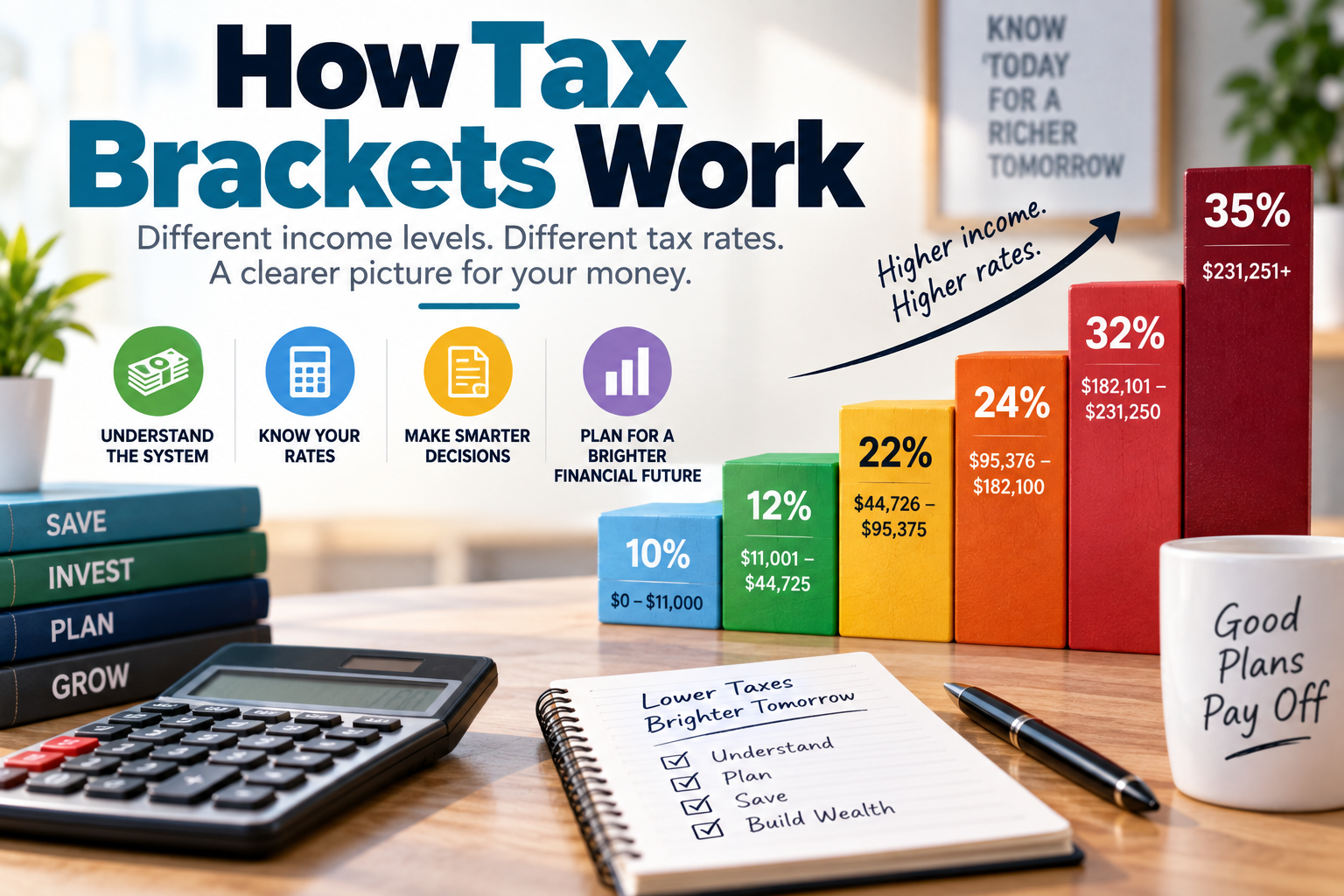
How Tax Brackets Work
Tax brackets are one of the most misunderstood parts of the income tax system. Many people hear that moving into a higher tax bracket could mean paying more in taxes and assume their entire income will suddenly be taxed at a higher rate.
That is not how a marginal tax system works.
Instead, different portions of taxable income are generally taxed at different rates. Understanding that structure can make it much easier to evaluate a raise, bonus, investment decision, retirement contribution, or other financial move without overestimating its tax impact.
For anyone trying to make better financial decisions, learning how tax brackets work is an important part of understanding the broader tax system.
What Is a Tax Bracket?
A tax bracket is a range of taxable income associated with a particular tax rate.
Under a progressive income tax system, higher portions of taxable income are generally taxed at progressively higher rates. The important word is portions.
If a taxpayer moves into a higher tax bracket, that does not normally mean every dollar they earn is taxed at the new higher rate. Only the income that falls within the higher bracket is subject to that rate.
This is why tax brackets are often described as a series of layers.
For example, imagine a simplified tax system with three brackets:
| Taxable Income Portion | Tax Rate |
|---|---|
| First $20,000 | 10% |
| Next $30,000 | 20% |
| Income above $50,000 | 30% |
Someone with $60,000 of taxable income would not pay 30% on the entire $60,000.
Instead:
- The first $20,000 would be taxed at 10%.
- The next $30,000 would be taxed at 20%.
- The remaining $10,000 would be taxed at 30%.
The result is a total tax bill that is lower than simply applying the highest applicable rate to the entire income.
This basic structure is the key to understanding tax brackets.
How Marginal Tax Rates Work
A marginal tax rate is the rate applied to the next dollar of taxable income.
This distinction is critical because people often confuse their marginal tax rate with their effective tax rate.
Suppose a taxpayer reaches a 30% marginal tax bracket. That generally means the next dollar of taxable income falls into the 30% bracket. It does not mean every dollar earned throughout the year was taxed at 30%.
The concept is explained in greater detail in the How Tax Brackets and Marginal Rates Work guide.
Understanding marginal rates can also make conversations about raises and bonuses much less confusing.
If someone receives a raise that pushes a portion of their income into a higher bracket, they do not necessarily lose money by earning more. The additional income may be taxed at a higher marginal rate, but the taxpayer still generally keeps some of that additional income after taxes.
Taxable Income Is What Matters
Another important point is that tax brackets generally apply to taxable income, not simply the amount shown on a paycheck or a person’s total gross income.
A taxpayer may have several types of income and adjustments that affect the amount ultimately subject to income tax.
For example, depending on the individual’s circumstances, taxable income can be affected by:
- Wages and salaries
- Self-employment income
- Business income
- Investment income
- Certain retirement income
- Tax deductions
- Adjustments to income
- Other taxable sources
That means two people earning the same amount of gross income could potentially have different amounts of taxable income and therefore different tax bills.
The Complete Guide to Income Taxes and Taxable Income provides a broader explanation of how income becomes taxable and why taxable income is more important than simply looking at gross earnings.
Tax Brackets vs. Effective Tax Rate
The marginal tax rate tells you the rate applied to the next layer of taxable income.
The effective tax rate looks at the taxpayer’s overall tax burden relative to their taxable or total income, depending on how it is being calculated.
Consider a simplified example.
Suppose someone has $80,000 of taxable income and pays $12,000 in income taxes.
Their effective tax rate would be:
$12,000 ÷ $80,000 = 15%
Even if the taxpayer’s highest marginal bracket were higher than 15%, their overall tax burden could still be 15% because earlier portions of their income were taxed at lower rates.
This is why saying “I’m in the 30% tax bracket” does not necessarily mean the taxpayer is paying 30% of their entire income in federal income taxes.
Why a Raise Does Not Automatically Make You Worse Off
One of the most persistent misconceptions about tax brackets is the idea that earning more money can cause someone to take home less money.
Under a conventional progressive marginal tax structure, crossing into a higher bracket does not cause all income to be retroactively taxed at the higher rate.
Imagine that the top portion of a taxpayer’s income enters a 30% bracket.
If an additional $1,000 falls into that bracket, the tax on that additional income could be approximately $300 under this simplified example, leaving approximately $700 before considering other taxes or deductions.
The taxpayer has still increased their after-tax income.
This does not mean every raise produces the same financial benefit. Payroll taxes, changes in deductions, credits, benefits, and other factors can affect the actual amount a person takes home. But the basic tax-bracket structure itself does not make earning additional income inherently harmful.
How Tax Deductions Affect Tax Brackets
Tax deductions can reduce the amount of income subject to tax.
For example, suppose someone has $70,000 in income but qualifies for deductions that reduce their taxable income to $55,000. Their tax brackets would generally be applied to the lower taxable-income figure rather than simply to the original $70,000.
This is one reason deductions can play an important role in tax planning.
However, a deduction does not necessarily reduce someone’s tax bill dollar-for-dollar.
If a taxpayer receives a $1,000 deduction, that generally means $1,000 of income is removed from taxation. The actual tax savings depend on the tax rate that would have applied to that income.
The Complete Guide to Tax Deductions and Credits explains the distinction between deductions and credits and how both can affect a taxpayer’s overall liability.
Tax Credits Work Differently
Tax credits are different from deductions.
A deduction generally reduces taxable income, while a tax credit can directly reduce the amount of tax owed, subject to the rules governing that particular credit.
For example, if a taxpayer owes $5,000 in tax and qualifies for a $1,000 nonrefundable credit, the credit could potentially reduce the tax liability to $4,000.
Because credits and deductions operate differently, taxpayers should not assume that a $1,000 deduction and a $1,000 credit have the same effect.
The difference becomes especially important when planning around major expenses, family-related tax benefits, education, retirement, or other qualifying situations.
Tax Brackets Can Change From Year to Year
Tax brackets are not necessarily permanent.
Tax authorities can change tax rates, income thresholds, deductions, credits, filing rules, and other provisions. In some systems, bracket thresholds may also be adjusted periodically for inflation.
As a result, taxpayers should be careful about relying on an old tax table when making decisions for a new tax year.
A tax strategy that made sense several years ago may not produce the same result today.
For financial planning purposes, it is generally more useful to understand the underlying mechanics of tax brackets while checking the applicable rules for the specific tax year being considered.
Filing Status Can Affect Tax Brackets
Tax brackets can also vary according to filing status.
In the U.S. federal income tax system, for example, taxpayers may fall under different structures depending on whether they file as single, married filing jointly, married filing separately, or head of household.
This means two households with the same total income can potentially face different tax calculations.
Filing status is therefore an important part of understanding a household’s overall tax position.
Other factors can also matter, including dependents, deductions, credits, investment income, retirement contributions, and the nature of the income itself.
Why Gross Income Can Give the Wrong Impression
Looking only at annual salary can produce an incomplete picture of someone’s tax situation.
Consider two people who each earn $100,000.
One person might have significant deductible expenses, qualifying tax benefits, retirement contributions, or other adjustments. Another might have a substantially different financial profile.
Even though their gross incomes are identical, their taxable incomes and final tax liabilities could be different.
This is why effective tax planning requires looking beyond salary.
A broader understanding of personal taxes and tax planning can help put tax brackets into the context of a household’s entire financial picture.
How Bonuses Are Taxed
Bonuses sometimes create confusion because the amount withheld from a bonus paycheck can look surprisingly large.
The amount withheld from a paycheck is not necessarily the same thing as the taxpayer’s final tax liability.
Employers may use specific withholding methods for supplemental wages such as bonuses. The final tax calculation is determined when the taxpayer’s overall income, deductions, credits, and other relevant information are taken into account.
As a result, receiving a large bonus does not automatically mean that the entire bonus has been permanently taxed at an unusually high rate.
It is useful to distinguish between withholding and actual tax liability.
Withholding is money set aside during the year toward an eventual tax bill. The final tax return determines whether the taxpayer has paid too much, too little, or approximately the right amount.
How Tax Brackets Affect Retirement Planning
Tax brackets can also influence decisions about retirement contributions.
Certain retirement accounts may provide tax benefits today, while others may offer different tax treatment later. The value of those benefits can depend partly on a person’s current and expected future tax situation.
For example, someone considering a deductible retirement contribution may want to understand which marginal tax bracket applies to the income being reduced.
That does not mean taxpayers should make retirement decisions based solely on tax rates. Investment choices, time horizon, employer benefits, contribution limits, withdrawal rules, and overall retirement goals also matter.
But tax brackets can be an important piece of the decision.
Tax Brackets and Investment Income
Not all income is necessarily treated identically for tax purposes.
Wages, interest, dividends, capital gains, business income, and other forms of income can be subject to different rules.
This is particularly important for investors.
Someone may have a salary that places them in one marginal income-tax bracket while also receiving investment income subject to separate tax rules.
That means calculating a tax bill requires more than simply finding a salary on a tax-bracket table.
Investors should consider the type of income, holding period where relevant, applicable rates, deductions, and other provisions that could affect their overall liability.
What Happens When You Cross a Tax Bracket?
Crossing a tax-bracket threshold is often less dramatic than people assume.
Suppose a simplified tax system has a 20% bracket ending at $50,000 and a 30% bracket beginning above $50,000.
If a taxpayer earns $50,100 of taxable income, the additional $100 does not cause the entire $50,100 to suddenly become taxable at 30%.
Instead, only the portion above the threshold enters the higher bracket.
This layered approach prevents the common misconception that earning one additional dollar can cause a person’s entire income to be taxed at a much higher rate.
It also explains why taxpayers generally should not reject additional income simply because it pushes a small portion of their earnings into a higher marginal bracket.
Tax Planning Is More Than Chasing a Lower Bracket
A lower tax bill is useful, but minimizing taxes should not be the only objective of a financial plan.
Sometimes people spend money or make unnecessary financial decisions simply to obtain a tax deduction. That can leave them worse off financially.
For example, spending $1,000 solely to receive a tax benefit does not make economic sense if the taxpayer would not otherwise have needed the expense.
Good tax planning focuses on the after-tax outcome while keeping the broader financial objective in view.
That might include:
- Increasing retirement savings
- Managing taxable investment income
- Timing certain income or expenses
- Taking advantage of eligible deductions
- Using qualifying tax credits
- Building an emergency fund
- Planning for major purchases
- Reviewing business expenses
- Preparing for future tax obligations
The best strategy depends on the individual’s circumstances.
Common Tax-Bracket Mistakes to Avoid
Several misunderstandings can lead taxpayers to make poor financial decisions.
Mistake 1: Thinking Your Entire Income Is Taxed at Your Highest Bracket
This is the most common misconception.
A marginal tax system generally applies different rates to different portions of taxable income.
Mistake 2: Confusing Withholding With Taxes Owed
The amount taken from a paycheck is not necessarily the taxpayer’s final tax bill.
Withholding is an advance payment toward the eventual liability.
Mistake 3: Ignoring Taxable Income
Gross income and taxable income are not always the same.
Deductions and other adjustments can affect the amount that actually enters the tax calculation.
Mistake 4: Treating Every Tax Benefit as a Credit
Deductions and credits work differently.
Understanding that distinction can help taxpayers estimate the real value of a tax strategy.
Mistake 5: Using Outdated Brackets
Tax thresholds and rules can change.
Always verify the applicable rules for the relevant tax year before making an important tax decision.
Mistake 6: Making Financial Decisions Solely to Avoid Taxes
A tax benefit is only one part of a financial decision.
A strategy that reduces taxes but creates a larger financial cost may not be worthwhile.
A Simple Way to Think About Tax Brackets
The easiest way to visualize tax brackets is as a series of buckets.
Imagine that your taxable income is poured into several buckets.
The first bucket is taxed at the lowest rate. Once that bucket is full, additional income flows into the next bucket, which has a higher rate. The process continues as taxable income rises.
Your highest filled bucket represents your marginal tax bracket.
But the tax you’ve paid across all the buckets determines your overall tax burden.
This mental model makes tax brackets much easier to understand than simply looking at a list of percentages.
Why Understanding Brackets Matters for Everyday Decisions
Tax brackets are not just an issue for accountants or high-income households.
They can affect everyday financial decisions involving employment, bonuses, retirement contributions, investments, self-employment, and household planning.
Knowing how marginal rates work can help people ask better questions before making major financial decisions.
For example:
- How much of a raise will I actually keep?
- How could a retirement contribution affect taxable income?
- Is a deduction worth pursuing?
- Why did my bonus withholding look different?
- What is my marginal tax rate?
- What is my effective tax rate?
- Could investment income change my tax situation?
- Should I adjust my withholding?
- What tax rules apply to my particular filing status?
The answers depend on the taxpayer’s circumstances, but understanding the basic structure provides a much stronger starting point.
Turning Tax Knowledge Into Better Financial Planning
Tax brackets become much less intimidating once the difference between marginal rates, taxable income, deductions, credits, withholding, and effective tax rates is clear.
The most important lesson is simple: moving into a higher tax bracket generally does not mean your entire income is taxed at that higher rate. Only the portion that falls within the higher bracket is generally subject to that marginal rate.
That distinction can prevent unnecessary anxiety around raises, bonuses, and other increases in income.
More importantly, it provides a foundation for smarter financial planning. Rather than trying to avoid a particular tax bracket at all costs, taxpayers can focus on the bigger picture: how much they earn, how much they save, what deductions and credits they legitimately qualify for, and how today’s decisions fit into their long-term financial goals.
Understanding the tax system does not eliminate the need to plan carefully, but it can make the numbers far easier to interpret—and help turn tax season from a source of confusion into a more manageable part of personal financial planning.