How Investors Interpret Economic Data
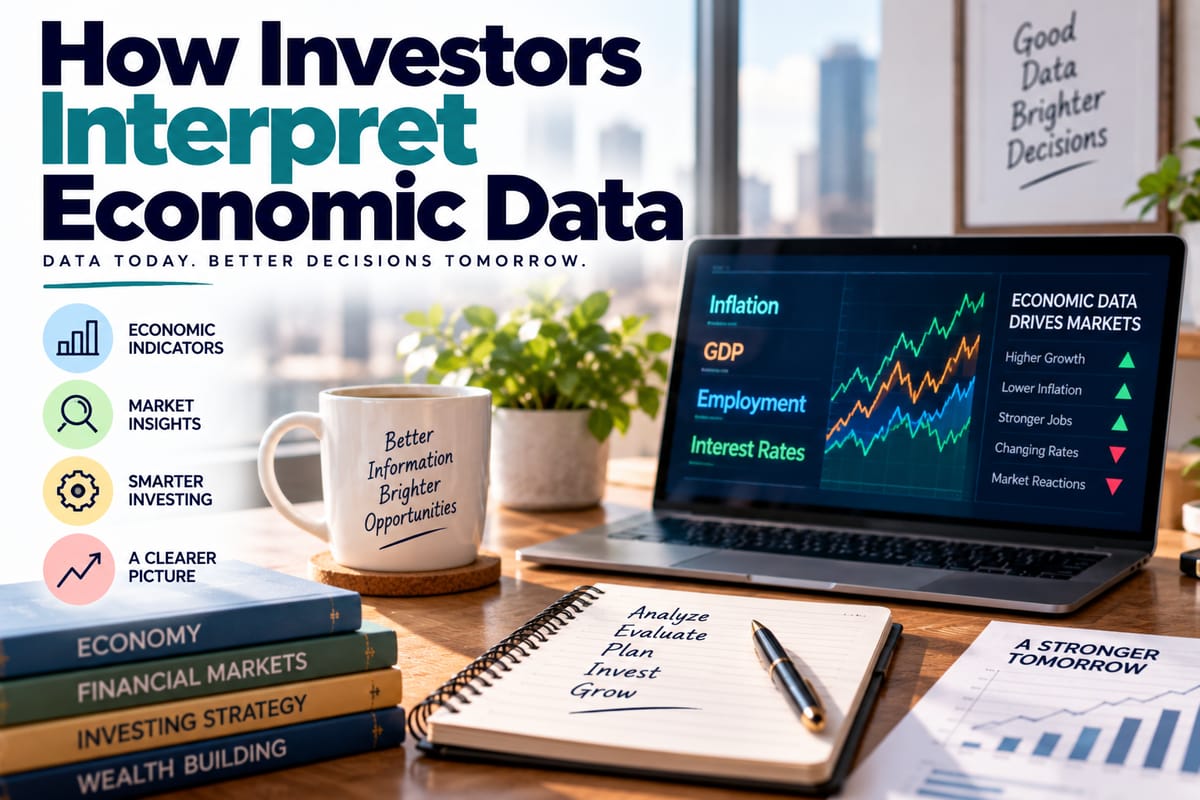
Economic data can provide investors with valuable clues about the health and direction of an economy. Reports on inflation, employment, economic growth, consumer spending, manufacturing, and other areas are released regularly and can influence expectations about interest rates, corporate earnings, and financial markets.
However, investors rarely look at a single economic figure in isolation. The meaning of a data release often depends on whether it is stronger or weaker than expected, how it compares with previous readings, and what it suggests about future economic conditions.
Understanding how investors interpret economic data can make financial market movements easier to understand.
Why Economic Data Matters to Investors
Economic data provides information about what is happening across different parts of an economy.
Investors use this information to assess questions such as:
- Is economic growth accelerating or slowing?
- Are consumers spending more or less?
- Is inflation increasing or declining?
- Is the labor market strengthening or weakening?
- Are businesses expanding or reducing activity?
- Could central banks change monetary policy?
- What might these developments mean for corporate earnings?
The complete guide to economic indicators provides broader context on the measurements economists and investors use to evaluate economic conditions.
Economic reports do not provide certainty about the future. Instead, they provide pieces of information that investors combine with other evidence.
Investors Often Focus on Expectations
One of the most important principles in financial markets is that prices often reflect expectations about the future.
This means an economic report can produce a significant market reaction even when the reported number itself appears positive.
For example, suppose investors expect economic growth to be strong and a new report confirms those expectations. The market response may be relatively limited because the information was already anticipated.
If growth is substantially stronger than expected, however, investors may adjust their outlook.
The same principle applies to inflation, employment, consumer spending, and other economic indicators.
Strong Data Is Not Always Positive for Every Investment
Economic data does not have a universally positive or negative interpretation.
Strong economic growth can support corporate revenues and profits because businesses may benefit from stronger demand. At the same time, unexpectedly strong growth can increase concerns about inflation or encourage expectations for tighter monetary policy.
Similarly, weak economic data can create concerns about corporate earnings while potentially increasing expectations for lower interest rates.
The impact therefore depends on the type of asset being considered and what investors already expect.
GDP Provides a Broad Picture of Economic Activity
Gross domestic product, or GDP, is one of the most widely followed measures of economic activity.
GDP measures the value of goods and services produced within an economy over a particular period. Changes in GDP can provide information about whether overall economic activity is expanding or contracting.
Investors examine not only the headline growth rate but also the components behind it.
The how GDP measures economic activity and economic growth guide provides more detail on how GDP is constructed and why it matters.
Investors may examine consumer spending, business investment, government activity, exports, imports, and other components to determine what is driving changes in economic output.
Employment Data Can Change Market Expectations
Employment reports receive significant attention because the labor market provides information about economic strength, household income, consumer spending, and potential inflationary pressure.
Investors may examine indicators such as:
- Payroll growth
- Unemployment
- Wage growth
- Labor-force participation
- Job openings
- Hours worked
A strong labor market can support consumer spending because more people are earning income. However, unusually strong wage growth or persistent labor shortages can also contribute to concerns about inflation.
The relationship between employment information and markets is explored in how employment data influences financial markets.
Inflation Is Closely Watched
Inflation is another major factor in how investors interpret economic conditions.
When consumer prices rise faster than expected, investors may reassess the likelihood that central banks will maintain or increase restrictive monetary policies.
If inflation falls more quickly than expected, markets may instead begin anticipating less restrictive policy.
Investors often examine both headline inflation and measures that attempt to identify underlying price trends.
The important question is not simply whether prices are rising, but whether inflation is moving in a direction consistent with expectations and monetary policy objectives.
Interest Rates Connect Economic Data to Asset Prices
Economic data can influence financial markets partly because it affects expectations about interest rates.
Central banks consider economic conditions when determining monetary policy. Investors therefore pay close attention to data that could influence future policy decisions.
For example, unexpectedly strong inflation may increase expectations for higher interest rates, while weaker economic activity or falling inflation may influence expectations in the opposite direction.
These expectations can affect stocks, bonds, currencies, and other financial assets.
Monetary Policy Can Amplify the Market Reaction
Central bank decisions can have broad consequences for financial markets.
Interest rates influence borrowing costs, consumer spending, business investment, housing activity, and financial conditions more generally.
Investors therefore pay close attention to economic data that central bankers are likely to consider.
The relationship is examined in how monetary policy affects financial markets.
A data release may therefore move markets not because the number itself directly changes the value of an asset, but because it changes expectations about future monetary policy.
Investors Compare Data With Previous Readings
A single economic report rarely tells the entire story.
Investors compare new information with previous reports to determine whether a trend is developing.
For example, one month of weaker employment growth may not necessarily indicate a major change in the labor market. Several consecutive reports showing weakening employment conditions could provide a stronger signal.
Trend analysis can therefore be more informative than focusing exclusively on individual monthly figures.
Revisions Can Change the Picture
Economic statistics are sometimes revised after their initial release.
Governments and statistical agencies may receive additional information or improve their estimates, leading to changes in previously reported figures.
Investors therefore distinguish between preliminary and revised data.
A report that initially suggested strong growth could later be revised downward, while an initially weak reading could eventually be revised higher.
This is another reason investors generally avoid treating one economic release as definitive evidence about the entire economy.
Leading, Coincident, and Lagging Indicators
Economic indicators can also be considered according to when they tend to provide information about economic conditions.
Leading indicators may provide clues about where economic activity could be heading. Coincident indicators describe conditions occurring around the present period, while lagging indicators tend to confirm developments that have already occurred.
Investors can combine these different types of information to build a broader view.
For example, weakening business surveys may provide an early signal of slower activity, while employment data may confirm changes in the labor market later.
No single category is sufficient on its own.
Consumer Spending Can Reveal Economic Momentum
Consumer spending is particularly important in economies where household consumption represents a large share of economic activity.
Investors may examine retail sales, household income, consumer confidence, credit usage, and other information to determine whether consumers are becoming more or less willing to spend.
Strong consumer spending can support businesses that depend on household demand.
However, investors may also consider whether spending is being supported by sustainable income growth or by borrowing and temporary factors.
The quality of economic growth can be just as important as the headline growth rate.
Manufacturing and Business Surveys Provide Additional Clues
Manufacturing data and business surveys can provide information about production, orders, employment intentions, inventories, and business confidence.
These indicators can sometimes change before official economic statistics show a clear shift.
Investors may therefore use business surveys as part of a broader process for assessing whether companies are preparing for stronger or weaker demand.
Again, the key is to look for consistent patterns rather than treating one survey as definitive.
Financial Markets Can React Within Minutes
Modern financial markets process economic information extremely quickly.
When an important report is released, investors and automated trading systems can respond almost immediately.
Prices may change sharply if the data differs substantially from expectations.
This can be especially noticeable in government bond yields, currencies, stock indexes, and interest-rate-sensitive assets.
The initial reaction may also change as investors examine the details behind the headline number.
Markets Can Reverse Their Initial Reaction
The first market response to economic data is not necessarily the final response.
Suppose an employment report initially appears positive because job creation is stronger than expected. Investors may then examine wage growth, unemployment, participation, and revisions.
If those details provide a different picture, the initial reaction can weaken or reverse.
This illustrates why investors often distinguish between the headline figure and the broader information contained within the report.
Different Assets Can React Differently
The same economic report can have different effects across financial markets.
A stronger-than-expected economic report might support expectations for higher corporate earnings, potentially benefiting some stocks. At the same time, stronger growth could increase expectations for higher interest rates, putting pressure on certain bonds.
Currency markets may respond depending on how the data changes expectations about monetary policy relative to other countries.
Investors therefore consider the relationship between economic data and the specific asset they are analyzing.
Economic Data Can Affect Corporate Earnings
Economic conditions ultimately influence many companies through demand, costs, financing conditions, and consumer behavior.
Strong economic activity can increase sales for businesses that depend on consumer or corporate spending.
However, companies can also face higher wages, materials costs, transportation expenses, and borrowing costs during periods of strong economic activity.
Investors therefore consider both revenue opportunities and cost pressures when interpreting economic reports.
International Data Matters Too
Investors with globally diversified portfolios cannot focus exclusively on their home economy.
Economic data from major trading partners can influence currencies, commodities, supply chains, interest rates, and multinational companies.
For example, slower growth in a major economy could affect demand for exports from other countries. Changes in foreign interest rates can also influence capital flows and exchange rates.
Global investors therefore monitor economic developments across multiple regions.
The Importance of the Bigger Economic Picture
Economic data is most useful when different indicators are considered together.
Suppose inflation is declining while employment remains strong and consumer spending continues to grow. Investors may interpret this combination differently from a situation where inflation is falling because economic activity and employment are weakening sharply.
The relationship between indicators can provide important context.
This is why professional investors often build economic views from multiple sources rather than relying on one statistic.
Economic Data Is Information, Not a Guarantee
Economic indicators can help investors understand current conditions and reassess expectations, but they cannot predict the future with certainty.
Unexpected events can change economic conditions quickly. Consumer behavior can shift, financial conditions can tighten, supply disruptions can occur, and policymakers can respond to new developments.
Investors therefore need to distinguish between what the latest data shows and what they believe could happen next.
The ability to interpret economic data is ultimately about understanding probabilities, relationships, trends, and changing expectations rather than finding a single number that provides a definitive answer.
Reading the Signals Behind the Numbers
Investors interpret economic data by looking beyond individual headlines.
They compare new figures with expectations, previous readings, long-term trends, and other economic indicators. They consider how the information could affect inflation, employment, economic growth, corporate earnings, and monetary policy.
The most meaningful insights often come from how several pieces of data fit together.
For anyone following financial markets, developing this broader perspective can make economic reports easier to understand and explain why markets sometimes react strongly to information that initially appears to be just another statistic.