How Geopolitical Disruptions Affect Commodity Markets
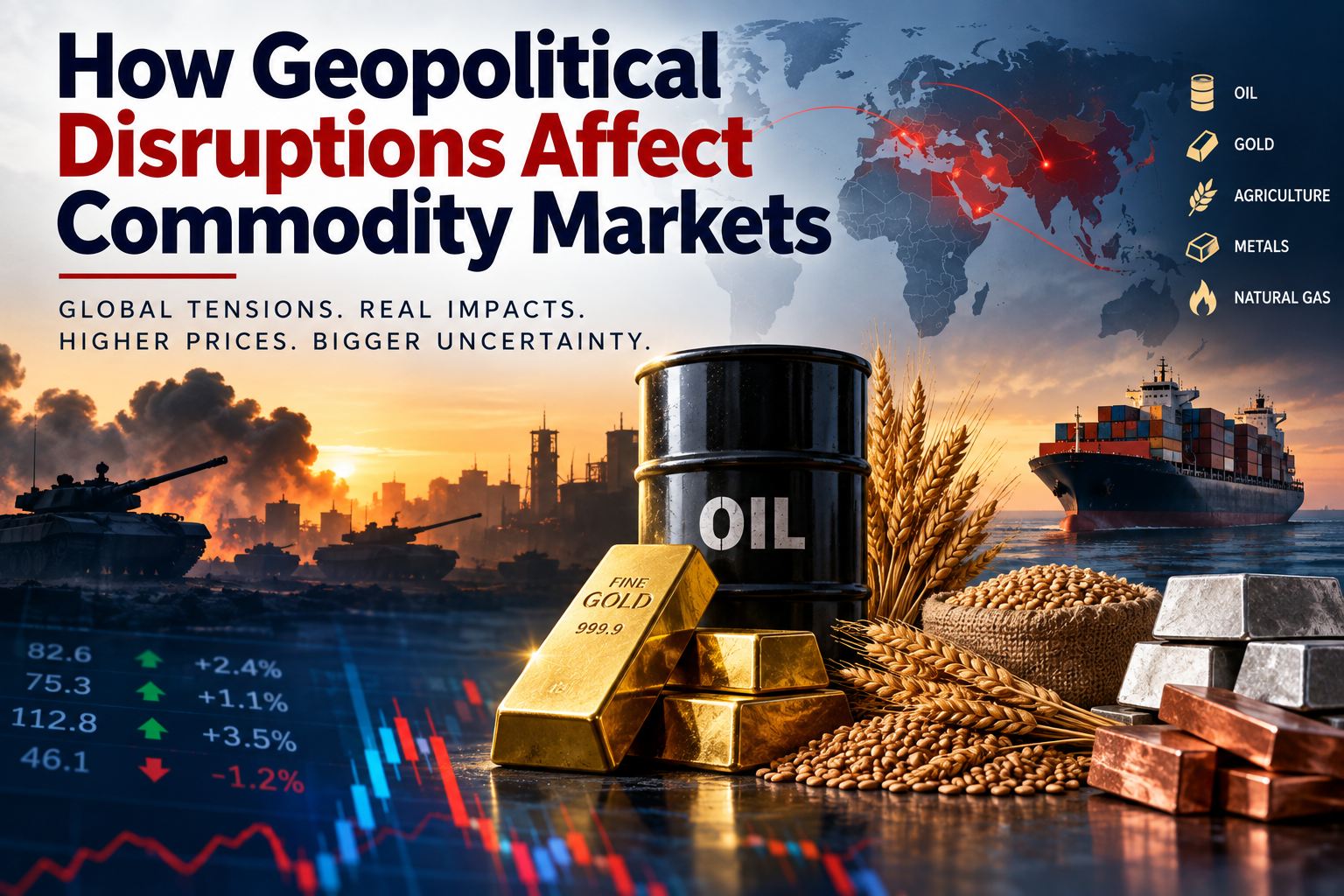
Geopolitical disruptions can send powerful shockwaves through commodity markets. A conflict, trade dispute, sanctions package, political crisis, or disruption to a major shipping route can quickly change expectations about the supply and demand of essential raw materials.
Commodities are particularly sensitive to geopolitical events because many of them are produced or transported through relatively concentrated regions. Oil production, natural gas supplies, metals mining, agricultural exports, and critical mineral processing can all be affected when political tensions interfere with normal economic activity.
Understanding these connections helps explain why commodity prices can sometimes move sharply even when the underlying supply or demand situation has not yet changed significantly.
Why Geopolitics Matters to Commodity Markets
Commodity markets connect producers, traders, manufacturers, investors, governments, and consumers around the world. The prices established in these markets influence everything from transportation and electricity costs to food production and manufacturing.
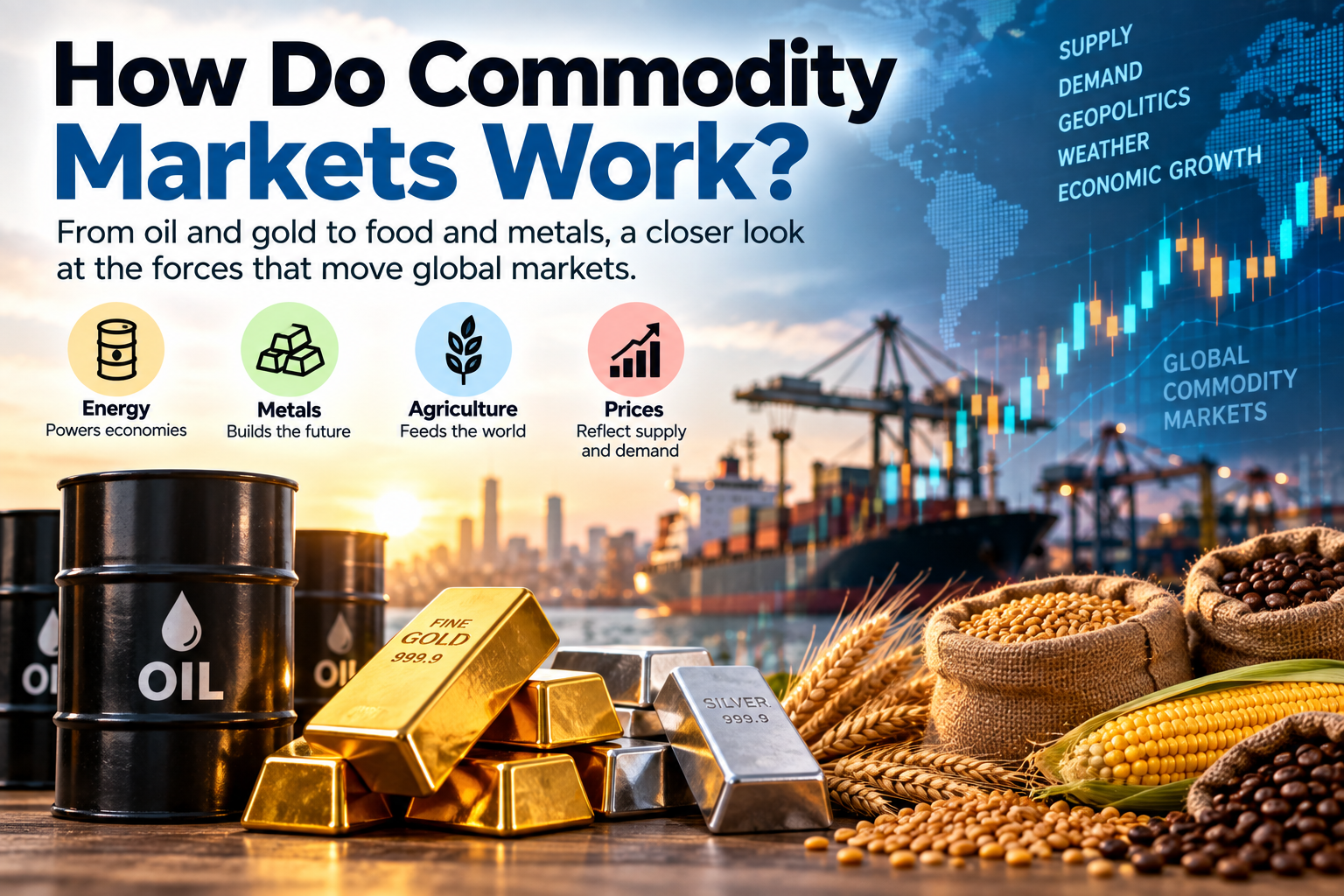
For a broader explanation of how these markets function, the guide to how commodity markets work provides useful background on supply, demand, trading, pricing, and market participants.
Geopolitical events matter because commodities depend heavily on international production and distribution networks. A disruption in one important region can therefore affect prices far beyond the country where the event occurs.
For example, a political crisis in a major oil-producing country may raise concerns about future petroleum supplies. Even before any barrels are physically removed from the market, traders may begin pricing in the possibility of tighter supply.
That expectation can be enough to push prices higher.
Supply Disruptions Can Move Prices Quickly
The most direct effect of geopolitical instability is often a potential reduction in supply.
Wars, sanctions, political unrest, export restrictions, infrastructure damage, and border disruptions can interfere with the production or transportation of commodities. When buyers believe less supply will be available, prices can rise as markets adjust.
Oil provides one of the clearest examples.
If production facilities, pipelines, ports, refineries, or shipping routes become threatened, traders may anticipate shortages. The resulting increase in prices can occur before an actual shortage develops.
The same principle applies to other commodities. A conflict affecting a major mining region could raise concerns about metal supplies, while restrictions on agricultural exports could create uncertainty in global food markets.
Oil Markets Are Especially Sensitive
Energy commodities tend to receive significant attention during geopolitical crises because oil and natural gas remain deeply integrated into the global economy.
Oil is used directly for transportation and indirectly in manufacturing, agriculture, chemicals, plastics, and many other industries. A sustained increase in crude prices can therefore affect businesses and households across multiple economies.
Events involving major oil-producing regions can be especially important. Concerns about disruptions involving Iran, for example, can affect expectations for global petroleum supplies and energy prices. Investors may also reassess energy companies when geopolitical risks increase, as explored in how Iran-related oil risks could affect energy stocks and investors.
The impact depends on the size and duration of the disruption, the amount of spare production capacity available elsewhere, inventory levels, and the ability of producers and consumers to adjust.
Shipping Routes Can Become a Major Risk
Commodity markets do not depend only on where resources are produced. They also depend on how those resources reach buyers.
Major maritime routes carry enormous quantities of oil, natural gas, grains, metals, and manufactured goods. A geopolitical crisis that threatens one of these routes can increase transportation costs and create delays.
Even when commodity production remains unchanged, shipping disruptions can make supplies more expensive to deliver.
Traders may respond by bidding up futures contracts as they attempt to account for potential delays or shortages. At the same time, companies may search for alternative suppliers, routes, or transportation methods.
These adjustments can create additional costs throughout the supply chain.
Sanctions Can Reshape Global Commodity Flows
Economic sanctions can have a significant effect on commodity markets by restricting trade with particular countries, companies, or industries.
When a major commodity producer faces restrictions, buyers may need to find alternative sources. Sellers may also redirect exports toward countries that remain willing and able to purchase them.
This can produce unusual market patterns.
A commodity may not disappear from the global economy, but it can become more expensive to transport, insure, finance, or trade. Supplies may travel longer distances, while established trading relationships may be replaced with new ones.
Over time, these changes can alter the geography of commodity markets.
Trade Restrictions Can Affect Agricultural Commodities
Geopolitical disruptions are not limited to energy.
Agricultural commodities can also be affected by export bans, trade disputes, armed conflicts, port closures, and disruptions to fertilizer supplies.
Countries that depend heavily on imported food may become particularly sensitive to these developments. If exports from a major producing region are restricted, international buyers may compete for supplies from other producers.
Fertilizer markets can also play an important role. Higher fertilizer costs can increase farmers’ production expenses, potentially influencing planting decisions, food prices, and agricultural commodity markets in subsequent seasons.
This illustrates how a geopolitical event can have effects that extend well beyond the initial disruption.
Metals and Critical Minerals Face Their Own Risks
Industrial metals and critical minerals are increasingly important to modern manufacturing, energy systems, electronics, and infrastructure.
Geopolitical tensions can affect these markets through mining restrictions, export controls, sanctions, processing bottlenecks, and competition for strategic resources.
Some minerals have highly concentrated production or processing networks. If an important supplier becomes unavailable or restricts exports, manufacturers may struggle to replace that source quickly.
This can encourage companies and governments to diversify supply chains, develop domestic production, build inventories, or invest in alternative materials.
The result may be higher short-term costs but greater supply-chain resilience over the longer term.
Commodity Prices Can Influence Financial Markets
Commodity markets do not operate independently from stocks, bonds, currencies, and other financial assets.
A sharp increase in energy or raw-material prices can raise business costs and influence inflation expectations. Investors may then reassess interest rates, corporate earnings, and economic growth.
The broader relationship between commodities and financial assets can be understood through the complete guide to financial markets and how they work.
Oil is particularly important because higher energy prices can affect transportation, manufacturing, utilities, and consumer spending.
When crude prices move substantially higher, investors may therefore reassess sectors differently depending on their exposure to energy costs.
Inflation Can Become Part of the Geopolitical Shock
One of the most important economic consequences of commodity disruptions is inflation.
Energy and food prices are significant components of household spending. Businesses also depend on commodities as inputs, meaning higher raw-material costs can eventually pass through to the prices of finished products and services.
A geopolitical shock that raises commodity prices may therefore create broader inflationary pressure.
Central banks can face a difficult environment when this happens. Higher commodity prices may push inflation upward at the same time that economic activity is being weakened by uncertainty and higher costs.
This creates a complicated policy environment because measures designed to restrain inflation can also affect economic growth.
Higher Oil Prices Can Put Pressure on Stocks
The relationship between commodity prices and equities can become especially visible during major energy shocks.
Companies that produce oil or other commodities may benefit from higher selling prices, while businesses that consume large quantities of energy can face increased operating expenses.
Transportation companies, manufacturers, retailers, airlines, and other fuel-intensive businesses may be particularly exposed to rising energy costs.
This is why commodity shocks can produce different effects across the stock market rather than moving every company in the same direction.
Periods in which oil prices rise sharply alongside other financial pressures can be especially challenging. The relationship is illustrated by analysis of how oil above $100 and rising Treasury yields can put fresh pressure on stocks.
Currency Movements Can Add Another Layer
Geopolitical disruptions can also affect currencies, which in turn influence commodity prices.
Many globally traded commodities are priced in U.S. dollars. When exchange rates change, the effective cost of commodities can change for buyers using other currencies.
A geopolitical crisis can therefore produce several simultaneous market effects:
- Commodity prices may rise because of supply concerns.
- The U.S. dollar may strengthen as investors seek liquidity.
- Importing countries may face higher costs because of currency movements.
- Producers may receive different revenues when commodity prices and exchange rates move together.
- Central banks may face changing inflation and economic-growth expectations.
These interactions can make commodity-market reactions difficult to interpret from a single price movement.
Markets Often React Before the Disruption Happens
Commodity markets are forward-looking.
Traders do not necessarily wait for a supply shortage to become visible. Instead, futures prices can respond to expectations about what might happen in the coming weeks or months.
That means geopolitical headlines can cause significant price movements even when physical commodity flows remain largely unchanged.
For example, if traders believe a conflict could threaten a major export route, prices may rise as participants hedge against the possibility of future disruption.
If the expected disruption never occurs, prices can subsequently fall as the risk premium disappears.
This is one reason commodity prices can sometimes be highly volatile during periods of geopolitical uncertainty.
Inventories and Spare Capacity Can Reduce the Impact
Not every geopolitical disruption produces a prolonged commodity shortage.
The size of the market’s existing inventories and available spare production capacity can determine how severe a disruption becomes.
If consumers and businesses have substantial inventories, they may be able to absorb a temporary supply interruption.
Similarly, if other producers can increase output quickly, the global market may replace some or all of the lost supply.
Transportation networks also matter. Buyers may be able to redirect shipments from alternative suppliers, although doing so may increase costs.
These buffers can prevent a temporary geopolitical event from becoming a long-lasting commodity crisis.
Why Some Price Shocks Last Longer Than Others
The duration of a commodity shock depends on several factors.
A short-lived political dispute may produce a temporary price spike that fades once markets receive reassuring information. A prolonged conflict that damages infrastructure or permanently changes trade relationships can have much longer-lasting consequences.
Several questions are particularly important:
- How much supply is actually at risk?
- How quickly can alternative suppliers respond?
- Are inventories sufficient to cover temporary shortages?
- Can shipments be redirected to other routes?
- How long is the geopolitical disruption expected to last?
- Are governments introducing sanctions or export restrictions?
- How sensitive is global demand to higher prices?
The answers determine whether the market experiences a brief volatility event or a structural change in commodity pricing.
Businesses Adapt to Geopolitical Commodity Risks
Companies that depend heavily on commodities increasingly consider geopolitical risk when planning their supply chains.
Businesses may diversify suppliers, maintain larger inventories, enter longer-term contracts, redesign products, or invest in alternative inputs.
Energy-intensive companies may also seek ways to reduce their exposure to volatile fuel prices.
Governments can take similar steps by maintaining strategic reserves, encouraging domestic production, or developing relationships with multiple trading partners.
These strategies cannot eliminate geopolitical risk, but they can reduce dependence on a single source or transportation route.
Investors Watch More Than the Commodity Price
A commodity’s headline price provides only part of the picture.
Market participants often watch inventories, futures curves, production forecasts, shipping costs, currency movements, interest rates, and changes in global demand.
The structure of the futures market can also provide clues about how traders view current versus future supply conditions.
At the same time, investors in commodity-producing companies need to consider factors beyond commodity prices, including production costs, debt levels, capital spending, government policies, and company-specific risks.
Geopolitical disruption can therefore create opportunities and risks across several different parts of the financial system.
Geopolitical Risk Can Reshape Commodity Markets for Years
Some geopolitical disruptions have consequences that extend far beyond the initial market reaction.
A major supply shock may encourage governments to reconsider energy security, companies to diversify suppliers, and investors to reassess the importance of particular commodities.
Over time, these changes can lead to new trade routes, alternative production centers, expanded strategic reserves, and investment in substitute technologies.
The commodity market that emerges after a major geopolitical disruption may therefore look different from the market that existed before the event.
Understanding this longer-term adjustment is important because commodity prices are shaped not only by immediate supply and demand but also by changing expectations about how the global economy will obtain and transport essential resources.