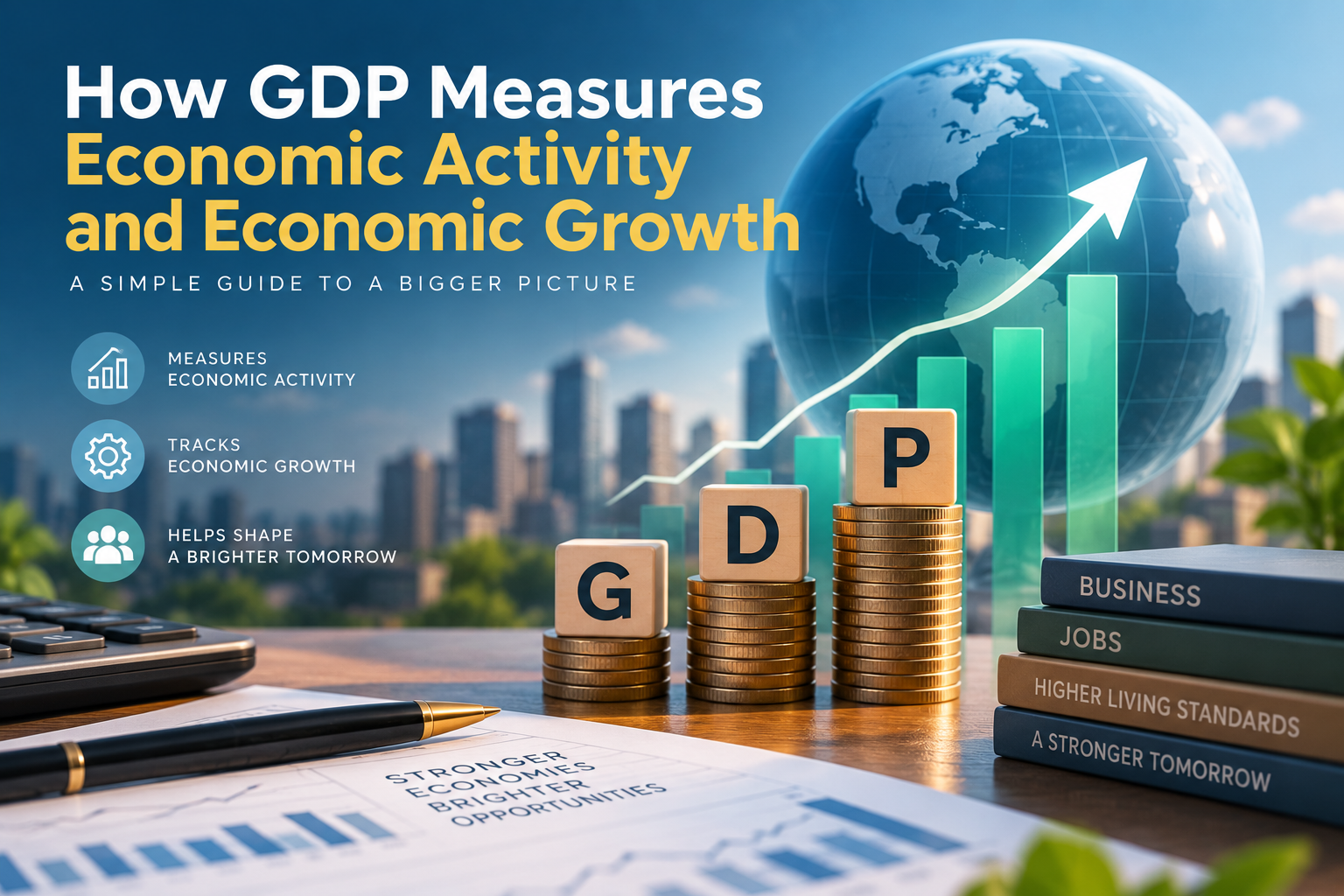
How GDP Measures Economic Activity and Economic Growth
Gross domestic product, commonly known as GDP, is one of the most widely used measures of economic activity. Governments, businesses, economists, investors, and households often look at GDP figures to understand whether an economy is expanding, slowing down, or contracting.
Although GDP is frequently mentioned in financial news, the concept can seem complicated when reduced to headlines about percentages and quarterly growth.
At its core, GDP measures the value of final goods and services produced within an economy over a particular period. Changes in that measure can provide an indication of how economic activity is developing.
GDP is useful, but it is not a complete measurement of economic well-being. Understanding what it measures, how it is calculated, and what its changes mean can make economic reports much easier to interpret.
What Is GDP?
GDP represents the monetary value of final goods and services produced within a country’s borders during a specified period.
The period is usually a quarter or a year.
Goods can include products such as vehicles, food, electronics, machinery, and clothing. Services can include healthcare, education, transportation, financial services, entertainment, and professional services.
The word final is important. GDP generally focuses on goods and services sold for final use rather than counting every intermediate component separately. This helps prevent the same economic output from being counted multiple times.
For example, if a farmer sells wheat to a bakery and the bakery uses that wheat to produce bread for consumers, counting the wheat and the entire value of the bread as separate final outputs would overstate economic activity.
Why GDP Matters
GDP provides a broad picture of the size and activity of an economy.
When GDP increases, it can indicate that businesses are producing more goods and services and that overall economic activity is expanding.
When GDP declines, it may indicate weaker production, spending, investment, or other forms of economic activity.
However, GDP should not be interpreted in isolation. Economists typically examine it alongside other indicators such as employment, inflation, consumer spending, business investment, and productivity.
The Complete Guide to Economic Indicators provides a broader look at the different measures used to understand economic conditions.
How GDP Is Calculated
There are several approaches to measuring GDP, but the expenditure approach is one of the most commonly discussed.
It can be represented as:
GDP = C + I + G + (X − M)
Where:
- C represents consumer spending
- I represents business investment
- G represents government spending
- X represents exports
- M represents imports
The final component, exports minus imports, represents net exports.
These categories capture different sources of demand for goods and services produced within an economy.
Consumer Spending
Consumer spending represents purchases made by households.
It can include spending on:
- Food
- Clothing
- Housing-related services
- Transportation
- Healthcare
- Entertainment
- Personal services
- Electronics and other consumer goods
Consumer spending is often an important part of economic activity because households collectively account for a large share of demand in many economies.
When consumers spend more, businesses may increase production, hire additional workers, or invest in expanding their operations.
When consumers become more cautious, businesses may experience weaker demand.
Business Investment
Business investment measures spending that helps increase productive capacity or supports future economic activity.
Examples can include:
- New machinery
- Buildings
- Equipment
- Software
- Business inventories
- Certain forms of intellectual property
Investment is important because it can influence an economy’s ability to produce goods and services in the future.
A business that purchases new equipment may become more productive. A company that builds a new factory may increase its future output.
Investment therefore has both short-term and long-term implications for economic growth.
Government Spending
Government spending is another component of GDP.
It can include spending on public services, infrastructure, government operations, and other activities.
Government investment in roads, transportation systems, public facilities, and other infrastructure can contribute to economic activity while potentially supporting future productivity.
Not every government financial transaction is treated as GDP-producing spending. For example, certain transfer payments are not payments for newly produced goods or services and are therefore handled differently in GDP calculations.
Exports and Imports
International trade also affects GDP.
Exports are goods and services produced domestically and sold to customers in other countries. They add to domestic production.
Imports are goods and services produced elsewhere and purchased domestically. They are subtracted in the expenditure calculation because consumer, business, or government spending on imports is already included in the relevant spending categories but does not represent domestic production.
The result is the contribution of net exports to GDP.
Nominal GDP and Real GDP
One of the most important distinctions in GDP analysis is the difference between nominal and real GDP.
Nominal GDP measures economic output using current prices.
If prices rise, nominal GDP can increase even when the physical amount of goods and services produced has not changed substantially.
Real GDP adjusts for changes in prices. This makes it more useful for assessing changes in the volume of economic production over time.
Suppose an economy produces roughly the same amount of goods and services in two consecutive years, but prices rise significantly. Nominal GDP could increase because of higher prices even though real production has barely changed.
Real GDP helps separate changes in production from changes caused by price movements.
What GDP Growth Means
Economic growth generally refers to an increase in an economy’s production of goods and services over time.
Real GDP growth is commonly used as an indicator of this expansion.
For example, if real GDP rises from one quarter to the next, it suggests that the economy produced more output after accounting for price changes.
If real GDP falls, economic activity may be weakening.
However, one quarter of growth or contraction does not necessarily establish a long-term trend. GDP can fluctuate because of temporary factors such as weather events, supply disruptions, changes in inventories, unusual consumer spending, or shifts in government activity.
Longer-term patterns are usually more informative than a single data point.
GDP Per Capita Provides Another Perspective
Total GDP tells us about the size of an economy, but it does not directly tell us how much economic output corresponds to each person.
GDP per capita divides GDP by the population.
This can provide a useful perspective when comparing economies of different population sizes.
An economy with a very large population may have a high total GDP but a lower GDP per capita than a smaller economy.
GDP per capita is not a direct measure of individual income or quality of life, but it can help provide context about economic output relative to population.
How Productivity Connects to Economic Growth
Economic growth depends on more than simply increasing the number of workers or resources available.
Productivity—the amount of output produced from a given amount of inputs—is particularly important for long-term growth.
Better technology, improved skills, more efficient processes, stronger infrastructure, and better organization can all contribute to higher productivity.
The relationship between these factors is explored in What Drives Economic Growth and How Productivity Affects Living Standards.
An economy that becomes more productive can potentially produce more goods and services without requiring a proportional increase in resources.
GDP Growth Does Not Mean Everyone Is Better Off
A growing GDP does not automatically mean that every household experiences improved financial circumstances.
Economic growth can be distributed unevenly.
Some industries may expand rapidly while others contract. Some workers may experience wage growth while others face stagnant incomes or job losses.
GDP also does not directly measure how income is distributed throughout society.
For that reason, GDP is best viewed as a measurement of overall economic production rather than a complete measure of household prosperity.
GDP and Employment
Economic activity and employment are often connected.
When businesses experience stronger demand, they may increase production and require additional workers. During periods of weaker economic activity, some businesses may reduce hiring or cut jobs.
The relationship is not always immediate or straightforward, however.
Businesses can sometimes increase output by improving productivity rather than hiring more workers. Similarly, employment can continue changing after GDP growth has slowed or accelerated.
This is why GDP and labor-market indicators are typically examined together.
GDP and Household Finances
Changes in GDP can eventually affect households through employment, wages, business conditions, government policies, and financial markets.
However, the connection between a GDP announcement and an individual’s finances is not always immediate.
For consumers trying to understand how economic growth figures may affect everyday financial decisions, What Does the Latest GDP Report Actually Mean for Your Paycheck, Spending and Savings? provides a more practical perspective.
A strong economy can create favorable conditions for employment and income growth, while a significant slowdown can create greater financial uncertainty.
GDP and Economic Cycles
GDP can also help identify different phases of the economic cycle.
Economies generally experience periods of expansion and slowdown, although the timing, intensity, and causes of these changes vary.
During an expansion, production and economic activity generally increase. A slowdown can involve weaker growth, while a recession represents a more substantial and sustained deterioration in economic activity under commonly used definitions.
Economic activity can influence financial markets as investors adjust expectations about corporate earnings, interest rates, inflation, and monetary policy.
The relationship between economic conditions and markets is discussed in How Economic and Financial Market Cycles Work.
Why GDP Estimates Can Change
GDP figures are not always final when they are first released.
Statistical agencies often publish an initial estimate and later revise it as additional information becomes available.
These revisions can occur because updated data provide a clearer picture of production, spending, trade, inventories, or other components.
This means a headline figure should not always be treated as an unchanging measurement.
Analysts often pay attention to both the initial release and subsequent revisions when evaluating economic trends.
GDP Has Important Limitations
GDP is powerful because it condenses an enormous amount of economic activity into a relatively understandable measurement.
But it has limitations.
GDP does not fully capture:
- Income inequality
- Household financial security
- Unpaid household work
- Leisure time
- Environmental damage
- Overall happiness
- Community well-being
- The quality of many goods and services
- How economic gains are distributed
An economy could record strong GDP growth while experiencing serious environmental problems or rising inequality.
Consequently, policymakers and economists use GDP alongside other measures to develop a more complete picture of economic conditions.
What Can Make GDP Rise?
Several factors can contribute to GDP growth.
Consumer demand can increase production. Businesses can invest in new equipment and facilities. Governments can increase productive spending. Exports can rise. Productivity improvements can allow businesses to produce more efficiently.
Population growth can also increase the potential size of an economy by expanding the workforce and consumer base, although population growth alone does not guarantee higher living standards.
Long-term economic growth is usually the result of multiple factors working together.
What Can Cause GDP to Fall?
GDP can decline for many reasons.
Consumers may reduce spending. Businesses may delay investment. Exports may weaken. Supply disruptions can restrict production. Higher borrowing costs may reduce spending and investment. Economic uncertainty can cause businesses and households to become more cautious.
Major shocks can also affect GDP, including natural disasters, geopolitical disruptions, financial crises, and widespread supply problems.
The underlying cause matters because different economic problems may require different responses.
Why GDP Is Still an Essential Economic Measure
Despite its limitations, GDP remains one of the most important tools for understanding an economy.
It provides a standardized way to track changes in production and compare economic activity across periods.
When combined with information about employment, inflation, productivity, household incomes, trade, and financial conditions, GDP becomes considerably more informative.
The key is to avoid treating one GDP number as a complete description of economic health.
Reading GDP Reports More Carefully
A GDP headline can contain much more information than simply whether the number went up or down.
When reading a GDP report, it can help to consider:
- Was GDP growing or shrinking?
- Was the figure based on real or nominal GDP?
- Which components contributed most to the change?
- Was growth driven by consumers, businesses, government, or trade?
- Was the change temporary or part of a longer trend?
- Were previous figures revised?
- How does GDP compare with employment and inflation data?
Looking at these details provides a more useful understanding of what is happening beneath the headline.
GDP as a Window Into the Economy
GDP is essentially a broad accounting measure of economic production. It helps reveal whether an economy is producing more or less over time and provides a common framework for discussing economic growth.
Real GDP is particularly useful for evaluating changes in production because it accounts for price changes. GDP growth can also provide clues about business conditions, employment prospects, consumer activity, and the broader economic cycle.
Yet GDP should never be confused with a complete measure of prosperity.
A country can produce more while households face rising costs, unequal income gains, or other challenges. That is why GDP is most valuable when viewed alongside the wider collection of economic indicators.
Understanding what drives the number—and what the number leaves out—makes GDP reports far more useful for anyone trying to understand the economy.