**How Business Cycles Affect Economies and Financial Markets
Economies rarely move in a straight line. Periods of strong growth are often followed by slower activity, contractions and eventually renewed expansion. These recurring changes in economic activity are commonly described as business cycles.
Business cycles influence businesses, households, governments and financial markets in different ways. When economic activity accelerates, companies may increase production, hiring and investment. When growth slows, businesses can become more cautious, unemployment may rise and consumers may reduce spending.
Financial markets respond to these changing conditions, but they do not always move in exactly the same direction or at exactly the same time as the broader economy. Investors are constantly assessing not only current conditions but also what they expect to happen next.
Understanding this relationship can make economic data, corporate performance and market movements easier to interpret.
What Is a Business Cycle?
A business cycle describes fluctuations in overall economic activity over time.
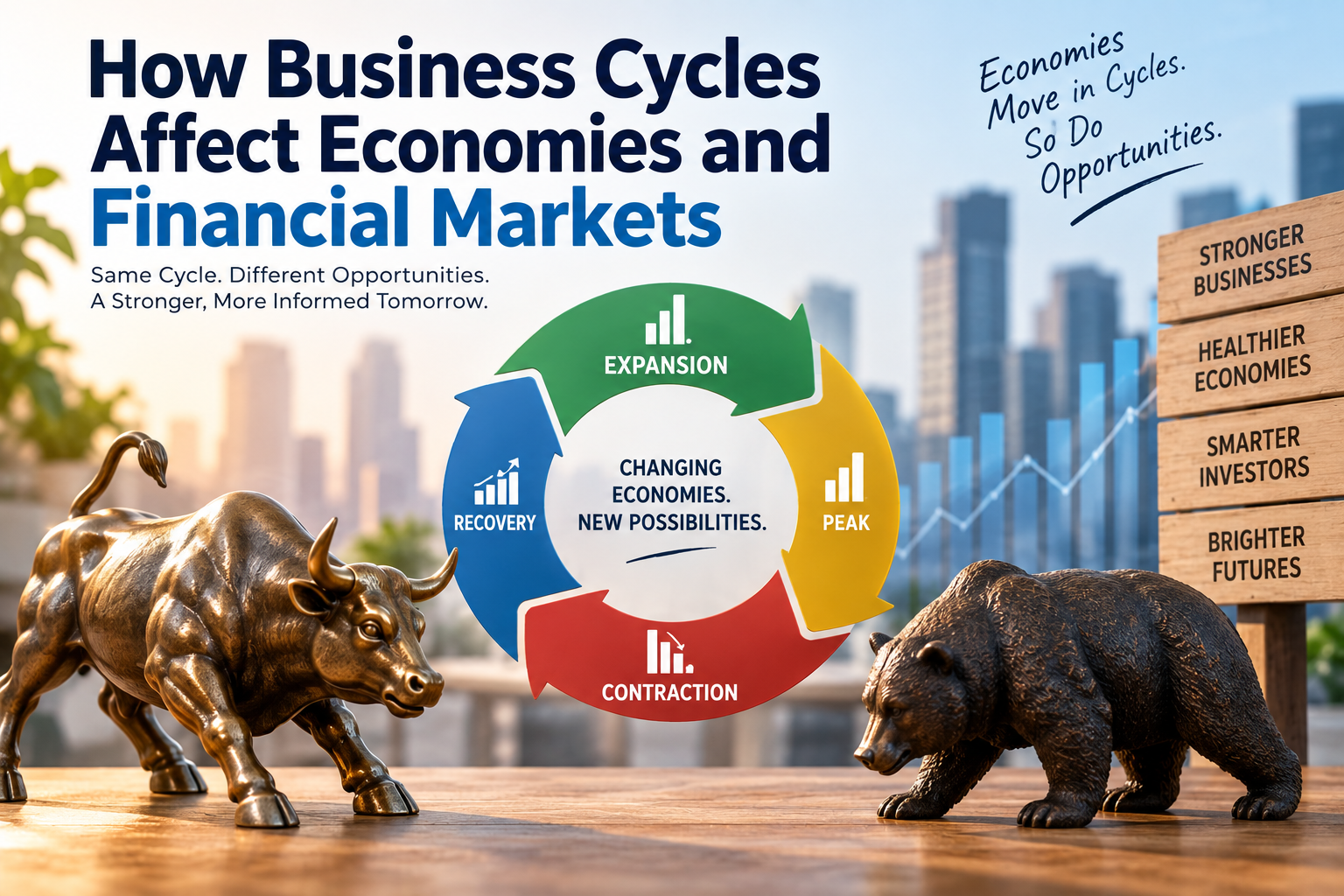
Although individual cycles differ in length and intensity, economists commonly discuss several stages:
- Expansion — economic activity increases.
- Peak — growth reaches a high point before slowing.
- Contraction — economic activity declines or weakens.
- Trough — activity reaches a low point before recovery begins.
These stages are not perfectly symmetrical. Expansions can last for years, while contractions can be relatively brief or prolonged.
Business cycles also differ across countries and regions. A global economy can therefore contain several economies experiencing different phases simultaneously.
For a broader explanation of how these patterns develop, the How Economic and Financial Market Cycles Work guide provides additional context.
What Drives Business Cycles?
There is no single cause behind every economic cycle.
Changes in consumer spending, business investment, interest rates, government policies, financial conditions, productivity, international trade and unexpected disruptions can all influence economic activity.
Consumer demand is particularly important because household spending represents a substantial part of economic activity in many economies.
When consumers feel financially secure, they may spend more on housing, vehicles, travel, entertainment and other goods and services. Businesses respond to stronger demand by increasing production and investment.
The reverse can happen when households become concerned about income, employment or borrowing costs.
How Expansion Changes the Economy
During an expansion, businesses generally experience stronger demand for goods and services.
Companies may respond by:
- Increasing production
- Hiring additional workers
- Expanding facilities
- Purchasing equipment
- Increasing inventories
- Launching new products
- Seeking additional financing
Employment can increase as businesses require more workers, which can support household income and further consumer spending.
Government revenues may also rise as economic activity and taxable income increase.
However, rapid expansion can create its own pressures. Strong demand can contribute to higher prices, tighter labor markets and increased borrowing costs if inflation becomes a concern.
What Happens Near an Economic Peak?
A peak represents a point around which economic growth stops accelerating and begins to slow.
This does not necessarily mean that the economy immediately enters a recession. Instead, it marks a transition from an increasingly strong phase toward slower activity.
Businesses may begin noticing that sales are no longer increasing as quickly. Hiring plans may become more cautious, while investment decisions may receive greater scrutiny.
Financial markets can react before these changes become obvious in official economic statistics because investors continuously assess future conditions.
How Contractions Affect Businesses and Households
During a contraction, economic activity weakens.
Businesses may experience declining sales and respond by reducing production, delaying investments or controlling costs. Some companies may reduce hiring or eliminate positions.
Households can also become more cautious. Concerns about employment or income can encourage people to postpone large purchases and increase savings.
These changes can reinforce one another.
When households spend less, businesses may generate less revenue. Lower business revenue can lead to reduced investment and employment, which can further weaken household spending.
Not every slowdown becomes a severe recession, but prolonged and broad-based contractions can have significant economic consequences.
Why Recessions Matter to Financial Markets
A recession can affect corporate earnings, employment, consumer spending and credit conditions simultaneously.
Companies that depend heavily on consumer demand may see revenues decline. Businesses with substantial debt can face additional pressure when financing becomes more expensive or when cash flows weaken.
Financial markets respond to these changing expectations.
The relationship between recessions and markets is examined in greater detail in How Recessions Happen and Affect Financial Markets.
Why Stock Markets Can Move Before the Economy
One of the most important distinctions between economic activity and financial markets is timing.
Economic statistics are generally designed to describe what has already happened or what is currently happening. Financial markets, by contrast, incorporate expectations about future corporate earnings, interest rates, inflation and economic conditions.
As a result, stock prices can decline while the economy is still growing if investors become concerned about future conditions.
Likewise, markets can begin recovering while economic data still looks weak if investors expect conditions to improve.
This is why a strong economy does not automatically mean that stock prices will rise every day, and a weak economy does not necessarily mean that markets will continue falling.
How Business Earnings Change Through the Cycle
Corporate earnings often respond to changes in economic demand.
During an expansion, rising sales can improve revenue and potentially increase profits. Companies may also benefit from greater utilization of factories, equipment and other resources.
During a slowdown, however, sales growth may weaken.
Companies can attempt to protect profits by reducing expenses, improving efficiency or adjusting prices. The effect varies significantly by industry.
Businesses selling essential products may experience different demand patterns from companies selling discretionary goods such as luxury products, travel services or high-end entertainment.
Different Industries Respond Differently
Business cycles do not affect every sector equally.
Companies connected to construction, manufacturing, automobiles and other economically sensitive industries may experience larger changes in demand as economic conditions shift.
Businesses providing essential goods and services may experience more stable demand.
Financial companies can also be affected by changes in borrowing, credit quality, interest rates and defaults.
Technology companies may respond to business investment trends, consumer demand and financing conditions in different ways depending on their business models.
For investors and analysts, this means that looking only at the overall economy may not provide enough information to understand the performance of a particular company.
Interest Rates Connect the Economy and Markets
Monetary policy is one of the major mechanisms connecting economic conditions with financial markets.
When a central bank changes interest rates, borrowing costs can change throughout the economy. This can influence household spending, business investment, housing activity and financial asset valuations.
Lower interest rates can reduce borrowing costs and potentially encourage spending and investment. Higher rates can have the opposite effect by making credit more expensive and encouraging saving.
The broader transmission process is explained in How Monetary Policy Affects Financial Markets.
Inflation Can Complicate the Business Cycle
Inflation can affect different stages of the business cycle and influence how policymakers respond.
During strong economic expansions, demand can sometimes grow faster than the economy’s ability to supply goods and services. This can contribute to upward pressure on prices.
Higher inflation can reduce purchasing power and increase costs for businesses and households.
If inflation remains elevated, central banks may tighten monetary policy, potentially slowing economic activity.
This creates a delicate relationship between growth, inflation and interest rates.
Employment Is an Important Economic Signal
Labor market conditions often provide valuable information about the state of the economy.
During expansions, companies frequently increase hiring as demand rises. Unemployment can decline, and wage pressures may increase when employers compete for workers.
During downturns, businesses may reduce hiring or cut jobs.
Employment data can therefore help economists, businesses and investors assess whether economic conditions are strengthening or weakening.
However, employment indicators should be considered alongside other measures because no single economic statistic provides a complete picture.
Consumer Spending Can Amplify Economic Changes
Consumer behavior can strengthen or weaken business-cycle movements.
When households increase spending, businesses receive more revenue and may increase production and hiring. Additional employment and income can then support further spending.
During periods of uncertainty, the process can work in reverse.
Households may postpone discretionary purchases, reducing business revenue. Companies may respond by cutting production or investment.
This feedback mechanism helps explain why changes in consumer confidence and spending can receive significant attention from economists and financial markets.
Business Investment Can Magnify the Cycle
Businesses do not invest at a constant rate.
When companies expect strong future demand, they may purchase equipment, build facilities, expand technology infrastructure or increase inventories.
When expectations deteriorate, businesses can delay those decisions.
Because large investment projects can involve substantial amounts of money, changes in business investment can have meaningful effects on economic activity.
Investment decisions can also reveal how companies perceive future conditions, making them relevant to financial-market analysis.
Credit Conditions Can Accelerate a Downturn
Access to credit can play a major role in business cycles.
Businesses often borrow to finance expansion, while households may use credit for homes, vehicles and other major purchases.
When credit is readily available and borrowing costs are manageable, spending and investment can increase.
If lenders become more cautious, interest rates rise sharply or borrowers face deteriorating financial conditions, credit growth can slow.
A reduction in available credit can make an economic slowdown more pronounced by limiting the ability of households and businesses to spend and invest.
Economic Indicators Help Track the Cycle
Because business cycles develop over time, analysts use a broad collection of economic indicators to assess current conditions.
These can include:
- Gross domestic product
- Employment and unemployment
- Consumer spending
- Industrial production
- Retail sales
- Inflation
- Housing activity
- Business investment
- Interest rates
- Consumer confidence
- Business confidence
Some indicators are considered leading indicators because they can provide clues about future activity. Others are coincident or lagging indicators that help describe current or past conditions.
The Complete Guide to Economic Indicators provides a broader framework for understanding these measurements.
Financial Markets Do Not All Respond the Same Way
The phrase “financial markets” covers several different asset classes, and each can react differently to changing economic conditions.
Stocks
Stock prices are influenced by expectations for corporate earnings, interest rates, risk and economic growth.
Bonds
Bond prices are strongly influenced by interest rates and expectations for inflation and future monetary policy.
Currencies
Exchange rates can respond to interest-rate differences, economic conditions, capital flows and expectations about monetary policy.
Commodities
Commodity prices can be influenced by global demand, supply conditions, inventories, weather and geopolitical developments.
Because these markets respond to different factors, an economic slowdown may produce different outcomes across asset classes.
Expectations Can Matter as Much as Current Data
Financial markets are forward-looking.
Suppose economic growth is currently weak but new evidence suggests that activity will recover. Investors may begin adjusting asset prices before the improvement appears clearly in economic statistics.
The opposite can also happen. Strong current economic data may fail to support markets if investors believe growth will weaken later.
This is why market reactions to economic announcements can sometimes appear surprising.
Markets are not simply responding to whether a number is “good” or “bad.” They are also responding to how the information compares with expectations.
Why the Same Economic News Can Affect Assets Differently
An interest-rate increase, for example, can have multiple effects.
Higher rates may make borrowing more expensive and potentially slow economic activity. They can also make newly issued bonds more attractive relative to older securities and influence how investors value future corporate earnings.
Similarly, stronger employment data can indicate a healthy economy but may also increase concerns about inflation or future interest-rate increases.
The market response therefore depends on the wider economic context and what investors had already anticipated.
Recoveries Can Begin Gradually
The transition from contraction to expansion is not always immediate.
Economic activity can stabilize before it begins growing strongly. Businesses may initially remain cautious, while households may continue rebuilding financial security.
Over time, stronger demand can encourage businesses to increase hiring and investment.
Financial markets may begin anticipating this recovery before the improvement becomes obvious across all economic indicators.
This helps explain why the economic cycle and market cycle can appear out of sync.
What Business Cycles Mean for Long-Term Financial Planning
Understanding business cycles can help put short-term economic news into perspective.
Economic expansions will eventually encounter periods of slower growth, while contractions can eventually give way to recovery. The timing and severity of these changes are difficult to determine precisely in advance.
For households and businesses, this reinforces the importance of financial resilience.
Maintaining manageable debt, maintaining appropriate cash reserves and avoiding decisions based entirely on short-term economic headlines can help reduce vulnerability when conditions change.
For investors, understanding the business cycle is one component of evaluating risk, valuation and potential changes in earnings and interest rates. It is not a guarantee of how any individual asset will perform.
Business Cycles Are Connected but Never Identical
Every business cycle has its own characteristics.
One downturn might be driven primarily by financial stress. Another could follow an unexpected external shock. A period of expansion might be supported by strong consumer demand, rising investment or productivity improvements.
The response from governments, central banks, businesses and households can also influence how the cycle develops.
This means historical patterns can provide useful context without providing a precise template for what will happen next.
Reading the Economy Through Multiple Signals
Business cycles affect economies and financial markets through a network of connected forces.
Consumer spending influences business revenue. Business investment affects production and employment. Employment affects household income. Interest rates influence borrowing and investment. Inflation influences purchasing power and monetary policy. Financial markets continuously incorporate expectations about all of these factors.
No single indicator can capture the entire process.
A clearer understanding comes from considering economic growth, employment, inflation, consumer behavior, business investment, credit conditions and monetary policy together.
Why the Business Cycle Matters
Business cycles provide a framework for understanding why economic activity changes and why financial markets can behave differently at different points in time.
During expansions, stronger demand can support business revenue, employment and investment. As growth slows, companies and households may become more cautious. During contractions, weaker demand and tighter financial conditions can place additional pressure on businesses and consumers. Eventually, stabilization and improving expectations can support recovery.
Financial markets add another layer because they respond to expectations as well as current economic conditions.
For households, businesses and investors alike, recognizing these relationships can make economic developments easier to interpret. The business cycle does not provide a simple roadmap for predicting markets, but it does provide a useful framework for understanding how growth, employment, inflation, interest rates, corporate earnings and investor expectations interact over time.