How Families Can Manage Recurring Subscriptions and Memberships
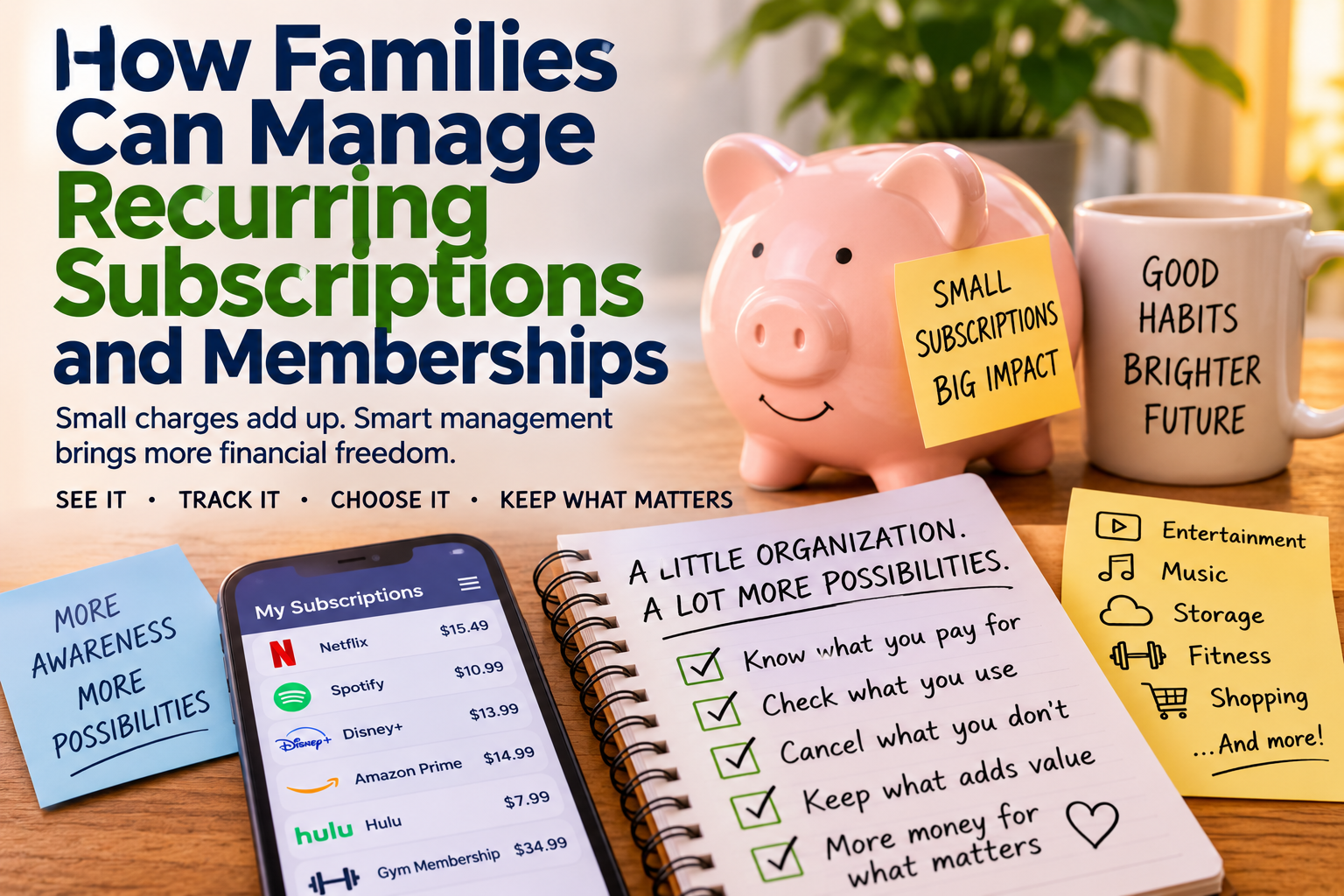
Recurring subscriptions and memberships have become a normal part of household spending. Streaming services, music platforms, cloud storage, fitness memberships, gaming services, software subscriptions, meal programs, educational platforms, and other recurring services can make everyday life more convenient.
The challenge is that these payments are easy to overlook.
A single $10 or $15 monthly charge may not seem significant, but several subscriptions can quietly turn into hundreds of dollars in annual household spending. Families can also end up paying for duplicate services, forgotten memberships, free trials that automatically renew, or subscriptions that nobody uses anymore.
Managing recurring expenses does not necessarily mean eliminating everything enjoyable. It means making sure the services a household continues paying for provide enough value to justify their cost.
With a simple system for reviewing, organizing, and prioritizing subscriptions, families can reduce financial waste while still keeping the services they genuinely use.
Why Recurring Subscriptions Are Easy to Overlook
Recurring payments are different from many everyday purchases because they happen automatically.
A family might consciously decide to sign up for a streaming service in January, but by June, the monthly payment may barely register.
This can happen because recurring charges are often:
- Automatically deducted from a bank account or card
- Relatively small individually
- Spread across multiple payment dates
- Charged through different companies
- Shared among different family members
- Forgotten after the original purchase
- Hidden among many other transactions
The convenience of automatic billing is also what makes these expenses easy to ignore.
A household may therefore continue paying for services long after the original reason for subscribing has disappeared.
Start by Creating a Complete Subscription List
The first step is knowing exactly what the household is paying for.
Instead of trying to remember every subscription, families should review bank statements, credit-card statements, digital wallets, and payment applications.
Create a list containing:
| Subscription | Monthly Cost | Annual Cost | Main User | Renewal Date | Keep? |
|---|---|---|---|---|---|
| Streaming service | $15 | $180 | Family | 12th | Yes |
| Music service | $11 | $132 | Parent | 18th | Review |
| Fitness membership | $35 | $420 | Parent | 3rd | Review |
| Cloud storage | $3 | $36 | Family | 25th | Yes |
The exact categories will vary from household to household.
The important thing is to create one central record.
Once everything is visible, unnecessary spending becomes much easier to identify.
Calculate the Annual Cost
Monthly pricing can make subscriptions appear cheaper than they really are.
A $12 monthly subscription costs:
$12 × 12 = $144 per year
Five subscriptions averaging $12 per month would cost:
$60 × 12 = $720 per year
That calculation can change how a family evaluates recurring expenses.
An expense that feels insignificant each month may represent a substantial amount of money over several years.
Annualizing the cost also makes it easier to compare subscriptions with larger household priorities such as savings, debt repayment, education, home improvements, or family experiences.
Separate Essential Services From Optional Services
Not every recurring expense should be treated equally.
Some subscriptions may be essential to the household.
For example, a family might consider internet service, cloud storage for important files, or educational software necessary.
Other subscriptions may be primarily recreational.
A useful system is to divide recurring expenses into three categories:
Essential
Services the household relies on regularly and would be difficult to replace.
Valuable
Services that are not essential but provide enough consistent value to justify their cost.
Optional
Services that are rarely used or could easily be canceled without significantly affecting daily life.
This classification helps families focus their attention where savings are most likely.
Include Subscriptions in the Family Budget
Subscriptions should not be treated as separate from the household budget.
They are recurring expenses and should be included alongside utilities, insurance, groceries, transportation, housing, and other regular costs.
Families building or improving their financial plan can use [How to Build a Family Budget]How to Build a Family Budget as a useful reference for organizing household income and spending.
Once subscriptions are included in the budget, they become more visible.
Instead of thinking, “It’s only $8 a month,” the household can see how that expense fits into the entire financial picture.
Create a Household Subscription Budget
Some families may find it useful to establish a specific monthly limit for discretionary subscriptions.
For example, a household could decide that entertainment and optional digital services should remain below a predetermined amount each month.
This creates a natural constraint.
When someone wants to add another subscription, the family must decide whether:
- There is room in the budget.
- Another service should be canceled.
- The new service should replace an existing one.
- The service provides enough value to justify increasing spending.
This approach prevents subscription costs from expanding indefinitely.
Watch for Duplicate Services
One of the easiest ways to reduce recurring expenses is to identify services that perform similar functions.
For example, a household might unknowingly maintain multiple:
- Video streaming platforms
- Music services
- Cloud storage accounts
- Fitness memberships
- News subscriptions
- Productivity applications
- Gaming services
- Photo storage platforms
There is nothing wrong with using multiple services if the household genuinely values them.
The problem occurs when overlapping subscriptions provide little additional value.
A family might discover that it is paying for three different cloud-storage plans when one shared service would be sufficient.
Rotate Entertainment Subscriptions
Families do not necessarily need to maintain every entertainment subscription year-round.
One alternative is subscription rotation.
For example, a household might subscribe to one streaming platform for a few months, watch the content it wants, cancel it, and later subscribe to another service.
The same strategy can sometimes work for:
- Streaming platforms
- Audiobook services
- Gaming subscriptions
- Online learning platforms
- Sports services
- Premium applications
Rotation allows families to access different services without paying for all of them simultaneously.
However, households should check cancellation policies, promotional pricing, and renewal terms before switching.
Be Careful With Free Trials
Free trials are a common source of forgotten recurring charges.
A household member may sign up for a seven-day or 30-day trial and forget to cancel before the paid period begins.
A simple solution is to record the trial’s expiration date immediately.
Calendar reminders can be especially useful.
For example:
Free trial started: March 5
Trial ends: March 12
Decision reminder: March 10
This gives the family time to decide whether the service is worth keeping.
Check Whether Annual Plans Actually Save Money
Companies often offer both monthly and annual payment options.
Annual billing can sometimes reduce the effective monthly price, but it is not automatically the better choice.
Before switching to an annual plan, ask:
- Will we use the service for the entire year?
- Is the annual payment refundable?
- Is the service likely to remain useful?
- Is the savings large enough to justify paying upfront?
- Are there cheaper alternatives?
A discount does not represent a saving if the household would not otherwise have purchased the service.
Review Family Sharing Options
Some services offer household or family plans that allow multiple people to use one account.
Where permitted by the service’s terms, family plans can reduce duplicate spending.
Instead of four household members maintaining separate subscriptions, one appropriately priced family plan may provide access for everyone.
Families should compare the total cost rather than assuming that a family plan is automatically cheaper.
It is also important to understand account-sharing rules because some companies restrict how subscriptions can be shared.
Assign Someone to Monitor Recurring Bills
Managing subscriptions becomes easier when responsibility is clear.
In a two-adult household, both partners should ideally understand the family’s recurring expenses, even if one person handles the actual payments.
A monthly review can cover:
- New subscriptions
- Canceled subscriptions
- Price increases
- Annual renewals
- Free trials
- Duplicate services
- Membership usage
- Changes in family needs
This reduces the risk of important recurring charges being overlooked.
Use Expense Tracking Tools
Manual reviews are useful, but expense-tracking tools can make recurring expenses easier to identify.
Some financial applications categorize transactions automatically, while banking applications may provide spending summaries and recurring-payment information.
Families can also use a simple spreadsheet.
The goal is not to create a complicated financial system. It is to make recurring expenses visible enough that they can be reviewed regularly.
For more information about organizing household spending, [How Expense Tracking and Cash Flow Tools Help Manage Household Finances]How Expense Tracking and Cash Flow Tools Help Manage Household Finances explains how these tools can support household financial management.
Include Subscriptions in the Monthly Bill Review
Subscription management should be part of the same process families use to review ordinary household bills.
A monthly financial checkup might include:
- Reviewing bank transactions.
- Checking credit-card statements.
- Identifying recurring charges.
- Comparing spending with the household budget.
- Looking for price increases.
- Checking upcoming annual renewals.
- Canceling services that are no longer useful.
Families can find additional strategies for organizing recurring household expenses in [How to Manage Household Bills and Monthly Expenses]How to Manage Household Bills and Monthly Expenses.
Evaluate Subscriptions Based on Usage
Price alone does not determine whether a subscription is worthwhile.
Usage matters.
Suppose a family pays $20 per month for a service that is used several times each week. That service may provide considerable value.
Another service costing $8 per month might be used only once every three months.
The cheaper subscription could actually be the worse financial decision.
A useful question is:
“How often did we actually use this service during the past month?”
For services used infrequently, cancellation or temporary subscription rotation may make sense.
Consider the Cost Per Use
Another useful measure is cost per use.
Imagine a $30 monthly fitness membership.
If someone uses it 20 times in a month, the cost is:
$30 ÷ 20 = $1.50 per visit
If the same person visits only twice:
$30 ÷ 2 = $15 per visit
This does not mean every expensive service is bad or every frequently used service is good.
It simply provides another way to evaluate value.
The same principle can be applied to streaming platforms, educational memberships, software, gaming services, and other recurring purchases.
Look for Price Increases
Subscription prices can change over time.
A service that originally cost $8 per month might eventually cost $12 or $15.
Small increases across several services can significantly affect annual household spending.
Families should therefore avoid assuming that an old subscription still costs the same amount.
During a monthly or quarterly review, compare current charges with the prices originally expected.
If a service has become substantially more expensive, reassess whether it still deserves a place in the budget.
Be Careful With Promotional Pricing
Some subscriptions use introductory pricing to attract new customers.
A household might sign up for a service at a discounted rate and later begin paying the regular price.
Promotional offers can be useful, but families should know:
- When the promotion ends
- What the standard price will be
- Whether the subscription automatically renews
- Whether cancellation is easy
- Whether a cheaper plan is available
The important number is the long-term cost, not just the introductory price.
Avoid Paying for Convenience You Don’t Need
Convenience has value, but families should decide how much they are willing to pay for it.
A premium subscription might remove advertisements, provide extra storage, unlock additional features, or offer faster service.
Sometimes those benefits are genuinely useful.
Other times, the household may be paying for features nobody uses.
Reviewing the differences between basic, standard, and premium plans can uncover easy savings.
Downgrading rather than canceling completely may be enough.
Teach Children About Recurring Spending
Children and teenagers may increasingly use digital services, gaming platforms, educational applications, and other subscription-based products.
Teaching young people how recurring payments work can help them develop stronger financial habits.
Parents can explain that:
- A subscription continues charging until it is canceled.
- Small monthly amounts add up.
- Free trials can become paid plans.
- Premium features are not always necessary.
- Every subscription competes with other uses of household money.
Older children can even participate in the family’s subscription review.
This turns an ordinary household task into a practical financial lesson.
Reduce Unnecessary Household Spending
Subscription management is one part of a broader strategy for controlling household expenses.
Families may also find savings by reviewing insurance, utilities, food spending, transportation costs, shopping habits, and other discretionary expenses.
The goal is not to eliminate every enjoyable purchase.
Instead, households can look for expenses that provide little value relative to their cost.
[How to Reduce Unnecessary Household Spending]How to Reduce Unnecessary Household Spending provides a broader framework for identifying and reducing avoidable household spending.
Create a Subscription-Free Period
Some families may benefit from a temporary subscription reset.
For example, a household could spend one month reviewing and canceling services that are not being used.
This does not mean permanently eliminating every subscription.
It simply creates a clean starting point.
After the reset, each service can be reintroduced only when there is a clear reason to do so.
This can prevent old subscriptions from accumulating again.
Keep a Cancellation Record
It can be useful to maintain a simple record of canceled services.
Include:
- Service name
- Cancellation date
- Final billing date
- Confirmation number, if applicable
- Whether access continues until the end of the billing period
This provides documentation if a company continues charging after cancellation.
Families should also check subsequent bank or card statements to confirm that recurring charges have actually stopped.
Don’t Confuse Sunk Costs With Future Value
Sometimes people continue paying for a subscription because they have already paid for it for months.
But money spent in the past cannot be recovered by continuing to pay.
The better question is:
“If we did not already have this subscription, would we sign up for it today at its current price?”
If the answer is no, that may be a strong signal that the subscription deserves another review.
A Simple Quarterly Subscription Review
A quarterly review can keep recurring expenses under control without requiring constant monitoring.
Every three months, families can ask:
What Are We Using?
Identify subscriptions that are actively used.
What Has Changed?
Look for price increases, new family needs, or changes in usage.
What Overlaps?
Identify services that provide similar benefits.
What Can We Pause?
Some subscriptions may be useful occasionally rather than continuously.
What Should We Cancel?
Remove services that no longer justify their cost.
What Should We Keep?
Keep subscriptions that consistently provide meaningful value.
A quarterly review is often enough to prevent subscription spending from becoming invisible.
A Practical Subscription Management System
Families looking for a simple system can use five categories:
Keep: Frequently used and worthwhile.
Downgrade: Useful, but a cheaper plan would work.
Rotate: Valuable occasionally but unnecessary year-round.
Review: Usage or value is uncertain.
Cancel: Little or no meaningful household benefit.
This system turns subscription management into a straightforward decision-making process.
Making Recurring Spending More Intentional
Recurring subscriptions are not inherently bad.
They can provide entertainment, education, convenience, communication, productivity, fitness, and other valuable services.
The problem is not having subscriptions.
The problem is allowing them to continue automatically without periodically asking whether they still deserve a place in the household budget.
Families can make recurring spending more intentional by keeping a complete list, calculating annual costs, reviewing usage, watching for price increases, eliminating duplication, and making subscription reviews part of their normal financial routine.
When recurring expenses are visible and evaluated regularly, households can spend less on services they barely use while protecting the subscriptions that genuinely make everyday life better. Over time, that simple habit can free up money for the things families value most.