How Children’s Allowances Can Work
Children’s allowances can be a practical way for parents to introduce money into everyday family life. Instead of learning about spending, saving and earning only through conversations, children can begin making small financial decisions with money they actually control.
An allowance does not have to be large, complicated or tied to every household task. Families can structure allowances in different ways depending on a child’s age, maturity, family budget and the lessons parents want to teach.
When used thoughtfully, an allowance can help children understand that money is limited, choices have consequences and saving often requires patience. It can also create opportunities for parents and children to talk about financial decisions without making every conversation about money feel like a formal lesson.
What Is a Children’s Allowance?
A children’s allowance is money regularly provided to a child for personal spending, saving or other purposes.
The amount and schedule can vary considerably. Some families provide money weekly, while others use a monthly system. Some give a fixed amount regardless of household chores, while others connect at least part of the allowance to completing agreed responsibilities.
The important feature is that the child has some control over the money. That control creates opportunities to practice making choices.
For example, a child might receive an allowance and decide to:
- Spend some of it on a small treat.
- Save some for a larger purchase.
- Set aside money for a gift.
- Keep a portion for future use.
- Donate some money if the family includes charitable giving in its financial discussions.
The purpose is not simply to give children spending money. It is to give them a manageable environment in which they can practice financial decision-making.
Why Allowances Can Be Useful for Children
Money concepts can be difficult for children to understand when they remain abstract. Telling a child that saving is important is different from giving them an opportunity to save toward something they want.
An allowance can turn financial concepts into experiences.
Children can learn that spending money reduces what remains available. They can see that saving over several weeks makes a larger purchase possible. They can also discover that buying something immediately may mean waiting longer for another goal.
These experiences can complement broader conversations about money. Families looking for age-appropriate ways to explain financial concepts can also explore how to teach children about money.
Allowances can help children practice:
- Budgeting: deciding how much money can be spent now.
- Saving: setting money aside for future goals.
- Prioritizing: choosing between competing wants.
- Delayed gratification: waiting for something instead of buying immediately.
- Planning: thinking about what money will be needed for later.
- Responsibility: managing a limited amount of money independently.
- Decision-making: accepting that every purchase involves a trade-off.
These lessons can become more meaningful as children grow and their financial responsibilities increase.
Should Allowances Be Earned or Given?
One of the most common questions parents face is whether children should receive an allowance simply because they are part of the family or whether they should earn it through chores.
There is no single system that works for every household.
A Regular Allowance
Under a regular allowance system, a child receives a predetermined amount on a consistent schedule.
For example, a family might provide a weekly allowance regardless of whether routine household responsibilities are completed.
This approach can separate two concepts: being a member of a household and being responsible for contributing to it.
Parents may still expect children to perform ordinary age-appropriate responsibilities without treating every task as a paid service.
A Chore-Based Allowance
Another approach links some or all allowance money to specific responsibilities.
A child might have a list of agreed tasks and receive money when those tasks are completed properly.
This can introduce a connection between effort and income. However, parents need to decide which responsibilities are simply part of family life and which are optional paid tasks.
A Hybrid System
Some families combine both approaches.
A child could receive a basic allowance while having opportunities to earn additional money for extra jobs.
For example:
- Regular allowance: a fixed weekly amount.
- Routine chores: expected as part of family responsibilities.
- Extra jobs: optional opportunities to earn additional money.
- Saving: encouraged through a specific savings goal.
This system can provide consistency while also introducing the idea that additional work can generate additional income.
How Much Should a Child Receive?
There is no universally correct allowance amount.
A useful starting point is to consider what the allowance is supposed to accomplish.
If the money is intended primarily to teach budgeting, the amount needs to be large enough to allow meaningful choices but small enough that mistakes remain manageable.
Parents can consider:
- The child’s age.
- What expenses the child is expected to cover.
- How frequently money will be provided.
- The family’s overall financial circumstances.
- Whether children have other opportunities to earn money.
- Whether the allowance includes money for saving, spending or giving.
- What parents can provide consistently.
An allowance should fit within the family’s financial reality. There is little value in creating a complicated system that places unnecessary pressure on household finances.
The goal is financial education, not competition between families over how much children receive.
Give Children Some Freedom to Make Mistakes
An allowance works partly because children get to make decisions.
That means parents may occasionally watch a child spend money on something they consider unnecessary.
If the purchase is safe and age-appropriate, allowing the child to experience the consequence can be more educational than immediately preventing the decision.
For example, a child may spend most of a week’s allowance on a toy and then have no money left for another item they want later.
Instead of replacing the money, parents can use the situation as a teaching opportunity.
Questions might include:
- “Are you happy with what you bought?”
- “What would you do differently next time?”
- “What are you saving for?”
- “How long would it take to save for that?”
- “Would you rather spend now or wait?”
The objective is to encourage reflection rather than shame the child for making a small financial mistake.
Introduce Spending and Saving at the Same Time
An allowance does not have to be entirely for spending.
Families can divide the money into different categories to make financial priorities visible.
A simple system might include:
| Category | Purpose |
|---|---|
| Spend | Money available for immediate purchases |
| Save | Money reserved for a future goal |
| Give | Money intended for gifts or charitable purposes |
| Long-term | Money that the child is encouraged to leave untouched |
Younger children may find physical containers useful because they can see the money accumulating.
Older children can use a simple notebook, spreadsheet or age-appropriate digital system to track balances.
The method matters less than the habit of knowing where money goes.
Allowances Can Teach Budgeting
A child who receives money regularly has a natural opportunity to practice a basic budget.
Suppose a child receives $10 each week. Rather than simply spending the entire amount, the child could decide in advance how much to allocate to different goals.
For example:
- $5 for spending.
- $3 for a savings goal.
- $1 for gifts.
- $1 for another long-term purpose.
The actual amounts are less important than the process of allocating limited resources.
As children become older, parents can gradually introduce more sophisticated budgeting concepts.
They might learn to distinguish between:
- Needs and wants.
- Short-term and long-term goals.
- Regular and occasional expenses.
- Planned and impulse purchases.
- Income and spending.
- Available cash and money already committed to a goal.
These concepts eventually become part of adult financial management, so practicing them on a small scale can make them easier to understand later.
Connect Allowances to Financial Goals
Saving becomes easier for children to understand when there is a clear purpose behind it.
Instead of simply saying, “Save your money,” parents can help children identify a specific goal.
For example:
“You want a bicycle that costs $80. If you save $5 each week, how many weeks will it take?”
The child can then watch the savings grow and understand the relationship between time, money and the desired purchase.
Goals can be:
- A toy.
- A book.
- Sports equipment.
- A birthday gift for someone else.
- A special outing.
- A larger hobby purchase.
Parents can also help children distinguish between goals that are close and goals that require longer-term saving.
This introduces the idea that not every financial objective can be achieved immediately.
Avoid Turning Every Household Task Into a Transaction
Paying children for every small household responsibility can unintentionally make family life feel transactional.
Some responsibilities are simply part of living together.
Making a bed, putting away personal belongings or helping with ordinary household routines may be treated as expected contributions rather than paid work.
Extra jobs can be handled differently.
For example, a parent might offer payment for:
- Cleaning a storage area.
- Washing a family vehicle.
- Helping organize a garage.
- Completing an unusually large household project.
- Performing an age-appropriate task beyond normal responsibilities.
This distinction can help children understand both responsibility and earning.
Make Allowance Day Predictable
Consistency can make an allowance system easier to manage.
Parents can choose a regular day and method for providing the money.
For example, allowance day might be every Saturday morning.
A predictable routine gives children an opportunity to:
- Receive their allowance.
- Check how much they have.
- Allocate money between spending and saving.
- Update a savings goal.
- Discuss upcoming purchases if needed.
This can become a small weekly financial routine rather than an occasional event.
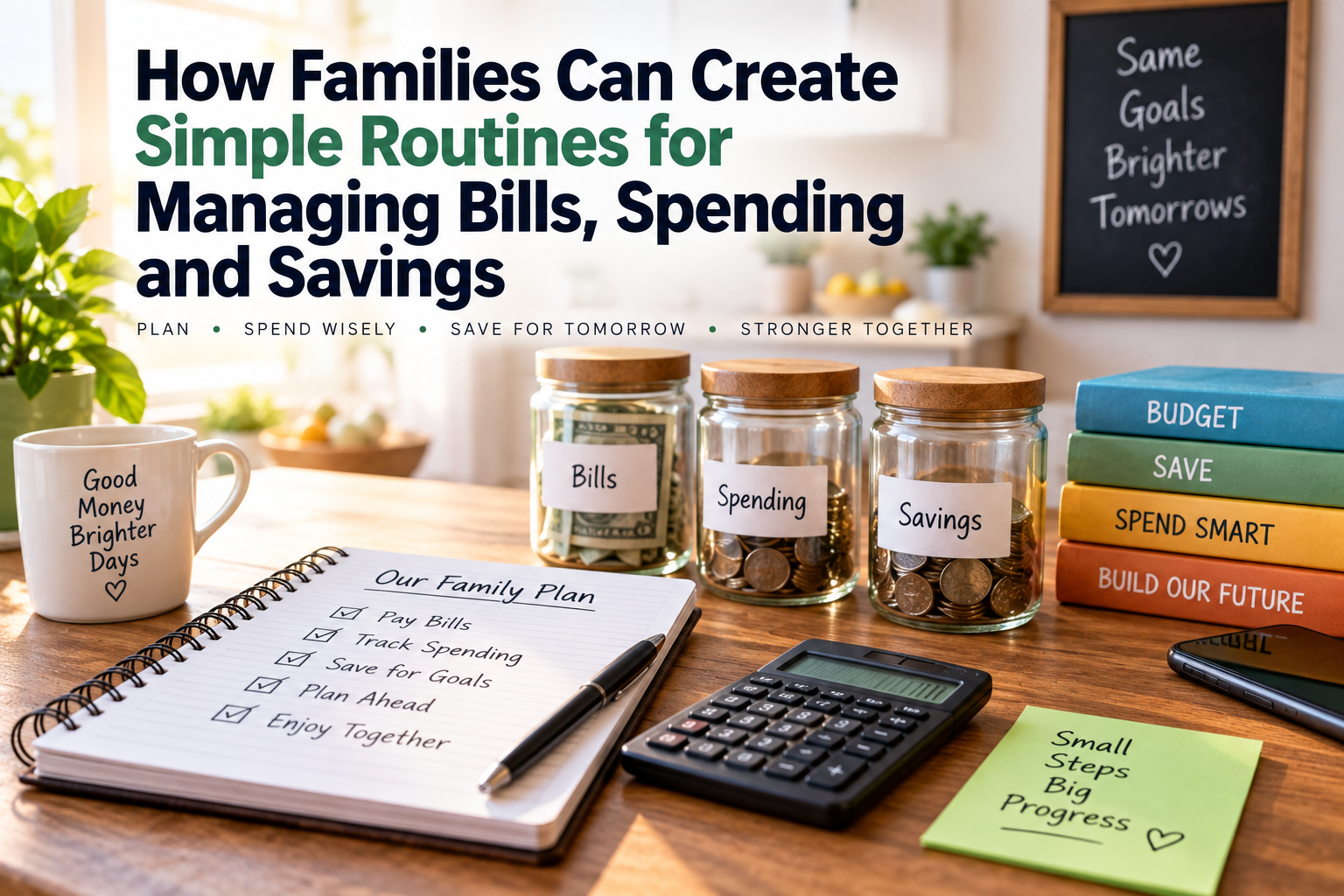
Families can also build money management into broader household routines. Establishing simple routines for managing bills, spending and savings can help parents demonstrate how money decisions fit into everyday family life.
Use Allowances to Teach Needs Versus Wants
One of the most important money distinctions children can learn is the difference between something they need and something they simply want.
Allowance money provides a practical setting for discussing the difference.
For example, a child might want a particular snack, toy or game. Parents can ask the child to consider whether the purchase is:
- Necessary.
- Useful but optional.
- Mainly for entertainment.
- Something they would enjoy briefly.
- Something they have wanted for a long time.
The purpose is not to prevent children from buying things they enjoy.
Learning about money also involves understanding that discretionary spending is legitimate. The lesson is that wants have to fit within available resources.
Teach Children to Compare Prices
As children get older, allowance decisions can become opportunities to introduce comparison shopping.
A child who wants a particular item can learn to ask:
- Does another store sell it for less?
- Is there a cheaper version?
- Will buying it now interfere with another savings goal?
- Is the product likely to be used often?
- Is the difference in price worth paying?
These questions encourage thoughtful purchasing instead of automatic spending.
Parents do not need to turn every small purchase into an extensive research project. Even occasional comparisons can demonstrate that consumers have choices.
Allowances and Family Budgets
An allowance should be treated as one part of the household’s broader financial picture.
Parents may already have a system for tracking income, expenses, savings and financial goals. Understanding how to build a family budget can provide a useful framework for thinking about where children’s allowances fit into household spending.
For example, parents can decide in advance:
- How much the family can comfortably allocate to allowances.
- Which expenses parents will continue to cover.
- Which discretionary purchases children are expected to fund themselves.
- Whether extra chores can generate additional income.
- Whether parents will provide occasional bonuses.
- How savings goals will be handled.
This prevents allowance decisions from being made differently from week to week.
What Should Parents Continue to Pay For?
This depends heavily on the child’s age and family circumstances.
Parents generally need to establish clear boundaries around what the allowance is intended to cover.
For younger children, parents may continue paying for virtually all necessities while the allowance is simply discretionary money.
Older children may gradually take responsibility for certain personal expenses.
Possible categories include:
| Expense | Possible approach |
|---|---|
| Food at home | Parent-funded |
| School essentials | Parent-funded |
| Basic clothing | Parent-funded |
| Toys and small treats | Child-funded |
| Optional hobbies | Shared or child-funded |
| Gifts for friends | Child-funded |
| Larger purchases | Saving or shared contribution |
These are examples rather than universal rules. A family’s financial situation, cultural expectations and the child’s age should shape the arrangement.
What Happens When a Child Spends Everything?
Running out of allowance can be part of the learning process.
If a child spends the entire amount early in the week, parents may be tempted to provide more money immediately.
Doing so can remove the budgeting lesson.
Instead, parents can explain when the next allowance will arrive and allow the child to plan around the remaining time.
This does not mean parents should refuse necessary expenses or leave a child without something essential. The distinction is between necessities and discretionary purchases.
A small mistake with spending can teach an important lesson while the financial stakes are still low.
Avoid Using Allowances as a Tool for Punishment
Parents may sometimes consider withholding allowance when a child misbehaves.
This can complicate the lessons the allowance is supposed to teach.
If allowance is being used as a financial education tool, parents may prefer to keep the money system predictable and handle discipline separately.
Similarly, parents can avoid using money to control every aspect of a child’s behavior.
The objective is to help children develop financial skills and responsibility, not to make them anxious about losing access to money whenever they make an ordinary mistake.
Adapt the System as Children Grow
An allowance system that works for a six-year-old may not work for a teenager.
Younger children may benefit from:
- Small amounts.
- Physical cash.
- Simple savings containers.
- Short-term goals.
- Frequent conversations.
Older children may be ready for:
- Larger financial responsibilities.
- Longer-term savings goals.
- Budgeting for personal expenses.
- Bank accounts where appropriate.
- Tracking income and spending.
- Comparing prices.
- Understanding financial trade-offs.
The system can therefore evolve instead of remaining fixed throughout childhood.
Teenagers Can Take on More Financial Responsibility
For teenagers, an allowance can become part of a broader preparation for adulthood.
Parents might gradually shift certain discretionary expenses to the teenager while explaining the limits of the arrangement.
For example, a teenager could be responsible for budgeting money for entertainment, small personal purchases or gifts.
This creates an opportunity to practice managing money over a longer period.
Instead of receiving money whenever a purchase comes up, the teenager learns to consider whether enough money is available.
That transition can make the difference between simply receiving money and actually managing it.
Parents Should Agree on the Rules
In households with two parents or caregivers, consistency can make the allowance system easier for children to understand.
Adults should ideally agree on:
- The allowance amount.
- The payment schedule.
- Which chores are expected.
- Which tasks can earn extra money.
- What the allowance covers.
- Whether parents will provide advances.
- How savings goals will be handled.
- How changes to the system will be communicated.
Money disagreements between adults can otherwise create confusing signals for children.
For households managing finances together, understanding the principles in the complete guide to couples and money management can also help parents establish clearer financial expectations.
Common Allowance Mistakes to Avoid
An allowance system does not need to be perfect, but certain problems can reduce its educational value.
Changing the Rules Constantly
Children need to know what to expect.
If the allowance amount, schedule or requirements change every week, it becomes harder for them to plan.
Giving Too Much Too Soon
An allowance should provide meaningful choices without removing the need to make choices.
If children receive more money than they can reasonably manage, they may not develop useful budgeting habits.
Rescuing Every Bad Purchase
Replacing money immediately after every poor decision can prevent children from experiencing natural financial consequences.
Making Every Chore Paid
Children can learn that contributing to a household is a responsibility rather than something that always requires payment.
Turning Money Into a Source of Shame
Financial mistakes are opportunities to learn. Criticizing a child harshly for spending money can make financial conversations more difficult in the future.
Focusing Only on Saving
Saving is important, but children also need to learn how to spend thoughtfully.
The goal is not to teach children that spending money is inherently bad. It is to help them understand how spending fits alongside other priorities.
A Simple Allowance Framework for Families
Families that want to start without creating a complicated system can begin with a few basic rules.
1. Choose a regular amount.
Select an amount that fits the family’s budget and the child’s age.
2. Set a consistent schedule.
Weekly allowances are often simple for younger children, while older children may eventually manage money over longer periods.
3. Decide what the allowance covers.
Be clear about which purchases remain the parents’ responsibility.
4. Establish household responsibilities.
Separate ordinary family chores from optional paid tasks if that fits the family’s approach.
5. Encourage a savings goal.
Help the child choose something meaningful to save toward.
6. Allow reasonable mistakes.
Let children experience the consequences of discretionary choices when the stakes are low.
7. Review the system occasionally.
As the child grows, increase responsibility and adjust the arrangement when necessary.
This approach keeps the system simple enough to maintain while still creating opportunities for financial learning.
The Bigger Lesson Behind an Allowance
An allowance is ultimately less about the amount of money a child receives than what the child learns from managing it.
A small weekly amount can introduce concepts that become increasingly important throughout adulthood: limited resources, planning, trade-offs, saving, spending and personal responsibility.
Parents do not need to turn every allowance payment into a lecture. Everyday moments are often enough.
A child who wants something expensive can learn about saving. A child who spends too quickly can learn about planning. A child who compares prices can learn about value. A child who saves for someone else’s gift can learn about generosity.
Over time, these small experiences can help make money a normal subject for family conversations rather than something children encounter only when they become adults.
The most useful allowance system is therefore one that fits the household, gives children appropriate independence and creates regular opportunities to practice making financial decisions.