How Economic Cycles Differ From Market Cycles
Economic cycles and market cycles are closely connected, but they are not the same thing. Both describe periods of expansion and contraction, yet they measure different aspects of economic and financial activity.
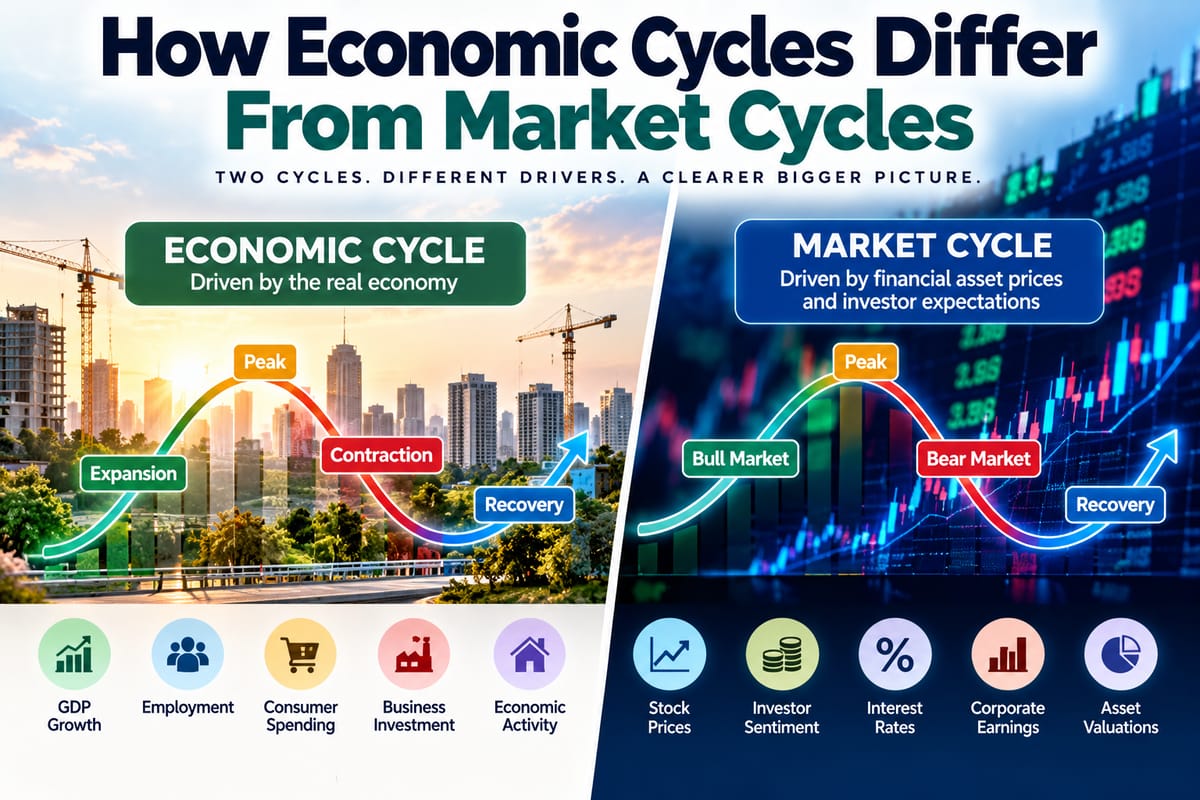
An economic cycle generally describes changes in overall economic activity, including production, employment, income, consumer spending, and business investment. A market cycle describes changes in the prices and behavior of financial assets such as stocks, bonds, and other investments.
Understanding the distinction can make it easier to interpret economic data, financial market movements, recessions, recoveries, and periods of strong or weak investor confidence.
What Is an Economic Cycle?
An economic cycle is the recurring pattern of expansion and contraction in economic activity.
During an expansion, businesses may increase production, employment can grow, consumers may spend more, and investment activity can strengthen.
Eventually, growth may slow. Economic activity can reach a peak before entering a period of contraction. If the contraction becomes sufficiently broad and persistent, it may be described as a recession.
After a period of contraction, economic activity can stabilize and begin expanding again.
The exact duration and intensity of these phases vary. Economic cycles do not follow a perfectly predictable timetable.
The Main Phases of an Economic Cycle
Economic cycles are commonly described using several phases:
- Expansion: Economic activity increases.
- Peak: Growth reaches a high point before slowing.
- Contraction: Economic activity weakens.
- Trough: Activity reaches a low point before beginning to recover.
- Recovery: Economic conditions improve and expansion resumes.
These phases are useful for describing broad economic patterns, but real economies rarely move neatly from one stage to another.
Different sectors can also experience different conditions at the same time.
What Is a Market Cycle?
A market cycle describes recurring changes in financial asset prices and investor behavior.
Stock markets, for example, can experience extended periods of rising prices followed by periods of declining prices. Investor expectations, valuations, interest rates, corporate earnings, liquidity, economic conditions, and sentiment can all influence these movements.
Market cycles can occur before, during, or after corresponding changes in the broader economy.
This is one of the most important differences between the two concepts: financial markets are forward-looking, while many economic indicators describe conditions that have already occurred or are currently developing.
Why Economic and Market Cycles Do Not Always Match
Financial markets are influenced by expectations about the future.
Suppose economic growth is slowing, but investors increasingly believe that inflation will decline and interest rates will eventually fall. Stock prices could respond positively to those expectations even while current economic data remains weak.
The reverse can also happen.
An economy may still be growing strongly, but investors may become concerned that growth will slow in the future. Financial markets can decline before the weakness becomes obvious in employment, production, or consumer spending data.
As a result, market cycles can lead economic cycles.
Understanding Economic Indicators
Economic data helps provide information about where an economy may be within its broader cycle.
The Complete Guide to Economic Indicators provides a broader framework for understanding measures such as employment, inflation, GDP, consumer activity, and other indicators.
Some indicators provide information about current conditions, while others can offer clues about future activity.
Examples include:
- Gross domestic product
- Employment and unemployment
- Consumer spending
- Business investment
- Industrial production
- Housing activity
- Inflation
- Retail sales
- Consumer confidence
No single indicator provides a complete picture of the economy.
Economic Cycles Are About the Real Economy
One useful way to distinguish the two cycles is to focus on what they measure.
Economic cycles are primarily concerned with activity in the real economy.
That includes whether businesses are producing more goods and services, whether people are employed, whether consumers are spending, and whether companies are investing.
A financial market can rise or fall without an immediate equivalent change in the production of goods and services.
For example, stock prices can change substantially in a single trading session even though the underlying economy cannot physically expand or contract at the same speed.
Market Cycles Are About Financial Prices and Expectations
Market cycles focus more directly on asset prices, valuations, investor positioning, and expectations.
A stock market cycle can be influenced by expectations about:
- Corporate earnings
- Interest rates
- Inflation
- Economic growth
- Government policy
- Global events
- Credit conditions
- Investor sentiment
- Future business conditions
Because markets constantly incorporate new information, prices can move before changes appear in traditional economic statistics.
Business Cycles and Economic Cycles
The terms “business cycle” and “economic cycle” are often used in similar ways.
Both can describe fluctuations in economic activity over time.
The way business cycles affect economies and financial markets helps illustrate the relationship between changes in production, employment, investment, corporate activity, and financial conditions.
Business activity is an important part of the broader economy. When companies increase hiring and investment, the effects can spread through households, suppliers, financial institutions, and other businesses.
When companies cut production and investment, the effects can move in the opposite direction.
Why Markets Can Turn Before a Recession
A recession represents a period of significant economic weakness, but investors do not necessarily wait until a recession is officially identified before changing their expectations.
Financial markets can respond to signs that economic growth is weakening.
For example, investors may react to declining business surveys, weaker corporate earnings forecasts, tightening credit conditions, or changes in interest-rate expectations.
This means a stock market decline can sometimes occur before a recession becomes visible in a broad range of economic statistics.
Similarly, financial markets can begin recovering while economic conditions are still difficult because investors anticipate future improvement.
How Recessions Affect Financial Markets
Recessions can affect corporate revenues, profits, employment, consumer spending, credit demand, and business investment.
The relationship between these conditions and asset prices can be complex.
The way recessions happen and affect financial markets provides additional context for understanding how economic contractions can influence financial conditions.
During a recession, some businesses may experience falling demand while others may be less affected or even benefit from changes in consumer behavior.
Financial markets therefore do not respond uniformly to every economic downturn.
Market Cycles Can Be Different Across Asset Classes
There is not necessarily one universal market cycle affecting every financial asset in exactly the same way.
Stocks, bonds, commodities, real estate, and currencies can respond differently to the same economic conditions.
For example, higher interest rates may create pressure for some stock valuations while increasing the income available from newly issued bonds.
Commodity prices may respond more directly to changes in global supply and demand.
Real estate markets can respond to borrowing costs, household incomes, construction activity, and local housing supply.
This means investors and analysts often examine individual asset classes rather than treating “the market” as a single entity.
Interest Rates Connect the Economy and Financial Markets
Interest rates are one of the major links between economic and market cycles.
Central banks may adjust monetary policy in response to inflation, employment, economic growth, and other conditions.
Changes in interest rates can affect borrowing costs for households and businesses. They can also influence bond yields, equity valuations, currency markets, housing activity, and investment decisions.
Because monetary policy affects both financial conditions and economic activity, changes in interest-rate expectations can cause financial markets to move before their full effects reach the wider economy.
Inflation Can Influence Both Cycles
Inflation is another important connection.
Rapid price increases can reduce household purchasing power and increase costs for businesses. Central banks may respond by tightening monetary policy, which can affect borrowing and investment.
Financial markets may react to inflation data immediately because investors are also considering what the data could mean for future interest rates.
The economy, meanwhile, may take longer to respond to changing monetary conditions.
This difference in timing is another reason economic and market cycles do not always move together.
Market Expectations Can Change Quickly
Economic conditions tend to change over months or years, although individual indicators can move much faster.
Financial markets can change within minutes.
A new economic report, corporate earnings announcement, central bank decision, or unexpected geopolitical event can cause investors to rapidly revise their expectations.
This creates a major difference in speed.
An economy consists of millions of households and businesses making decisions over time. A financial market can reprice assets almost immediately when new information becomes available.
Economic Data Can Be Revised
Another complication is that economic statistics are sometimes revised.
Initial estimates of GDP, employment, production, or other measures may later be updated as additional information becomes available.
Investors may therefore react to an initial estimate even though the final measurement later looks different.
This does not make economic data unhelpful. It simply means that analysts need to consider both the initial release and subsequent revisions when evaluating historical conditions.
Different Sectors Can Be in Different Cycles
An economy is made up of many industries, and they do not always move together.
Housing, manufacturing, technology, energy, transportation, tourism, agriculture, and financial services can experience different conditions at the same time.
For example, a strong technology investment cycle could coexist with weakness in residential construction.
This creates another reason why broad economic measures and financial market indexes should not be interpreted as perfect representations of every business or household.
How Economic and Financial Market Cycles Interact
Economic and market cycles are separate concepts, but they influence one another.
Strong economic growth can support corporate revenues and earnings, which may affect stock valuations.
Financial market declines can reduce household wealth and make companies more cautious about investment.
Tighter financial conditions can also affect borrowing and spending.
The relationship therefore works in both directions.
The broader framework of how economic and financial market cycles work helps explain these interactions and the different factors that can cause cycles to develop.
Why Timing Matters
Timing is one of the biggest reasons economic cycles and market cycles can appear out of sync.
Imagine an economy that has begun slowing after a long period of expansion.
Economic data may continue showing relatively strong activity because businesses and households are still operating on decisions made months earlier.
At the same time, investors may already be anticipating weaker conditions and adjusting financial asset prices.
Later, when economic data confirms the slowdown, markets may have already moved substantially.
The opposite can occur during recovery periods.
The Difference Between Economic Recovery and Market Recovery
An economic recovery occurs when broader economic activity begins improving after a period of weakness.
A market recovery refers to financial asset prices recovering from previous declines.
These recoveries can occur at different times.
Financial markets may begin rising because investors expect stronger future economic conditions, even while unemployment remains elevated or consumer spending is still weak.
As economic conditions improve, those expectations may eventually be reflected in stronger production, employment, and business activity.
Why Investors Watch Both
Understanding both cycles can provide a more complete picture of economic and financial conditions.
Economic indicators can help show what is happening in employment, production, inflation, spending, and investment.
Market prices can reveal how investors are currently assessing future conditions and risks.
Neither provides a perfect forecast.
Economic data can arrive with delays and revisions, while market prices can be influenced by expectations that later prove incorrect.
Looking at both can therefore help distinguish current economic conditions from expectations about what may happen next.
A Cycle Is Not a Simple Calendar
Economic and market cycles do not operate according to a fixed schedule.
An expansion does not automatically last a particular number of years. A market decline does not always have the same duration or severity as previous declines.
The causes of each cycle can also differ.
One period might be shaped by inflation and monetary policy, while another could be influenced by financial stress, supply disruptions, changes in consumer behavior, technological developments, or external shocks.
Historical cycles can provide useful context, but they should not be treated as identical repetitions.
Economic Cycles and Market Cycles Tell Different Stories
Economic cycles describe changes in the activity of the broader economy, while market cycles describe changes in financial asset prices and investor expectations.
The two interact continuously, but they operate at different speeds and respond to different combinations of information.
Economic data can reveal how households, businesses, and governments are behaving. Financial markets can reveal how investors are pricing expectations about future conditions.
Understanding the distinction makes it easier to interpret situations in which markets rise while economic data remains weak, or markets fall while the economy is still expanding.
Rather than expecting the two cycles to move in perfect synchronization, it is more useful to recognize that they are connected parts of a larger economic and financial system.