Gold Nears $4,400: Why Investors Are Turning to Gold Again in 2026
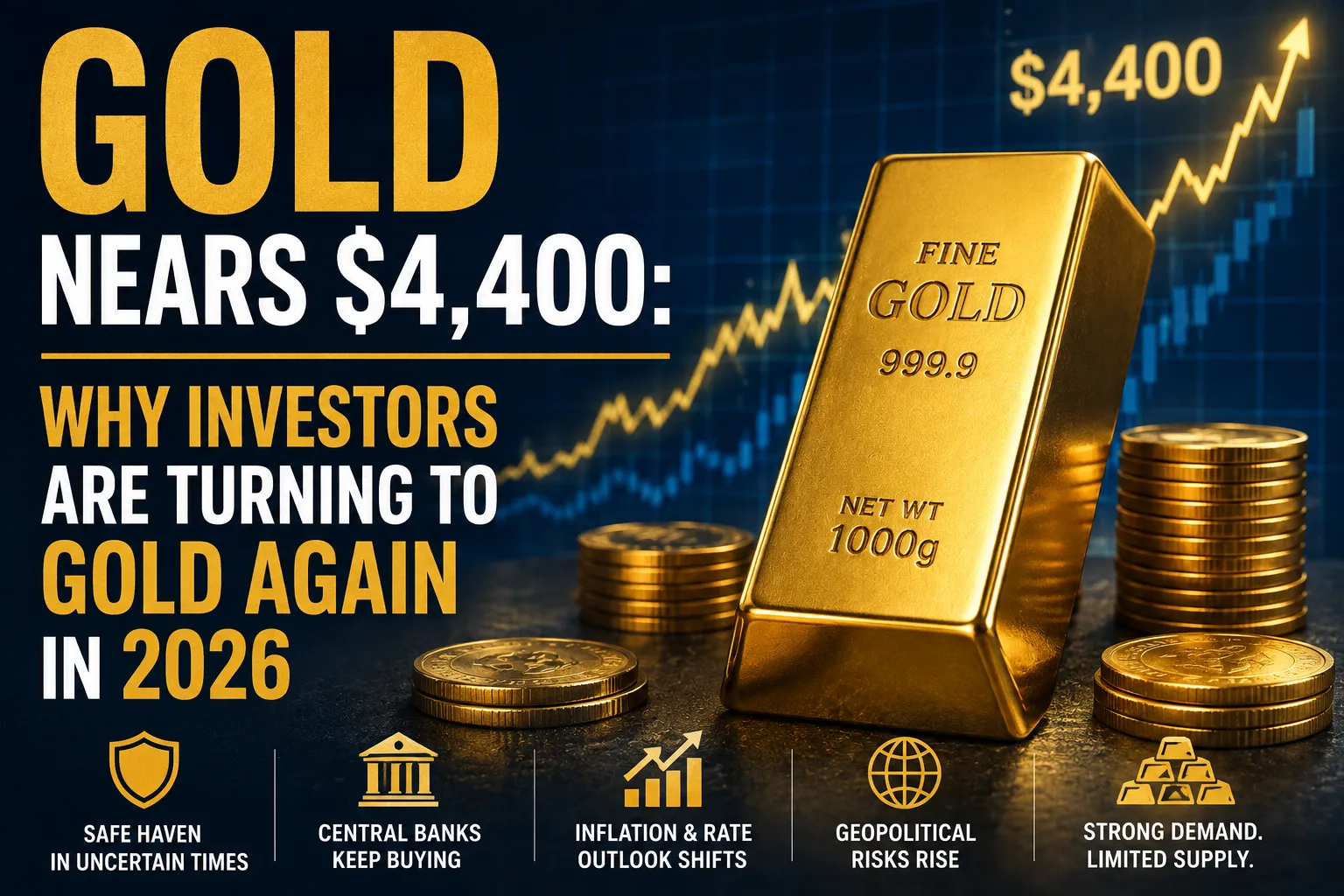
Gold has returned to the spotlight in August 2026, with prices trading around the $4,400-an-ounce level after a powerful rebound from the sharp correction seen earlier in the year.
The renewed rally comes as investors reassess the outlook for U.S. interest rates, inflation, the dollar and geopolitical risk. Spot gold was around $4,344 an ounce on Friday, August 14, while December U.S. gold futures were around $4,400.40. Gold had recently climbed above $4,400 and briefly moved beyond $4,500 before pulling back as investors took profits.
The move is significant because gold has already experienced extraordinary volatility in 2026. The metal reached a record around $5,405 an ounce in January before falling below $4,000 in June, according to the World Gold Council.
So why are investors buying gold again?
For a broader explanation of how gold fits alongside stocks, bonds and other asset classes, see the complete guide to financial markets and how they work.
Gold’s 2026 Roller Coaster
Gold’s performance this year has been anything but predictable.
The metal began 2026 with a historic rally, setting multiple records and reaching about $5,405 an ounce in late January. It subsequently experienced a substantial correction, falling below $4,000 by June.
The latest rebound has taken gold back toward $4,400.
Recent gains have been particularly notable because they followed a period in which higher bond yields and expectations for tighter monetary policy had weighed on the metal.
Gold doesn’t generate interest or dividends, so its relative attractiveness can decline when investors can earn higher returns from interest-bearing assets.
That relationship has recently started working in gold’s favor.
Softer U.S. Inflation Is Changing Rate Expectations
One of the most important drivers behind the latest rally has been changing expectations for the U.S. Federal Reserve.
Recent U.S. inflation data have reduced expectations for an aggressive rate-hike path. Markets had reduced the probability of a September Fed rate hike to about 33%, down from 44% the previous week.
That matters for gold because lower expected interest rates can reduce the opportunity cost of holding an asset that doesn’t pay interest.
When investors believe rates may fall—or remain lower than previously expected—gold can become comparatively more attractive.
The relationship isn’t automatic, however. Gold can still fall when inflation expectations, bond yields, the dollar or investor positioning move against it.
Why the Federal Reserve Matters So Much for Gold
The Fed’s monetary-policy decisions are closely watched by gold investors because they influence several factors simultaneously.
A change in expectations for interest rates can affect:
- U.S. Treasury yields
- The U.S. dollar
- Inflation expectations
- Investor demand for safe-haven assets
- The opportunity cost of holding gold
- Broader risk appetite
When interest rates and real yields rise significantly, investors may prefer interest-bearing assets.
When rate expectations decline, gold can become more competitive.
This is one reason traders are watching every major U.S. inflation, employment and economic-growth report.
Investors can also explore the complete guide to bond markets to better understand how bond yields and fixed-income markets interact with broader investment decisions.
Geopolitical Risk Is Supporting Gold’s Safe-Haven Appeal
Monetary policy isn’t the only factor driving gold.
Geopolitical uncertainty remains another important source of demand.
The World Gold Council said geopolitical risk was a major contributor to gold’s first-half performance in 2026, with the U.S.-Iran conflict playing a particularly significant role.
Current tensions involving Iran and the Strait of Hormuz are also influencing markets. Oil prices were rising amid continuing geopolitical tensions, while gold remained sensitive to developments surrounding the conflict.
Gold has historically attracted investors during periods when confidence in economic, financial or geopolitical stability is under pressure.
That doesn’t mean gold always rises during every crisis. The 2026 experience itself demonstrates how quickly prices can reverse when market expectations change.
Central Banks Are Still an Important Part of the Gold Story
Perhaps one of the strongest long-term arguments for gold is that demand isn’t coming exclusively from individual investors.
Central banks have increasingly accumulated gold as part of their reserve strategies.
The World Gold Council’s 2026 Central Banks Gold Reserves Survey found that 89% of surveyed reserve managers expect global central-bank gold holdings to increase over the following 12 months. Meanwhile, 45% expected their own institutions to increase gold holdings.
Central banks have accumulated an average of around 1,000 tonnes of gold annually over the previous four years, compared with approximately 500 tonnes per year during the preceding decade, according to the World Gold Council.
That creates an important structural source of demand.
Central-bank buying doesn’t guarantee higher prices, but it can provide a longer-term foundation for the gold market.
China Is Becoming More Important to Gold Demand
China is another important part of the current story.
The World Gold Council reported that China’s gold bar and coin demand increased 67% year over year in the first quarter of 2026, reaching a record 207 tonnes.
China’s central bank has also remained an important buyer. World Gold Council data showed that China’s central-bank purchases continued through April, extending its buying streak to 18 consecutive months at that point.
This matters because gold demand is increasingly influenced by Asian markets rather than being driven solely by Western investment flows.
The World Gold Council has specifically highlighted the growing importance of Asian markets in gold price discovery.
Investors Are Returning to Gold ETFs
Another sign of renewed investment interest is the behavior of gold-backed exchange-traded funds.
According to data cited by Business Insider from the World Gold Council, global gold-backed ETFs attracted about $3 billion in July 2026, reversing two consecutive months of outflows. Holdings increased by roughly 23 tonnes to 4,068 tonnes.
ETF flows are worth watching because they provide a useful indication of whether institutional and investment demand is returning alongside the physical market.
The recent recovery therefore isn’t simply about jewelry demand or retail buyers purchasing coins and bars.
Investment demand is becoming an increasingly important component of the gold market.
Gold’s Investment Case Has Changed
Gold has traditionally been associated with several roles in a portfolio:
- Safe-haven asset
- Inflation hedge
- Portfolio diversifier
- Store of value
- Reserve asset
- Alternative to currency exposure
However, investors shouldn’t assume that gold automatically protects against every economic problem.
Gold can experience large declines, as demonstrated by its fall from the January record to below $4,000 in June.
The World Gold Council’s mid-year outlook emphasized just how volatile the market has become, noting that gold’s average volatility increased to about 30% during the first half of 2026.
For investors, that means gold can serve a diversification role without necessarily being a low-risk asset.
Why Gold Can Rise Even When Inflation Is Falling
At first glance, a gold rally during a period of moderating inflation may seem contradictory.
Gold is frequently described as an inflation hedge, so why would investors want it when inflation pressures are cooling?
The answer is that gold responds to multiple variables.
Investors may buy gold because of:
- Interest-rate expectations
- Real yields
- Currency movements
- Geopolitical uncertainty
- Central-bank demand
- Portfolio diversification
- Financial-system concerns
- Expectations for future inflation
In the current environment, the market is paying particular attention to the combination of interest-rate expectations and geopolitical uncertainty.
The latest rally therefore isn’t simply a bet that inflation will accelerate.
The U.S. Dollar Is Another Key Variable
Gold is generally priced in U.S. dollars, making currency movements an important factor.
When the dollar weakens, gold can become cheaper for buyers using other currencies, potentially supporting international demand.
Recent market reports have linked the gold rebound partly to a softer dollar alongside changing expectations for Federal Reserve policy.
A stronger dollar, by contrast, can create headwinds for gold.
This means gold investors should watch the dollar alongside the metal itself rather than treating gold as an isolated market.
What Could Push Gold Above $4,400?
Gold’s next major move will depend on several competing forces.
Lower Interest Rates
If markets increasingly price in lower U.S. interest rates, gold could receive additional support.
Continued Central-Bank Buying
Persistent reserve accumulation could strengthen the long-term demand outlook.
Escalating Geopolitical Risk
A worsening geopolitical environment could increase demand for perceived safe-haven assets.
A Weaker Dollar
Further dollar weakness could make gold more attractive internationally.
Strong ETF Inflows
Continued investment flows into gold-backed funds would provide evidence that institutional demand is strengthening.
What Could Send Gold Lower?
The rally isn’t guaranteed to continue.
Several factors could create downward pressure.
Higher Interest Rates
If inflation proves more persistent than expected and the Fed signals tighter policy, Treasury yields could rise and gold could lose some of its appeal.
Stronger Dollar
A sustained dollar rally could weigh on gold prices.
Profit-Taking
After a sharp rally, investors may lock in gains.
That is already happening to some extent. Gold pulled back from its recent high on August 14 as investors took profits.
Reduced Geopolitical Risk
A meaningful improvement in geopolitical conditions could reduce the demand for safe-haven assets.
Weak Investment Demand
If ETF inflows reverse again, the recent rally could lose an important source of support.
Is Gold Heading Back Toward Its 2026 Record?
That is one of the biggest questions facing investors.
The answer is far from certain.
Gold remains substantially below its January record after the dramatic correction earlier in the year. The World Gold Council has described the second half of 2026 as a period where geopolitical conditions, interest rates and investor positioning could produce significant swings.
Some analysts have become more bullish following the latest rebound. But the current market also shows why price forecasts should be treated cautiously.
Gold has already moved from above $5,400 to below $4,000 and back toward $4,400 within the same year.
That level of volatility makes a straight-line forecast particularly unreliable.
What Gold’s Rally Means for Ordinary Investors
For individual investors, the bigger question isn’t simply whether gold will rise tomorrow.
It’s whether gold has a useful role within a diversified financial plan.
Investors can gain exposure to gold in several ways, including:
- Physical gold bars
- Gold coins
- Gold-backed ETFs
- Gold mining companies
- Gold mining ETFs
- Certain financial products linked to gold prices
Each option carries different risks, costs and liquidity characteristics.
Physical gold, for example, involves storage and security considerations. Gold mining stocks can behave very differently from the metal itself because mining companies face operating costs, management risks and commodity-price fluctuations.
Gold ETFs can provide more direct exposure to gold prices, but investors should understand the fund’s structure, fees and risks before investing.
Gold Is Not a Substitute for a Diversified Portfolio
The renewed gold rally may be attracting investors who missed the earlier move, but chasing a rapidly rising asset can introduce its own risks.
Gold doesn’t produce earnings like a company or interest like a bond.
Its investment case depends heavily on changes in supply, demand, monetary policy, currencies, geopolitical conditions and investor sentiment.
For that reason, gold is often more useful as one component of a diversified portfolio than as a complete investment strategy.
The appropriate allocation depends on an investor’s objectives, time horizon, risk tolerance and broader financial circumstances.
Investors considering how different assets fit together can also review how to build an investment plan for long-term goals.
Gold’s Bigger 2026 Story
The latest move toward $4,400 is more than another price milestone.
It highlights how quickly investor sentiment toward gold can change when expectations for interest rates, inflation and geopolitical risk shift.
The World Gold Council’s research points to a market supported by several structural forces: central-bank demand, investment demand, geopolitical uncertainty and gold’s growing role in reserve management.
At the same time, the dramatic swings of 2026 demonstrate that gold remains a volatile asset.
For investors watching the market now, the most important question may not be whether gold reaches a particular round-number target. It is whether the forces supporting the latest rally—lower rate expectations, central-bank buying, renewed ETF demand and geopolitical uncertainty—remain strong enough to sustain it.
What Investors Should Watch Next
Gold’s journey from its January record to below $4,000 and back toward $4,400 has made one thing clear: the metal remains highly sensitive to changes in the global financial environment.
The next major clues will likely come from U.S. monetary-policy expectations, inflation and labor-market data, Treasury yields, the dollar, central-bank purchases, ETF flows and developments in major geopolitical flashpoints.
For now, gold’s return toward $4,400 shows why the precious metal continues to occupy a unique place in global portfolios. It can offer diversification and a potential store of value, but its 2026 performance also serves as a reminder that even traditional safe-haven assets can experience substantial volatility.
This article is for informational purposes only and does not constitute investment advice. Gold and other investments can lose value, and investors should consider their own circumstances and risk tolerance before making financial decisions.