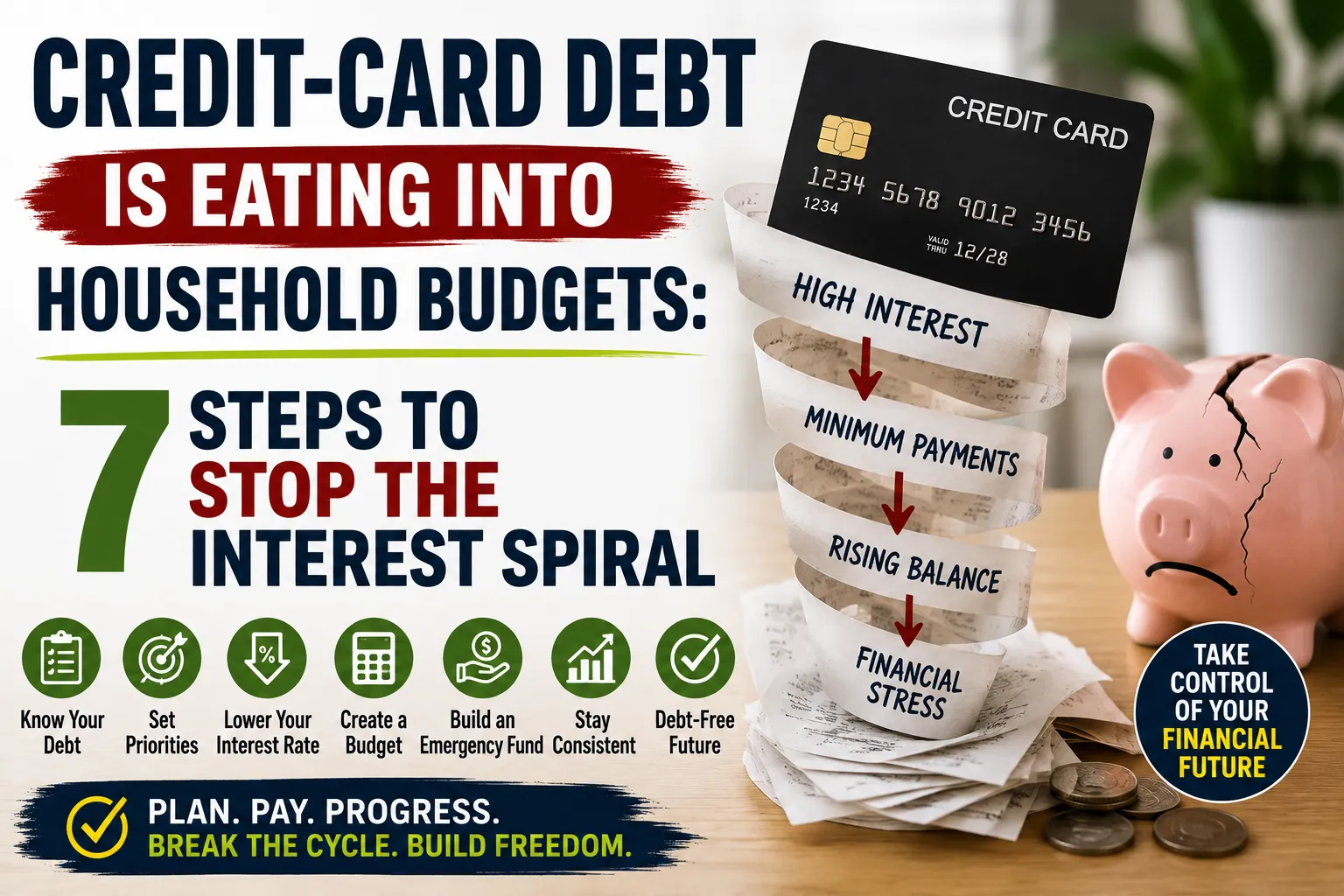
Credit-Card Debt Is Eating Into Household Budgets: 7 Steps to Stop the Interest Spiral
For millions of households, a credit card balance can begin as a convenient way to cover an unexpected expense, bridge a gap between paychecks or earn rewards on everyday purchases. The problem starts when that balance becomes a permanent part of the monthly budget.
Credit-card borrowing can be particularly expensive because interest can accumulate while the balance remains unpaid. When balances remain outstanding, interest charges can consume part of each payment, making it harder to reduce the principal.
At the household level, that can create a difficult cycle: higher interest charges consume more of each payment, leaving less money available to reduce the principal balance. Meanwhile, everyday expenses continue to arrive.
Breaking that cycle does not necessarily require a dramatic financial overhaul. It starts with understanding exactly where the money is going and then directing as much cash as possible toward expensive debt.
For a broader overview of borrowing, debt and the tools consumers can use to manage credit, see the Complete Guide to Credit Tools.
Here are seven practical steps that can help.
1. Stop Adding New Debt First
The first priority is to prevent the balance from growing while you are trying to pay it down.
If you are consistently charging more to your cards than you can pay off each month, even aggressive payments may have limited impact. A debt-payoff plan works much better when the balance is moving in only one direction: downward.
For a short period, consider switching to debit, cash or another payment method for routine purchases if using a credit card makes it easier to spend beyond your budget.
This does not mean credit cards are inherently bad. When balances are paid in full, many cards allow consumers to avoid interest on purchases through a grace period.
The problem is carrying expensive balances month after month.
2. Make a Complete Debt Inventory
Before deciding how to repay your cards, write down every balance.
Create a simple list containing:
| Information | What to Record |
|---|---|
| Card | Name of the card |
| Balance | Current amount owed |
| APR | Annual percentage rate |
| Minimum payment | Required monthly payment |
| Due date | Payment deadline |
| Promotional rate | If applicable |
| Promotional expiration | When the rate ends |
Do not rely on memory.
Your statements should provide important information about your balance, minimum payment, applicable APRs and other terms. Different portions of a credit-card balance can sometimes carry different interest rates.
Once everything is visible in one place, you can determine which debt deserves the most attention.
3. Attack the Highest-Interest Balance
One of the most mathematically efficient approaches is the debt avalanche.
Under this method, you make at least the required minimum payment on every card but direct all additional money toward the card with the highest APR.
For example:
- Card A: $2,500 at 29% APR
- Card B: $4,000 at 22% APR
- Card C: $1,500 at 17% APR
You continue making required payments on all three accounts while putting extra money toward Card A.
Once Card A is eliminated, you redirect the money that had been going toward it to Card B.
The advantage is straightforward: reducing the balance with the highest interest rate first can reduce the amount of interest accumulating along the way.
There is another popular approach, the debt snowball, which prioritizes the smallest balance rather than the highest APR. It can provide faster psychological wins and may be easier for some people to stick with.
The best method is ultimately the one you can consistently follow.
4. Pay More Than the Minimum
The minimum payment is designed to keep the account current. It is not necessarily designed to get you out of debt quickly.
Making only the minimum payment can result in taking years to repay a credit-card balance, while paying more reduces both the repayment period and interest costs. Credit-card statements may also provide information showing how long repayment could take under certain payment assumptions.
Consider a simple illustration.
Suppose you owe $5,000 and have a high APR. A minimum payment may look manageable because it consumes relatively little of your monthly budget. But a small payment also leaves a large balance exposed to additional interest.
Increasing the payment—even by a relatively modest amount—can accelerate the reduction in principal.
The key is to choose an additional payment amount that is large enough to make meaningful progress but realistic enough to sustain every month.
5. Try to Lower the Interest Rate
Reducing the interest rate can make the same monthly payment more effective.
Start by contacting your credit-card issuer. Depending on your circumstances and account history, you may be able to discuss options such as a lower rate or a repayment arrangement.
Some creditors may be willing to reduce interest rates, lower minimum payments, waive certain fees or adjust payment dates for consumers experiencing financial difficulties.
You can also investigate:
- Balance-transfer cards
- Lower-interest consolidation loans
- Credit-union lending options
- Nonprofit credit counseling
However, lower advertised rates require careful examination.
A balance transfer, for example, may involve a fee and the promotional rate generally lasts only for a limited period. If the promotional period ends before the balance is eliminated, the remaining debt may be subject to a substantially higher rate.
Always compare the total cost, not simply the advertised interest rate.
If you are considering replacing several balances with another form of borrowing, How Personal Loans Work and When to Use One can provide useful context about how personal-loan borrowing works and when it may be appropriate.
6. Build a Budget That Creates Debt-Payoff Money
Paying off credit-card debt requires cash flow.
That means your budget needs to answer one important question:
How much money can I reliably direct toward debt every month without falling behind on essential expenses?
Start with your take-home income and subtract necessities such as:
- Housing
- Utilities
- Groceries
- Transportation
- Insurance
- Essential medical expenses
- Minimum debt payments
Then examine discretionary spending.
Look for expenses that can temporarily be reduced while you are aggressively paying down debt. That could include restaurant meals, subscriptions, entertainment, impulse purchases or other nonessential spending.
The goal isn’t necessarily to eliminate every enjoyable expense.
Instead, create a defined period in which more of your available income is assigned to debt reduction.
That distinction can make a budget easier to maintain.
For households managing several debts at once, How Debt Repayment Tools Help Plan Debt Payoff can also help explain how structured repayment tools can organize balances, payments and payoff strategies.
7. Create a Plan for Financial Emergencies
One of the most frustrating parts of debt repayment is making progress only to need the credit card again when an unexpected expense appears.
A basic emergency fund can help break that cycle.
If your budget is extremely tight, you may not be able to build a large emergency fund immediately. But setting aside even a modest cash reserve can provide some protection against expenses such as:
- Car repairs
- Emergency travel
- Home repairs
- Insurance deductibles
- Unexpected bills
- Temporary income disruptions
The appropriate amount depends on your income, expenses and financial circumstances.
The important principle is to create some separation between unexpected expenses and new credit-card debt.
Why Credit-Card Interest Can Become So Difficult
Credit-card interest can be confusing because it isn’t necessarily calculated like a simple one-time fee.
Many issuers calculate interest daily using an average daily balance or another daily calculation method. That means carrying a balance can result in interest accumulating over time.
The effect becomes particularly powerful when a consumer continues making purchases while carrying an existing balance.
A cardholder may therefore face two problems simultaneously:
- Interest is being added to the existing balance.
- New purchases are increasing the amount owed.
This is why stopping new borrowing is often the first step in breaking the cycle.
Be Careful With Balance Transfers and “Zero-Interest” Offers
Promotional offers can be useful tools, but they aren’t automatically a solution.
A balance-transfer offer may reduce the interest burden temporarily, but you need to know:
- How long the promotional rate lasts
- Whether a transfer fee applies
- What APR applies afterward
- Whether new purchases receive a grace period
- What happens if you miss a payment
- How payments are allocated among different balances
Some store financing arrangements also use deferred interest rather than a conventional 0% APR structure.
Under certain deferred-interest arrangements, failing to pay the promotional balance in full by the deadline can result in previously deferred interest becoming due.
Read the terms before moving a balance rather than assuming “0%” means there are no conditions.
What If You Cannot Afford the Minimum Payment?
This situation requires immediate action.
Ignoring the problem can make it worse through late fees, credit consequences and potentially higher interest costs.
Contact the card company as soon as possible if you cannot make the required payment. Some issuers may have hardship or payment-assistance options.
You can also investigate reputable nonprofit credit counseling.
Be particularly cautious about debt-relief companies that promise to make your debt disappear, demand substantial upfront fees or tell you to stop communicating with creditors or stop making payments.
A lower monthly payment is not necessarily a better deal if it dramatically increases the total amount you will pay.
A Simple Seven-Step Debt Reset
For households that need a straightforward starting point, the process can look like this:
Step 1: Stop adding unnecessary credit-card balances.
Step 2: List every card, balance, APR and minimum payment.
Step 3: Keep every account current by making required minimum payments.
Step 4: Direct extra money toward the highest-interest balance—or use the snowball method if that is more motivating.
Step 5: Contact issuers and investigate legitimate lower-cost repayment options.
Step 6: Temporarily redirect discretionary spending toward debt reduction.
Step 7: Build a cash reserve so unexpected expenses do not automatically become new credit-card debt.
The objective isn’t simply to make the next payment. It is to change the direction of the household’s finances.
When the Interest Spiral Finally Starts Reversing
Credit-card debt can make a household budget feel permanently compressed because interest consumes money that could otherwise go toward savings, investing, housing or everyday expenses.
But the cycle can be interrupted.
The most important shift is moving from managing payments to actively reducing principal. Once new borrowing is controlled, high-interest balances are prioritized and more cash is directed toward repayment, each subsequent payment can begin doing more useful work.
For households struggling with credit-card debt, the strongest strategy is usually not a single financial trick. It is a combination of accurate budgeting, disciplined repayment, lower borrowing costs where possible and a plan for handling emergencies without reaching for another high-interest balance.
If managing multiple debts is part of the challenge, How to Manage Household Debt and Pay Off Multiple Debts offers another perspective on organizing household debt and working toward a sustainable payoff plan.
This article is for general informational purposes and does not constitute personalized financial advice. Credit-card terms, fees and interest calculations vary by issuer, so review your card agreement and consider professional advice for complex debt situations.