Complete Guide to Financial Markets and How They Work
Financial markets can seem complicated from the outside.
News reports talk about stocks rising, bond yields falling, currencies strengthening, commodities jumping, and investors changing their expectations about interest rates. Behind all of those headlines is a network of markets that allows individuals, businesses, governments, and institutions to borrow, invest, trade, and manage financial risk.
You do not need to be a professional trader to understand how these markets work.
In fact, having a basic understanding of financial markets can make everyday financial news much easier to interpret. It can also help investors understand why the value of their savings, investments, pensions, or retirement accounts can change.
This guide explains what financial markets are, how they operate, the major types of markets, who participates in them, how prices are determined, and why financial markets matter to the broader economy.
Start With the Major Financial Markets
Financial markets cover several interconnected areas, including stocks, bonds, currencies, commodities, derivatives, and short-term lending markets. Understanding how each market works provides a foundation for understanding how money moves through the broader financial system.
What Are Financial Markets?
A financial market is a system where financial assets are bought and sold.
These assets can include:
- Stocks
- Bonds
- Currencies
- Commodities
- Derivatives
- Investment funds
- Other financial instruments
Financial markets connect people and organizations that have capital with those that need capital.
For example, a company may need money to expand its operations.
It could raise that money by selling shares to investors or borrowing through bonds.
An investor, meanwhile, may have money available and want the potential returns that come from investing in a business.
The financial market provides a mechanism that can bring the two sides together.
Why Do Financial Markets Exist?
Financial markets serve several important purposes.
Raising Capital
Businesses can raise money to expand, develop products, hire employees, acquire other companies, or invest in infrastructure.
Investing
Individuals and institutions can invest money with the goal of generating returns.
Price Discovery
Markets help establish prices for financial assets through buying and selling activity.
Liquidity
Investors can often sell assets without having to find a buyer personally.
Risk Management
Financial instruments can allow businesses and investors to manage certain financial risks.
Economic Allocation
Markets help direct capital toward businesses, governments, and projects seeking funding.
Together, these functions help financial markets support economic activity.
How Financial Markets Work
At the most basic level, financial markets work through buyers and sellers.
A buyer wants to purchase an asset at a particular price.
A seller wants to sell it at a particular price.
When the two sides agree, a transaction can occur.
In modern markets, this process is often handled electronically.
For example, when you place an order to buy shares through a brokerage platform, your order can be routed to a market or trading venue where it is matched with a seller.
The transaction is then processed and settled according to the applicable market rules.
Supply and Demand Determine Prices
Financial-market prices are heavily influenced by supply and demand.
When more investors want to buy an asset than sell it, buyers may be willing to offer higher prices.
When selling pressure increases, sellers may have to accept lower prices.
This is why prices can change constantly even when a company’s physical operations have not changed.
Investors are continually reassessing what an asset is worth.
What Is the Stock Market?
The stock market is where shares of publicly traded companies are bought and sold.
When you purchase a share, you generally acquire an ownership interest in the company.
Companies issue shares to raise capital.
Investors purchase those shares because they believe the company may become more valuable or provide other potential benefits, such as dividends.
For investors who want to understand the income component of stock ownership, dividends and stock ownership provide a useful starting point.
Examples of well-known stock markets include major exchanges and trading venues in the United States, United Kingdom, Europe, Asia, Africa, and other regions.
What Is a Stock?
A stock represents an ownership interest in a company.
If a company has one million shares outstanding and you own 10,000 shares, you own a portion of that company.
The percentage ownership depends on the total number of shares outstanding.
Different companies issue different classes of shares, and shareholder rights can vary.
Why Do Stock Prices Move?
Stock prices can change because investors constantly update their expectations about a company’s future.
Factors can include:
- Revenue growth
- Profitability
- Earnings
- Competition
- Management decisions
- Interest rates
- Economic growth
- Regulation
- Consumer demand
- Industry trends
- Geopolitical events
- Investor sentiment
Corporate earnings are particularly important because they can change how investors value a business. The relationship between earnings, expectations, stock prices, and valuations is explored in how corporate earnings affect stock prices and market valuations.
A company can report strong earnings and still see its stock price fall if investors expected even better results.
This is why markets react to expectations, not simply whether the news appears positive or negative.
Primary Markets and Secondary Markets
Financial markets are often divided into primary and secondary markets.
Primary Market
The primary market is where securities are issued to investors for the first time.
An initial public offering, or IPO, is one example.
A company sells shares to investors and receives capital from the transaction.
Governments and companies can also issue bonds in primary markets.
Secondary Market
The secondary market is where investors trade securities that have already been issued.
If you buy shares of a publicly traded company from another investor, the company usually does not receive the money from that particular transaction.
Instead, ownership of the shares changes from one investor to another.
The existence of an active secondary market makes securities more attractive because investors can potentially sell them later.
What Is the Bond Market?
The bond market is where debt securities are issued and traded.
A bond represents a form of borrowing.
When you buy a bond, you are generally lending money to the issuer.
The issuer could be:
- A government
- A corporation
- A municipality
- Another organization
In exchange, the bondholder may receive interest according to the bond’s terms and eventually receive repayment of principal if the issuer meets its obligations.
Investors who want a deeper explanation of fixed-income investing can explore the complete guide to bond markets.
How Bonds Work
Imagine a company issues a bond with:
- $1,000 face value
- 5% annual coupon
- Five-year maturity
A buyer who purchases the bond at its original terms could receive interest payments according to the bond agreement and, assuming the issuer does not default, receive the principal at maturity.
Actual bond structures can be considerably more complicated.
Bond Prices and Interest Rates
One of the most important concepts in fixed-income markets is the relationship between bond prices and yields.
Generally, when market interest rates rise, prices of existing bonds with lower fixed coupons tend to fall.
When market interest rates decline, existing bonds with relatively higher coupons can become more attractive, potentially pushing their market prices higher.
This relationship is one reason financial news frequently reports changes in government bond yields.
What Is the Foreign Exchange Market?
The foreign exchange, or forex, market is where currencies are traded.
It is one of the world’s largest financial markets.
Currencies are traded in pairs.
For example:
- U.S. dollar and euro
- British pound and U.S. dollar
- Japanese yen and U.S. dollar
A currency’s value changes relative to another currency.
Why Are Currencies Traded?
Foreign exchange markets support international commerce and investment.
A company importing goods from another country may need to exchange its domestic currency for the seller’s currency.
International investors may need foreign currency to purchase overseas assets.
Banks, corporations, governments, investment funds, and traders also participate in foreign exchange markets.
What Makes Currency Values Change?
Currency prices can be affected by:
- Interest rates
- Inflation
- Economic growth
- Trade flows
- Political developments
- Central-bank policy
- Investor sentiment
- Capital flows
- Government debt
- Expectations about future economic conditions
A currency does not become stronger or weaker in isolation.
It always moves relative to another currency.
What Is the Commodity Market?
Commodity markets involve the buying and selling of physical or financial interests linked to raw materials and natural resources.
Common commodities include:
- Oil
- Natural gas
- Gold
- Silver
- Copper
- Wheat
- Corn
- Coffee
- Sugar
- Livestock
Commodity prices can influence businesses and consumers because raw materials are inputs into many products and services.
Investors may also follow precious metals when assessing diversification, inflation concerns, and changing market sentiment. For example, gold and investor demand can become part of broader discussions about how investors allocate capital across asset classes.
Why Commodity Prices Matter
A rise in oil prices can increase transportation and production costs.
Higher agricultural prices can affect food costs.
Changes in metals prices can influence construction, manufacturing, and technology companies.
Commodity markets therefore connect financial markets to the real economy.
What Are Derivatives?
Derivatives are financial contracts whose value is linked to an underlying asset, index, rate, or other variable.
Common types include:
- Futures
- Options
- Swaps
- Forwards
Derivatives can be used for:
- Hedging
- Risk management
- Speculation
- Price exposure
- Portfolio strategies
They can also be complex and involve substantial risks.
Futures Contracts
A futures contract is an agreement involving the purchase or sale of an asset at a specified price and date under standardized market terms.
Futures exist for assets and variables such as:
- Oil
- Gold
- Agricultural commodities
- Stock indexes
- Interest rates
- Currencies
Businesses can use futures to hedge against price changes.
For example, a producer may use contracts to reduce the uncertainty associated with future commodity prices.
Options
An option gives its holder a right, but generally not an obligation, to buy or sell an underlying asset at a specified price under the contract’s terms.
The two basic types are:
- Calls
- Puts
Options can be used for hedging, income strategies, or speculation.
However, they can be significantly more complex than simply buying or selling shares.
What Is the Money Market?
The money market generally deals with short-term borrowing and lending.
Instruments can include:
- Treasury bills
- Commercial paper
- Certificates of deposit
- Repurchase agreements
- Other short-term instruments
Money markets are important for managing short-term liquidity.
Banks, governments, corporations, and institutional investors can use them to manage cash needs.
What Is the Capital Market?
Capital markets generally refer to markets for raising and investing longer-term capital.
They include:
- Equity markets
- Bond markets
A company can use capital markets to raise funds for expansion.
An investor can use them to invest capital with the expectation of receiving a return.
What Are Financial Institutions?
Financial institutions play a central role in financial markets.
They can include:
- Banks
- Investment banks
- Insurance companies
- Pension funds
- Asset managers
- Brokerage firms
- Mutual funds
- Hedge funds
- Private-equity firms
These institutions can provide liquidity, facilitate transactions, manage investments, lend money, or help companies raise capital.
What Is a Stock Exchange?
A stock exchange is a regulated marketplace or trading venue where securities can be listed and traded according to established rules.
Companies generally have to meet listing requirements before their shares can trade on a particular exchange.
An exchange can provide:
- Trading infrastructure
- Market rules
- Price information
- Listing standards
- Transparency requirements
- Market surveillance
Modern trading can involve multiple venues rather than a single physical location.
What Is a Brokerage?
A brokerage firm provides services that allow investors to buy and sell financial assets.
A brokerage platform may provide access to:
- Stocks
- Bonds
- Funds
- Options
- Other securities
The services available depend on the broker and jurisdiction.
Brokerages can also provide research, account management, trading tools, and educational resources.
Investors increasingly rely on digital research and portfolio-management services, making investing tools and platforms an important part of the modern investing process.
How Does an Investor Buy a Stock?
The process generally looks like this:
Open an investment account → deposit money → research an investment → place an order → order execution → settlement → hold or sell the investment
The exact process depends on the market and brokerage.
Market Orders
A market order generally instructs a broker to buy or sell an asset at the best available price.
The final execution price can differ from the price you saw immediately before placing the order.
Limit Orders
A limit order specifies the maximum price you are willing to pay when buying or the minimum price you are willing to accept when selling.
The order may not execute if the market does not reach the specified price.
What Is a Bid and Ask?
The bid is the highest price a buyer is currently offering.
The ask is the lowest price at which a seller is currently willing to sell.
The difference between them is called the bid-ask spread.
For example:
- Bid: $99.90
- Ask: $100.00
The spread is $0.10.
Highly liquid assets often have relatively narrow spreads, while less liquid assets may have wider spreads.
What Is Liquidity?
Liquidity refers to how easily an asset can be bought or sold without causing a significant change in its price.
Cash is extremely liquid.
A rare collectible may be much less liquid.
In financial markets, liquidity matters because investors generally prefer to know that they can enter or exit a position without facing extreme transaction costs or price movements.
Liquidity is also important beyond individual trades because market liquidity and financial stability are closely connected.
What Is Market Capitalization?
Market capitalization, often called market cap, measures the total market value of a company’s outstanding shares.
The basic calculation is:
Share price × shares outstanding = market capitalization
For example, if a company has:
- 100 million shares
- Share price of $20
Its market capitalization would be:
$2 billion
Market capitalization is commonly used to classify companies as small-cap, mid-cap, or large-cap, although definitions vary.
What Are Stock Market Indexes?
A stock-market index tracks the performance of a selected group of securities.
Indexes can represent:
- A country’s stock market
- A particular sector
- Large companies
- Small companies
- A global market
- A specific investment theme
Investors use indexes as benchmarks for measuring market performance.
Index movements are often reported as shorthand for broader market conditions, although individual securities can behave very differently.
Why Indexes Matter
Suppose a news report says:
“The market rose 2% today.”
That usually refers to a particular index rather than every individual stock.
An index provides a snapshot of a selected group of securities.
Individual companies can perform very differently from the overall index.
What Is an Exchange-Traded Fund?
An exchange-traded fund, or ETF, is an investment fund whose shares trade on a market.
Many ETFs hold a collection of assets.
For example, an ETF may track:
- A stock index
- Government bonds
- Corporate bonds
- Commodities
- A particular industry
- A geographic market
ETFs can provide diversification through a single investment, although the risks and costs depend on the specific fund.
What Are Mutual Funds?
Mutual funds pool money from multiple investors and use that capital to purchase investments according to the fund’s strategy.
A fund might invest in:
- Stocks
- Bonds
- Money-market instruments
- Real estate
- Other securities
Unlike ETFs, traditional mutual funds generally do not trade continuously throughout the day on an exchange.
The exact structure depends on the fund and jurisdiction.
What Is Market Volatility?
Volatility refers to the degree and speed at which an asset’s price changes.
A highly volatile asset can experience large price movements over a short period.
Volatility can increase because of:
- Economic data
- Earnings announcements
- Interest-rate decisions
- Political events
- Geopolitical developments
- Market uncertainty
- Investor sentiment
Volatility is not necessarily the same thing as risk, although the two are closely related.
For a more focused explanation, see how stock market volatility works and what causes market volatility.
Why Do Markets Rise and Fall?
Markets move because investors constantly reassess the future.
Important influences include:
Economic Growth
Strong economic growth can support corporate revenue and earnings.
Interest Rates
Higher rates can increase borrowing costs and affect asset valuations.
Inflation
Persistent inflation can influence consumer spending, business costs, and monetary policy.
Corporate Earnings
Companies with improving profits can become more attractive to investors.
Government Policy
Tax, spending, regulatory, and trade policies can influence markets.
Geopolitical Events
Wars, elections, sanctions, and international disputes can affect investor confidence.
Sentiment
Investors are human.
Fear, optimism, uncertainty, and expectations can influence buying and selling.
How Interest Rates Affect Financial Markets
Interest rates are among the most important forces in financial markets.
Central banks influence short-term interest rates through monetary policy.
When rates rise:
- Borrowing can become more expensive.
- Savings may become more attractive.
- Bond yields may rise.
- Some stock valuations may come under pressure.
- Currency values can be affected.
When rates fall:
- Borrowing can become cheaper.
- Savings rates may decline.
- Existing bonds may become more attractive.
- Some growth-oriented assets may benefit.
The actual effect depends on the economic environment and market expectations.
Why Central Banks Matter
Central banks influence financial conditions through monetary policy.
Their responsibilities vary by country, but they commonly focus on objectives such as:
- Price stability
- Employment
- Financial stability
- Economic conditions
Central-bank decisions can move markets because investors immediately reassess the future path of interest rates.
Sometimes the market reaction is driven more by what policymakers say about the future than by the immediate rate decision.
Inflation and Financial Markets
Inflation measures the general increase in prices over time.
For investors, inflation matters because it can affect:
- Consumer purchasing power
- Corporate costs
- Interest rates
- Bond returns
- Investment valuations
- Currency values
If inflation rises unexpectedly, markets may anticipate tighter monetary policy.
If inflation falls sustainably, investors may begin expecting lower interest rates.
The Relationship Between Bonds and Stocks
Stocks and bonds are different asset classes, but they interact.
When bond yields rise significantly, bonds can become more attractive relative to stocks for some investors.
Higher yields can also affect the valuation of future corporate earnings.
However, stocks and bonds do not always move in opposite directions.
Their relationship changes depending on whether the market is responding primarily to inflation, economic growth, monetary policy, or other factors.
What Is a Bull Market?
A bull market generally refers to a sustained period of rising asset prices.
The term is most commonly associated with stocks, but it can also describe other markets.
Bull markets are often supported by factors such as:
- Strong earnings
- Economic growth
- Falling interest rates
- Improving investor confidence
- Strong demand
A bull market does not mean prices rise every day.
Short-term declines are normal even during long periods of growth.
What Is a Bear Market?
A bear market generally refers to a significant and sustained decline in asset prices.
Bear markets can occur because of:
- Recession fears
- Falling corporate earnings
- Financial crises
- Geopolitical shocks
- Rising interest rates
- Investor panic
They can be painful for investors, but they are also a normal part of market cycles.
What Is a Market Correction?
A correction is a significant decline from a recent market high.
Corrections are generally smaller than major bear markets, although definitions can vary.
Corrections can occur even when the long-term economic outlook remains healthy.
Markets do not move upward in a straight line.
What Is a Recession?
A recession is a significant decline in economic activity across the economy.
Recessions can affect financial markets through:
- Lower corporate earnings
- Higher unemployment
- Reduced consumer spending
- Falling business investment
- Changes in interest-rate policy
Stock markets often react to recession expectations before official economic data confirm a downturn.
This is because financial markets are forward-looking.
Why Markets Often Move Before the Economy Does
Investors are constantly trying to anticipate what will happen next.
If traders believe an economic slowdown is coming, they may begin selling stocks before corporate earnings actually decline.
Similarly, if investors expect interest rates to fall, bond and stock prices may adjust before the central bank officially changes policy.
This is why financial markets can sometimes appear to “predict” economic developments.
They are not always correct.
They are pricing probabilities.
What Is Investor Sentiment?
Investor sentiment describes the general attitude of market participants.
When investors are optimistic, demand for riskier assets can increase.
When investors are fearful, they may seek safer or more liquid assets.
Sentiment can change rapidly.
A market that looks extremely optimistic one week can become cautious the next.
Behavioral Finance and Market Decisions
Investors do not always behave rationally.
Common behavioral biases include:
- Fear of missing out
- Loss aversion
- Herd behavior
- Overconfidence
- Recency bias
- Confirmation bias
These behaviors can contribute to market bubbles and sharp sell-offs.
Understanding your own biases can be just as important as understanding financial statements.
What Is Diversification?
Diversification means spreading investments across different assets or markets.
Instead of putting all your money into one company, you might own a collection of:
- Stocks
- Bonds
- Cash
- Property
- Other assets
Diversification can reduce the impact of a single investment performing badly.
It does not eliminate risk.
If an entire market declines, diversified portfolios can still lose value.
Investors also use diversification when considering opportunities across countries and regions. For example, emerging markets investment can represent one area of international market exposure.
Asset Allocation
Asset allocation is the process of deciding how much of a portfolio should be invested in different asset classes.
For example, an investor might divide a portfolio among:
- Equities
- Bonds
- Cash
- Property
- Other investments
The appropriate allocation depends on:
- Age
- Financial goals
- Time horizon
- Risk tolerance
- Income
- Liquidity needs
There is no universal portfolio that is correct for everyone.
Long-Term Investing vs. Trading
Investing and trading are not the same thing.
Long-Term Investing
Long-term investors generally focus on building wealth over years or decades.
They may prioritize:
- Diversification
- Business fundamentals
- Low costs
- Consistency
- Long-term goals
Trading
Traders generally focus more heavily on shorter-term price movements.
They may use:
- Technical analysis
- Market data
- News events
- Price patterns
- Risk-management systems
Trading can involve substantially higher costs, complexity, and risk.
What Is Fundamental Analysis?
Fundamental analysis involves evaluating the underlying financial and economic characteristics of an investment.
For a company, investors might examine:
- Revenue
- Earnings
- Cash flow
- Debt
- Profit margins
- Competitive advantages
- Management
- Industry conditions
- Valuation
The objective is to determine whether the market price appears attractive relative to the investment’s fundamentals.
What Is Technical Analysis?
Technical analysis focuses primarily on price and trading data.
Analysts may examine:
- Price trends
- Trading volume
- Support and resistance
- Moving averages
- Momentum
- Chart patterns
Technical analysis is widely used by traders, although investors disagree about how useful particular indicators are.
What Is a Financial Bubble?
A financial bubble occurs when asset prices rise to levels that become difficult to justify based on underlying fundamentals.
Bubbles can be driven by:
- Speculation
- Excessive optimism
- Cheap credit
- Herd behavior
- Fear of missing out
Eventually, if expectations change, prices can fall sharply.
Not every rapidly rising asset is a bubble.
Determining whether an asset is in a bubble is difficult while the market is still rising.
What Causes Market Crashes?
A market crash can result from a combination of factors.
Potential triggers include:
- Financial-system stress
- Economic shocks
- Excessive leverage
- Geopolitical events
- Sudden changes in interest-rate expectations
- Corporate failures
- Investor panic
Crashes can be intensified by automatic trading and forced selling.
What Is Market Leverage?
Leverage involves using borrowed money or financial instruments to increase exposure to an investment.
Leverage can amplify gains.
It can also amplify losses.
For example, an investor who uses borrowed money may make a larger profit if an investment rises—but can suffer much larger losses if it falls.
This is why leverage is generally considered a higher-risk strategy.
The Role of Financial Regulation
Financial markets require rules to function effectively.
Regulators may oversee:
- Exchanges
- Brokers
- Banks
- Investment funds
- Public companies
- Trading activity
Regulations can address issues such as:
- Market manipulation
- Insider trading
- Fraud
- Disclosure
- Consumer protection
- Capital requirements
The specific regulators and rules vary by country.
What Is Insider Trading?
Insider trading generally refers to trading securities using material, nonpublic information in violation of applicable laws.
The rules are complex and differ by jurisdiction.
The basic principle is that financial markets should operate fairly, with investors having access to appropriate information.
What Is Market Manipulation?
Market manipulation involves deliberately attempting to distort the price or trading activity of a financial asset.
Examples can include deceptive trading practices or spreading false information to influence prices.
Market regulators generally prohibit such behavior.
Why Financial News Moves Markets
Financial news can change investor expectations.
A single headline can affect markets if it changes perceptions about:
- Interest rates
- Corporate earnings
- Inflation
- Economic growth
- Government policy
- Geopolitical risk
But not every headline matters equally.
Markets tend to respond most strongly to information that differs significantly from what investors already expected.
Why “Expected” Matters
Suppose investors expect a company to report $1 billion in quarterly profit.
The company reports $1.1 billion.
That sounds positive.
But if analysts expected $1.2 billion, the market may view the result as disappointing.
Financial markets respond to the difference between reality and expectations.
This principle applies to economic data as well.
Understanding Market Reactions to Corporate Earnings
Corporate earnings announcements can become major market events because investors compare reported results with expectations.
Company-specific developments can therefore affect individual stocks even when the broader market is relatively stable. Investors following large retailers and other publicly traded companies may encounter earnings-driven market moves such as those discussed in Lowe’s and Target earnings.
How Economic Data Affect Markets
Investors monitor indicators such as:
- Inflation
- Employment
- Retail sales
- Economic growth
- Manufacturing
- Consumer confidence
- Housing
- Wage growth
The significance of each indicator depends on the current economic environment.
For example, inflation data can become particularly important when investors are uncertain about future interest-rate decisions.
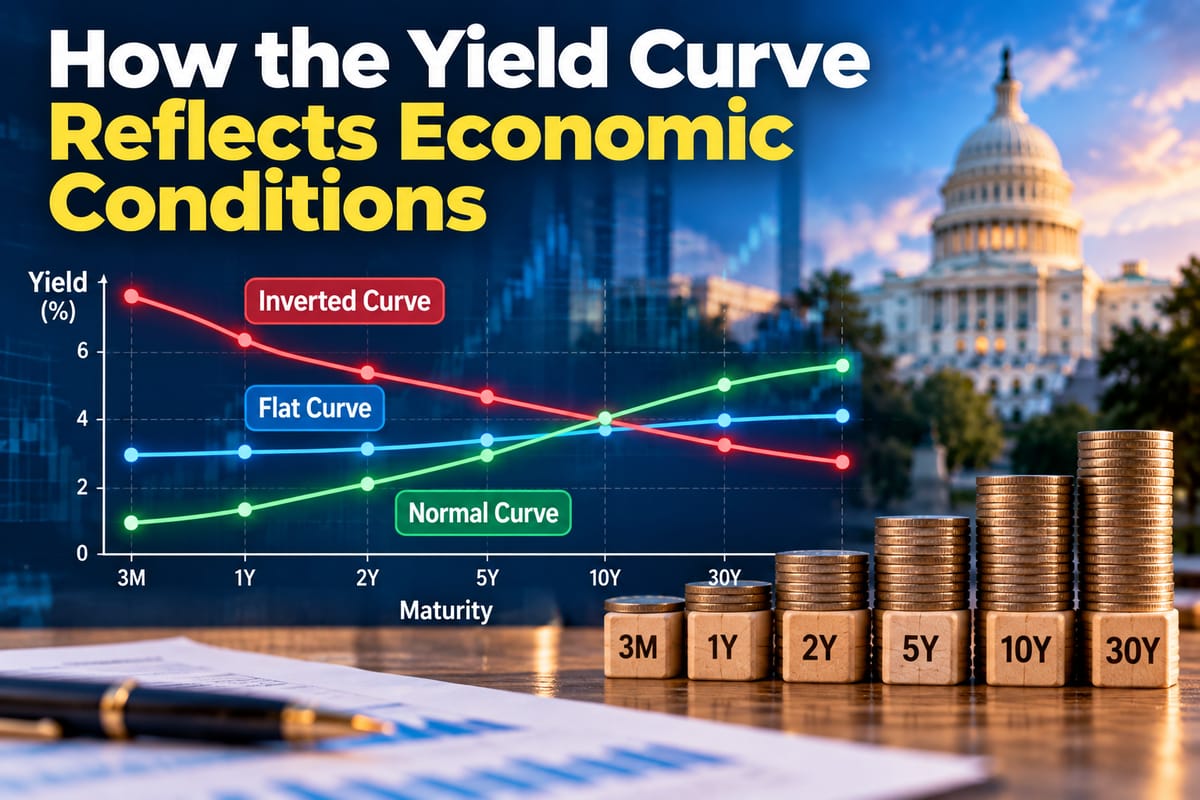
What Is a Yield Curve?
The yield curve shows interest rates or yields across different maturities of debt securities, commonly government bonds.
A typical curve might show:
- Short-term yields
- Medium-term yields
- Long-term yields
The shape of the curve can provide information about market expectations for inflation, growth, and interest rates.
Normal Yield Curve
Longer-term yields are generally higher than shorter-term yields.
Inverted Yield Curve
Shorter-term yields are higher than longer-term yields.
An inverted yield curve has historically attracted attention because it has sometimes preceded economic downturns.
However, it is not a guaranteed recession signal.
Treasury Yields and Stock Valuations
Changes in Treasury yields can have important implications for equity valuations because investors compare expected stock returns with the returns available from bonds.
Market developments involving Treasury yields and stock valuations illustrate why bond markets can have effects far beyond fixed-income investors.
Similarly, rising Treasury yields and stocks can become an important consideration when investors reassess the relative attractiveness of equities and bonds.
What Is a Credit Market?
Credit markets allow borrowers and lenders to exchange capital.
They include instruments such as:
- Corporate bonds
- Government bonds
- Bank loans
- Asset-backed securities
- Other debt instruments
Credit markets are crucial because businesses and consumers often rely on borrowing to finance activity.
What Is Credit Risk?
Credit risk is the possibility that a borrower will fail to meet its financial obligations.
A government, corporation, or individual may have different levels of credit risk.
Investors generally demand compensation for taking greater credit risk.
This is one reason riskier borrowers may have to pay higher interest rates.
What Is a Credit Rating?
Credit-rating agencies evaluate the creditworthiness of certain borrowers and securities.
Ratings can help investors assess relative credit risk.
However, ratings are not guarantees.
An investment with a high credit rating can still lose value or experience unexpected problems.
What Is Market Capital?
Market capital can be thought of as the pool of financial resources available for investment and economic activity.
Businesses seek capital.
Investors provide capital.
Financial markets facilitate the exchange.
When capital flows efficiently toward productive opportunities, it can support economic growth.
How Financial Markets Affect Everyday Life
You do not have to own individual stocks to be affected by financial markets.
Markets influence:
- Mortgage rates
- Savings rates
- Pension funds
- Retirement accounts
- Currency exchange rates
- Fuel prices
- Food prices
- Business financing
- Employment
- Government borrowing costs
Even people who never actively trade can therefore be indirectly exposed to financial-market movements.
Financial Markets and Retirement
Retirement savings are often invested in financial assets.
Depending on the retirement system, investments may include:
- Stocks
- Bonds
- Investment funds
- Property
- Cash
Market performance can therefore influence the future value of retirement savings.
This is one reason long-term investors should focus on diversification, costs, risk, and time horizon rather than attempting to predict every short-term market movement.
Financial Markets and Businesses
Businesses use financial markets to:
- Raise capital
- Borrow money
- Manage currency risk
- Manage commodity risk
- Invest excess cash
- Acquire other businesses
A healthy financial system can make it easier for companies to access capital and grow.
Technology companies and other businesses can experience particularly strong market reactions when earnings expectations change. Sector-specific developments involving companies such as software and cybersecurity firms can be seen in coverage of Salesforce and CrowdStrike earnings.
Financial Markets and Governments
Governments also participate heavily in financial markets.
They issue bonds to finance spending and refinance existing debt.
Investors purchase those bonds in exchange for interest and repayment according to the bond’s terms.
Government borrowing costs can influence broader interest rates throughout the economy.
Treasury debt-market activity can include transactions beyond ordinary issuance and trading. For example, Treasury bond buybacks can affect how investors think about government debt markets and liquidity.
What Happens During Financial Stress?
When investors become concerned about financial conditions, they may move money toward assets perceived as safer or more liquid.
This can create:
- Falling stock prices
- Rising demand for certain government bonds
- Currency movements
- Wider credit spreads
- Reduced lending
- Higher volatility
If financial stress becomes severe, it can spread from markets into the broader economy.
How Global Markets Are Connected
Modern financial markets are deeply interconnected.
A change in one major economy can affect markets elsewhere.
For example:
Central-bank decision → bond yields → currency markets → global capital flows → stock markets
Likewise:
Oil-price shock → inflation expectations → interest-rate expectations → bond and stock markets
Investors therefore monitor international developments even when investing primarily in domestic assets.
Commodity and geopolitical developments can be especially important for energy markets. For example, Iran oil risks and energy stocks illustrate how developments affecting oil supply can influence companies and investors beyond the energy sector.
International trade policy can create another transmission channel. Changes in tariffs and trade relationships can alter costs, supply chains, corporate expectations, and investor risk assessments, as illustrated by tariffs and investor risks.
What Does “The Market Is Up” Actually Mean?
Financial headlines often simplify complicated information.
When journalists say:
“The market rose today.”
they usually mean that a particular benchmark or index increased.
That does not mean every stock increased.
Some companies may have risen sharply.
Others may have fallen.
Still others may have barely moved.
Always look at which market, index, or asset the headline is referring to.
How to Read Financial Market Headlines
A useful approach is to ask five questions:
1. What actually moved?
Was it stocks, bonds, currencies, commodities, or a particular company?
2. How much did it move?
A 0.2% change is very different from a 5% move.
3. Why did it move?
Look for the underlying catalyst.
4. Was the move unexpected?
Markets care about surprises.
5. Is the development temporary or structural?
One day’s movement does not necessarily indicate a long-term trend.
Common Financial Market Mistakes
Treating Headlines as Investment Advice
A news report explains what happened.
It does not automatically tell you what you should buy or sell.
Chasing Rising Assets
An asset that has risen rapidly may already reflect optimistic expectations.
Panic Selling
Selling during a sharp decline can turn temporary volatility into a permanent loss.
Ignoring Fees
Investment costs can significantly affect long-term returns.
Using Too Much Leverage
Borrowing to invest can magnify losses.
Putting Everything Into One Asset
Concentration increases exposure to a single source of risk.
Trying to Predict Every Market Move
Even experienced professionals cannot consistently predict short-term market movements.
How Beginners Can Start Learning About Financial Markets
You do not need to understand every financial instrument immediately.
Start with:
- Stocks
- Bonds
- Interest rates
- Inflation
- Indexes
- Diversification
- Risk
- Investment funds
- Market cycles
- Basic financial statements
Once those concepts are familiar, more complicated subjects such as derivatives and structured products become easier to understand.
A Simple Financial Market Framework
When you hear about a major market event, think through this chain:
Economic event
↓
Investor expectations
↓
Interest rates and financial conditions
↓
Asset prices
↓
Business and household decisions
↓
Broader economic effects
This framework can help explain why a single piece of economic news can eventually affect everything from stock prices to mortgage costs.
The Difference Between Price and Value
One of the most important lessons in financial markets is that price and value are not always identical.
The market price is what buyers and sellers currently agree to transact at.
Value is an investor’s assessment of what an asset is worth based on expected future benefits, cash flows, risk, and other factors.
Different investors can calculate different values.
That disagreement is what makes markets possible.
If everyone agreed on exactly what an asset was worth, there would be little reason to trade.
Financial Markets Are Forward-Looking
Markets are constantly attempting to price the future.
That means today’s market price reflects not just what investors know today but also what they expect to happen tomorrow.
A company’s share price may already reflect expectations about:
- Future earnings
- Interest rates
- Competition
- Economic growth
This is why markets can sometimes rise even when current economic data look weak.
Investors may believe conditions will improve later.
The reverse can also happen.
Markets can fall while economic data still look strong if investors believe the future will deteriorate.
Risk and Return
One of the central principles of investing is the relationship between risk and potential return.
Higher potential returns generally come with greater uncertainty or risk.
Lower-risk assets generally offer lower potential returns over the long term, although no investment is completely risk-free.
Investors should therefore ask:
How much risk am I taking to pursue this return?
The answer is often more important than the advertised return itself.
Time Horizon Matters
The amount of time you have to invest can influence how much volatility you can reasonably tolerate.
Money needed next month is very different from money needed in 30 years.
A long investment horizon can give investors more time to recover from temporary market declines.
Short-term goals generally require greater attention to liquidity and preservation of capital.
Why Diversification Matters More Than Prediction
It is tempting to believe successful investing requires knowing exactly what will happen next.
In reality, diversification provides another way to manage uncertainty.
Instead of predicting which single asset will perform best, investors can spread exposure across multiple assets.
The objective is not to eliminate losses.
It is to avoid allowing one mistake or one unexpected event to destroy the entire portfolio.
Financial Markets Will Always Change
Financial markets are dynamic.
Interest rates change.
Businesses grow and fail.
Governments change policies.
New technologies appear.
Consumer behavior evolves.
Geopolitical conditions shift.
Investors update their expectations.
As a result, there is no permanent market environment.
A strategy that worked in one economic period may perform differently in another.
Understanding Markets Is More Valuable Than Predicting Them
Financial markets can appear unpredictable because prices can change rapidly and sometimes react to seemingly contradictory information.
But the underlying mechanisms are relatively understandable.
Markets connect buyers and sellers.
Companies and governments use them to raise capital.
Investors use them to allocate money.
Prices respond to supply, demand, expectations, risk, and new information.
Interest rates, inflation, economic growth, corporate earnings, government policy, and investor psychology all contribute to the process.
The most useful lesson for individual investors is not that they should become expert traders or attempt to forecast every market movement.
It is that they should understand what they own, why it can rise or fall, what risks they are taking, and how their investments fit into their broader financial goals.
Financial markets will always produce surprises. A strong understanding of how those markets work can make those surprises easier to interpret—and can help investors make decisions based on a plan rather than the latest headline.