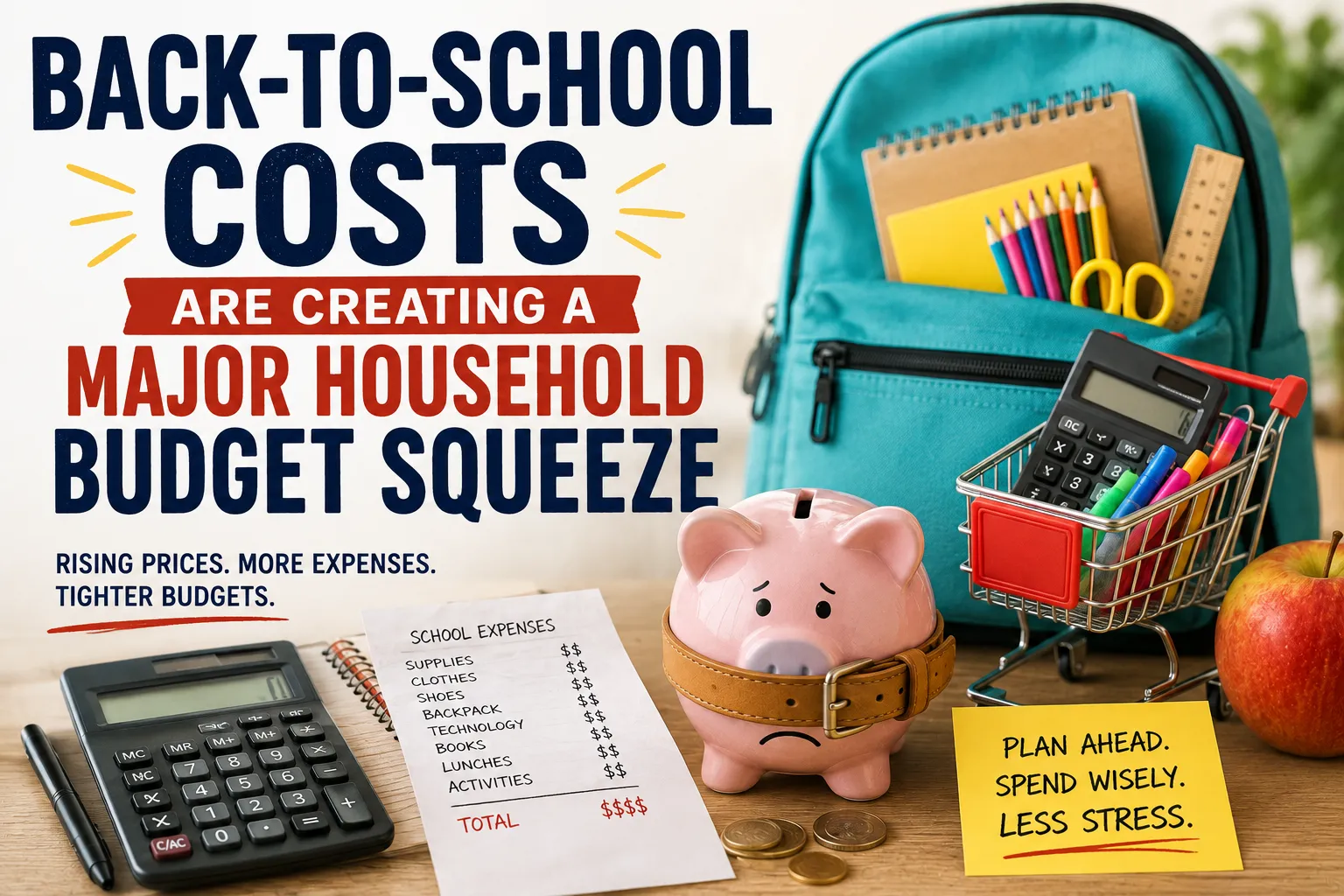
Back-to-School Costs Are Creating a Major Household Budget Squeeze
For many families, back-to-school season arrives with a predictable list of expenses—but the financial pressure behind that list is becoming harder to ignore.
New clothes, shoes, backpacks, stationery, books, technology, transportation and school-related fees can turn what looks like a routine shopping trip into one of the year’s largest household expenses. For families with more than one child, the costs can multiply quickly.
In the United States, the scale of spending illustrates just how significant the season has become. The National Retail Federation expects families with children in elementary through high school to spend an average of $863.86 per household on back-to-school items in 2026, with total K–12 spending projected to reach a record $43.3 billion. College students and their families are expected to spend another $103.5 billion.
At the same time, many households are trying to manage those expenses alongside rent or mortgages, groceries, transportation, utilities, debt payments and everyday living costs.
The result is a difficult balancing act: parents need to prepare children for a new school year while protecting the rest of the household budget.
Why Back-to-School Shopping Has Become Such a Big Expense
Back-to-school spending used to be associated mainly with notebooks, pencils, uniforms and a new pair of shoes.
Today’s shopping list can be considerably longer.
Depending on the child’s age and school, families may need to pay for:
- School uniforms and everyday clothing
- Shoes
- Backpacks
- Stationery
- Books
- Lunch supplies
- Sports equipment
- Art materials
- School fees and activities
- Computers and tablets
- Headphones and accessories
- Dormitory supplies for college students
- Transportation
- Personal-care products
Technology has become particularly important.
The NRF estimates that K–12 families will spend an average of $293.11 on electronics in 2026, compared with $250.29 on clothing and accessories, $174.01 on shoes and $146.45 on school supplies.
That means a family can face hundreds of dollars in expenses before considering costs such as tuition, extracurricular activities or transportation.
Families Are Spending More, But That Doesn’t Mean They Feel Comfortable
The headline spending numbers don’t tell the entire story.
A household can spend hundreds of dollars on school necessities while simultaneously feeling financially squeezed.
The 2026 NRF survey found that shoppers are actively looking for ways to stretch their budgets. Nearly half—47%—say they plan to buy only essential items needed at the start of the school year and replenish supplies later if necessary. Another group is deliberately spreading purchases across the season.
This is an important shift.
Instead of treating August as a single shopping event, families are increasingly approaching back-to-school purchases as an ongoing budgeting exercise.
The Cost Pressure Extends Beyond School Supplies
One reason back-to-school expenses can catch families off guard is that not every cost appears on the official school supply list.
Parents may also face:
- Registration costs
- Transportation expenses
- School meals
- Sports fees
- Field trips
- Clubs
- Uniform replacements
- Technology requirements
- Classroom contributions
- After-school care
- Tutoring
- Graduation-related expenses
These costs can arrive at different points throughout the school year.
A family that budgets only for the initial shopping trip may therefore underestimate its actual annual education-related spending.
Families can reduce this uncertainty by planning ahead for irregular household expenses rather than treating every non-monthly cost as an emergency.
Technology Can Be One of the Biggest Budget Challenges
A laptop or tablet can cost substantially more than a notebook or backpack.
And technology requirements are increasingly specific.
Schools or teachers may recommend particular:
- Operating systems
- Laptop specifications
- Storage capacities
- Software
- Headphones
- Accessories
- Calculators
For college students, the costs can be even greater.
The NRF expects college students and their families to spend an average of $1,437.79 in 2026, with electronics representing the largest category at an average of $341.95 per shopper.
A technology purchase can therefore consume a significant portion of a household’s available back-to-school budget.
Why Families Are Shopping Earlier
Back-to-school shopping is increasingly starting well before classes begin.
The NRF reported that 62% of shoppers had already started shopping by early July 2026, compared with 67% at the same point in 2025 and 55% in 2024.
The reason isn’t necessarily excitement about shopping.
For many households, starting early is a budgeting strategy.
Buying a few items each month can be easier than suddenly finding several hundred dollars at the end of summer.
Early shopping can also give families more opportunities to compare prices and wait for sales.
But Shopping Early Can Also Encourage Overspending
Starting early isn’t automatically cheaper.
The longer shopping season can create more opportunities for impulse purchases.
Parents may see:
- Limited-time promotions
- Social-media recommendations
- “Back-to-school must-haves”
- Matching accessories
- Trend-driven clothing
- Upgraded electronics
and gradually spend more than they originally planned.
A discount doesn’t save money if it causes you to purchase something you didn’t need.
The Pressure to Keep Up Can Be Expensive
Back-to-school shopping isn’t purely practical.
Children can be influenced by what their classmates have.
A particular backpack, shoe brand, smartphone, laptop or clothing style can suddenly become socially important.
Parents may feel pressure to provide products that match what other families are buying.
A 2026 NerdWallet survey found that 21% of back-to-school shoppers feel pressure to keep up with what other parents are spending, while 37% of parents said their children may miss at least one school activity because of cost.
This is where a practical shopping exercise can become an emotional one.
Social Media Is Changing Back-to-School Shopping
Parents aren’t only seeing school products in stores anymore.
They’re encountering them through:
- TikTok
- YouTube
- Search engines
- Influencers
- Online marketplaces
- AI shopping tools
A recent report citing Deloitte’s 2026 back-to-school research found that technology-oriented parents who use search, social media and AI in their shopping process reported substantially higher planned spending than parents who don’t use those tools.
The lesson isn’t that technology is bad.
It’s that more exposure to products can make it harder to distinguish between what a student needs and what marketers want parents to buy.
The Difference Between Needs and Wants Matters More Than Ever
Before purchasing anything, divide the shopping list into three categories.
Must Have
Items required for school to start.
Examples might include:
- Uniform
- Required textbooks
- Basic stationery
- Appropriate shoes
- Required technology
Useful
Items that make school life easier but aren’t immediately necessary.
Examples:
- Extra stationery
- Additional clothing
- Lunch accessories
- Optional organizational products
Nice to Have
Items purchased primarily for preference or trends.
Examples:
- Premium accessories
- Designer backpacks
- Trend-driven clothing
- Upgraded gadgets
- Decorative school supplies
When money is tight, prioritize the first category.
Take Inventory Before Going Shopping
One of the easiest ways to reduce back-to-school costs is to shop your home first.
Check what you already have.
You may discover:
- Unused notebooks
- Pens and pencils
- Nearly new folders
- Extra backpacks
- Spare lunch containers
- Gently worn uniforms
- Clothing that still fits
- Chargers
- Headphones
- Calculator batteries
- Art supplies
A previous year’s supplies don’t automatically become unusable simply because the school year has changed.
Reuse Where It Makes Sense
Reusing isn’t a sign that a family is failing to provide for a child.
It’s a practical financial decision.
If a backpack is still in good condition, use it.
If a calculator works, keep it.
If last year’s winter coat still fits, there’s no financial reason to replace it.
The goal isn’t to buy new things every August.
The goal is to make sure students have what they actually need.
Build a Back-to-School Budget Before Shopping
A shopping list tells you what to buy.
A budget tells you how much you can afford to spend.
Start by determining:
- How much money is available?
- How many children need supplies?
- What expenses are mandatory?
- What can be reused?
- What purchases can wait?
- What school-related costs are coming later?
Then divide the available money among the priorities.
For a broader household approach, families can use a family budget to incorporate school costs alongside housing, food, transportation, savings and other recurring obligations.
Don’t Forget the Rest of the Household Budget
This is where back-to-school planning often goes wrong.
A family might spend heavily on school supplies and then discover that there’s less money available for:
- Groceries
- Rent
- Utilities
- Transportation
- Debt payments
- Emergency savings
School expenses should therefore be incorporated into the monthly household budget, not treated as completely separate spending.
Families that need a more systematic way to organize recurring obligations can also review how to manage household bills and monthly expenses.
Spread the Cost Across Several Months
Back-to-school expenses are predictable.
That makes them easier to plan for than unexpected emergencies.
If you know that school-related purchases will cost approximately $600 and you have six months to prepare, setting aside $100 per month is considerably easier than finding $600 all at once.
Even a smaller amount helps.
The important principle is to turn a large seasonal expense into a series of smaller savings contributions.
Create a Back-to-School Sinking Fund
A sinking fund is simply money set aside gradually for a known future expense.
You could create separate savings categories for:
- School supplies
- Uniforms
- Technology
- School fees
- Sports
- Transportation
When the school season arrives, you draw from the money you’ve already saved instead of relying entirely on current income or credit.
Compare Prices Before Buying
The first price you see isn’t necessarily the best price.
Compare:
- Local stores
- Online retailers
- Discount stores
- School-approved suppliers
- Secondhand marketplaces
- Warehouse retailers
But don’t compare only the sticker price.
Consider:
- Shipping
- Delivery fees
- Warranty
- Return policies
- Product quality
- Expected lifespan
The cheapest product isn’t always the cheapest purchase over time.
Buy Quality Where Durability Matters
Some school items are worth spending more on.
A durable backpack that lasts several years may be better value than a cheap backpack that needs replacing every few months.
The same principle can apply to:
- Shoes
- Jackets
- Laptops
- Calculators
- Certain sports equipment
Think in terms of cost per use, rather than purchase price alone.
But Don’t Overpay for Branding
A recognizable logo doesn’t necessarily make a product more durable.
When comparing products, look at:
- Materials
- Construction
- Warranty
- Reviews
- Repairability
- Expected lifespan
A less expensive product can sometimes perform just as well.
Be Careful With Buy Now, Pay Later
Installment payment services can make a large purchase appear more affordable.
But dividing a $600 purchase into several payments doesn’t make the underlying expense disappear.
Before using buy-now-pay-later financing, ask:
- Can I afford the full purchase?
- What are the fees?
- What happens if I miss a payment?
- How many other installment plans am I already paying?
- Will these payments overlap with future school expenses?
For households already under financial pressure, adding several small payment obligations can make the monthly budget harder to manage.
Credit Cards Can Hide the True Cost
Credit cards can be useful financial tools when used responsibly.
But carrying a balance can make back-to-school purchases significantly more expensive because interest accumulates.
A $500 shopping trip isn’t necessarily a $500 expense if the balance remains unpaid for months.
Before charging school expenses, understand:
- Your interest rate
- Minimum payment
- Due date
- Available credit
- How long repayment will take
If possible, avoid financing routine school purchases at high interest.
Don’t Sacrifice Essential Household Bills for School Shopping
Financial pressure can make parents feel they must provide everything immediately.
But a household’s basic needs still matter.
A child doesn’t benefit from having the newest backpack if the family cannot afford essential bills.
When the budget is genuinely tight, prioritize:
- Housing
- Utilities
- Food
- Transportation
- Required school expenses
- Essential debt obligations
- Other spending
The exact priorities depend on each household’s circumstances, but the principle remains: protect the financial foundation first.
Ask the School What Is Actually Required
Some school supply lists are broader than what a student needs on the first day.
Before buying everything, clarify:
- Which items are mandatory?
- Which are optional?
- Which can be shared?
- Which can be purchased later?
- Which items are already provided by the school?
This can prevent families from buying supplies that sit unused.
Buy Only What Is Needed at the Start
The NRF found that 47% of K–12 shoppers plan to purchase only the essentials needed for the beginning of the school year and replenish later.
This approach can make sense when:
- The school year is long
- Supplies are used gradually
- Prices may fall later
- Your budget is tight
There’s little reason to buy a year’s worth of everything if you aren’t sure how much will actually be used.
Shop With a List
Shopping without a list is one of the easiest ways to overspend.
Before leaving home:
- Check existing supplies
- Write down required purchases
- Set a spending limit
- Decide which items can wait
Then stick to the plan.
Avoid Shopping While Stressed
Financial stress can make shopping decisions more emotional.
Parents may think:
“My child deserves the best.”
Of course they do.
But “the best” doesn’t always mean the most expensive version.
A child can feel supported without having every product their classmates own.
Involve Older Children in the Budget
For teenagers and college students, back-to-school shopping can become an excellent financial lesson.
Give them a fixed budget.
Then let them decide how to allocate it.
For example:
“You have $250 for clothing and school accessories. Choose what matters most.”
This teaches:
- Prioritization
- Price comparison
- Delayed gratification
- Trade-offs
- Financial responsibility
Parents looking for additional ways to develop financial awareness at home can also explore how to teach children about money.
Secondhand Can Be a Smart Choice
Secondhand shopping isn’t limited to clothing.
Depending on your circumstances, you may find savings on:
- Furniture
- Calculators
- Textbooks
- Sports equipment
- Backpacks
- Uniforms
- Electronics
For electronics, inspect condition carefully and verify functionality before buying.
Swap With Other Families
Families often have unused school items sitting at home.
One child outgrows something while another needs exactly the same item.
Consider organizing informal swaps for:
- Uniforms
- Books
- Sports equipment
- School bags
- Children’s clothing
This can reduce costs while keeping useful items in circulation.
Don’t Forget Repairs
A broken zipper doesn’t necessarily mean a backpack is finished.
A loose shoe sole doesn’t always mean it’s time for a new pair.
A minor clothing tear can often be repaired.
Before replacing something, ask:
Can this reasonably be repaired?
Repairing one item can be cheaper than replacing it.
How to Handle Expensive Technology
If a student needs a laptop, don’t immediately choose the most powerful model.
Determine the actual requirements.
Ask:
- What software is required?
- How much storage is needed?
- Does the student need a high-performance processor?
- Is portability important?
- How long should the device last?
- Does the school offer technical specifications?
Buying based on requirements rather than marketing can save hundreds of dollars.
Consider Refurbished Electronics
Certified refurbished electronics can sometimes provide substantial savings.
If considering refurbished equipment, check:
- Seller reputation
- Warranty
- Battery condition
- Return policy
- Operating system
- Compatibility
- Device age
Avoid buying a device simply because it is cheap if it cannot reliably handle the student’s requirements.
Protect Expensive School Purchases
If you’ve invested in a laptop, tablet or other expensive equipment, protect it.
Use:
- Appropriate cases
- Screen protection where useful
- Passwords
- Backups
- Device tracking features
- Secure storage
Preventing one major replacement can save more money than finding a small discount on stationery.
Back-to-School Spending Can Affect the Whole Year
The budget squeeze doesn’t necessarily end when school starts.
Families may continue paying for:
- Lunches
- Transportation
- Activities
- Sports
- School trips
- Projects
- Replacement supplies
- Clothing
- Technology
- Tutoring
This is why a back-to-school budget should include some room for ongoing expenses.
Build a Small School Expense Buffer
If possible, keep a small amount aside after the initial shopping trip.
For example, if you budget $800 and spend $700, don’t immediately treat the remaining $100 as available spending money.
It could cover an unexpected school expense later.
What Families Should Avoid Doing
Several strategies can make a temporary budget squeeze worse.
Avoid Taking High-Cost Debt for Nonessential Items
Don’t borrow expensive money to purchase premium accessories.
Avoid Panic Buying
A fear that prices will rise can encourage unnecessary purchases.
Avoid Buying Everything at Once
You may find that some items aren’t needed.
Avoid Comparing Your Budget to Other Families
Different households have different incomes and priorities.
Avoid Ignoring Existing Supplies
You may already own much of what you need.
A Simple Back-to-School Shopping Strategy
Use this five-step approach:
Step 1: Inventory
Find everything you already own.
Step 2: Prioritize
Separate required purchases from optional ones.
Step 3: Set a Budget
Decide how much you can actually afford.
Step 4: Compare
Check multiple sellers and consider secondhand options.
Step 5: Track
Record every purchase so small expenses don’t quietly push you over budget.
Back-to-School Budget Example
Suppose a family has a $600 budget for one child’s initial purchases.
They might divide it roughly like this:
| Category | Budget |
|---|---|
| Clothing | $150 |
| Shoes | $100 |
| School supplies | $75 |
| Backpack | $60 |
| Technology | $150 |
| Miscellaneous | $65 |
| Total | $600 |
This is only an example, not a recommended spending allocation.
The important part is deciding the maximum amount before shopping.
What If the Budget Isn’t Enough?
Sometimes even careful planning won’t make the numbers work.
If essential school costs exceed what a family can reasonably afford, consider asking about:
- School assistance programs
- Payment plans
- Fee waivers
- Community organizations
- Uniform exchanges
- Used-book programs
- Local charities
- School-provided supplies
- Government assistance programs where available
There is no shame in asking for help.
The Financial Lesson Behind Back-to-School Shopping
Back-to-school season is also an opportunity to teach children about money.
Instead of presenting budgeting as something negative, explain that every household has limits.
A child can learn that:
- Money is finite
- Needs come before wants
- Products have different values
- Saving requires planning
- Discounts aren’t always savings
- Reusing things can be smart
- Waiting can prevent impulse purchases
These are valuable skills long after the school year begins.
How Retailers Influence Back-to-School Spending
Retailers know that parents are under pressure to prepare.
That’s why back-to-school promotions often create urgency through:
- Limited-time sales
- Bundles
- “Back-to-school essentials”
- Influencer recommendations
- Countdown promotions
- Exclusive colors
- Matching collections
The best defense is a predetermined shopping list.
When you know what you need, it’s easier to ignore what you don’t.
Why Record Spending Doesn’t Necessarily Mean Families Are Better Off
The projected $43.3 billion in K–12 back-to-school spending for 2026 is a record, but that doesn’t mean individual families are financially comfortable.
Total spending can rise because there are more consumers, higher prices, changes in what families purchase and increased spending in certain categories.
Meanwhile, households can still feel squeezed.
Deloitte’s 2026 research found that K–12 back-to-school spending is expected to remain relatively steady at $30.4 billion in its survey, but inflation-adjusted spending is projected to be 6% lower year over year, suggesting families are adjusting their purchasing behavior even as nominal prices remain elevated.
The bigger picture is therefore more complicated than simply saying families are spending more.
The Goal Isn’t the Cheapest School Year
The cheapest possible shopping list isn’t necessarily the best outcome.
A better objective is:
Get everything the student genuinely needs while minimizing unnecessary spending and avoiding financial stress.
That might mean buying one durable backpack instead of two cheap ones.
It might mean using last year’s calculator.
It might mean choosing a refurbished laptop.
It might mean buying fewer clothes but selecting pieces that can be worn repeatedly.
It might mean waiting until October to buy something that isn’t needed in September.
A More Sustainable Approach to Back-to-School Shopping
A financially sensible approach can also reduce waste.
Before purchasing something new:
- Use what you already have.
- Repair what can reasonably be repaired.
- Buy secondhand when appropriate.
- Choose durable products.
- Avoid unnecessary duplicates.
- Donate usable items when they’re no longer needed.
- Recycle electronics responsibly.
This can lower costs while keeping perfectly usable products out of the waste stream.
The Bottom Line for Families
Back-to-school season isn’t going away, and neither are the expenses that come with it.
But families don’t have to accept the idea that preparing for school requires an uncontrolled spending spree.
The most effective strategy is surprisingly straightforward:
Start early, make an inventory, separate needs from wants, set a realistic budget, compare prices, reuse what still works and avoid financing unnecessary purchases with expensive debt.
The 2026 numbers show just how significant the season has become. With U.S. K–12 households expected to spend an average of nearly $864 and total spending projected at $43.3 billion, back-to-school shopping represents a major annual financial event for millions of families.
But the smartest household budget isn’t the one that buys the most.
It’s the one that gets children ready for school without leaving parents struggling to recover financially afterward.
Turning a Seasonal Expense Into a Planned Expense
Back-to-school costs are predictable, which gives families an advantage.
Unlike an unexpected repair or medical bill, school supplies and many education-related expenses arrive on a schedule. That means they can be anticipated, divided into monthly savings goals and incorporated into the household budget well before the shopping season begins.
The strongest approach isn’t to eliminate every expense or deny children things they genuinely need. It’s to make each purchase intentional.
A backpack doesn’t need to be the trendiest. A laptop doesn’t need to be the most expensive. A new outfit doesn’t need to replace clothing that still fits. And a sale isn’t a saving if it leads to an unnecessary purchase.
When families treat back-to-school shopping as part of their broader financial plan rather than a last-minute emergency, the season becomes much easier to manage—and the household budget has a better chance of making it through September intact.