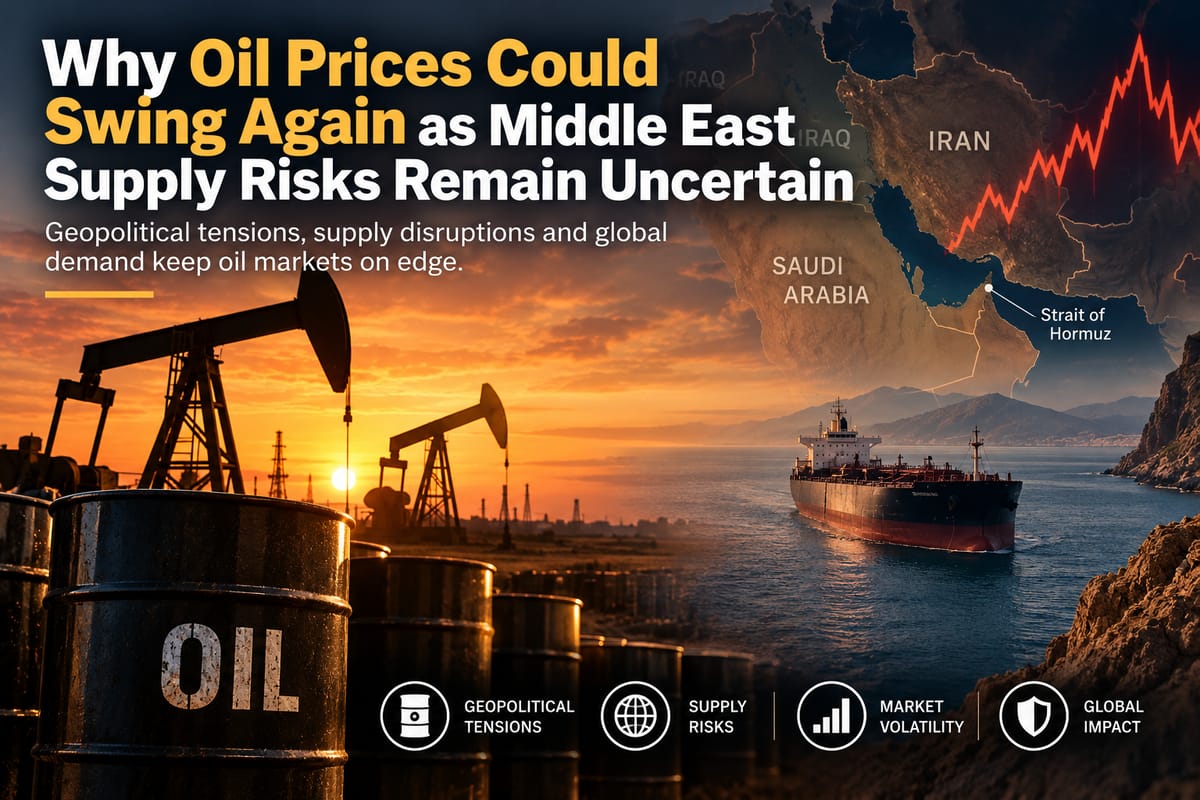
Why Oil Prices Could Swing Again as Middle East Supply Risks Remain Uncertain
Oil prices have spent much of September moving sharply in response to developments across the Middle East, and the latest decline does not necessarily mean the market has moved beyond its supply concerns.
Brent crude fell below $102 a barrel on September 21, extending a four-session decline as investors responded to signs that some Saudi oil flows could recover and hopes for renewed diplomatic efforts involving the United States and Iran.
Yet the underlying supply situation remains complicated.
Shipping through the Strait of Hormuz is still far below normal levels, attacks have continued to threaten regional infrastructure, and alternative export routes remain constrained. That leaves oil markets highly sensitive to any development that could either improve or worsen the flow of crude from the Gulf.
For investors, the result is an oil market where prices can move quickly in either direction.
Why Oil Prices Have Been So Volatile
Oil prices are determined by the balance between supply and demand, but geopolitical events can disrupt that balance almost immediately.
When traders believe fewer barrels will reach the global market, crude futures can rise before an actual physical shortage develops. Buyers and refiners may compete for available supplies, while traders price in the possibility of further disruptions.
That dynamic has been particularly visible during the current Middle East crisis.
Brent climbed above $100 a barrel earlier in September after attacks on tankers and energy infrastructure intensified concerns about supplies. On September 10, Brent settled at $107.63 a barrel after rising more than 6% in a single session.
The subsequent decline illustrates the other side of the market.
When traders see evidence that additional barrels may become available, some of the geopolitical risk premium can disappear quickly. That is what has been happening recently as Saudi export flows show signs of recovery and diplomatic possibilities have reduced some fears of an immediate worsening of the supply disruption.
Understanding this relationship is essential for anyone trying to follow energy markets. A useful overview of how commodity markets work explains why expectations, inventories, production and geopolitical events can all influence prices.
The Strait of Hormuz Remains a Critical Risk
One of the biggest reasons oil prices could swing again is the continued uncertainty surrounding the Strait of Hormuz.
The waterway is one of the world’s most important energy chokepoints, connecting the Persian Gulf with international shipping routes. Disruptions there can affect not only crude oil but also refined petroleum products and other commodities.
U.S. Energy Information Administration data show just how dramatically flows through the strait have changed. Oil and petroleum liquids transported through Hormuz averaged 21.6 million barrels per day in the fourth quarter of 2025, but that figure fell to 4.9 million barrels per day in the second quarter of 2026.
More recent shipping data show that traffic remains unusually depressed. Reuters reported that only 17 commodity vessels passed through the Strait of Hormuz over the weekend, compared with 37 the previous week and a pre-war average of about 125 vessels per day.
At the same time, oil is still moving through the region.
That is an important distinction. The market is not dealing with a simple situation in which exports have completely stopped. Instead, companies and traders are using alternative arrangements, different routes and ship-to-ship transfers to keep barrels moving.
Those workarounds can prevent an immediate global shortage, but they can also increase transportation costs and create additional logistical risks.
Saudi Arabia Could Help Stabilize Supply
Saudi Arabia is one of the most important factors currently influencing the oil market.
Attacks on infrastructure have disrupted some of the country’s normal export routes, increasing pressure on shipments through the Gulf. But Saudi Arabia has also been working to restore production and export capacity.
Reuters reported on September 21 that Saudi oil exports had recovered to more than 4 million barrels per day in September, compared with about 2.4 million barrels per day in August. Satellite data also supported evidence of increased shipments.
That recovery has helped push prices lower.
However, it does not eliminate the broader risk.
The East-West pipeline, which can transport Saudi crude toward the Red Sea and reduce reliance on Gulf shipping routes, has been affected by attacks. Reuters also reported that no crude loadings from Saudi Arabia’s Yanbu port on the Red Sea had been observed since September 16.
If alternative infrastructure is restored and shipping conditions improve, the market could see additional supply relief.
If disruptions persist, the opposite could happen.
The Red Sea Creates Another Layer of Uncertainty
The Strait of Hormuz is not the only important shipping route facing disruption.
The Bab el-Mandeb Strait, which connects the Red Sea with the Gulf of Aden, is also strategically important for energy and other commercial shipping.
Recent attacks involving Yemen’s Houthis have added another layer of uncertainty for companies moving energy products through the region. Reuters reported that weekend traffic through Bab el-Mandeb fell to 51 vessels from 57 previously.
When vessels avoid vulnerable routes, they may have to travel considerably farther.
That increases transportation time, fuel consumption and insurance costs. In an oil market already dealing with limited tanker availability, those additional costs can eventually influence the price paid for physical crude.
The broader relationship between conflict and commodity prices is explored in How Geopolitical Disruptions Affect Commodity Markets.
Why Diplomatic Developments Could Move Oil Quickly
Oil traders are paying close attention to diplomatic developments because even the possibility of reduced conflict can affect prices.
That was visible on September 21, when expectations surrounding potential diplomatic efforts involving the United States and Iran helped offset concerns caused by continuing attacks in the region. Oil prices declined despite the fact that the underlying security situation remained unsettled.
This demonstrates how expectations can become just as important as current production figures.
If traders believe tensions could ease, they may reduce the premium they are willing to pay for crude. If negotiations break down or new attacks threaten major infrastructure, that premium can return quickly.
Consequently, oil prices may remain sensitive to headlines even when physical supply changes only modestly.
Energy Stocks Could Feel the Effects
Oil-price volatility does not affect every company in the same way.
Producers can benefit when crude prices rise because higher selling prices can increase revenue and potentially expand margins. Refiners, transportation companies and fuel-intensive businesses can face different effects depending on their ability to pass higher costs to customers.
Investors therefore need to look beyond the headline oil price.
A sustained rise in crude can influence earnings expectations across the energy sector, while a sharp decline can reduce the revenue outlook for producers. The effects can also spread into airlines, transportation companies, manufacturers and consumer businesses.
The relationship between Middle East supply risks and financial markets is particularly relevant to investors following energy companies. How Iran-Related Oil Risks Could Affect Energy Stocks and Investors provides additional context on that connection.
Inflation Could Become Another Market Concern
A renewed oil-price surge could also affect the wider economy.
Higher crude prices can increase the cost of gasoline, diesel, jet fuel and other petroleum products. Businesses may then face higher transportation and production expenses.
Some companies can absorb those costs. Others may raise prices.
That makes oil an important variable for investors watching inflation.
The issue becomes especially significant when central banks are already dealing with elevated price pressures. A sustained energy shock can make it harder for policymakers to determine whether inflation is temporary or becoming more persistent.
Oil prices can therefore influence financial markets even when an investor has no direct exposure to energy companies.
Treasury Yields Add to the Market’s Sensitivity
The relationship between oil and financial markets becomes even more important when bond yields are elevated.
If higher oil prices contribute to inflation expectations, investors may become more cautious about the prospect of lower interest rates. Rising yields can then put pressure on stocks, particularly companies whose valuations depend heavily on future earnings.
This creates a potential feedback loop:
- Middle East disruptions reduce expected oil supplies.
- Oil prices rise.
- Energy and transportation costs increase.
- Inflation expectations move higher.
- Bond yields respond.
- Some equity valuations come under pressure.
The relationship is not automatic, and markets can react differently depending on the broader economic environment. But the combination of energy shocks and rising bond yields has historically been an important consideration for investors.
The broader market implications are examined in Oil Above $100 and Rising Treasury Yields Put Fresh Pressure on Stocks.
Demand Could Put a Ceiling on Prices
Supply risks are only one side of the equation.
If oil becomes significantly more expensive, consumers and businesses may respond by reducing fuel consumption. High prices can encourage efficiency improvements, alternative energy use and changes in travel or industrial activity.
Economic growth also matters.
A weaker global economy would reduce demand for transportation fuels and industrial energy, potentially limiting how far prices can rise even when supply remains uncertain.
China is another important variable because of its role as a major oil consumer. Changes in Chinese purchasing patterns can have a significant influence on global demand and inventories.
This means an oil-price rally caused by geopolitical fears may eventually face resistance if high prices begin damaging consumption.
Why Another Sharp Move Remains Possible
The current market contains competing forces.
On one side, Saudi exports are recovering, some traders expect diplomatic progress, and oil prices have already fallen for four consecutive sessions. Those developments suggest that some of the extreme supply fears priced into crude earlier this month are easing.
On the other side, shipping through Hormuz remains far below normal, alternative export routes are under pressure, attacks continue to threaten infrastructure and the broader regional conflict remains unresolved.
That combination makes the market unusually sensitive to new information.
A further improvement in shipping could push prices lower. A serious attack on additional energy infrastructure or a renewed disruption to tanker traffic could have the opposite effect.
The direction may therefore depend less on one isolated headline and more on whether physical oil flows continue improving.
What Investors May Be Watching Next
Several indicators could provide clues about where crude prices go from here.
Strait of Hormuz traffic: A sustained recovery in vessel movements would indicate that more normal shipping conditions are returning.
Saudi export volumes: Continued increases could help ease concerns about lost regional supply.
Pipeline and port operations: The restoration of alternative export routes would reduce the market’s dependence on vulnerable shipping lanes.
Tanker rates: Extremely high shipping costs can indicate that physical logistics remain under severe pressure even if crude prices decline.
Diplomatic developments: Any credible reduction in tensions could remove part of oil’s geopolitical premium.
Global demand: Signs of weakening consumption could counterbalance supply concerns.
Inventories: Commercial and strategic stock levels can determine how much of a temporary supply disruption the market can absorb.
For investors, watching these indicators together can provide a more complete picture than following the daily oil-price headline alone.
A Market Still Balancing Relief and Risk
The recent decline in oil prices shows that markets can quickly respond when fears of an immediate supply shortage begin to fade. But the underlying infrastructure and shipping disruptions across the Middle East mean the risk has not disappeared.
Brent’s move back toward the $100 level is therefore not necessarily a sign that the energy market has returned to normal. It may instead reflect a temporary balance between recovering supplies, diplomatic expectations and continuing geopolitical risks.
That balance could shift again if shipping conditions deteriorate, infrastructure suffers further damage or negotiations produce a meaningful change in the regional conflict.
For investors, the key issue is not simply whether oil is rising or falling today. It is whether the physical flow of energy is becoming more reliable — and whether that improvement can continue without another geopolitical shock.