Understanding Interest Rates and Their Effects
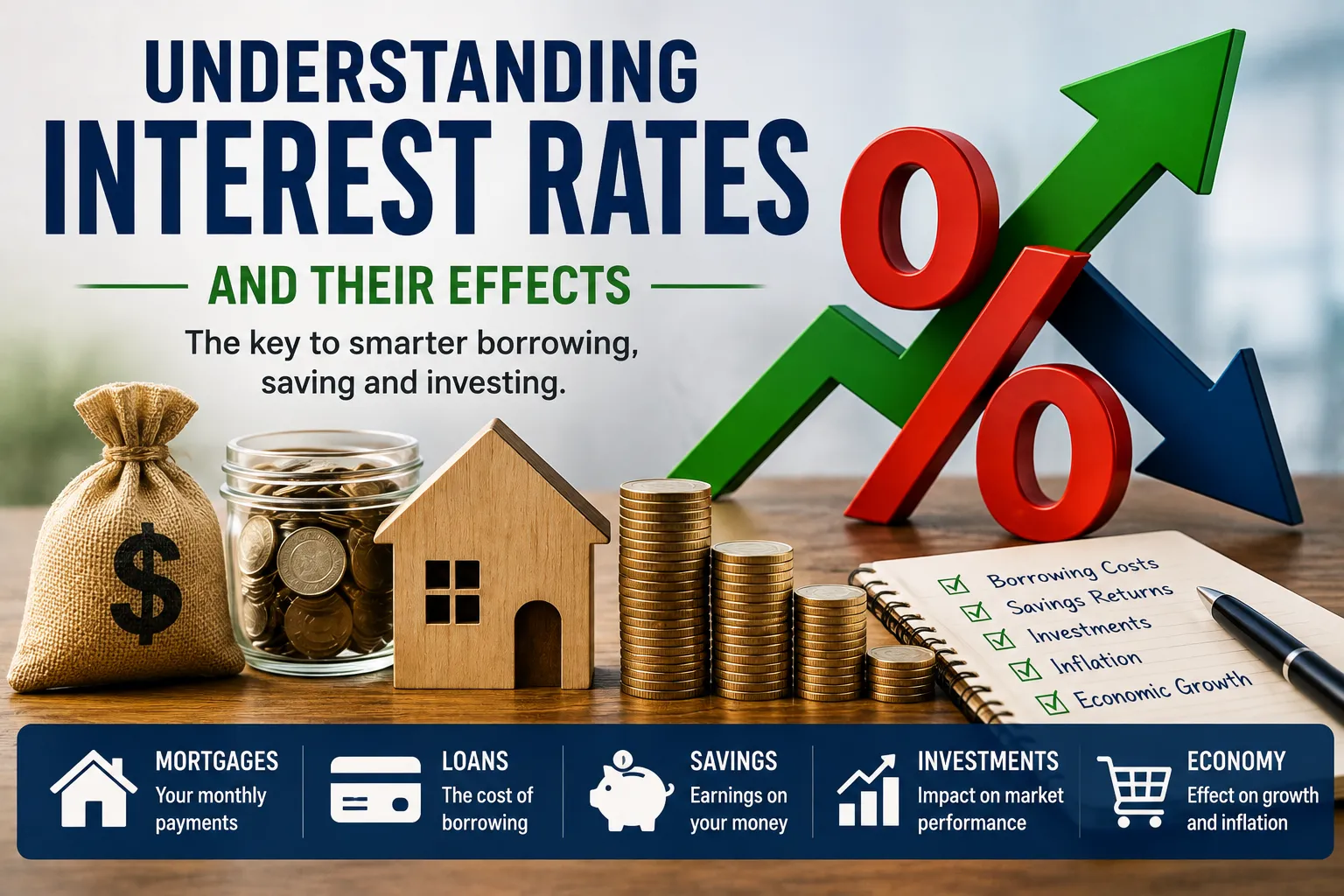
Interest rates influence some of the biggest financial decisions households and businesses make, from taking out a mortgage to saving money or investing for the future. They also play an important role in the wider economy by affecting borrowing, spending, business investment and financial markets.
Because rates can change the cost of money across the economy, understanding how they work can make economic headlines easier to interpret and help consumers make better-informed financial decisions.
What Are Interest Rates?
An interest rate is the cost of borrowing money or the return earned for lending or saving money.
When someone borrows money, the lender generally charges interest in exchange for providing the funds. When someone deposits money into an interest-bearing account, the financial institution may pay interest because it can use those funds for lending and other activities.
Interest rates are usually expressed as a percentage.
For example, if a $10,000 loan carries a hypothetical annual interest rate of 6%, the interest cost would initially be equivalent to $600 per year under a simple-interest illustration. Actual loan calculations can differ because many loans use amortization and other repayment structures.
Why Interest Rates Matter
Interest rates affect the financial incentives facing households, companies and investors.
When borrowing becomes more expensive, people and businesses may be more cautious about taking on new debt. When borrowing becomes cheaper, financing large purchases or investments can become more attractive.
Rates can therefore influence:
- Consumer spending
- Mortgage affordability
- Credit card costs
- Business investment
- Housing activity
- Savings returns
- Bond prices
- Investment decisions
- Currency markets
- Economic growth
- Inflation
The effects do not occur instantly or equally across the economy. Different borrowers and savers experience changes in interest rates in different ways.
For a broader look at how interest rates fit into the wider economic landscape, see this complete guide to economic indicators.
How Central Bank Interest Rates Work
One of the most important interest rates in an economy is the policy rate set or influenced by its central bank.
Central banks use monetary policy to influence financial conditions.
When inflation is too high or economic demand is growing too rapidly, a central bank may raise interest rates to make borrowing more expensive and encourage saving.
When inflation is under control and economic activity is weak, a central bank may lower rates to make borrowing cheaper and encourage spending and investment.
The exact framework differs from one country to another, but the broad mechanism is similar.
From Policy Rates to Consumer Loans
A central bank does not necessarily determine the exact interest rate a consumer pays on a mortgage, personal loan or credit card.
Instead, its decisions influence broader financial conditions.
Commercial lenders consider factors such as:
- Their own funding costs
- Credit risk
- Competition
- Loan duration
- Market conditions
- Borrower creditworthiness
- Expected future interest rates
As a result, consumer borrowing rates can move differently from the central bank’s policy rate.
For more on this transmission process, see how monetary policy affects financial markets.
Fixed and Variable Interest Rates
Borrowing products can have either fixed or variable interest rates.
Fixed Interest Rates
A fixed-rate loan keeps the agreed interest rate unchanged for a specified period or, depending on the product, the entire loan term.
This can provide greater payment predictability.
For example, a homeowner with a fixed-rate mortgage generally knows what their scheduled principal-and-interest payment will be during the fixed period.
Variable Interest Rates
A variable-rate loan can change as market conditions or a reference rate changes.
This means borrowers may benefit when rates fall but face higher payments when rates rise.
Variable-rate products can therefore introduce greater uncertainty into household budgets.
How Interest Rates Affect Borrowers
Higher interest rates generally increase the cost of new borrowing.
The effect can be particularly significant for large loans.
Mortgages
Housing is one of the areas where interest rates can have a major impact.
Suppose someone takes out a hypothetical $300,000 mortgage. A higher rate can increase the monthly payment and the total interest paid over the life of the loan.
Even a difference of a few percentage points can materially change the long-term cost of financing a home.
Higher rates can also reduce the amount some prospective buyers can afford to borrow while keeping their monthly payments within budget.
Credit Cards
Credit card borrowing can become particularly expensive when interest rates rise.
Unlike some installment loans, credit cards may carry relatively high variable interest rates.
Consumers who carry balances from month to month can therefore feel the impact of higher rates more quickly than people who pay their balances in full.
Auto Loans
Interest rates also affect vehicle financing.
A higher rate can increase monthly payments or reduce the amount a borrower can comfortably finance.
Because vehicles typically depreciate, taking on a large loan at a high interest rate can create additional financial pressure if the vehicle’s value falls faster than the loan balance.
How Interest Rates Affect Savers
Interest rates do not only affect borrowers.
Higher rates can benefit people who hold certain interest-bearing savings products.
Banks and other financial institutions may increase the rates offered on products such as:
- Savings accounts
- Certificates of deposit
- Money market accounts
- Other interest-bearing deposits
However, deposit rates do not always rise immediately or by the same amount as central bank rates.
The relationship depends on competition between financial institutions, funding needs and broader market conditions.
Changes in inflation can also determine whether higher savings rates actually translate into greater purchasing power. How inflation affects everyday finances explains how rising prices can influence household budgets, savings and financial decisions.
The Difference Between Nominal and Real Interest Rates
An important concept in economics is the distinction between nominal and real interest rates.
The nominal interest rate is the stated rate.
The real interest rate adjusts for inflation.
A simplified relationship is:
Real interest rate ≈ Nominal interest rate − Inflation rate
For example, if an investment earns 5% while inflation is 3%, the approximate real return is 2%.
This matters because earning more dollars does not necessarily mean gaining the same amount of purchasing power.
Interest Rates and Inflation
Interest rates and inflation are closely connected.
When inflation rises significantly, central banks may increase interest rates in an attempt to reduce demand.
Higher borrowing costs can discourage households and businesses from taking on new debt or making certain purchases.
At the same time, higher savings returns can provide an incentive to save rather than spend.
These forces can reduce economic demand over time, potentially helping inflation move lower.
However, monetary policy cannot instantly solve every source of inflation. Supply disruptions, energy prices, food costs, exchange rates, government policies and other factors can also influence consumer prices.
Why Rate Changes Take Time
Interest-rate decisions do not usually affect the entire economy immediately.
There can be a significant delay between a policy change and its full economic effects.
For example, a household with a fixed-rate mortgage may see no immediate change in its monthly payment after a central bank raises rates.
A household with variable-rate debt may experience a much faster impact.
Businesses with existing fixed-rate financing may also be temporarily insulated, while companies seeking new financing can face higher costs relatively quickly.
This uneven transmission is one reason economists pay attention to both current rates and expectations about future rates.
Interest Rates and Economic Growth
Interest rates can influence economic growth through several channels.
Consumer Spending
When borrowing becomes more expensive, consumers may delay purchases that require financing.
This can affect spending on homes, cars, renovations and other major purchases.
Business Investment
Companies often borrow money to expand operations, purchase equipment, build facilities or develop new products.
Higher financing costs can make some investments less attractive.
Housing Activity
Mortgage rates influence housing affordability and can affect demand for homes.
Changes in housing activity can also affect construction, real estate services, furniture sales and other industries connected to the property market.
Saving and Spending Decisions
Higher rates can increase the reward for saving.
Lower rates can reduce the incentive to hold cash and may encourage spending or investment instead.
These changes can feed into broader economic cycles. For a wider explanation of how expansions, slowdowns and financial markets interact, see how economic and financial market cycles work.
How Interest Rates Affect Bonds
Interest rates and bond prices generally have an inverse relationship.
When market interest rates rise, existing bonds with lower fixed coupon payments can become less attractive compared with newly issued bonds offering higher yields.
As a result, the market price of existing bonds may fall.
When market rates decline, existing bonds with relatively higher fixed payments can become more attractive, potentially pushing their prices higher.
This relationship is particularly important for investors who hold bond funds or longer-duration bonds.
Why Bond Duration Matters
Not all bonds respond equally to changes in interest rates.
Generally, bonds with longer durations are more sensitive to rate movements than shorter-duration bonds.
This means an investor holding a portfolio of longer-term bonds may experience larger price changes when interest rates move.
Understanding duration can therefore help investors assess interest-rate risk within a fixed-income portfolio.
Interest Rates and Stock Markets
The relationship between interest rates and stocks is more complicated.
Higher rates can put pressure on stock valuations because future corporate cash flows may be discounted at a higher rate.
Higher borrowing costs can also affect corporate profits.
At the same time, rate changes often reflect broader economic conditions, which can influence individual companies and sectors differently.
For example, financial institutions, property companies, technology businesses and consumer-focused companies may respond differently to changing interest-rate environments.
This means there is no universal rule that stocks must rise when rates fall or fall when rates rise.
Employment conditions can also influence expectations for economic growth and monetary policy, making how employment data influences financial markets a useful related topic.
Interest Rates and Currency Values
Interest-rate differences between countries can influence currency markets.
If one country’s financial assets offer relatively higher interest rates, investors may find them more attractive, although currency movements depend on many factors beyond interest rates.
Exchange rates can also affect:
- Import prices
- Export competitiveness
- International investments
- Inflation
- Corporate earnings
Currency markets are therefore another channel through which monetary policy can affect the broader economy.
Why Interest Rates Can Be Good or Bad Depending on Your Position
The same rate environment can help one household while hurting another.
Consider two hypothetical households.
Household A has substantial savings and little debt.
Higher rates could increase the income earned from certain savings products.
Household B has significant variable-rate debt.
Higher rates could increase its monthly financial obligations.
This illustrates why economic headlines about “higher rates” or “lower rates” should not automatically be interpreted as positive or negative for everyone.
Your financial position matters.
How Households Can Respond to Changing Rates
Consumers do not control central bank decisions, but they can manage their own exposure to interest-rate changes.
Review Variable-Rate Debt
If you have variable-rate borrowing, understand how changes in rates could affect your payments.
Compare Savings Rates
When rates rise, it can be worth checking whether your savings are earning a competitive return.
Financial institutions do not necessarily offer identical rates.
Avoid Taking on Unnecessary Debt
Higher rates make expensive borrowing even more costly.
Before taking out a new loan, consider both the monthly payment and the total repayment cost.
Consider Your Time Horizon
People making long-term financial decisions should consider how today’s rates fit into their broader financial plans rather than trying to predict every future rate movement.
Maintain an Emergency Fund
Accessible savings can reduce the need to rely on expensive credit when unexpected expenses arise.
Common Misunderstandings About Interest Rates
“Lower Rates Are Always Better”
Not necessarily.
Lower rates can make borrowing cheaper, but they may also reduce the income savers receive from certain deposits and investments.
“The Central Bank Controls Every Interest Rate”
Central banks influence financial conditions, but lenders ultimately set many consumer and business borrowing rates.
“Higher Rates Affect Everyone Immediately”
The timing depends on the type of debt or financial asset involved.
Fixed-rate borrowers may experience little immediate change, while variable-rate borrowers can be affected much sooner.
“Interest Rates Only Matter for Loans”
Rates influence saving, investing, housing, currencies, business investment and economic growth as well.
The Bigger Picture Behind Rate Decisions
Interest rates are one of the most important mechanisms through which monetary policy affects an economy.
For households, the impact can show up in mortgage payments, credit card balances, savings income and investment returns. For businesses, rates can influence financing costs, investment decisions and profitability. For investors, changing rates can affect bonds, stocks and currencies.
The most useful way to understand interest-rate news is therefore to look beyond the headline number and ask how the change moves through borrowing costs, savings returns, inflation, economic demand and financial markets.
For consumers and investors alike, that broader perspective can make it easier to distinguish a temporary market reaction from a meaningful change in the financial environment.